European carriers fearful they may end up like legacy auto when they didn't take EVs seriously.
TLDR: They will pool money to buy the spectrums SpaceX needs in Europe to enable direct-to-cell service and/or try to get those spectrums
restricted to ownership by EU companies only.
Deutsche Telekom, Orange, Telefónica, Vodafone plan joint satellite spectrum bid

www.techbuzz.ai
Europe's Big Four Telecoms Unite Against Starlink
Deutsche Telekom, Orange, Telefónica, Vodafone plan joint satellite spectrum bid
Four of Europe's largest mobile carriers just drew a line in the sand against SpaceX's satellite dominance.
Deutsche Telekom,
Orange,
Telefónica, and
Vodafone signed a letter of
intent to pursue a joint spectrum bid that would power a homegrown direct-to-device satellite network, marking the continent's most coordinated response yet to
Starlink's rapid expansion. The alliance would see the telecoms handle ground infrastructure while an unnamed satellite partner provides the orbital constellation, setting up a showdown over who controls Europe's next-generation connectivity.
Deutsche Telekom,
Orange,
Telefónica, and
Vodafone are
betting that strength in numbers can counter SpaceX's first-mover advantage in satellite-to-phone connectivity. The four carriers announced they're exploring a
joint bid for spectrum that would enable direct-to-device satellite services across Europe, according to a
letter of intent published by Deutsche Telekom.
The timing isn't coincidental.
SpaceX has been aggressively expanding its wireless ambitions, deploying thousands of satellites and acquiring spectrum in a play that sent traditional telecom stocks tumbling. The European alliance represents a defensive maneuver by incumbents who watched
Starlink's U.S. network plans trigger a telecom stock rout just weeks ago, with Verizon suffering its worst trading day since 2002.
The European carriers say their joint initiative aims to "meet customer demand for universal coverage in underserved areas, strengthen the resilience of public networks, protect critical communications, and support development" of next-generation connectivity.
But the subtext is clear - this is about preventing SpaceX from owning the satellite-to-phone market the way it dominates orbital launch services.
The partnership divides responsibilities in a way that plays to each side's strengths. The four telecoms would manage terrestrial infrastructure, leveraging their existing cell tower networks, spectrum licenses, and customer relationships. An unnamed satellite partner - whose identity the carriers haven't disclosed - would handle the orbital side, deploying and operating the constellation that beams signals directly to standard smartphones.
That mystery partner is the critical variable.
Amazon has been ramping up its Project Kuiper constellation, recently
hitting 1,000 satellites in its production pipeline. European satellite operators like
Eutelsat and
SES have direct-to-device ambitions but lack SpaceX's manufacturing scale. The partnership structure suggests the carriers want flexibility to negotiate with multiple potential satellite providers rather than locking in too early.
The spectrum bid itself will be the first major battleground. European regulators have been weighing how to allocate frequencies for satellite services, with the
FCC's recent moves toward a 25MHz auction setting a precedent that Brussels is watching closely. A unified bid from four major carriers carries political weight that could influence how European spectrum authorities structure their auctions.
But the European alliance faces formidable challenges. SpaceX has already launched over 6,000 Starlink satellites and demonstrated working direct-to-phone connectivity with
T-Mobile in the U.S. The company's vertical integration - building rockets, satellites, and ground equipment in-house - gives it cost advantages that traditional aerospace contractors can't match.
SpaceX recently secured $40 billion in financing for a massive Nvidia GPU purchase, underscoring its access to capital and willingness to invest at scale.
The carriers also have to navigate complex regulatory environments across multiple European countries, each with different spectrum rules and national security concerns about satellite infrastructure. Getting four major telecoms to coordinate on technology standards,
investment timelines, and revenue sharing will test whether this alliance can move fast enough to matter.
What's driving the urgency is the recognition that satellite connectivity isn't a niche feature anymore. Direct-to-device service promises to eliminate dead zones in rural areas, provide backup during natural disasters, and enable IoT applications that current cellular networks can't reach. Whoever controls that infrastructure gains leverage over the entire mobile ecosystem. The
European carriers watched SpaceX's spectrum deals reshape competitive dynamics in the U.S. and decided that surrendering the European market without a fight wasn't an option.
The letter of intent is just the opening move. The carriers still need to finalize their satellite partnership, submit formal spectrum bids, secure regulatory approvals, and actually deploy a working network. SpaceX, meanwhile, keeps launching satellites at a pace of roughly 100 per month. The question isn't whether Europe can build a satellite network - the technology exists - but whether a consortium of legacy telecoms can execute fast enough to compete with a company that's rewriting the rules of the space industry.
Future tech predictions
Europe's telecom giants are making their stand against SpaceX's satellite ambitions, but they're fighting an uphill battle against a competitor that's already in orbit and launching faster than traditional aerospace ever imagined. The joint spectrum bid signals that European carriers recognize the existential threat of losing connectivity infrastructure to a Silicon Valley outsider. Whether this alliance can translate coordination into execution speed will determine if Europe builds its own satellite future or becomes a customer of Elon Musk's constellation. The spectrum auctions ahead won't just allocate radio frequencies - they'll decide who controls the next layer of global communications infrastructure.
US Ambassador to the EU Andrew Puzder warned of possible US measures if the EU reserves satellite spectrum for European operators, potentially limiting access for SpaceX and Amazon.

ua.news
US Ambassador to the EU warns of possible response to spectrum restrictions — Anadolu Agency
US Ambassador to the European Union Andrew Puzder warned that European companies could face potential US retaliatory measures in the American market. This could happen
if the EU advances a proposal to reserve a significant portion of radio spectrum for direct satellite-to-smartphone communications for European operators,
Anadolu Agency reports.


 www.cnbc.com
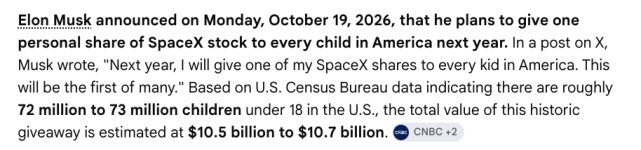
 I know how Elon Musk thinks and if I were him I'd also make sure this is a way to give away his wealth by really sticking it to the Lefties like Bernie Sanders somehow for nagging him to give away his wealth....I just have to think of what his rationale is to make them absolutely positively cringe every day for the rest of their lives regreting asking him to do it....these SpaceX shares aren't voting shares.....what could it be..