
Hopefully you can teach that to your fellow wumao
@Beijingwalker now
chatgpt:
Although both China and India may experience a decline in net FDI, the reasons are not the same.
1. India’s situation: mainly a decline in foreign inflows, not an increase in outward investment
India’s net FDI is calculated in a similar way:
Foreign direct investment flowing into India − Indian direct investment abroad
India’s problem is that:
Foreign investment inflows have slowed;
Indian companies’ overseas investment remains relatively limited.
Therefore, when India’s net FDI declines, the main reason is usually:
A reduction in foreign capital entering India
rather than:
Large-scale capital outflows by Indian companies.
For example:
Previously:
Foreign investment into India: US$80 billion
Indian overseas investment: US$10 billion
Net FDI:
+US$70 billion
Later:
Foreign investment into India: US$50 billion
Indian overseas investment: US$10 billion
Net FDI:
+US$40 billion
The decline is mainly caused by lower foreign investment inflows.
2. China’s situation: two-way changes are happening simultaneously
China’s case is different.
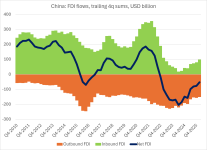
For many years, China has been one of the world’s largest recipients of FDI, but it has also become an increasingly important exporter of capital.
For example:
Previously:
Foreign investment into China: US$200 billion
Chinese overseas investment: US$50 billion
Net FDI:
+US$150 billion
Later:
Foreign investment into China: US$100 billion
Chinese overseas investment: US$150 billion
Net FDI:
−US$50 billion
In this situation, a negative net FDI figure does not mean that foreign investors have completely withdrawn from China. It means:
China’s outward investment has grown faster than foreign investment inflows.
3. Why is India’s overseas investment relatively small?
This is related to the different structures of the two economies.
China:
China has many:
Globally competitive manufacturing companies;
Large state-owned enterprises;
Energy and mining investment companies;
Infrastructure companies.
Therefore, Chinese companies have made large overseas investments in areas such as:
Mines;
Energy projects;
Factories;
Ports;
Industrial supply chains.
China has already become one of the world’s major sources of outbound capital.
India:
Indian companies also invest abroad, such as:
Tata Group;
Reliance Industries;
Information technology companies.
However, the overall scale is much smaller than China’s.
Reasons include:
Fewer globally competitive manufacturing exporters;
Lower degree of corporate internationalization;
Greater preference for investing in India’s large domestic market;
Fewer large-scale overseas acquisitions.
Therefore, changes in India’s FDI figures are more likely to reflect:
Whether foreign investors are increasing or reducing their investment in India.
4. Therefore, the same decline in FDI can have different meanings
Country Main reason for declining net FDI What it indicates
China Lower foreign inflows + rising Chinese overseas investment A transition from a capital-importing country toward a capital-exporting country
India Mainly slower foreign investment inflows Changes in India’s ability to attract foreign capital
5. However, India’s situation should not simply be interpreted as “foreign investors leaving India”
India’s FDI has also been affected by global factors, such as:
Higher global interest rates;
Slower global investment cycles;
A downturn in technology-sector investment.
At the same time, India continues to attract foreign investment in sectors such as:
Electronics manufacturing;
Semiconductors;
Automobiles;
Software services;
Renewable energy.








 China
China India
India


