DOGFIGHT AT DAWN
By: Sarmad Hassan Sharif
Date: September 06, 1965
Time: 0530 Hours
Sector: Wazirabad-Rahwali
On 6 September 1965, it was about 0530 hours that full realization of the scale of the Indian onslaught was realized by Pakistan, by which time the early morning CAPs were already airborne to patrol over Chamb. It was about the same time when four Indian Air Force Mystères from Adampur were reported, attacking a passenger train which had just pulled at Gakhar Railway Station.
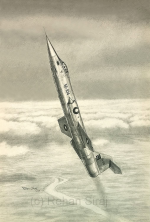
Sakesar diverted two F-104 Starfighters who were on a high level CAP. As both the aircraft reached overhead Rahwali they could not visually acquire the enemy fighters which were reported down below them. Since it was twilight, and dawn was breaking in the horizon, the ground features were not yet visible. Nonetheless, Flight Lieutenant Aftab Alam dived down while the other Starfighter remained on that altitude; acting as a radio relay.
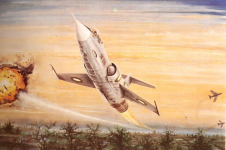
Scanning the horizon, Aftab picked up the Mystères, which upon spotting the Starfighter, scurried in the general direction of India at deck level. The Starfighter positioned itself behind one of the trailing Mystères and fired a Sidewinder. Aftab then pulled up allegedly owing to flash from his Sidewinder missile. In this process he lost sight of the other Mystères who made good their escape. The PAF awarded the pilot with one Mystère destroyed and one Mystère damaged. The PAF History 1988 has mentioned it as the first kill by a Mach-2 fighter, as well as the first kill by a Sidewinder missile by the PAF. However, there was no kill.
I have discussed this mission with several war veterans and retired PAF pilots who have actually fired the AIM-9B Sidewinder (GAR-8) missile in combat. The missile had the limitation of firing beyond 2 G’s, but more important is the severe limitation that the heat source had to be well above the horizon and therefore the predator aircraft had to be clearly below and behind its quarry. This then limited the effectiveness of the old version of AIM-9B Sidewinder (GAR-8) against a target which had to be above the horizon to prevent lock-on to ground return heat energy. Therefore, to claim missiles kill from ultra-low levels, in this case ~ 50 ft. the F-104 had to be lower than the target, which seems impossible. As revealed later by IAF that the F-104 did not scored any hit in that mission. Yet there was a claim of one destroyed and one damaged. Since the Mystère was flying at treetop level, it was virtually impossible for a Sidewinder to home-in on the Mystère. Exiting at tree top level, the Indian Mystère escaped unscathed, as the missile hit the ground (owing to greater heat emission from the ground as compared to the aircraft exhaust). Another observation noted were the tactic which the Indians adopted after being intercepted inside Pakistani territory. Once intercepted, the Indians hugged the terrain after cleaning their configuration. This method proved successful against any Sidewinder equipped PAF interceptor, which did not have the cushion to get below the escaping intruders. Many missiles were unsuccessfully fired later on in the conflict thus validating the limited performance of AIM-9B missile, its deterrent value notwithstanding.
In this case, although an explosion was observed, it later transpired that the Indian pilot, identified as Flight Lieutenant Paddy Earle, had jettisoned his drop tanks hoping to put distance between himself and the menacing Mach-2 Starfighter. The ‘blinding flash’ was the result of the tanks exploding and was presumed by the Pak Army observer to be the destruction of the Mystère. While the three Mystères landed back at Adampur, Paddy Earle had to divert to Pathankot after escaping the menacing Starfighter, reported to have been admonished by his superiors for losing his precious drop tanks.
Copyright 2021 Sarmad Hassan Sharif. All Rights Reserved. Reproduction in whole or in part in any form or medium without express written permission of author is prohibited.
© Painting Gp Capt S M A Hussaini