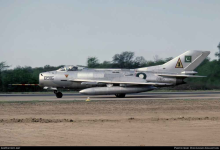
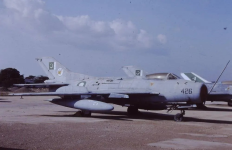
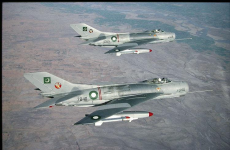
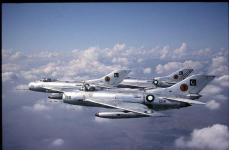
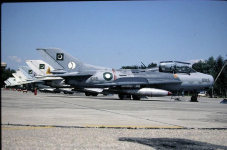
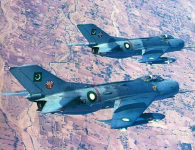
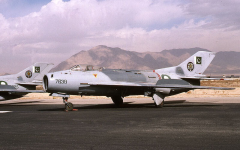
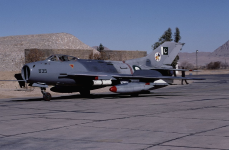
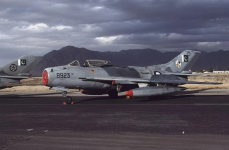
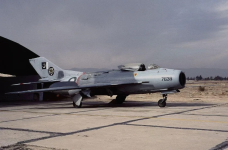
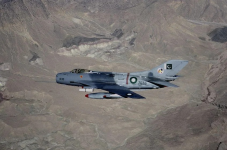
F-6 of Pakistan Air Force

Nice picture

1706291816925.png
 
Between 1965–1980, the Pakistan Air Force (PAF) received 260 F-6 fighters which went on to serve with ten PAF squadrons
 
Based on the Russian MiG-19, the Chinese F-6 was inducted into the PAF in 1966 and is now at the end of its operational life. The F-6 will be phased out by the year 2000. It is atwin-engined, supersonic, fighter-interceptor and light ground-attack bomber with good handling and manoeuvring capability. A total of 170 F-6s were inducted into the PAF but now only 49 remain in service. Of the original 170, some had been attritioned, some have been de-commissioned and put up on static displays around the country while one squadron has been sold to the Bangladesh Air Force. Currently, the F-6 forms part of PAF's No. 17 and No. 23 Squadrons.

Background:

The F-6 (the modified export version of Chinese J-6) is based on the Russian MiG-19SF 'Farmer-C' and is the first supersonic fighter which China manufactured. The Chinese version proved to be more popular. Export success for the F-6 was followed by large exports of the A-5 on which it was based. In the early 1950's, China, under help from Russia, set up the first jet fighter production line in Shenyang. In 1955, the first Chinese jet-fighter, the MiG-17 was assembled using Russian parts. On 13 July 1956, the first all-Chinese MiG-17, using Chinese-made parts was rolled out of the Shenyang factory. After, a 15-day inspection period, it was given the go-ahead for a full production run. It was first designated the 'Type 56' and that designation was later changed to 'J-5'. The first J-6 (an advanced version of the J-5 was made using Russian parts. It rolled out of the manufacturing plant in 1958. However, during the initial period, many J-6s were manufactured with poor quality, and the whole project had to be re-started. The first qualified J-6 rolled out of factory in December 1963. The variant of J-6s include the J -6A and the JJ-6, the export version being designated the F-6 and FT-6 respectively.

The F-6A is the Chinese equivalent of the MiG-19PF with a fixed armament of two 30 mm cannon and radar to provide limited all-weather interception capability. The F-6B is the Chinese equivalent of the MiG-19M 'Farmer-D' with the two 30mm cannon supplemented by two semi-active radar-homing AAMs derived from the Soviet AA-1 'Alkali' and used in association with interception radar. The F-6C 'Farmer' is a J-6 development for the day-fighter role with the brake chute relocated to a bullet fairing at the base of the rudder. The J-6Xin is a development of the J-6A with Chinese radar in a sharp-tipped radome on the splitter plane rather than Russian radar in the inlet centrebody. The Tianjin JJ-6 (export FT-6) is a trainer development equivalent to (but not identical with) the MiG-19UTI which was developed in prototype form in the USSR but then not placed in production. The JZ-6 is the Chinese version of the MiG-19R reconnaissance aircraft.

Mission:

The F-6 "Farmer" is a fighter fitted with avionics for both day and night missions. It is highly manoeuvrable and agile and has proven itself in air-to-air combat in the past during the Indo-Pakistan War of 1971 and the Indo-Chinese War of 1965 . It is now being replaced by F-7P 'Skybolt' which has become the mainstay of the PAF in terms of quantity.

Features:

The F-6 was originally designed as a day fighter. However, with time it came to be fitted with better avionics and armaments to transform it into a night-time fighter as well. Though this night-flying capability has not been tested in battle. Its primary duties are attack and reconnaissance. It has two to three powerful 30 mm cannons. These aircraft have attachments under their wings to carry the PAF AIM-9B and AIM-9L Sidewinder missiles for interception missions, with provision of more for external fuel tanks. The F-6 is technologically obsolete, but in a close-range turning engagement is still a formidable air-combat adversary
as a result of its great agility and powerful cannon armament.

Basic Specifications:

Primary Function:
Day-time fighter, attack and reconnaissance aircraft.

Manufacturer: Shenyang/Tianjin (China)

Power Plant: Two Shenyang Wopen-6 (WP-6) turbojet engines.

Thrust: 31.87 kN. (7,165 lb. st) - each engine

Length: 48 feet, 10.5 inches (14.9 metres) (excluding probe)

Height: 12 feet, 8.7 inches (3.88 meters)

Wingspan: 30 feet, 2.25 inches (9.2 meters)

Maximum Takeoff Weight: 22,046 lb. (10,000 kg)

Speed: 957 mph (1,540 km/h, Mach 1.45 at 35,000 feet)

Ceiling: 58,725 feet (17,900 meters)

Range: 1,366 miles (2,200 km) with two drop tanks; 685 km (370 miles) without drop tanks.

Armament: Two 30 mm cannons, under wings pylons for AIM-9B Sidewinder air-to-air missile. It can carry four air-to-air guided weapons, two 250 kg bombs, or single rockets of up to 212 mm calibre. 500 kg of disposable stores, including AAMs, free-fall bombs, rocket launchers and drop tanks, carried on four external hardpoints (2 on each wing) and one centreline hardpoint for a drop tank.

Crew: F-6: one; FT-6: two (trainer variant)

PAF Inventory: 49 F-6s; 15 FT-6s (current); 170 (original)
 
Creative Ingenuity. F-6 (MiG-19) was once the backbone of the PAF. A very unique example. It's a Russian designed fighter built by the Chinese, Pakistani engineers wired it to fire American Sidewinder missiles, the pilot sits on a British Martin-Baker ejection seat, equipped with French avionics and Tamed by Pakistani pilots.

1709132975994.png
 
img_59-7.jpg
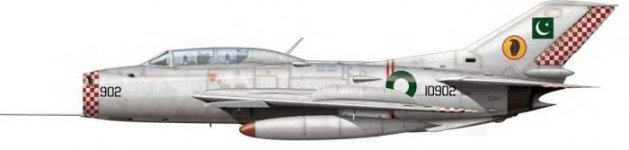
Shenyang FT-6, ‘10902/902’, 15 Squadron ‘Cobras’, Pakistan Air Force, Kamra, 1980s. Overall white with red/white trim, 15 Squadron ‘Cobra’ marking on fin.
 
airforce-bullet.gif

F-6 Aircraft of Pakistan Air Force​

Columnist Gp Capt SM HALI remembers the Chinese F-6 aircraft in the PAF.

The mach 1.4 F-6 Day Fighter is an export designation of the Chinese-built J-6 (Fighter aircraft 6) which was originally designed as MiG-19 in the USSR, its Soviet prototype having flown for the first time in September, 1953.

Immediately after the 1965 Indo-Pak War, USA placed an embargo on the supply of weapons to both countries. Pakistani defence planners selected the F-6 aircraft as an addition to the PAF inventory. Thus its induction commenced on 30 December, 1965. Initially 72 aircraft were procured with subsequent additions bringing the total to 253 aircraft.

At its peak, the F-6 aircraft equipped ten Fighter Squadrons of Pakistan Air Force.
PAF pilots have now flown this aircraft for more than thirty-four years. They mastered this twin engined pack of roaring power in a considerably short time.

On 09 March, 1968, PAF F-6s participated in an impressive Fire-Power display at the Jamrud Firing Range near Peshawar organised for the visiting Iranian monarch, Raza Shah Pahelvi. In 1969, PAF formed an aerobatics team named ‘Rattlers’. The team comprised four F-6 aircraft painted black. On 14 March, 1969, the team performed formation aerobatics in a thrilling display of speed control and co-ordination in an air display organized for the visiting Soviet Minister of Defence, Marshal Grechko.

While the PAF pilots gained expertise on this thrilling but difficult and demanding weapon system, PAF’s engineers and technicians carried out a number of indigenous modifications and improvements to make the F-6 more effective and enhance its roles of air superiority and ground attack.

The major upgrading and innovative modifications include the provision of western avionics, Martin and Baker ejection seats, the AIM-9 Sidewinder air-to-air missile, French 68 mm rockets, additional under wing tanks and under-belly ‘Gondola’ fuel tanks and a special ground-power unit for instantly starting its twin engines to shorten ‘scramble’ time.

PAF’s expertise on the F-6 was fully tested during the 1971 Indo-Pak War. Its three F-6 squadrons, Nos 11, 23 and 25 gave an excellent account of themselves: flying 945 sorties comprising 735 hours and destroying numerous enemy tanks, armoured cars and field guns during the close support missions. In air combat, F-6 pilots shot down eight Indian Air Force fighter aircraft including a superior MiG-21 and damaged five.

On 04 December, Flight Lieutenant Javed Latif of No 23 Squadron shot down an SU-7 while it was attacking the PAF airfield at Risalewala. Its pilot Flight Lieutenant Harvinder Singh was killed in action. On 04 December, Flying Officer Qazi Javed of No 25 Squadron shot down an Indian Hunter when it came to attack PAF airfield at Mianwali. Its pilot Flight Lieutenant Vidya Dhar Shankar was also killed in action.

On 05 December, Wing Commander Saad A Hatmi, the Officer Commanding of No 25 Squadron and his Number two, Flight Lieutenant Shahid Raza chased two IAF Hunters and shot them down close to Sakesar. Their pilots Flight Lieutenants G.S. Rai and K.L. Malkani were both killed in action.

On 07 December, Flight Lieutenant Atiq Sufi of No 11 Squadron shot down an IAF SU-7 near the battle front at Samba. Its pilot Flight Lieutenant Jiwa Singh was killed in action.
On 08 December, Wing Commander S. M. Hashmi, Officer Commanding of No 23 Squadron shot down two IAF SU-7s which were attacking Risalewala airfield.

On 14 December, Flight Lieutenant Aamer A Sharif of No 11 Squadron engaged a superior IAF MiG-21 and after a classic battle, shot it down near Niankot.
All three squadrons received battle honours for the 1971 War, while three F-6 pilots were awarded gallantry medals.

Todate F-6 aircraft have flown more than 400,000 hours. The Pakistan Aeronautical Complex Kamra’s F-6 Rebuild Factory, which was inaugurated in 1980, has played a major role in giving the F-6 aircraft a new lease of life by completely over-hauling it.​
 

Users who are viewing this thread

Pakistan Defence Latest

Back
Top