Navigation
Install the app
How to install the app on iOS
Follow along with the video below to see how to install our site as a web app on your home screen.
Note: This feature may not be available in some browsers.
More options
Style variation
You are using an out of date browser. It may not display this or other websites correctly.
You should upgrade or use an alternative browser.
You should upgrade or use an alternative browser.
F-86 Sabres of Pakistan Air Force
- Thread starter ghazi52
- Start date
More options
Who Replied?


ghazi52
THINK TANK: CONSULTANT
- Thread starter
- #48
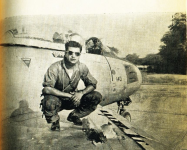
L-to-R: Flt Lt Mazhar Abbas, Flt Lt Fazal Elahi. Mazhar participated in the first strike on Pathankot airbase during ‘65 war & went on to retire as an Air Cdre. Elahi was KIA during 71’ war when his Sabre was hit by AAA during a CAS mission.
@palettefm_bot

@palettefm_bot

ghazi52
THINK TANK: CONSULTANT
- Thread starter
- #50
Pakistan Air Force - The Canadair Sabre Goes to War
During 1965 and 1971 two brief but furious wars flared up between India and Pakistan. The first lasted 23 days and saw the PAF pitting its F-86Fs, F-104s and B-57s against the IAF's Hunters, Vampires, Gnats, Ouragans, Mysteres and Canberras. Losses all round were severe. To recoup its losses, Pakistan took three main steps.
Because of an arms embargo, it was cut off from its traditional source of supply, the United States, so turned to France for a limited supply of Mirages (these were too costly for the PAF to obtain in the numbers it needed). It turned to China for a large number of F-6 Fighters. These are a version of the MiG-19 and have been to this day an affordable but reliable (if outdated) aircraft. Finally, Pakistan looked for anv available "bargains" and, as it turned out, found an excellent one.
A large batch of Luftwaffe Sabre 6s were currently surplus. Working no doubt with seasoned international arms dealers, Pakistan agents concluded a deal which saw the Sabres purchased by Iran. Some 90 were ferried to that country by Luftwaffe pilots. Once there so the story goes, they were flown into West Pakistan "for overhaul." They never returned and were soon flying with PAF squadrons. The Sabre 6 was an ideal find for the Pakistanis---it was inexpensive and was readily serviceable; PAF fighter pilots had been brought up on the F-86F, yet the Sabre 6 was a good half generation advanced over the "F". The Canadair Sabre was to form the backbone of the PAFs day fighter operation in the 1971 war and would fly again%[ vastly superior numbers of IAF fighters, including the Gnat, Hunter, Mystere HF-24, SU-7 and state-of-the-art MIiG-21.
In 1971 Last Pakistan was in turmoil and the movement by revolutionaries to reform it as an independent slate destabilized the region. In December India launched an all-out invasion of East, then West Pakistan. All the PAF had in the East was a single squadron of Sabres. Too small to take on the Indians offensively, Pakistan had little choice but to try holding on its own frontiers. Unfortunately for the PAF, many of its new F-6s were not vet combat ready. With few Mirages available, it was the Sabre 6s, along wish the surviving F-86Fs, that would have to fend off the Indians.
It appears that the first. engagement in the air war occurred on November 22, with Gnats and Sabres dog fighting over East Pakistan. One Gnat and two Sabres were lost. From here on activity rose and after the first four days of fighting in December the PAP had claimed 95 enemy aircraft shot down in combat-a high figure, but it has been widely accepted that the PAF made excellent use of its aircraft and did, in fact, establish a high kill ratio against the IAF. A typical day's work was December 6 when five SU-7s, three Canberras and two Hunters were shot down for the loss of two Sabres.
On December II PAF Sabres also did well: a supersonic MiG-2I and two SU-7s were bagged. Three days later a MiG fell to an F-6. On the 17th, a Sabre brought down another MiG-21, bringing the PAF tally to 141 enemy aircraft destroyed. That day India agreed to a cease-fire. It is the official Pakistan view that the tenacity of the PAF and the way it established air superiority led to India's sudden acceptance of the cease-fire. Without control of the skies, India apparently felt that victory couldn't be assured. By far the most active PAF fighter in the 1971 war was the F-g6, and it would appear that a large number of Sabre 6s participated and accounted for many of the 141 PAF kills. Thus, in its "declining years," the mighty Sabre 6 had finally been put to work "for real." And the results, for those on the receiving end, proved devastating. PAF records show that 24 Sabre 6s were lost in 1971, most, it is safe to assume, during the war.
Of course, the IAF deserves its due as well, and its fighters were able to down many PAF aircraft. One of its more potent weapons was its smallest, the Gnat, Barely 31 feel long, the Gnat was fast and well armed. In Aircraft of /lit, Indian Air Force it is noted that, "The diminutive fighter earned the appellation `Sabre Slayer' for it had achieved much distinction, proving capable of outfighting both the F'-g6 Sabre and the F-104A Starfighter ... Because of its small size, Pak. pilots found the Gnat difficult to see let alone engage... " This excerpt front an official P AF paper covers the story of the Sabre 6 and its role in the 1971 war:
'the end of 1965 Indo-Pak War entailed a grave challenge as the U.S. military aid to Pakistan was abruptly suspended. Although the suspension of military aid was equally applicable to both India and Pakistan, it hurt Pakistan harder as The Pakistan armed forces had been exclusively equipped with American military hardware within the framework of the then-existing CENTO and SEATO pacts.
Pakistan armed forces were thus entirely dependent on American weapons systems. India on the other hand was far less affected in view of her diversified inventory of arms, including a sizable supply from the Soviet Union, Subsequernt to the war, India's military needs confined to be met by a substantial and continuous flow of Soviet military equipment and other East European countries, coupled with her own indigenous production of armament
Obviously, this embargo operated to the great disadvantage of Pakistan and was rightly viewed as constituting per se a formidable threat to the territorial integrity of Pakistan. In view of the jeopardized security of the country, the government lodged a strong protest with the U.S.A. for violating existing military pacts. '1 'he embargo also accelerated Pakistan's worldwide explorations for new, and alternative sources of supply of military equipment along with the ,catch for the badly needed spares for PAF aircraft. This probing for new avenues resulted, between 1966-68, in the acquisition of (tic Mirage III from France. and MiG-19 (f (F-6s) from China , all immediate interim reinforcement, however, the year 1966 saw a bulk upply of 90 used Canadair Sabre Mk. 6s of the German .Air Force.
The aircraft had already flown for a number of years and were inducted as a slop-gap measure.
The 90 Sabres were ferried to Pakistan via Iran, as follows:
April 1966 ..... 10
May 20
Tune 20
July x
October 12
December 20
These Canadair Sabres (F-86E) belonged to Canada's most widely produced aircraft with approximately 1800 manufactured in all. This epoch making fighter built under license by Canada continued to fly in the air forces of a number of countries and was extremely popular in the PAF right up to its phasing out in 1990 due to spares supply having completely dried up.
PAF's F-86Es were allocated in (the former) West Pakistan to No. 17, 18 and 19 Squadrons and No. 14 Squadron in (the former) East Pakistan (now Bangladesh). In the 1971 Indo-Pak War, air combat operations by E-86E.s were of great historical significance and interest. Some selected and salient war events involving the Canadair Sabres are summed up in the following paragraphs. The resource constraints permitted the PAF to station only a single squadron (No. 14) flying I'-86Es in the then Eastern wing of Pakistan. This lone squadron had to face no less than 10 squadrons of the Indian Air Force (IAF) simultaneously, comprising MiG-21s Gnats and Hunters.
The grim but resolute and heroic resistance of No. 14 Squadron will go down in air combat history as a glorious chapter of a valiant and determined fight against a vastly superior enemy. It was a no win situation front the outset, but the squadron Put up a fierce fight and continued it against heavy odds. I he young and gallant pilots of PAF, with only 1011-150 operational hours to their credit, were invariably pitted against eight to ten enemy aircraft at a lime.
The story of FIt. Lt. Saeed Afzal Khan, a young pilot decorated for his action in the E-86E, is described in the citation in these words: "On 41h December, 1971, HELL Saeed Afzal Khan was flying as No.2 in a formation of two P'-86 aircraft when he engaged four Indian Hunters and immediately shot down one, Meanwhile another formation of four Hunters joined the aerial battle. In the subsequent combat, although lacing great odds, be was not deterred from attacking them. He put up a gallant fight with complete disregard to his own safety. Due to his [determination and flying skill, be pre-vented everyone of diem from attacking their target, i.e. Dacca airfield."
The citation in fact describes actions very typical of No.14 Squadron's war effort. The objective of the small but dedicated team of PAF men was to protect Dacca airfield from hostile attacks and to keep it safe enough for continued operations. In this mission their resolute performance was acknowledged even by the adversaries.
With the launching of an all-out assault by Indian forces on East Pakistan on November 22, 1971, the IAF let loose the full combat power of its 10 squadrons against one. The IAF kept on relentless pressure for three days and nights. Dacca Air Base was raided several times by as many as 20 aircraft simultaneously. But for the dogged resistance and will of t lie PAF, the W. would have succeeded in achieving their objective within three to tour hours of the first day. But the heavily outnumbered but determined pilots of 14 Squadron did not allow the IAF such an easy victory The PAF F-86s rose repeatedly to meet MiG-21s, SU-7s and Hunters to inflict casualties on the intruders notwithstanding the ladder's overwhelming superiority.
A memorable dogfight in the defence of Dacca Air Base, amongst the many witnessed by newsmen from the nearby roof of the litter Continental Hotel, involved the young Flying Officer Shamsul Haq. He alone engaged five enemy aircraft and shot three of (hem down, two Hunters and one SU-7. F/O Shams, though quite young in flying experience as well as age, engaged each enemy aircraft in turn and got his kills through a blend of aggressiveness and .skill.
Realizing the ineffectiveness of SU-7s. the IAF effected a qualitative as well as a quantitative change in then air element by introducing supersonic and better maneuvering and more powerful Mig-21s along with the Bunters.
This uneven grim tussle tot- air superiority between the two unequal rivals dragged on until December 81b, when Dacca runway. having been cratered too many times, was irreparably damaged. thus bringing PAF operations to an inevitable end. The Indians, however, tailed to destroy No.14 Squadron.
Even when the runway had been rendered non-operational, I t F-86Es remained intact. Air war in the then Western wing of Pakistan was a different proposition. The PAP held full sway over her air space and the air superiority gained by the PAF was seldom contested. In the initial 24 hours after the outbreak of war, the IAF suffered the loss of 19 aircraft including 9 S4-7s, 5 Hunters, 3 Canberra%, I HF-24 and I Gnat. In several encounters the F-86E easily outmaneuvered IAF aircraft and in one case this pilots' favorite shot down even the much faster MiG-21, when the latter attempted unwisely to turn with it, in a tree-top dogfight.
The foregoing brief account is a valuable tribute to the Canadair Sabres, which served PAF in good stead. It is also a tribute to those dedicated, brave pilots who flew these fighters with aggressiveness and skill. The F-86E is still well-remembered in the PAF
Ruins of ex PAF Sabre 6 No 1606 in a Bangladesh AF scrap yarn The BAF used several Sabre 6s for a short. time following independence from Pakistan (BAF)
During 1965 and 1971 two brief but furious wars flared up between India and Pakistan. The first lasted 23 days and saw the PAF pitting its F-86Fs, F-104s and B-57s against the IAF's Hunters, Vampires, Gnats, Ouragans, Mysteres and Canberras. Losses all round were severe. To recoup its losses, Pakistan took three main steps.
Because of an arms embargo, it was cut off from its traditional source of supply, the United States, so turned to France for a limited supply of Mirages (these were too costly for the PAF to obtain in the numbers it needed). It turned to China for a large number of F-6 Fighters. These are a version of the MiG-19 and have been to this day an affordable but reliable (if outdated) aircraft. Finally, Pakistan looked for anv available "bargains" and, as it turned out, found an excellent one.
A large batch of Luftwaffe Sabre 6s were currently surplus. Working no doubt with seasoned international arms dealers, Pakistan agents concluded a deal which saw the Sabres purchased by Iran. Some 90 were ferried to that country by Luftwaffe pilots. Once there so the story goes, they were flown into West Pakistan "for overhaul." They never returned and were soon flying with PAF squadrons. The Sabre 6 was an ideal find for the Pakistanis---it was inexpensive and was readily serviceable; PAF fighter pilots had been brought up on the F-86F, yet the Sabre 6 was a good half generation advanced over the "F". The Canadair Sabre was to form the backbone of the PAFs day fighter operation in the 1971 war and would fly again%[ vastly superior numbers of IAF fighters, including the Gnat, Hunter, Mystere HF-24, SU-7 and state-of-the-art MIiG-21.
In 1971 Last Pakistan was in turmoil and the movement by revolutionaries to reform it as an independent slate destabilized the region. In December India launched an all-out invasion of East, then West Pakistan. All the PAF had in the East was a single squadron of Sabres. Too small to take on the Indians offensively, Pakistan had little choice but to try holding on its own frontiers. Unfortunately for the PAF, many of its new F-6s were not vet combat ready. With few Mirages available, it was the Sabre 6s, along wish the surviving F-86Fs, that would have to fend off the Indians.
It appears that the first. engagement in the air war occurred on November 22, with Gnats and Sabres dog fighting over East Pakistan. One Gnat and two Sabres were lost. From here on activity rose and after the first four days of fighting in December the PAP had claimed 95 enemy aircraft shot down in combat-a high figure, but it has been widely accepted that the PAF made excellent use of its aircraft and did, in fact, establish a high kill ratio against the IAF. A typical day's work was December 6 when five SU-7s, three Canberras and two Hunters were shot down for the loss of two Sabres.
On December II PAF Sabres also did well: a supersonic MiG-2I and two SU-7s were bagged. Three days later a MiG fell to an F-6. On the 17th, a Sabre brought down another MiG-21, bringing the PAF tally to 141 enemy aircraft destroyed. That day India agreed to a cease-fire. It is the official Pakistan view that the tenacity of the PAF and the way it established air superiority led to India's sudden acceptance of the cease-fire. Without control of the skies, India apparently felt that victory couldn't be assured. By far the most active PAF fighter in the 1971 war was the F-g6, and it would appear that a large number of Sabre 6s participated and accounted for many of the 141 PAF kills. Thus, in its "declining years," the mighty Sabre 6 had finally been put to work "for real." And the results, for those on the receiving end, proved devastating. PAF records show that 24 Sabre 6s were lost in 1971, most, it is safe to assume, during the war.
Of course, the IAF deserves its due as well, and its fighters were able to down many PAF aircraft. One of its more potent weapons was its smallest, the Gnat, Barely 31 feel long, the Gnat was fast and well armed. In Aircraft of /lit, Indian Air Force it is noted that, "The diminutive fighter earned the appellation `Sabre Slayer' for it had achieved much distinction, proving capable of outfighting both the F'-g6 Sabre and the F-104A Starfighter ... Because of its small size, Pak. pilots found the Gnat difficult to see let alone engage... " This excerpt front an official P AF paper covers the story of the Sabre 6 and its role in the 1971 war:
'the end of 1965 Indo-Pak War entailed a grave challenge as the U.S. military aid to Pakistan was abruptly suspended. Although the suspension of military aid was equally applicable to both India and Pakistan, it hurt Pakistan harder as The Pakistan armed forces had been exclusively equipped with American military hardware within the framework of the then-existing CENTO and SEATO pacts.
Pakistan armed forces were thus entirely dependent on American weapons systems. India on the other hand was far less affected in view of her diversified inventory of arms, including a sizable supply from the Soviet Union, Subsequernt to the war, India's military needs confined to be met by a substantial and continuous flow of Soviet military equipment and other East European countries, coupled with her own indigenous production of armament
Obviously, this embargo operated to the great disadvantage of Pakistan and was rightly viewed as constituting per se a formidable threat to the territorial integrity of Pakistan. In view of the jeopardized security of the country, the government lodged a strong protest with the U.S.A. for violating existing military pacts. '1 'he embargo also accelerated Pakistan's worldwide explorations for new, and alternative sources of supply of military equipment along with the ,catch for the badly needed spares for PAF aircraft. This probing for new avenues resulted, between 1966-68, in the acquisition of (tic Mirage III from France. and MiG-19 (f (F-6s) from China , all immediate interim reinforcement, however, the year 1966 saw a bulk upply of 90 used Canadair Sabre Mk. 6s of the German .Air Force.
The aircraft had already flown for a number of years and were inducted as a slop-gap measure.
The 90 Sabres were ferried to Pakistan via Iran, as follows:
April 1966 ..... 10
May 20
Tune 20
July x
October 12
December 20
These Canadair Sabres (F-86E) belonged to Canada's most widely produced aircraft with approximately 1800 manufactured in all. This epoch making fighter built under license by Canada continued to fly in the air forces of a number of countries and was extremely popular in the PAF right up to its phasing out in 1990 due to spares supply having completely dried up.
PAF's F-86Es were allocated in (the former) West Pakistan to No. 17, 18 and 19 Squadrons and No. 14 Squadron in (the former) East Pakistan (now Bangladesh). In the 1971 Indo-Pak War, air combat operations by E-86E.s were of great historical significance and interest. Some selected and salient war events involving the Canadair Sabres are summed up in the following paragraphs. The resource constraints permitted the PAF to station only a single squadron (No. 14) flying I'-86Es in the then Eastern wing of Pakistan. This lone squadron had to face no less than 10 squadrons of the Indian Air Force (IAF) simultaneously, comprising MiG-21s Gnats and Hunters.
The grim but resolute and heroic resistance of No. 14 Squadron will go down in air combat history as a glorious chapter of a valiant and determined fight against a vastly superior enemy. It was a no win situation front the outset, but the squadron Put up a fierce fight and continued it against heavy odds. I he young and gallant pilots of PAF, with only 1011-150 operational hours to their credit, were invariably pitted against eight to ten enemy aircraft at a lime.
The story of FIt. Lt. Saeed Afzal Khan, a young pilot decorated for his action in the E-86E, is described in the citation in these words: "On 41h December, 1971, HELL Saeed Afzal Khan was flying as No.2 in a formation of two P'-86 aircraft when he engaged four Indian Hunters and immediately shot down one, Meanwhile another formation of four Hunters joined the aerial battle. In the subsequent combat, although lacing great odds, be was not deterred from attacking them. He put up a gallant fight with complete disregard to his own safety. Due to his [determination and flying skill, be pre-vented everyone of diem from attacking their target, i.e. Dacca airfield."
The citation in fact describes actions very typical of No.14 Squadron's war effort. The objective of the small but dedicated team of PAF men was to protect Dacca airfield from hostile attacks and to keep it safe enough for continued operations. In this mission their resolute performance was acknowledged even by the adversaries.
With the launching of an all-out assault by Indian forces on East Pakistan on November 22, 1971, the IAF let loose the full combat power of its 10 squadrons against one. The IAF kept on relentless pressure for three days and nights. Dacca Air Base was raided several times by as many as 20 aircraft simultaneously. But for the dogged resistance and will of t lie PAF, the W. would have succeeded in achieving their objective within three to tour hours of the first day. But the heavily outnumbered but determined pilots of 14 Squadron did not allow the IAF such an easy victory The PAF F-86s rose repeatedly to meet MiG-21s, SU-7s and Hunters to inflict casualties on the intruders notwithstanding the ladder's overwhelming superiority.
A memorable dogfight in the defence of Dacca Air Base, amongst the many witnessed by newsmen from the nearby roof of the litter Continental Hotel, involved the young Flying Officer Shamsul Haq. He alone engaged five enemy aircraft and shot three of (hem down, two Hunters and one SU-7. F/O Shams, though quite young in flying experience as well as age, engaged each enemy aircraft in turn and got his kills through a blend of aggressiveness and .skill.
Realizing the ineffectiveness of SU-7s. the IAF effected a qualitative as well as a quantitative change in then air element by introducing supersonic and better maneuvering and more powerful Mig-21s along with the Bunters.
This uneven grim tussle tot- air superiority between the two unequal rivals dragged on until December 81b, when Dacca runway. having been cratered too many times, was irreparably damaged. thus bringing PAF operations to an inevitable end. The Indians, however, tailed to destroy No.14 Squadron.
Even when the runway had been rendered non-operational, I t F-86Es remained intact. Air war in the then Western wing of Pakistan was a different proposition. The PAP held full sway over her air space and the air superiority gained by the PAF was seldom contested. In the initial 24 hours after the outbreak of war, the IAF suffered the loss of 19 aircraft including 9 S4-7s, 5 Hunters, 3 Canberra%, I HF-24 and I Gnat. In several encounters the F-86E easily outmaneuvered IAF aircraft and in one case this pilots' favorite shot down even the much faster MiG-21, when the latter attempted unwisely to turn with it, in a tree-top dogfight.
The foregoing brief account is a valuable tribute to the Canadair Sabres, which served PAF in good stead. It is also a tribute to those dedicated, brave pilots who flew these fighters with aggressiveness and skill. The F-86E is still well-remembered in the PAF
Ruins of ex PAF Sabre 6 No 1606 in a Bangladesh AF scrap yarn The BAF used several Sabre 6s for a short. time following independence from Pakistan (BAF)
ghazi52
THINK TANK: CONSULTANT
- Thread starter
- #51
Summary of PAF Sabre 6s to 1986.
Contributed by: Tanweer Abbas
North American Aviation's
Sabre F-86 North American Sabra F-86 served with distinction with Air Forces of new ferwer than 37 nations. Overall, an impressive tally for an aircraft which is generally regarded as the ebst fighter if its era because of its excellent combat record on Korean war, its technical achievemnts, it was far in advance of the jet fighters which immediately preceded it.
The story of Pakistani F-86 starts when in 1955 US sold 120 of F-86-F40s to Pakistan Air Force. PAF had eight squadrons of F-86Fs on its order of battle which formed squadron no 5. 11, 14, 15, 16, 17, 18 and 19 making up a total of about 100 operational airctaft. of these 100 aircraft, 25 were equipped with Sidewinder air-to-air missiles. 90 former Luftwaffe Canadian Sabres were illegally sold to Pakistan (then subjected to UN arms embargo ) with Iran acting as the sales agent.
The luftwaffe was told that the Sabres were for Imperial Iran Air Foce, IIAF, but the intention was always to pass them on to Pakistan
The PAF sabres were extensively used during 1965 and 71' war in combat air patrol, strike against airfields and close support mission. Several air battles between Pakistani and Indian aircraft took place, the Sabre pilots ultimately claiming numerous kills including Hunter, Gnats, Vampires, Mysteres and a Canberra among them.
In 1971 war, PAF had 6 Sabre Squadrons; NO 14, 15, 16, 17, 18 and 19. At the end of the war, 11 remaining Sabres of No 14 squadron were destroyed delibrately to avoid capture, although Sabre pilots once again made their mark and despite the age of their aircraft claimed Hunter, SU-7, Gnat nd even a pair of Mig-21s. The Sabre remained in PAF service untill 1980.

A picture of PAF Sabre at the end of '71 war which was
delibrately destroyed by PAF
At the end of '71 war, Bangladesh had five Canadian Mk.6 Sabres which fell into their hands after some defectors fled to the East Pakistan (Bangladesh).
There are also rumors that out of these five Sabres, some were construced after mutilating the 11 destroyed Sabres of No. 14 Squadron and the remaining spares. These Sabres operated by Bangladesh Air Force for on;y two years until a lack of spare parts forced their withdrawl from service.

This North American Sabre is now in the museum at Dhaka
History of PAF Sabre starts after the Korean war, when USAF realized Mig-15 was much better fighter and Sabre needed much work on it, specially rate of climb. F-86Fm the day fighter variant which Pakistan acquired embodied a much improved airframe.
Combat experience also revealed a need for enhanced manoeuvrability, resulting in the development of the so called '6-3' wing with leading edge slats removed. With this modification installed, the Sabre was able to out-turn a Mig-15 and its high altitude/high Mach number manoeuvrability was considerably enhanced.
The F-86 was powered by the J47-GE-27 engine rated at 5,910lb thrust, a 13 per cent improvement on A and E models. This resulted in greater speeds but a significantly improved rate of climb - in the order of 25 per cent at sea level - although this was still slightly inferior to the Mig-15.
The final varint of F series, was the F-86F-F40. It had a curious mix of wing features. In order to restore the previous low speed docility and reduce the stalling speed, the leading edge slats were reinstated and each wing tip extended by 12 inches, resulting in a an overall wing span of 39ft 1.4 in and wing area increased to 313.4sq ft. The result was a stalling speed some 17 knots below that of the F-86F with '6-3' wing.
Serial | Fate | year |
1592 | Crashed | 1971 |
1594 | " | 1969 |
1595 | Extant | - |
1606 | Crashed | 1971 |
1607 | " | " |
1608 | " | " |
1614 | " | " |
1616 | " | 1970 |
1617 | " | 1971 |
1618 | " | " |
1621 | " | 1972 |
1622 | Scrapped | 1979 |
1623 | Extant | - |
1624 | Crashed | 1973 |
1626 | Scrapped | 1978 |
1627 | Extant | - |
1629 | " | - |
1632 | " | - |
1634 | Scrapped | 1980 |
1636 | Crashed | 1978 |
1639 | Extant | - |
1650 | Crashed | 1970 |
1652 | Scrapped | 1968 |
1653 | Crashed | 1971 |
1655 | Extant | - |
1656 | Extant | - |
1657 | Crashed | 1971 |
1658 | " | 1967 |
1660 | " | 1974 |
1661 | - | 1971 |
1663 | " | " |
1665 | Scarpped | 1976 |
1669 | Crashed | 1971 |
1670 | Museum | - |
1674 | " | 1968 |
1683 | " | 1975 |
1689 | Crashed | 1971 |
1692 | " | 1976 |
1693 | Extant | - |
1695 | Crashed | 1973 |
1701 | Extant | - |
1702 | " | - |
1703 | Crashed | |
1705 | Extant | - |
1709 | " | - |
1718 | Crashed | 1971 |
1719 | " | " |
1720 | " | 1968 |
1722 | Extant | - |
1728 | Museum | - |
1733 | Extant | - |
1735 | Crashed | 1971 |
1738 | " | " |
1739 | Extant | - |
1742 | Crashed | 1968 |
1747 | Extant | - |
1749 | Crashed | 1968 |
1751 | Extant | - |
1754 | Extant | - |
1756 | Scrapped | 1978 |
1763 | Crashed | 1971 |
1764 | Extant | - |
1765 | Crashed | 1966 |
1766 | " | 1970 |
1771 | Scrapped | 1978 |
1772 | Crashed | 1971 |
1777 | Scrapped | 1978 |
1778 | Extant | - |
1781 | Scarpped | 1975 |
1783 | Extant | - |
1786 | Crashed | 1971 |
1787 | " | 1975 |
1788 | " | 1980 |
1789 | Extant | - |
1790 | " | - |
1792 | Scrapped | 1980 |
1794 | Extant | - |
1797 | " | - |
1798 | Crashed | 1974 |
1800 | " | 1972 |
1802 | " | 1971 |
1803 | " | " |
1804 | " | 1975 |
1808 | " | 1978 |
1809 | Scrapped | 1977 |
1810 | Extant | - |
1811 | Crashed | 1975 |
1812 | Scrapped | 1974 |
1815 | Extant | - |
Contributed by: Tanweer Abbas
North American Aviation's
Sabre F-86 North American Sabra F-86 served with distinction with Air Forces of new ferwer than 37 nations. Overall, an impressive tally for an aircraft which is generally regarded as the ebst fighter if its era because of its excellent combat record on Korean war, its technical achievemnts, it was far in advance of the jet fighters which immediately preceded it.
The story of Pakistani F-86 starts when in 1955 US sold 120 of F-86-F40s to Pakistan Air Force. PAF had eight squadrons of F-86Fs on its order of battle which formed squadron no 5. 11, 14, 15, 16, 17, 18 and 19 making up a total of about 100 operational airctaft. of these 100 aircraft, 25 were equipped with Sidewinder air-to-air missiles. 90 former Luftwaffe Canadian Sabres were illegally sold to Pakistan (then subjected to UN arms embargo ) with Iran acting as the sales agent.
The luftwaffe was told that the Sabres were for Imperial Iran Air Foce, IIAF, but the intention was always to pass them on to Pakistan
The PAF sabres were extensively used during 1965 and 71' war in combat air patrol, strike against airfields and close support mission. Several air battles between Pakistani and Indian aircraft took place, the Sabre pilots ultimately claiming numerous kills including Hunter, Gnats, Vampires, Mysteres and a Canberra among them.
In 1971 war, PAF had 6 Sabre Squadrons; NO 14, 15, 16, 17, 18 and 19. At the end of the war, 11 remaining Sabres of No 14 squadron were destroyed delibrately to avoid capture, although Sabre pilots once again made their mark and despite the age of their aircraft claimed Hunter, SU-7, Gnat nd even a pair of Mig-21s. The Sabre remained in PAF service untill 1980.
A picture of PAF Sabre at the end of '71 war which was
delibrately destroyed by PAF
At the end of '71 war, Bangladesh had five Canadian Mk.6 Sabres which fell into their hands after some defectors fled to the East Pakistan (Bangladesh).
There are also rumors that out of these five Sabres, some were construced after mutilating the 11 destroyed Sabres of No. 14 Squadron and the remaining spares. These Sabres operated by Bangladesh Air Force for on;y two years until a lack of spare parts forced their withdrawl from service.
This North American Sabre is now in the museum at Dhaka
History of PAF Sabre starts after the Korean war, when USAF realized Mig-15 was much better fighter and Sabre needed much work on it, specially rate of climb. F-86Fm the day fighter variant which Pakistan acquired embodied a much improved airframe.
Combat experience also revealed a need for enhanced manoeuvrability, resulting in the development of the so called '6-3' wing with leading edge slats removed. With this modification installed, the Sabre was able to out-turn a Mig-15 and its high altitude/high Mach number manoeuvrability was considerably enhanced.
The F-86 was powered by the J47-GE-27 engine rated at 5,910lb thrust, a 13 per cent improvement on A and E models. This resulted in greater speeds but a significantly improved rate of climb - in the order of 25 per cent at sea level - although this was still slightly inferior to the Mig-15.
The final varint of F series, was the F-86F-F40. It had a curious mix of wing features. In order to restore the previous low speed docility and reduce the stalling speed, the leading edge slats were reinstated and each wing tip extended by 12 inches, resulting in a an overall wing span of 39ft 1.4 in and wing area increased to 313.4sq ft. The result was a stalling speed some 17 knots below that of the F-86F with '6-3' wing.
Specifications
| Powerplant | One 5,910lb thrust General Lelectric J-47-GE-27 axial flow torbojet; internal fuel capacity 437 USgal (1,654 l) and/or two 120 USgal underwing drop tanks. |
| Dimensions | Wing span 37 ft 1.4 in; length 37 ft 6.6 in; wing area 303sq ft |
| Weights | Empty 10,950lb; normal loaded 16,860lb; maximum 20,357lb |
| Armament | Six 0.50in Browning M-3 machine gun in nose with 267 rounds per gun; four underwing hardpoints for drop tanks or two 1,000lb on inboard points; alternatively 15 5in HVAR rockets. |
| Performance | maximum speed 604kt (1,118km/h) at sea level, 530kt at 35,000ft; cruising speed 423-452kt, initial climb rate of 9300ft/min; service ceiling 48,000ft; combat radius (2 1,000lb bombs) 275 nm, combat radius with internal fuel 683nm. ferry range with 2 external tanks, 1,327nm |
ghazi52
THINK TANK: CONSULTANT
- Thread starter
- #52
Canadair Sabre #1815 returns to Canada

Rolling a gleaming, newly painted Sabre Jet into a hangar for the first time is a sight everyone will remember but very few will ever experience. Four hundred guests assembled at the Western Canada Aviation Museum (WCAM) in Winnipeg on 8 August 1997 for just that experience. The museum was about to welcome Canada Sabre #1815; the last Sabre ever built in Canada, into its already impressive aircraft collection.
The story actually began a number of years ago when the WCAM sent a letter to the Pakistan Air Force (PAF) inquiring about the possibility of acquiring a Sabre that was about to be retired from the PAF’s active service list. Built in Canada, the Sabre represented the leading edge of modern jet technology in the 1950’s and as a result served in Air Forces all over the world right up to the 1970s.
Not receiving a reply to the request, the WCAM went about its business until 1996 when the PAF’s Air Commodore Kamran Qureshi contacted the WCAM to see when they were coming to get their airplane! With the wheels now in motion and with the help of 435 Sqn, the museum was able to retrieve the Sabre in May of 1996. Tragically, the very helpful and generous Air Commodore died in a drowning accident within hours of seeing the Sabre off to its new home.

Back at the museum, preparations were being made to restore Sabre #1815 to its former condition. The decision was made to honour Air Commodore Qureshi by painting the Sabre in PAF colours and to add the Air Commodore’s name on the rim of the cockpit. Winnipeg 402 Sqn took on the task of restoring the body of the aircraft and Air Canada donated the time and skill to paint and apply the markings.
On 8 August the Sabre was ready and the WCAM’s guests gathered in the hangar to hear fascinating speeches by former RCAF Sabre pilots Andy MacKenzie, Syd Burrows, and Jim Pugh.
Also providing welcoming remarks were Pakistan delegate Dr. Khalique Ahmed, MP John Harvard. WCAM President Bill Tweed and Executive Director George Elliot. As Jim Pugh raised his champagne glass in salute, the hangar doors opened and the Sabre moved forward in to the Museum to the strains of the Air Force March past. It was a very dramatic and touching moment that brought some to the point of tears.
The Sabre now has a place of honour in the Western Canada Aviation Museum’s permanent collection and can be seen by the public.
By Gwen Kerr

Fatman17
Moderator
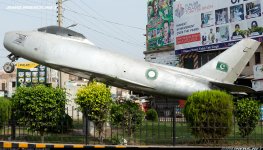
Aircraft
Pakistan - Air Force
North American F-86F Sabre
Reg.: 55-4029
MSN: 227-214
Location & Date
Toba Tek Singh [OFF AIRPORT]
Pakistan - August 12, 2023
Fatman17
Moderator
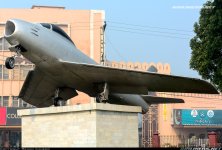
Aircraft
Pakistan - Air Force
Canadair CL-13 Sabre Mk.2
Reg.: 1670
Location & Date
Lahore [OFF AIRPORT]
Pakistan - 2020
Fatman17
Moderator
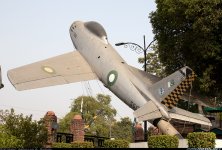
Aircraft
Pakistan - Air Force
Canadair CL-13B Sabre 6
Reg.: 55-1728
Location & Date
Lahore [OFF AIRPORT]
Pakistan - June 11, 2022
Fatman17
Moderator
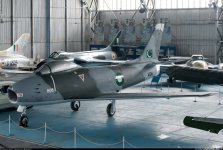
Aircraft
Pakistan - Air Force
Canadair CL-13B Sabre 6
Reg.: 1606
Location & Date
Delhi - Indira Gandhi International (Palam) (DEL / VIDP)
India - August 7, 2021
Caption
On display at IAF Museum Palam, this former PAF Sabre was presented by the Bangladesh Air Force to Air Chief Marshal RKS Bhadauria in 2021 to commemorate the 50th anniversary of the War of Liberation. PAF Sabres of 14 Sqn. were based at Tejgaon, which was struck around the clock by the IAF in Dec. 1971, rendering the airfield useless. The Sabre was inducted in the PAF in the mid-50s, opposed the IAF in 1965 and 1971 and was retired in 1980. This Sabre has red circles painted around damage done to it.
Fatman17
Moderator
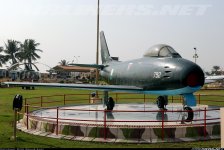
Aircraft
Pakistan - Air Force
Canadair CL-13B Sabre 6
Reg.: 1792
MSN: S6-1792
Location & Date
PAF Museum, Karachi.
Pakistan - January 19, 2021
Fatman17
Moderator
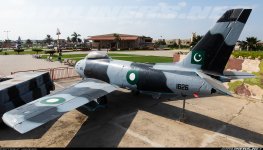
Aircraft
Pakistan - Air Force
Canadair CL-13B Sabre 6
Reg.: 1626
MSN: S6-1626
Location & Date
Karachi - Faisal AB (OPSF)
Pakistan - October 10, 2020
Fatman17
Moderator
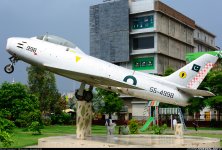
Aircraft
Pakistan - Air Force
North American F-86F Sabre
Reg.: 55-4998
MSN: 227-231
Location & Date
Faisalabad [OFF AIRPORT]
Pakistan - September 2020
Fatman17
Moderator
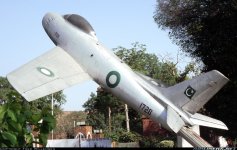
Aircraft
Pakistan - Air Force
Canadair CL-13B Sabre 6
Reg.: 1728
Location & Date
Lahore [OFF AIRPORT]
Pakistan - May 3, 2002
Users who are viewing this thread
Total: 1 (members: 0, guests: 1)
Pakistan Defence Latest
-
India sends 500 tonnes of hilsa to Bangladesh in reverse trade flow amid supply crunch (9 Viewers)
- Latest: SoulSpokesman
-

-

-

-

Country Watch Latest
-
 Iran - Israel/US War: Israel-US declare war on Iran, Iran responds (125 Viewers)
- Latest: Persian Gulf
-

-

-
-
Latest Posts
-
India sends 500 tonnes of hilsa to Bangladesh in reverse trade flow amid supply crunch (9 Viewers)
- Latest: SoulSpokesman
-
-
-
 Naqvi did not object to India’s refusal to collect Women’s Asia Cup trophy (23 Viewers)
- Latest: El Sidd
-
 Breaking News: Yemen's Houthis strike Saudi Arabia's Abha airport with missiles and drones in a sharp escalation (13 Viewers)
- Latest: Malik Abdullah