Fatman17
Moderator

RAF v PAF
Sabre rattling
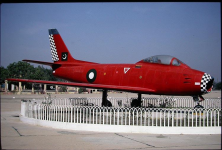
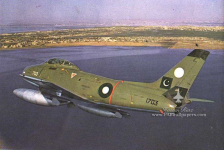
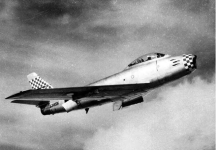
During the so-called ‘confrontation’ in the Far East, in the 1960s UK-based Lightning squadrons undertook DACT with a BBMF Spitfire Mk.XIX. It might have looked one-sided, but they were preparing for the possibility of facing Indonesian Mustangs; the Griffonengined Spitfire was as close as it got.As further proof of this method’s value, I recall a Hunter v Sabre encounter during a visit to Pakistan. The Pakistan Air Force (PAF) pilots were first class and, against my better judgement, we got into a fight on the Sabre’s terms, not the Hunter’s. The first event pitted four PAF Sabres against two RAF Hunters. The odds seemed slightly in favour of the home team, particularly when they told us that we would be running a CAP at 20,000ft over a given line and they would ‘bounce’ us from a radar-directed intercept, almost certainly with a height and speed advantage.
I briefed my No.2 that we would not play their game but would use the Hunter’s relative advantages, namely high Mach number performance. The Sabre could out-turn a Hunter but would be at considerable disadvantage in terms of climb ability. Therefore, while we were briefed to CAP at Mach 0.8 (advantage to the home side!) as soon as we had them on visual we would accelerate to 0.9 and maintain at least that speed and not below.
We’d been on CAP over a range of low hills about 20nm south of Peshawar for 45 minutes with absolutely nothing happening – where were they? It transpired that the PAF ground radar was not very sharp and the Sabres had spent 45 minutes rushing around on various headings without getting close to us. Eventually the PAF leader gave up and just headed for the line of hills. He, like us, was getting very frustrated and, also like us, was getting a bit tight on fuel. My No.2 spotted them about the same time they saw us; in our 6 o’clock high, range about three to four miles and closing. Great!


A series of images taken from a gunsight camera. The target is a Pakistan Air Force Shenyang J-6, the Chinese-built MiG-19


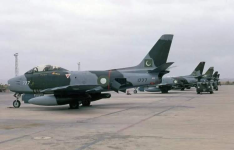
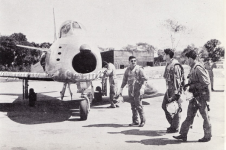
Peshawar, Pakistan – Hunter (left) and Sabre. Note that the Hunter’s 100-gallon drop tanks have replaced the inboard 230-gallon tanks for greater manoeuvrability
I knew our tactics would work, but that it would have resulted in a long, delicate dancing act before we’d gain an advantageous position. Nobody had the fuel for that kind of game. What the heck, we thought, we’re going to have a scrap before we call it off. “Hard inwards turnabout – go!” Within seconds we were mixing it with four Sabres and a turning fight was on – definitely not what was planned.
The Hunter turns quite well, especially with a notch or two of flap out, but these late model Canadair Sabres, as predicted, could more than match it, and they went round on the proverbial sixpence. Fairly quickly I ended up with one Sabre latched on my tail – there was no way I could shake him. What next, sit here and watch myself die, even if only on film? Not likely.
Sydney Camm endowed the Hunter with superb handling. This, plus the carefree handling of the Rolls-Royce Avon, meant there was a further trick to be tried – stopping! Although not in the same league as the Harrier, the Hunter could generate high rates of deceleration by slam-closing the throttle, airbrake out and full flap and pulling a hard turn right into deep and heavy airframe buffet. The aircraft remained fully controllable but lost speed at an incredible rate. My opponent could not see any of this as I was top side up to him in the hard turn. The Sabre suddenly, and unexpectedly, found himself closing at a high rate with insufficient time to get a tracking solution and too much speed to hold the turn. He flew through my flight path, astern, at fairly close range. At this stage we trust the Avon and open the throttle to full power, airbrake in, half flap, a boot full of top rudder and aileron, and nose high reverse the turn, hopefully into a barrel roll to drop behind the opponent… Well, not quite!
As I ‘reversed’, there was the Sabre, about 50 yards away, on a parallel heading, canopy to canopy and pulling hard towards me. I wasn’t about to chicken out and lose this hard-won equality, but neither was the Sabre prepared to ease off. Fortunately, he was going a bit faster than I was and he flew across my nose at very close range top side up and with his fin appearing about to slice through my nose. He missed, but not by much. I reckon that if I’d fired my guns ‘for real’, the rounds would not even have armed before they hit him, he was that close! As he dived out I followed him down and managed to get a few fleeting shots. As we got down to treetop level (somewhat lower than the agreed 7,000ft!) we all ran out of playing fuel and had to knock it off.
As in the PAF, in the RAF the minimum height for combat training is (or was, in my day) 7,000ft above ground level, probably set at that due to accidents, and to give a high degree of safety. Unfortunately, it does give a false sense of security and did not prepare anyone for what was likely to occur at low level. The SOAF trained for combat to ground level with no minimum height, but only over the airfield where there were some visual height cues compared to the open desert. It focused the attention on ensuring that, while fighting, you did not become a statistic by hitting the ground.
MiG versus Hunter
The fact that some aircraft have a significant speed advantage on paper does not necessarily convert into an advantage in combat. The maximum speed, particularly if it is a Mach number, will have been set at high altitude and with a ‘clean’ aircraft. Hang some pylons and external tanks on the aircraft and there will be a significant reduction in performance. Similarly, bring the aircraft down to low level, where indicated airspeed becomes the main limitation, and the assumed superiority may well have disappeared.Another potential limitation at the lower levels is fuel consumption, more so if the aircraft has afterburner.
During the detachment to Pakistan, I, along with Rog Wholey who is an outstanding combat pilot, had the opportunity to fight two PAF Shenyang J-6s, the Chinese-built MiG-19. On paper, the MiG-19 was clearly the higher performance aircraft having a marked speed advantage over the Hunter, but how would that translate in an actual combat situation?
We were at 40,000ft on the northbound leg of a north-south track about 40 miles north of Sargodha (the MiG operating base) when we saw them – contrails coming in from the 3 o’clock. We split vertically with Rog going low for speed and turning into them fairly hard, and with me going high and turning gently. It worked; they both followed Rog but could not turn with him. After less than one turn I was in position to drop on the back man and Rog was working into a good position on the leader. It obviously looked to the No.2 MiG that it was going to be a good sandwich, with him getting Rog before Rog got the MiG leader – wrong.
“On paper, the MiG-19 was clearly the higher performance aircraft”
I came down right into his 6 o’clock and closed to about 400 yards before the MiG pilot saw me and broke hard right – too late, I was in and staying. Rog latched on to the leader and stayed behind him for the rest of the fight. We were now two independent one v one combats being split beyond visual range and doing our own thing, but keeping track of events in the other fight by radio – all seemed to be going well.
Over the next few minutes, both fights worked their way down to deck level with little changed. The MiG could roll very rapidly, certainly in excess of the Hunter, but that is not of great advantage with someone camped right behind you. Despite having a theoretical speed advantage, this was not all that apparent. It probably would have been if the combat had stayed at high level, where the MiG-19’s supersonic capability might have told, but most of the time we were below 20,000ft and the aircraft seemed fairly evenly matched on speed. Despite everything my man threw at me – hard breaks, attempted forced fly-throughs into the previously described barrel roll, slowing down into a scissors (very low speed cross-overs trying to make the opponent fly ahead) – he could not shake me. Rog was having the same result. It was clear that at medium and low level the Hunter could match the MiG-19’s turning ability, and was much superior at low speed handling.

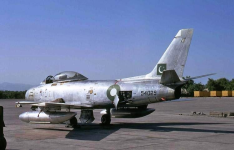
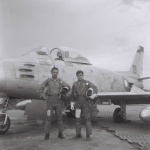
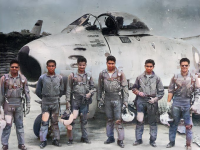
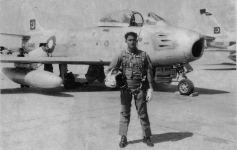
Rod sits in the cockpit of a Pakistan Air Force Sabre during air combat exercises from Peshawar
This could not go on for much longer. At full power, fuel was disappearing at 200lbs per minute and the MiG, with two engines and reheat, was probably worse off. After a couple of minutes at very low level, my man started running flat out on the deck on a southerly heading. Rog reported that his opponent was doing the same. They were obviously heading home; we followed.
Fuel was now getting a bit tight, but we were going to follow them back to Sargodha, even if meant we had to land there. I saw the airfield when we had about three miles to run and, at about the same time, the other MiG with Rog firmly glued to his tail appeared line abreast – there we were, a big box of two MiG-19s and two Hunters doing the best part of 600kts, on the deck heading right for Sargodha.
As the MiGs broke downwind over the base, Rog and I both got the ‘bingo’ lights – just 1,300lbs of fuel remaining and something like 130nm to go in the opposite direction. The 600kts was converted into a rapid climb via about the first 30% of a loop and a half-roll, and within a very short time we were back at 40,000ft and at range speed for the return to Peshawar. We landed with about 400lbs of fuel remaining in each aircraft – agood sortie that had lasted all of 45 minutes.