FDI, Foreign Reserves News

ghazi52

THINK TANK: CONSULTANT
Joined
Mar 21, 2007
Messages
159,805
Reaction score
209,071
Reputation
9,242.7
Country of Origin
Country of Residence

Integrating renewable energy into operations : Nepra grants approval to two of three RFPs submitted by KE

Recorder Report

ISLAMABAD: In a significant development, National Electric Power Regulatory Authority (NEPRA) has granted approval for two of the three Requests for Proposals (RFPs) submitted by K-Electric (KE) for the addition of renewable energy to its power generation fleet.

These approvals were part of KE’s strategic plan to integrate renewable energy into its operations aimed at contributing to a cleaner and more sustainable energy future. Under the approved RFPs, solar projects would be installed within KE’s territory, aligning closely with the power utility’s commitment to diversify its generation mix with renewable energy resources.

Moonis Alvi, CEO of KE, emphasized the importance of these approvals, saying, “As we strive towards the goal to incorporate at least 30% renewable into our fleet by 2030, the approval of these RFPs by NEPRA serves as a cornerstone of our ambitious plan. The impending commencement of the installation process signifies a tangible step forward in KE’s journey towards a greener energy ecosystem.”

“With the necessary regulatory approvals in place, KE is poised to initiate the implementation phase promptly, aiming at expediting the integration of renewable energy solutions into its system,” he said, adding that “this initiative underscores KE’s unwavering commitment to sustainability and environmental stewardship, while also contributing to the broader national agenda of transitioning towards clean energy resources.”

Alvi extended his gratitude to NEPRA, and all other stakeholders involved for their support and collaboration throughout the approval process.
 

Nestle announces additional $60m investment in Pakistan​

Finance minister terms move 'strong vote of confidence' in Pakistan’s economic reforms, formalisation drive

Web Desk
January 22, 2026

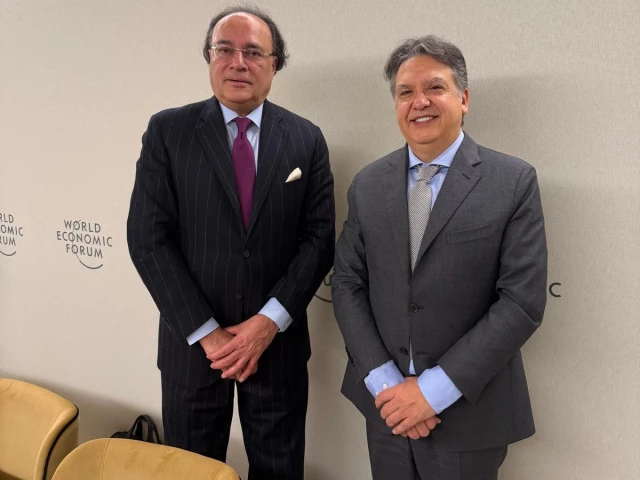
finance minister muhammad aurangzeb meets nestl executive vice president and chief executive officer for asia oceania and africa remy ejel on the sidelines of the world economic forum s annual meeting in davos switzerland on thursday ministry of finance x


Finance Minister Muhammad Aurangzeb meets Nestlé Executive Vice President and Chief Executive Officer for Asia, Oceania and Africa Remy Ejel on the sidelines of the World Economic Forum's annual meeting in Davos, Switzerland on Thursday. — MINISTRY OF FINANCE X

Nestlé has announced an additional $60 million investment in Pakistan in a move that signals renewed confidence in the country’s economic reform agenda, the finance ministry said on Thursday.

The finance ministry said in a post on X that the development came during a high-level business roundtable, held on the sidelines of the World Economic Forum annual meeting in Davos, that was chaired by Finance Minister Muhammad Aurangzeb and brought together chief executives and senior leaders of major multinational companies to discuss Pakistan’s investment climate, reform trajectory and long-term growth prospects.

It said a "major highlight" of the discussion was the announcement by Nestlé Executive Vice President and Chief Executive Officer for Asia, Oceania and Africa Remy Ejel of "an additional investment of $60 million in Pakistan".
 

China to invest up to $10bn in Pakistan with new agreements​


Deals include $1.5bn in joint ventures and $9bn MoUs across key sectors

Ehtesham Mufti
January 22, 2026


federal minister for investment and board of investment boi chairman qaiser ahmed sheikh photo file


Federal Minister for Investment and Board of Investment (BOI) Chairman Qaiser Ahmed Sheikh. PHOTO: FILE

KARACHI: China has signed new investment agreements worth billions of dollars with Pakistan and is set to invest up to $10 billion in the near future, Pakistan’s Federal Minister for Investment Qaiser Ahmed Sheikh said on Thursday.

In an exclusive interview, Sheikh said global attention was increasingly focused on Pakistan, with expectations of broad-based foreign investment in the coming years. He added that new joint venture agreements worth $1.5 billion have been finalised between the governments of Pakistan and China.

In addition, China has signed memorandums of understanding (MoUs) worth about $9 billion in Pakistan’s agriculture, automotive, and minerals sectors, signalling a renewed push for large-scale cooperation across key industries.

Sheikh said a major Pakistani trade delegation comprising around 300 business leaders recently visited China to attract further investment.
 
He added that the government plans to connect the Reko Diq mining project to Karachi via Chagai with a special railway track and a new highway to facilitate transport and trade. Around $7 million would be secured from international financial institutions for the development of this economic corridor.

Sheikh said the largest share of foreign direct investment in Pakistan is expected to flow into the agriculture and mining sectors.
 

Pakistan’s cost of doing business 34% higher than region: PBF​


Forum links export stagnation to high energy costs and currency instability

Our Correspondent
January 23, 2026


tribune


LAHORE: Pakistan's business community is facing a serious competitiveness crisis as the cost of doing business is 34% higher than in regional economies, severely undermining the ability of local industries to compete in international markets, Pakistan Business Forum (PBF) Chief Organiser Ahmad Jawad said on Thursday.

According to a statement, Jawad attributed the widening cost gap to irrational taxation, high electricity and gas tariffs, and persistent currency instability. He said Pakistani exporters have been unable to match regional competitors, resulting in stagnant exports since 2022.
 
Jawad stressed that Pakistan must immediately rationalise its taxation system, reduce industrial electricity and gas prices, and adopt a clear policy to strengthen and stabilise the rupee.

He reiterated PBF's position that the rupee should be stabilised at around Rs240 per US dollar, arguing that a stronger and more predictable exchange rate would help curb inflation, lower imported raw material costs, and bring certainty to export and import purchase orders.

Jawad said continuous devaluation has fuelled inflation, increased production costs, and eroded business confidence.

He said the rupee has depreciated by nearly Rs160 against the dollar over the past six years, reflecting weak economic management rather than market fundamentals. While the rupee is currently holding its ground, he argued that low foreign exchange reserves suggest the existing exchange rate remains excessively high.
 
To view this content we will need your consent to set third party cookies.
For more detailed information, see our cookies page.
 
To view this content we will need your consent to set third party cookies.
For more detailed information, see our cookies page.
 
To view this content we will need your consent to set third party cookies.
For more detailed information, see our cookies page.
 
To view this content we will need your consent to set third party cookies.
For more detailed information, see our cookies page.
 

First time in 23 months: foreign investors emerge as net buyers at PSX in July 2026

  • Foreigners inject net $34.4mn, mainly in banking and E&P sectors
August 1, 2026
Salman Siddiqui

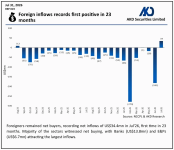
Foreign investors turned net buyers at the Pakistan Stock Exchange (PSX) for the first time in 23 months, pumping a net $34.4 million into equities in July 2026 despite the benchmark KSE-100 Index declining 2.3% during the month.

“Foreigners remained net buyers, recording net inflows of $34.4 million in July 2026, first time in 23 months,” AKD Securities Director Research Muhammad Awais Ashraf reported citing the data compiled by the National Clearing Company of Pakistan Limited (NCCPL).

  • Net buyers are investors whose total share purchases exceed their total share sales.
“Majority of the sectors witnessed net buying, with banks and oil and gas exploration and production (E&P) attracting the largest inflows of $13.8 million and $6.7 million, respectively [from foreign investors in July 2026] .”
 
AHL Research reported that foreign investors injected another net $1.7 million in fertiliser sector, and $1.2 million in oil marketing companies (OMCs) in the month. They made the highest net investment of $17.7 million in other sectors.

On the other hand, foreign investors pulled out net $3.6 million from technology stocks, $2.7 million from power stocks, and sold cement and textile stocks for net $0.2 million each in the month.

According to NCCPL data, foreign investors including overseas Pakistanis bought shares worth $322.3 million in the month and sold worth $287.9 million, emerging as net buyer of the stocks worth $34.4 million in July 2026 - the first month of the current fiscal year 2026-27 in Pakistan.
 
In the prior 22 months, foreign investors continued to remain net sellers of stocks in the range of $12 million to $279 million in each month.

AHL Research reported the KSE 100 Index shed 4,208 points, or dropped by 2.3%, in July 2026 to close at 176,094 points, “as geopolitical tensions kept investor confidence on edge throughout the month”.

Giving sector wise performance of KSE-100 Index, the research house said the sectors contributing positive points in the index included banks, refinery, synthetic, and tobacco.

On the other hand, the sectors that contributed negative points in the index included E&P, cement, fertiliser, and technology. The performance of auto assemblers, textiles and auto parts manufacturers remained muted in the month under review.

In July 2026, average trading volumes reached 845.1 million shares, up by 1% month-on-month. The average total traded value was $134.9 million, with a 5% month-on-month decrease in US dollar terms.
 

Users who are viewing this thread

Back
Top