The
FIFA World Cup 2026 introduces a completely overhauled knockout qualification system driven by the expansion from 32 to
48 participating nations. [
1,
2]
The Core Qualification Rules
Teams are divided into
12 groups of four. For the first time in tournament history, the knockout phase begins with a
Round of 32 rather than a Round of 16. To fill these 32 slots, teams qualify via two pathways: [
1,
2,
3]
- Top Two Finishers: The 1st and 2nd place teams from all 12 groups automatically advance (24 teams total).
- Eight Best Third-Placed Teams: The remaining 8 slots are awarded to the highest-performing 3rd-place teams across all 12 groups. [1, 2]
New Group Tiebreaker Rules
To determine group standings and rank the 12 third-placed teams against each other, FIFA has radically shifted its tiebreaker protocol: [
1]
- Head-to-Head Over Goal Difference: Goal difference—the historic primary tiebreaker—has been replaced by head-to-head results as the very first tiebreaker. If two teams finish level on points, whoever won their direct group matchup finishes higher. [1]
- The Mini-League: If three teams finish level on points, a mini-league is created isolating only the matches played between those specific teams. They are ranked by points won in those games, followed by head-to-head goal difference, and then head-to-head goals scored. [1]
- Global Group Criteria: If teams remain deadlocked, global group statistics are applied: total group goal difference, followed by total group goals scored. [1]
- Team Conduct Score (TCS): If still tied, a strict discipline metric is enforced. Teams lose points from a starting balance of zero based on cards received:
- Yellow card: -1 point
- Red card (via two yellows): -3 points
- Straight red card: -4 points
- Yellow followed by a straight red: -5 points [1, 2, 3, 4]
- FIFA Rankings: If a tie persists after all the above criteria, the team with the higher official June FIFA World Ranking advances. [1]
Tennis-Style Knockout Bracket Seeding [
1]
Once the 32 teams are locked in, they enter a
tennis-style seeded bracket designed to protect top-tier teams: [
1,
2]
- Seeded Paths: Group winners are assigned knockout paths partially influenced by their FIFA rankings to ensure the strongest teams are spread out evenly across the bracket. [1]
- Semifinal Protection: The structure is purposefully engineered so that the tournament's top four ranked teams (Spain, Argentina, France, and England) are placed in completely separate quadrants, meaning they cannot face each other until at least the Semifinals—provided they win their respective groups. [1, 2]
- Google AI






 ️
️

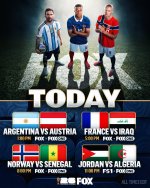
 The upcoming match in the World Cup will be Austria against Argentina.