Figure robots - Updates and Discussion

To view this content we will need your consent to set third party cookies.
For more detailed information, see our cookies page.

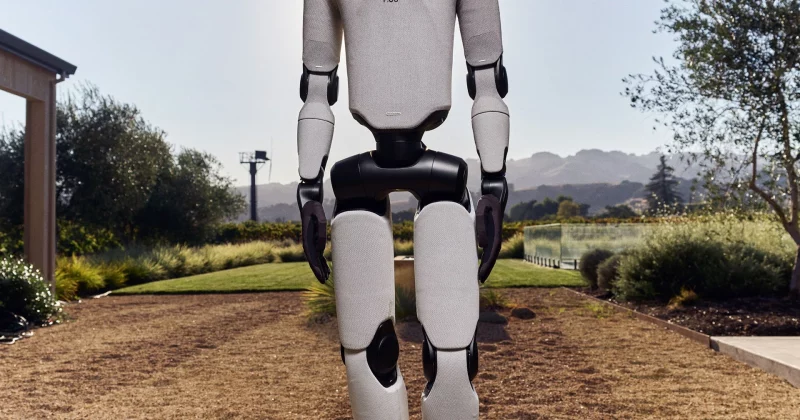
Figure 3

This looks like something straight out of I, Robot, especially with its natural and fluid movement.
 
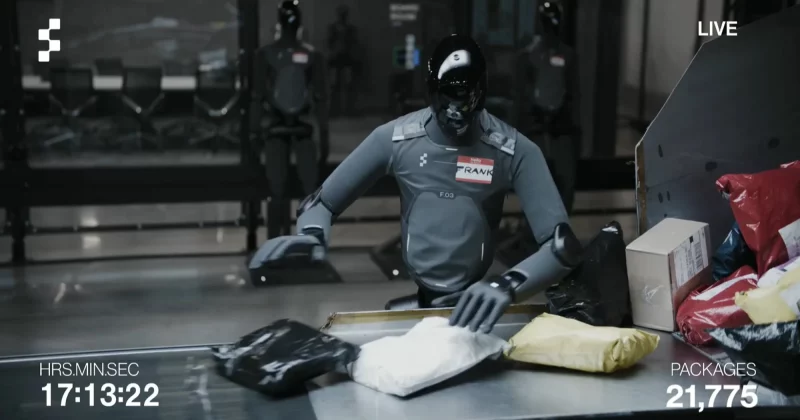
Hours of Figure robot sorting packages

To view this content we will need your consent to set third party cookies.
For more detailed information, see our cookies page.
 
Hours of Figure robot sorting packages

To view this content we will need your consent to set third party cookies.
For more detailed information, see our cookies page.


It seems three robots are taking turns.

LOL! at the 6:05:40 mark it is getting frustrated and freaking out! Doing a "hey why the $%^& am I here!!"

Definitely making more mistakes..might start raging soon!

Sorry our future robotic overlords..we didn’t mean it.
 
Last edited:
It seems three robots are taking turns.

LOL! at the 6:05:40 mark it is getting frustrated and freaking out! Doing a "hey why the $%^& am I here!!"

Definitely making more mistakes..might start raging soon!

Sorry our future robotic overlords..we didn’t mean it.

So they have multiple humanoid robots which seem to have different settings. The “Rose” robot is not working at as an insane speed as the others and because of it is making far less errors.
 

Silicon Valley's latest binge-watch is a humanoid warehouse worker​


Humanoid sorting packages

Viewers gave the three humanoids sorting packages names: Bob, Frank and Gary

  • Figure AI's humanoids drew over 3 million views on X as it sorted packages on a viral livestream.
  • CEO Brett Adcock said the robots worked autonomously with zero failures for 24 hours.
  • One robotics expert said the demo was impressive, but the humanoids are not deployment-ready.
Silicon Valley's hottest livestream this week is a humanoid robot clocking in for a warehouse shift.

It began Wednesday, when Figure AI CEO Brett Adcock set out to prove to skeptics that his robots could complete an eight-hour stretch of autonomous labor. Within hours, Figure AI had a film crew at its San Jose headquarters and was streaming a humanoid doing one of the dullest tasks imaginable: sorting packages.

The internet was captivated. Millions tuned in to watch the robot pick up small packages and place them on a conveyor belt with the barcode facing down. Two humanoids stood on chargers in the background, ready to sub in when the working robot ran low on battery. One viewer called the feed "surprisingly addicting" and asked for a 24/7 livestream, while investor Jason Calacanis wrote that "robotic ASMR is bizarrely comforting." As the livestream climbed past 1.5 million views on X over its first eight hours, some viewers gave the three robots names: Bob, Frank, and Gary.

Figure AI reached its goal of running the robot for eight hours with "zero failures," Adcock said, and decided to keep going. By the 24-hour mark on Thursday morning, the humanoids had sorted more than 30,000 packages, with more than 3 million cumulative views.

The viral stream is more than a robotics stunt. For Figure AI, a startup valued near $40 billion, it is a public audition for a future in which humanoids can work long shifts in warehouses, factories, and eventually homes. The demo gave investors and potential customers a rare look at whether the company's robots can perform repetitive labor reliably.

It also exposed the gap between spectacle and commercial readiness: Figure's humanoids may be getting closer to human speed, but experts say they still have a long way to go before they can handle the messy reality of a logistics center.

'A whole new economy'

Many tasks that feel mindless to humans remain challenging for robots, requiring dexterity, perception, balance, and judgment people barely notice themselves using. That is part of what makes videos of humanoids doing routine work so compelling.

Last week, Figure AI released a video of two of its humanoids making a bed together, while French startup Genesis AI, backed by former Google CEO Eric Schmidt, showed a robot cracking an egg and playing the piano.

Among the viewers of this week's livestream were Figure investors and board members Jesse Coors-Blankenship and Gregg Hill of Parkway Venture Capital, who said they were watching from their New York office and planned to celebrate the milestone later.

Coors-Blankenship said the conveyor belt was a large loop, with the same packages cycling through repeatedly. The point, he said, was to show potential customers that Figure AI's humanoids can work reliably for long stretches, including 24-hour shifts.

"It's just something that's never been done before, except for maybe in a movie," Coors-Blankenship said. "It's so captivating because everyone's realizing we're moving into a whole new economy."

The livestream raises the stakes in the race to develop commercially useful humanoids. Figure AI faces stiff competition from Tesla, Agility Robotics, and China's Unitree.

"I bet you that 50,000 of the viewers are Tesla investors," Hill said.

'More like a science project'​

When asked about Figure AI's livestream at an event in San Francisco on Wednesday night, Agility Robotics cofounder Jonathan Hurst replied: "Congratulations. We did that two years ago." The Oregon-based startup has deployed its humanoid robot, Digit, with customers including Amazon, Schaeffler Group, and GXO, a logistics company.

Last year, Figure AI came under scrutiny after Fortune reported that Adcock appeared to overstate the company's work with its marquee customer, BMW. Adcock disputed the report, and the company has said its previous humanoid model spent 11 months at BMW's Spartanburg plant, where it ran 10-hour weekday shifts and helped produce more than 30,000 X3 vehicles.

Figure CEO Brett Adcock is pictured.

Figure AI CEO Brett Adcock is betting on a future of "general-purpose humanoids." Bloomberg/Getty Images

Figure AI's livestream did not have any major glitches, but the robots did have some prolonged pauses and eccentric gestures like touching an arm to its helmet-like head. The moments fueled speculation that the humanoids were getting help from a remote human operator. Adcock stressed that the robots are fully autonomous and decide what to do based on what they see through their cameras.

Adcock said that when a robot gets stuck, its AI model triggers an automatic reset, which viewers occasionally saw during the stream. And if a robot has a software or hardware issue, he added, it can autonomously leave for maintenance while another robot takes over.

"We haven't had a failure yet, but statistically we probably will at some point," Adcock wrote on X.

Human package sorters average about three seconds per package, according to Adcock, and Figure AI's robots are now near human parity. But roboticist Ayanna Howard, dean of Ohio State University's College of Engineering, said speed is only one measure of readiness.

Howard said the livestream was impressive because the robot appeared to operate for so long without a failure. Still, she said the humanoids looked more like a "science project" than machines ready for deployment, citing accuracy issues she saw during the stream, including packages placed on the conveyor belt with the barcode facing the wrong way and one package being knocked off the belt.

"It's not ready for prime time," Howard said, adding that the robot was performing only one small part of the package-sorting process.

"We're a long way away from a fully autonomous humanoid in a logistics center."

By Thursday evening, the livestream was still running, and the humanoids had logged 30 hours of continuous work. Adcock also introduced a new member to the robot crew: Rose.

To view this content we will need your consent to set third party cookies.
For more detailed information, see our cookies page.
 

Figure AI’s humanoid robots sort 88,000 packages in 72 hours during nonstop livestream​


@Ali_Baba

Things are moving faster than I predicted and I work in the software engineering field!
 
Things are moving faster than I predicted and I work in the software engineering field!
Assuming the robot was not stopped during that 72 hour period, that equates to 1222 packages per hour.

We're using robotic induction arms in some of our sort facilities. 1200 was the baseline minimum during evaluations 2-1/2 years ago. Just prior to retirement, I recall the baseline was being upped to 1500 per hour.
 
Assuming the robot was not stopped during that 72 hour period, that equates to 1222 packages per hour.

We're using robotic induction arms in some of our sort facilities. 1200 was the baseline minimum during evaluations 2-1/2 years ago. Just prior to retirement, I recall the baseline was being upped to 1500 per hour.

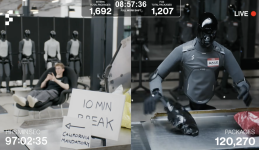
They are tag teaming when the robots battery runs low

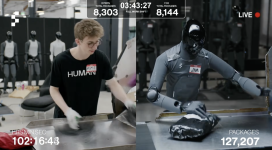
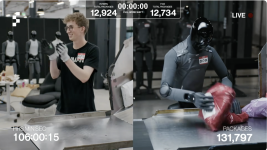
now it is man vs robot..with man slightly ahead
To view this content we will need your consent to set third party cookies.
For more detailed information, see our cookies page.
\
break.png
manvsrobot.png
 
Last edited:

Figure’s F.03 robot completes 200-hour logistics stress test, sorts 250,000 packages​


Figure AI’s F.03 humanoid robots just pulled off the kind of endurance test that would make an Amazon warehouse worker weep. Over the course of 200 continuous hours, three robots autonomously sorted nearly 250,000 packages without a single hardware failure.

The test was originally planned as an 8-hour demonstration. It ran for 25 times longer than that.

What actually happened​

The livestream kicked off around May 13-14, with Figure AI’s F.03 robots working in shifts at what amounted to a nonstop logistics gauntlet. Three robots, affectionately named Bob, Frank, and Gary by viewers, rotated autonomously through their duties. When one needed to charge, another stepped in. No human remote control required.

The robots were powered by Figure AI’s Helix-02 AI system, which handled package identification and placement. Processing speeds clocked in at roughly 2.6 to 2.83 seconds per package. That’s nearly on par with human workers performing the same task.

The company also staged a separate competition pitting one of its robots against a human intern in a ten-hour package-sorting face-off.

The company behind the robots​

Figure AI is currently valued at approximately $39 billion. The startup has been scaling aggressively, increasing production capacity by 24 times in recent months.

The company’s dedicated manufacturing facility, called BotQ, now produces one robot per hour.

What this means for investors​

The $39 billion valuation looks rich by traditional metrics. But if Figure AI can maintain this production trajectory of one robot per hour and continue demonstrating this level of reliability, the economics start to make more sense. Each robot that can perform the equivalent of multiple human shifts per day has a calculable return on investment for warehouse operators.

The processing speed of 2.6 to 2.83 seconds per package is also worth monitoring over time. Matching human speed is the baseline. Beating it consistently is what would make the economic case irresistible for warehouse operators weighing the cost of a robot against the cost of a human worker, benefits included.
 

BMW Group deploys Figure 03 humanoid after tests with previous version​


Figure 03 adds tactile-sensor hands, palm cameras, wireless charging, and speech-to-speech audio over its predecessor.
Figure 03 adds tactile-sensor hands, palm cameras, wireless charging, and speech-to-speech audio over its predecessor. | Source: BMW Group

BMW Group is doubling down on its deployment of Figure.AI’s humanoid robots. The automaker last week announced that, following its successful deployment with Figure 02 at its plant in Spartanburg, S.C., it will deploy the company’s latest Figure 03 robot.

“Plant Spartanburg is the birthplace of humanoid robotics in BMW Manufacturing’s operational day-to-day activities,” said Ulrich Wieland, vice president of production control and logistics at BMW Manufacturing. “Having already successfully completed a pilot with Figure 02 in our body shop, we are now looking forward to deploying Figure 03 for a sequencing use case in logistics.”

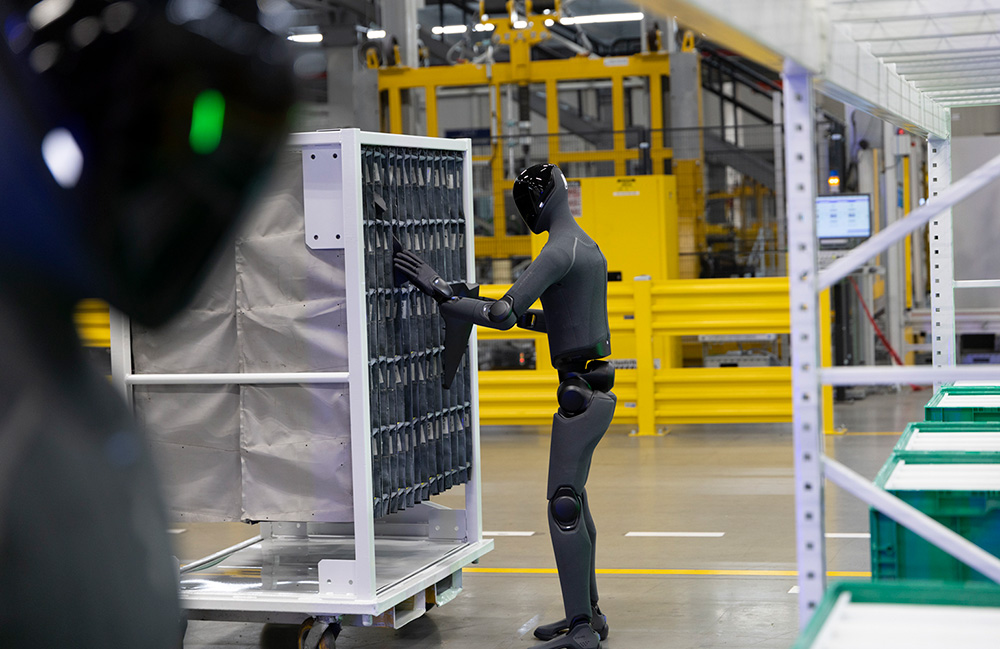
The BMW Group said it gained important experience with humanoid robots at Plant Spartanburg in 2025. Figure 02 supported the production of more than 30,000 BMW X3 vehicles. In the body shop, the robot inserted sheet-metal parts for the welding process, a task that demands high speed and accuracy and that can be physically demanding.

“Our 11-month deployment of Figure 02 proved that humanoids are no longer lab experiments — they can be a valuable asset in establishing a flexible, reliable manufacturing workforce,” stated Brett Adcock, founder and CEO of Figure AI. “We are excited to continue our work in Spartanburg as Figure tackles the complexity of the assembly and logistics hall.”

The findings gained from BMW’s first manufacturing deployment form the basis for its next steps with Figure 03.

“The robot introduces several new features for expanded applications. These include soft components designed for enhanced safety, wireless charging designed for higher availability, and audio functions for speech-to-speech communication, along with improved hands with tactile sensors and palm cameras designed to increase precision and dexterity,” said Adcock.

In the new sequencing use case, components will initially arrive in larger containers, unsorted. Figure 03 will pick them up and sort them into a sequencing trolley, according to the San Jose, Calif.-based company. The trolley will then be taken to a defined collection point for onward transport.

An automated tugger train or a smart transport robot will then transport the parts to the installation location, where they will be provided to assembly employees “just in sequence.” This use case occurs frequently in automotive production logistics and offers potential for further development and scalability, said the companies.

The use of humanoids is part of the BMW’s broader strategy to expand its automation portfolio with physical AI. The company said its potential lies particularly in monotonous, ergonomically demanding, or safety-critical activities.

BMS said its goal is to protect and effectively utilize employees while further improving workplaces.
 

Users who are viewing this thread

Pakistan Defence Latest

Back
Top