General Economic Updates

Pakistan’s defense and economy are deeply interconnected, and its ability to compete with India in a conventional war depends on economic strength and strategic financial planning. Without a robust economy, sustaining long-term military advancements becomes increasingly difficult.

To achieve this, Pakistan must prioritize economic development, reduce government overhead, and implement tax reforms that ensure major industries contribute fairly to national revenue. Expanding the tax net and incentivizing new industries—particularly in technology, manufacturing, and defense production—will be crucial in generating sustainable growth.

A stronger economy would allow Pakistan to increase its defense budget by an additional $3 billion annually, enabling investment in advanced military technology, indigenous defense production, and strategic deterrence capabilities. This would not only enhance Pakistan’s military readiness but also reduce reliance on foreign suppliers, fostering self-sufficiency in defense manufacturing.

However, a major obstacle remains—the current NFC Award, which allocates 57% of tax revenue to the provinces. While decentralization is important, Pakistan must reassess this distribution to ensure the federal government has sufficient resources to address national security and economic challenges. Without a balanced fiscal approach, the country will continue to struggle with financial instability.

Additionally, anti-corruption laws must be strengthened, with severe penalties for those found guilty to deter financial misconduct. Judicial reforms are also essential to speed up trial processes, ensuring swift justice and preventing prolonged legal battles that allow corruption to thrive.

Pakistan’s future depends on bold economic reforms, fiscal discipline, and a long-term vision that aligns economic prosperity with national security. Without these changes, the country risks continued foreign debt dependency, industrial decline, and diplomatic isolation. Stability depends on prioritizing national security, economic stability, and job creation, instead of political vendettas.
 

Pakistan’s IT FDI Collapse Amid Booming Tech Talent​


The net FDI figure in the IT sector over the last five years:
  • FY 2024-25 (July-April): USD 31.2 million
  • 2024: USD 39.4 million
  • 2023: USD 45.1 million
  • 2022: USD 146.4 million
  • 2021: USD 73.5 million
There is a lack of investor confidence in a sector that should have become second only to the textile sector. If this decline isn't reversed, you will have a stagnant industry.

Another factor is that many IT firms are choosing to incorporate outside of Pakistan.

@Fatman17 @Forsvaret @That_Guy
 
Last edited:
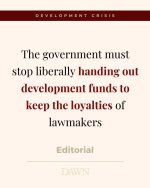
40% of the newly acquired funds won't be spent on development. Instead, a significant portion will go towards salary increases for government officials, MNAs, and MPAs. The remainder of the 40% will be link to corruption and undue benefits for associates.

Pakistan need a Lean government.
 
Higher living costs compel people to borrow.

ISLAMABAD: The prolonged combination of low economic growth and high inflation over the past few years in Pakistan appears to have taken a serious financial toll on large sections of the population, leading to increasing borrowing needs, according to the latest survey.

“In the last five years, increased living costs are the leading reason for borrowing in 2024, reported by 12pc of Pakistani adults”, said Karandaaz Pakistan — a government partner in digitisation and tax reforms — in its once-a-decade Financial Inclusion Survey (K-FIS).

Besides the living costs coming as financial shock and increasing borrowing needs, the survey completed with the financial support of the Gates Foundation and UK’s Foreign, Commonwealth and Development Office (FCDO) noted that 7pc adult Pakistanis were found to have been forced to borrow due to healthcare expenses and 6pc others for the loss of employment.

Other notable reasons include marriage expenses 3pc, and climate change-related needs like crop failure or agricultural loss 3pc, and property damage 2pc, while education expenses 1.5pc and earthquake-related losses 0.1pc were the least common reasons for borrowing.

“The need for loans due to rising living costs is widespread, affecting 12pc of Pakistani adults overall. The highest demand is among self-employed individuals (15pc), followed by blue-collar workers (14pc), housewives (14pc), and individuals who are not working due to a disability (12pc), indicating financial strain across diverse groups”, the survey findings said adding the urban residents (8pc) and white-collar workers (7pc) reported lower demand, while students (2pc) had the least need.

The need for loans due to unexpected medical expenses is reported by 7pc of Pakistani adults, with the highest demand among the unemployed with disabilities (16pc), followed by blue-collar workers (10pc) and unemployed individuals (10pc), indicating financial vulnerability in these groups. Rural residents (8pc) report a higher need than urban residents (6pc), while white-collar workers (3pc) and students (1pc) have the lowest loan demand for medical expenses.

The overall need for loans due to loss of employment or income remains low at 6pc across most demographics. Blue-collar workers (10pc) report the highest need in this financial shock as well, followed by the self-employed (7pc), unemployed (6pc) and housewives (6pc), indicating higher financial vulnerability in these groups. White-collar workers (4pc), retired individuals (2pc), and students (1pc) have the lowest loan demand due to income loss. Rural and urban residents report equal needs (6pc).

Published in Dawn, June 19th, 2025
 
Pakistan's facing significant challenges that impact its growth and development. Here are some key areas of concern:

1. Leadership and Governance: The country needs effective leadership that can drive meaningful change. There's a sense that the current system isn't delivering the kind of governance that benefits the nation as a whole.

2. Agricultural Sector: Agriculture is a vital part of Pakistan's economy. However, the sector's facing issues like rising costs and lack of investment, which affect farmers and the broader economy.

3. Brain Drain: Many Pakistanis, including skilled professionals, are leaving the country in search of better opportunities. Some are heading to countries like Turkey, Azerbaijan, Sweden, and Finland (2 years residency). This trend highlights the need for an environment that supports innovation and rewards talent.

4. Public Frustration: There's growing discontent among the public due to perceived inaction from those in power. People are looking for leadership that prioritizes the nation's needs over personal or institutional interests.

These issues underscore the importance of addressing the root causes of Pakistan's challenges to create a more stable and prosperous future.
 
LAHORE: Despite India’s heavy subsidies on exports, Pakistan’s rice shipments remained largely unaffected due to a strategy adopted by local exporters that prioritised agility and quality.

India recently re-entered the international rice market after a two-year hiatus imposed to ensure domestic food security. The lifting of export bans by New Delhi generated considerable excitement in Indian media, which predicted a significant economic blow to Pakistan’s rice exports, which had been performing robustly in the interim.


For the three months preceding India’s return (July to September 2024), Pakistan’s rice exports averaged a strong 550,000 tonnes per month. Indian officials, trade bodies, and think tanks anticipated that a surge in cheaper Indian rice would undercut Pakistan’s global market share.

However, Pakistani exporters countered with a swift, quality-centric strategy, avoiding a direct price war and instead focusing on premium offerings. According to sector expert Hamid Malik, this approach paid off as India’s re-entry failed to significantly disrupt Pakistan’s rice trade in the following six months (October 2024 to March 2025).

New Delhi’s cheap rice strategy faces WTO heat, market blowback
Pakistan retained its foothold in high-end markets such as the United Kingdom and European Union while also serving price-sensitive African destinations through a calibrated quality approach. Data from the Pakistan Bureau of Statistics shows rice exports for the first 11 months of FY25 stood at 5.544 million tonnes, compared to 5.593m tonnes a year earlier — a marginal decline of just 0.87pc.

Yet, a new challenge looms. A 3.7pc drop in rice output during Kharif 2024 has led to rapid depletion of stocks since April 2025. As a result, rice exports for the final quarter (April–June 2025) are projected to fall by around 15pc due to tight inventory.

Meanwhile, India continues to offer both Basmati and non-Basmati rice at what industry insiders describe as “throwaway” prices. At $349 per tonne (FOB), India is currently the cheapest exporter of 25pc broken non-Basmati rice — undercutting Thailand ($376), Vietnam ($362), and Pakistan ($365).

This aggressive pricing has raised eyebrows, given India’s government-set Minimum Support Price (MSP) for non-Basmati paddy stands at $265 per tonne. With a 66pc milling recovery, the ex-mill cost comes to $330 per tonne, and when factoring in transportation, port handling, packaging and wharfage — around $55 — the actual FOB cost is closer to $385. This discrepancy suggests deep, potentially WTO-incompatible subsidies.

In fact, the United States, Canada, Australia and New Zealand have lodged complaints with the World Trade Organisation (WTO), alleging that India’s export strategy violates the Doha Agreement by exceeding the allowed 10pc subsidy threshold.

Despite its subsidised push, India’s rice exports declined sharply in April and May 2025 — falling 50pc year-on-year. The downturn has drawn criticism from within India. Prominent voices such as rice historian and author Chandrasakhran, as well as exporters, have questioned the government’s policy, pointing to rice diversion for ethanol, swelling stocks at the Food Corporation of India (39m tonnes of rice and 19.5m tonnes of paddy), inefficiencies in the Public Distribution System, and the removal of the Minimum Export Price (MEP).

As global scrutiny of India’s subsidy-driven strategy intensifies, Pakistan’s exporters are cautiously monitoring developments — focused on safeguarding their gains through quality, adaptability, and disciplined market targeting.

Published in Dawn, June 24th, 2025
Follow Dawn Business on X, LinkedIn, Instagram and Facebook for insights on business, finance and tech from Pakistan and across the world.


Pakistan
https://www.facebook.com/sharer/sha...awn.com/news/1919523&display=popup&ref=plugin
 
26213601da382a5.jpg
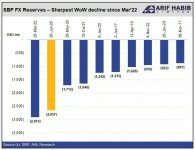
Foreign exchange reserves held by the State Bank of Pakistan (SBP) decreased by record $2.66 billion on a weekly basis, clocking in at $9.06 billion as of June 20, data released on Thursday showed.

This is the biggest weekly decline in SBP reserves in over 3 years. The central bank’s reserves had previously declined by $2.9 billion back in March 2022.
 
India’s attempt to disrupt Pakistan’s external trade by banning ships carrying Pakistani goods from anchoring at its ports has failed to yield the desired impact, according to shipping industry representatives.

On May 2, India imposed a ban on ships carrying goods originating from or destined for Pakistan, barring them from entering Indian ports or transiting through Indian territory. The move followed military aggression under ‘Operation Sindoor’ launched on May 7, which ended within four days due to Pakistan’s forceful retaliation.

Read more: https://www.dawn.com/news/1920880
 
ISLAMABAD: With the Fiscal Year 2024-25 coming to an end, it has come to light that the Federal Bureau of Revenue (FBR) missed its tax collection target of Rs12.97 trillion by Rs1.235 trillion, collecting only Rs11.735 trillion.

As per a report published in The News, the tax collection target was revised downward twice — first in February-March 2025, from Rs12.97tr to Rs12.332tr, and then during the 2025-26 budget, when it was further reduced to Rs11.9tr.
 
To view this content we will need your consent to set third party cookies.
For more detailed information, see our cookies page.


1751378295462.png
 

Users who are viewing this thread

Latest Posts

Back
Top