Navigation
Install the app
How to install the app on iOS
Follow along with the video below to see how to install our site as a web app on your home screen.
Note: This feature may not be available in some browsers.
More options
Style variation
You are using an out of date browser. It may not display this or other websites correctly.
You should upgrade or use an alternative browser.
You should upgrade or use an alternative browser.
General Economic Updates
- Thread starter Sainthood 2.0
- Start date
More options
Who Replied?
Waterboy
Registered Member


Best decision would be to ban the 5000 rs bill. Implementation of pos at ever shop and encouraging people to use sadapay type apps for transactions.The country is nearing bankruptcy. On the
other hand:
Prices of property is all time high. A 4
bedroom apartment in the new project in
Emaar is priced at between 16 to 20
crores....and all sold out.
Restaurant are full.
Petrol pumps have long queues.
Flights going full.
Dollar is at Rs 300 and still not available
in the market.
Event planners don't have dates. Shadi
halls are booked three months in
advance.
Fashion designers outlets are packed.
You just have to go to Dolmen mall and
witness the crowds.
Just a normal Country with a poor government but rich people.

India's higher PER CAPITA income is based on overpopulation? This is the dumbest thing I have heard in a very long time.It's why Indians are lower on the hunger index,, it's why you are behind in multiple indexes and why you never find the massive slums you have in India, in Pakistan
India is a communal dump of a place full of hatred
Your economic rise is built on being overpopulated whilst the majority of your population are slum dwellers
Now admittedly Pakistan has failed to take advantage of this and it's own politics and elite capture has ensured economic development is slow, but as a underdeveloped state it has enormous potential
It will always be in a position to have better conditions then a state like India
Do you understand the term PER CAPITA at all?

Chipotle
Registered Member
Pakistan's GDP is expected to grow by 2.1% in 2024 and 4.8% in 2025. That is not bad. Political stability should lead to bold economic policies.Silver lining is : IT can't get any worse. With political stability in 2024, Pakistan will most probably bounce back.

View from Dawn: The solution to Pakistan’s economic woes lie in trade with India
Pakistan seems to have shut itself off to importing both good ideas or cheap goods from its eastern neighbour.
 scroll.in
Pakistan seems to have shut itself off to importing both good ideas or cheap goods from its eastern neighbour.
Dawn.com
Jun 14, 2023 · 09:30 pm

The Pakistan Democratic Movement coalition may have failed to set a direction for the flailing economy in its rather unimaginative second budget, but trade and industry leaders have been quite clear about how they believe Pakistan can chart a way out of its present crisis.
They have been pointing out some common-sense measures that successive governments have failed to implement, which include steps like fixing the country’s justice system, improving education delivery, reforming the bureaucracy, enforcing contracts, rightsizing the bloated machinery of the state, and forcing it to divest from businesses that have become a burden on the public exchequer.
The right interventions in these areas, most experts agree, can help create more wealth for both the citizenry and the government. Unfortunately, as the past year has shown, the country’s managers have seemed clueless about where to begin despite finding themselves in the midst of a major crisis.
The chairman of one of the largest conglomerates in the country, in a recent interview to Dawn, pointed to India as a case study. New Delhi implemented tough reforms following its last International Monetary Fund programme some three decades ago, and is now reaping the rewards for its labours. He also echoed what many have been urging for a while now – that the revitalisation of trade with India, along with other regional economies, is a prerequisite to Pakistan’s long-term economic stability.
Unfortunately, Pakistan seems to have shut itself off to importing both good ideas or cheap goods from its eastern neighbour. Urging the government to reconsider, many have reasoned that when other countries with historical rivalries do not refuse to engage economically with each other, why should Pakistan and India? It is difficult to disagree.
Indeed, if one were to thoroughly account for the costs and benefits of Islamabad’s decision to suspend trade with India, the bottom line would reflect a net loss for our people. Perhaps it is time for our foreign policy pundits and decision-makers to reconsider their stance and decouple trade from geopolitical disputes.
From food to pharmaceuticals, Pakistan can import much from India and at far cheaper rates than from anywhere else in the world. Yet, we refuse to do so. With inflation crushing our citizens, the question “why” must be revisited.
The state can keep pursuing its principled differences with New Delhi even while the two countries trade. It did so, for most of the two countries’ history.
Meanwhile, goods that can be bought for cheaper than the options available in the market should be allowed in so that the inflationary pressure can be relieved. Trade and geopolitics should be treated as independent components of international policy. Politicking on the matter is selfish and does no service to our people. Both our state and our politicians need to agree on this.
This article was first published on Dawn.com.

I think it's across political spectrum. Wajahat Khan is extremely pro-IK. Yet, he clearly accepts that Pakistan desperately needs India, even though India doesn't need Pakistan at all.We would be seeing more of such articles since Nawaz Sharif is going to be imposed on Pakistan in coming elections

Fatman17
THINK TANK: CONSULTANT
I think it's across political spectrum. Wajahat Khan is extremely pro-IK. Yet, he clearly accepts that Pakistan desperately needs India, even though India doesn't need Pakistan at all.
Pakistan needs to trade with india but without preconditions. It can open a cheap land transit route to Afghanistan and the central Asian states. Unfortunately both countries cannot seem to shed the baggage of the past between them. Whether we desperately need india I'm not so sure.
I think it's across political spectrum. Wajahat Khan is extremely pro-IK. Yet, he clearly accepts that Pakistan desperately needs India, even though India doesn't need Pakistan at all.
WSK can be an idiot too at times

I don't think it was WSK talking.WSK can be an idiot too at times
He is the messenger. I think it was Imran Khan reaching out to India. IK has been reaching out to all foriegn nations in a hope to generate some support for self. This might be a desperate attempt as well.

hydrabadi_arab
Trusted Member
Trade with India didn't save Sri Lanka from bankruptcy. Its idiotic to think anyone can save Pakistan but its own establishment and political elite who enjoy state rent seeking.
India cannot control Pakistan currency printing machine hence cannot save it.
India cannot control Pakistan currency printing machine hence cannot save it.

MH.Yang
Trusted Member

Consider India's pitifully small export figures.View from Dawn: The solution to Pakistan’s economic woes lie in trade with India
Pakistan seems to have shut itself off to importing both good ideas or cheap goods from its eastern neighbour.Pakistan seems to have shut itself off to importing both good ideas or cheap goods from its eastern neighbour.
Dawn.com
Jun 14, 2023 · 09:30 pm
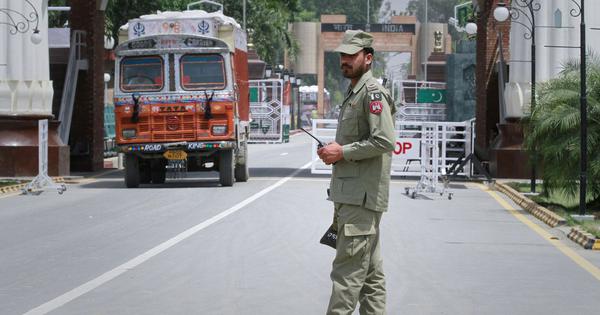
A paramilitary soldier stands guard as a truck carrying wheat crosses into Pakistan from India, at the Wagah border in April 2011. | Reuters
The Pakistan Democratic Movement coalition may have failed to set a direction for the flailing economy in its rather unimaginative second budget, but trade and industry leaders have been quite clear about how they believe Pakistan can chart a way out of its present crisis.
They have been pointing out some common-sense measures that successive governments have failed to implement, which include steps like fixing the country’s justice system, improving education delivery, reforming the bureaucracy, enforcing contracts, rightsizing the bloated machinery of the state, and forcing it to divest from businesses that have become a burden on the public exchequer.
The right interventions in these areas, most experts agree, can help create more wealth for both the citizenry and the government. Unfortunately, as the past year has shown, the country’s managers have seemed clueless about where to begin despite finding themselves in the midst of a major crisis.
The chairman of one of the largest conglomerates in the country, in a recent interview to Dawn, pointed to India as a case study. New Delhi implemented tough reforms following its last International Monetary Fund programme some three decades ago, and is now reaping the rewards for its labours. He also echoed what many have been urging for a while now – that the revitalisation of trade with India, along with other regional economies, is a prerequisite to Pakistan’s long-term economic stability.
Unfortunately, Pakistan seems to have shut itself off to importing both good ideas or cheap goods from its eastern neighbour. Urging the government to reconsider, many have reasoned that when other countries with historical rivalries do not refuse to engage economically with each other, why should Pakistan and India? It is difficult to disagree.
Indeed, if one were to thoroughly account for the costs and benefits of Islamabad’s decision to suspend trade with India, the bottom line would reflect a net loss for our people. Perhaps it is time for our foreign policy pundits and decision-makers to reconsider their stance and decouple trade from geopolitical disputes.
From food to pharmaceuticals, Pakistan can import much from India and at far cheaper rates than from anywhere else in the world. Yet, we refuse to do so. With inflation crushing our citizens, the question “why” must be revisited.
The state can keep pursuing its principled differences with New Delhi even while the two countries trade. It did so, for most of the two countries’ history.
Meanwhile, goods that can be bought for cheaper than the options available in the market should be allowed in so that the inflationary pressure can be relieved. Trade and geopolitics should be treated as independent components of international policy. Politicking on the matter is selfish and does no service to our people. Both our state and our politicians need to agree on this.
This article was first published on Dawn.com.
What goods are cheaper and of better quality in India than their Chinese counterparts? Oil from Russia?
HAIDER
THINK TANK: CONSULTANT
India need passage to Central asia, europe, middle east. Plus, to save the local small industry , we should not trade with India. Because in Nawaz era trade of balance was extremely in favor of India.
Its unfortunate we export raw material and import manufactured/furnished product at double the cost. Instead we setup manufacturing unit or encourage people to setup industry in Pak.
Its unfortunate we export raw material and import manufactured/furnished product at double the cost. Instead we setup manufacturing unit or encourage people to setup industry in Pak.
Last edited:
peagle
Trusted Member

View from Dawn: The solution to Pakistan’s economic woes lie in trade with India
Pakistan seems to have shut itself off to importing both good ideas or cheap goods from its eastern neighbour.Pakistan seems to have shut itself off to importing both good ideas or cheap goods from its eastern neighbour.
Dawn.com
Jun 14, 2023 · 09:30 pm
A paramilitary soldier stands guard as a truck carrying wheat crosses into Pakistan from India, at the Wagah border in April 2011. | Reuters
The Pakistan Democratic Movement coalition may have failed to set a direction for the flailing economy in its rather unimaginative second budget, but trade and industry leaders have been quite clear about how they believe Pakistan can chart a way out of its present crisis.
They have been pointing out some common-sense measures that successive governments have failed to implement, which include steps like fixing the country’s justice system, improving education delivery, reforming the bureaucracy, enforcing contracts, rightsizing the bloated machinery of the state, and forcing it to divest from businesses that have become a burden on the public exchequer.
The right interventions in these areas, most experts agree, can help create more wealth for both the citizenry and the government. Unfortunately, as the past year has shown, the country’s managers have seemed clueless about where to begin despite finding themselves in the midst of a major crisis.
The chairman of one of the largest conglomerates in the country, in a recent interview to Dawn, pointed to India as a case study. New Delhi implemented tough reforms following its last International Monetary Fund programme some three decades ago, and is now reaping the rewards for its labours. He also echoed what many have been urging for a while now – that the revitalisation of trade with India, along with other regional economies, is a prerequisite to Pakistan’s long-term economic stability.
Unfortunately, Pakistan seems to have shut itself off to importing both good ideas or cheap goods from its eastern neighbour. Urging the government to reconsider, many have reasoned that when other countries with historical rivalries do not refuse to engage economically with each other, why should Pakistan and India? It is difficult to disagree.
Indeed, if one were to thoroughly account for the costs and benefits of Islamabad’s decision to suspend trade with India, the bottom line would reflect a net loss for our people. Perhaps it is time for our foreign policy pundits and decision-makers to reconsider their stance and decouple trade from geopolitical disputes.
From food to pharmaceuticals, Pakistan can import much from India and at far cheaper rates than from anywhere else in the world. Yet, we refuse to do so. With inflation crushing our citizens, the question “why” must be revisited.
The state can keep pursuing its principled differences with New Delhi even while the two countries trade. It did so, for most of the two countries’ history.
Meanwhile, goods that can be bought for cheaper than the options available in the market should be allowed in so that the inflationary pressure can be relieved. Trade and geopolitics should be treated as independent components of international policy. Politicking on the matter is selfish and does no service to our people. Both our state and our politicians need to agree on this.
This article was first published on Dawn.com.
This is a viewpoint of ignorant individuals who can do nothing better then parrot each other, either because they have an agenda, or they're simply incapable to presenting coherent arguments.
Trade is always good, but trade does not happen in a vacuum, it exists with your other realities.
In the case of India and China, their trade is totally different, their markets are different, culturally they are different, so unable to exert undue direct influence in other others markets, and India does not have much of a choice, lot of what it imports from China, it can't really get from anywhere else.
There is a large size differential between Pakistan and India, and both our markets are pretty much the same, it will only result in the larger Indian market completely dominating the Pakistani market, especially with the constant political instability.
India needs this trade far more then Pakistan.
India has around a 12 billion dollar trade surplus with Bangladesh, it will likely have a similar if not larger surplus in any trade with Pakistan.
India is desperate to get access to central Asian states, plus Afghanistan, it can use this route for smuggling, for any number of other issues, including terrorism. Right now, it uses Afghanistan and Iran, it will have direct access to Pakistani territory whilst transporting goods and building a greater trade surplus with Central Asian states.
Whilst the statement that trade with India is good for Pakistan is true, that trade will benefit India far more then it benefits Pakistan.
Pakistan's woes are not due to lack of trade with India, Pakistan's woes are purely due to political instability, which has effected every other sphere of life in the country.
Political instability is the main problem, everything else is just people trying to sound clever.
Last edited:
peagle
Trusted Member
I think it's across political spectrum. Wajahat Khan is extremely pro-IK. Yet, he clearly accepts that Pakistan desperately needs India, even though India doesn't need Pakistan at all.
He is surrounded by Indians, which isn't necessarily bad, but it is if you allow it to colour your fair judgment, he has certain agendas of his own, he is just a fool trying to make a living with any clickbait content he can produce.
Users who are viewing this thread
Total: 6 (members: 0, guests: 6)
Pakistan Defence Latest
-
 PAF pilot highlights how chinese J10C fighters has edged US F16's (26 Viewers)
- Latest: NGAD IS THE BEST
-
 Federal cabinet gives nod to imposition of emergency in KP; summary sent to president (25 Viewers)
- Latest: gamaji
-

-

-

Country Watch Latest
-
 Iran - Israel/US War: Israel-US declare war on Iran, Iran responds (920 Viewers)
- Latest: Persian Gulf
-

-

-

-
Latest Posts
-
PAF pilot highlights how chinese J10C fighters has edged US F16's (26 Viewers)
- Latest: NGAD IS THE BEST
-
Makkah Defence Alliance: Turkey, Saudi Arabia, and Pakistan, news & updates (62 Viewers)
- Latest: HAIDER
-
Iran - Israel/US War: Israel-US declare war on Iran, Iran responds (920 Viewers)
- Latest: Persian Gulf
-
Federal cabinet gives nod to imposition of emergency in KP; summary sent to president (25 Viewers)
- Latest: gamaji
-
