Navigation
Install the app
How to install the app on iOS
Follow along with the video below to see how to install our site as a web app on your home screen.
Note: This feature may not be available in some browsers.
More options
Style variation
You are using an out of date browser. It may not display this or other websites correctly.
You should upgrade or use an alternative browser.
You should upgrade or use an alternative browser.
General Economic Updates
- Thread starter Sainthood 2.0
- Start date
More options
Who Replied?


hydrabadi_arab
Trusted Member
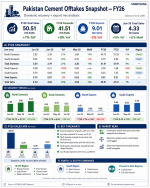
Cement dispatches rise 7.21% to 50.5 million tonnes in FY26
APCMA data shows domestic sales increased 9.5% to 41.507 million tonnes, while exports fell 2.19% to 9.008 million tonnesPakistan’s cement dispatches increased 7.21% to 50.515 million tonnes in FY2025-26, compared with 47.116 million tonnes in the previous fiscal year, according to data released by the All Pakistan Cement Manufacturers Association (APCMA).
Domestic sales rose 9.5% to 41.507 million tonnes from 37.906 million tonnes a year earlier, while exports declined 2.19% to 9.008 million tonnes from 9.21 million tonnes.
In June 2026, total cement dispatches increased 18.38% year-on-year to 4.331 million tonnes, compared with 3.658 million tonnes in June 2025.
Domestic sales during the month rose 26.78% to 3.541 million tonnes from 2.793 million tonnes. Exports fell 8.73% to 789,840 tonnes from 865,387 tonnes.
North-based mills dispatched 3.019 million tonnes in June, up 16.39% from 2.594 million tonnes a year earlier.
South-based mills dispatched 1.31 million tonnes during the month, up 23.23% from 1.065 million tonnes.
Domestic sales by North-based mills rose 26.53% to 3.019 million tonnes in June, while South-based mills sold 522,021 tonnes locally, up 28.24% from June 2025.
There were no exports from North-based mills in June. South-based mills exported 789,840 tonnes, up 20.12% from 657,527 tonnes a year earlier.
For the full fiscal year, North-based mills recorded domestic dispatches of 34.720 million tonnes, up 10.83% from 31.329 million tonnes in FY2024-25.
However, their exports fell 53.85% to 777,207 tonnes from 1.683 million tonnes. Overall dispatches from northern mills rose 7.53% to 35.498 million tonnes.
South-based mills posted domestic sales of 6.787 million tonnes in FY2025-26, up 3.18% from the previous fiscal year.
Their exports increased 9.36% to 8.230 million tonnes, while total dispatches rose 6.48% to 15.017 million tonnes.
An APCMA spokesperson said cement demand was expected to remain strong in domestic and international markets in the coming months.
The spokesperson said efforts to ease geopolitical tensions could help ensure stable and competitively priced energy supplies, as high fuel and energy costs continue to affect the sector.
hydrabadi_arab
Trusted Member
North here mean Punjab/KPK/GB/AJK. And south is Sindh/Balochistan. Looks like exports from north will be zero going forward with Afghanistan border closed. The south have great potential to increase exports further if Iran economy open up. In short term Iran

Pakistanithinktank
Registered Member
This is exactly why we need Economic Zone model in Pakistan to eliminate land mafia and corrupt system that is supporting them.
Owaiz
Registered Member

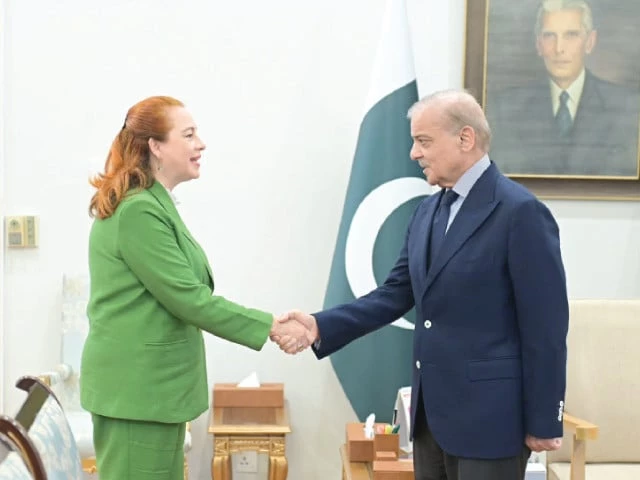
PM directs embassies to boost overseas jobs | The Express Tribune
PM directs embassies to boost overseas jobs
 tribune.com.pk
Looks like "brain gain" and remittance dependence is now formal government policy. Shameful admission that this patwari hukkumat will not maintain the pretence that it will try to create domestic jobs to retain the best people.

ACE OF HEARTS
Registered Member

ghazi52
THINK TANK: CONSULTANT
ADB keeps Pakistan's growth outlook unchanged at 3.7pc for current fiscal year
Khaleeq KianiJuly 9, 2026
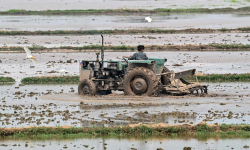
A farmer uses a tractor to plough a field on the outskirts of Lahore on July 8, 2026. — AFP
ISLAMABAD: The Asian Development Bank (ADB) on Thursday left its forecast for Pakistan’s economic growth unchanged at 3.7 per cent and projected inflation at 8.3pc for the current fiscal year, slightly higher than the government’s estimate.
In its Asian Development Outlook (ADO) July 2026, the Manila-based lender, however, lowered its growth forecast for developing Asia and the Pacific to 4.9pc for 2026 from 5.5pc in 2025, marking a 0.2-percentage-point reduction from its April projections.
SoulSpokesman
Trusted Member

Professor Riazul Haq sb on the need for Pak to improve its data quality

 www.riazhaq.com
Policy-makers need data to formulate good policies. Good data produced by government agencies can be expected to lead to good policies and desirable outcomes. But data collection and statistical analyses require adequate methodologies and resources. Unfortunately, Pakistan's data quality gets a "C" grade by international agencies like the International Monetary Fund (IMF). Clearly the country faces significant data quality challenges. These challenges range from estimation of the size and scope of the informal economy and electricity demand/consumption to education and nutrition. Here are some examples of where the Pakistan Bureau of Statistics (PBS) data differs sharply from what is being reported by non-government groups:
1. Gross Domestic Product:
A large chunk of Pakistan's economy is not documented. The PBS seems to be failing in making even the most rudimentary estimates of it. A 2024 joint study of the International Labor Organization and the Small and Medium Enterprise Development Authority (SMEDA) estimated Pakistan's undocumented economy at $457 billion. While other South Asian nations, particularly Bangladesh and India, do include estimated undocumented GDP figures in their official GDP, Pakistan's official GDP figures do not include such estimates. If the Pakistani government decides to include estimates of the informal economy in its official figures, the country's GDP would jump to $1,059 billion in market exchange terms and over $4,000 billion in PPP terms.
2. Electricity Consumption:
Electricity demand and consumption are very important indicators of socioeconomic development in any country. Unfortunately, the PBS is failing to comprehend the scale of solarization and energy consumption in Pakistan. The country is experiencing soaring demand for electricity across all of the sectors of its economy. The new demand is being met by rapidly growing deployment of distributed solar, estimated at 38 GW as of June, 2025. In 2025, 44% of solar deployment was residential, followed by industry (26%), agriculture (21%) and commercial users (9%). The expansion of distributed solar has enhanced electrification across the economy, lifting Pakistan's electrification rate to 21.7% in FY2025 from 17% in FY2023, close to the global average of 22%. This surge to over 200 terawatt-hours of electricity is not reflected in official data, according to a report by Ember Energy titled "The solarization of Pakistan's energy economy".
3. Out of School Children:
The Annual Status of Education Report (ASER) Pakistan 2025 national report, officially released on March 26, 2026, shows that the number of "Out of School Children" (OOSC) aged 6-16 years in Pakistan is now 5 million, not 25 million generally reported. "The findings on access are encouraging. Enrollment levels are high, with 92.2 percent of children aged 6–16 in school and only 7.7 percent out of school", says the ASER Pakistan 2025 report. ASER Pakistan is a citizen-led initiative, primarily led by Idara-e-Taleem-o-Aagahi (ITA) in collaboration with various national and international partners to promote foundational learning. It also works closely with over 10,000 volunteers and numerous local civil society organizations such as the Aga Khan Foundation (AKF), PAL Network (People's Action for Learning), UNESCO and federal and provincial government departments in Pakistan.
4. Pakistan Household Survey:
The HIES 2024-25 household integrated economic survey by Pakistan Bureau of Statistics (PBS) raises more questions than it answers. For example, it shows that Pakistani households are buying lower amounts of basic food ingredients like wheat, meat and eggs in the last four years, implying that people are eating less to cover other expenses, like electricity and gas. But it doesn't explain why the households have reported significantly lower purchases of these items than production reported recently by the PBS. What is the source of this discrepancy? Is the data flawed? Or, is it missing a new trend toward less home cooking? Is the young urbanized population buying more prepared foods? Are they ordering out more often using ubiquitous food delivery services?
Summary:
Clearly, the Pakistan Bureau of Statistics (PBS) faces significant data quality challenges in areas such as the size of the informal economy to electricity consumption, education and nutrition.
To keep up with the demands of modern governance, the PBS needs to carry out substantial reforms aimed at improving transparency, quality, and data credibility. The reliability of national indicators such as GDP, electricity consumption, education and nutrition is critical not only for local policy but also for global perception and investor confidence. It also requires additional funding for new technology, increased expertise in field offices and more enumerators in the field to collect data. The PBS's current annual budget of Rs. 5.1 billion (US$18 million) for a population of over 250 million people is not enough to do justice.
Regards
Pakistan Needs to Address Its Significant Data Quality Challenges
News, analysis and opinions about India, Pakistan, US, Canada, Europe, Mid East, South Asia, Silicon Valley, High Technology, Economy, Politics, World
Policy-makers need data to formulate good policies. Good data produced by government agencies can be expected to lead to good policies and desirable outcomes. But data collection and statistical analyses require adequate methodologies and resources. Unfortunately, Pakistan's data quality gets a "C" grade by international agencies like the International Monetary Fund (IMF). Clearly the country faces significant data quality challenges. These challenges range from estimation of the size and scope of the informal economy and electricity demand/consumption to education and nutrition. Here are some examples of where the Pakistan Bureau of Statistics (PBS) data differs sharply from what is being reported by non-government groups:
1. Gross Domestic Product:
A large chunk of Pakistan's economy is not documented. The PBS seems to be failing in making even the most rudimentary estimates of it. A 2024 joint study of the International Labor Organization and the Small and Medium Enterprise Development Authority (SMEDA) estimated Pakistan's undocumented economy at $457 billion. While other South Asian nations, particularly Bangladesh and India, do include estimated undocumented GDP figures in their official GDP, Pakistan's official GDP figures do not include such estimates. If the Pakistani government decides to include estimates of the informal economy in its official figures, the country's GDP would jump to $1,059 billion in market exchange terms and over $4,000 billion in PPP terms.
2. Electricity Consumption:
Electricity demand and consumption are very important indicators of socioeconomic development in any country. Unfortunately, the PBS is failing to comprehend the scale of solarization and energy consumption in Pakistan. The country is experiencing soaring demand for electricity across all of the sectors of its economy. The new demand is being met by rapidly growing deployment of distributed solar, estimated at 38 GW as of June, 2025. In 2025, 44% of solar deployment was residential, followed by industry (26%), agriculture (21%) and commercial users (9%). The expansion of distributed solar has enhanced electrification across the economy, lifting Pakistan's electrification rate to 21.7% in FY2025 from 17% in FY2023, close to the global average of 22%. This surge to over 200 terawatt-hours of electricity is not reflected in official data, according to a report by Ember Energy titled "The solarization of Pakistan's energy economy".
3. Out of School Children:
The Annual Status of Education Report (ASER) Pakistan 2025 national report, officially released on March 26, 2026, shows that the number of "Out of School Children" (OOSC) aged 6-16 years in Pakistan is now 5 million, not 25 million generally reported. "The findings on access are encouraging. Enrollment levels are high, with 92.2 percent of children aged 6–16 in school and only 7.7 percent out of school", says the ASER Pakistan 2025 report. ASER Pakistan is a citizen-led initiative, primarily led by Idara-e-Taleem-o-Aagahi (ITA) in collaboration with various national and international partners to promote foundational learning. It also works closely with over 10,000 volunteers and numerous local civil society organizations such as the Aga Khan Foundation (AKF), PAL Network (People's Action for Learning), UNESCO and federal and provincial government departments in Pakistan.
4. Pakistan Household Survey:
The HIES 2024-25 household integrated economic survey by Pakistan Bureau of Statistics (PBS) raises more questions than it answers. For example, it shows that Pakistani households are buying lower amounts of basic food ingredients like wheat, meat and eggs in the last four years, implying that people are eating less to cover other expenses, like electricity and gas. But it doesn't explain why the households have reported significantly lower purchases of these items than production reported recently by the PBS. What is the source of this discrepancy? Is the data flawed? Or, is it missing a new trend toward less home cooking? Is the young urbanized population buying more prepared foods? Are they ordering out more often using ubiquitous food delivery services?
Summary:
Clearly, the Pakistan Bureau of Statistics (PBS) faces significant data quality challenges in areas such as the size of the informal economy to electricity consumption, education and nutrition.
To keep up with the demands of modern governance, the PBS needs to carry out substantial reforms aimed at improving transparency, quality, and data credibility. The reliability of national indicators such as GDP, electricity consumption, education and nutrition is critical not only for local policy but also for global perception and investor confidence. It also requires additional funding for new technology, increased expertise in field offices and more enumerators in the field to collect data. The PBS's current annual budget of Rs. 5.1 billion (US$18 million) for a population of over 250 million people is not enough to do justice.
Regards


Pakistanithinktank
Registered Member
hydrabadi_arab
Trusted Member
EU Decides to Retain GSP+ Status! Efforts of Niazi sons and other anti-Pakistan elements failed.
hydrabadi_arab
Trusted Member
Fouji Foundation to launch another housing society. DHA Gandhara! On 4000 acres of land in Rawalpindi. Plot files available for 75 lakh 1 Kanal. The price will double soon after launch, buy now.
Owaiz
Registered Member

Gulf war triggers investment outflow from Pakistan
Bahrain withdraws $30m from bonds in first 10 days of FY27; SBP says no forex inflow during first 10 days of current fiscal year.
www.dawn.com
The situation is dire
Owaiz
Registered Member
GSP+ status was not in any danger. The risk will be in 2027, when Pakistan will have to reapply and compliance with conditions will be assessed.EU Decides to Retain GSP+ Status! Efforts of Niazi sons and other anti-Pakistan elements failed.
Users who are viewing this thread
Total: 1 (members: 0, guests: 1)
Pakistan Defence Latest


Country Watch Latest
-

-
 India Has Lost Air Superiority to Pakistan, No Jets Left to Fight (12 Viewers)
- Latest: Vikramaditya1
-
 Chinese Aircraft Carriers - Liaoning, Shandong, Fujian and the future (3 Viewers)
- Latest: Beijingwalker
-
-
