General Economic Updates

Pakistan's power generation rises 8.7% in October, fuel costs jump 24.9%​

Electricity generation increases 6.3% in July-October FY27 as coal and hydropower output rises, while reduced LNG supplies push up generation costs

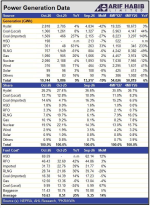
Pakistan's electricity generation increased 8.7% year-on-year to 10,744 gigawatt-hours (GWh) in October 2026, while generation costs rose 24.9% amid greater reliance on expensive fuels and reduced liquefied natural gas (LNG) supplies.

According to power sector data analysed by Arif Habib Limited (AHL), electricity generation grew 6.3% during July-October FY27, supported by lower tariffs, increased industrial consumption from the national grid and improved economic activity.

October generation was 3.4% above the seven-year average for the month, although it remained below the October 2021 peak of 11,296 GWh. Large-scale manufacturing recorded 1.9% year-on-year growth during the first two months of FY27.


Generation also exceeded the reference level determined by the National Electric Power Regulatory Authority (Nepra), potentially affecting upcoming quarterly tariff adjustments.

However, the average adjusted fuel cost reached Rs10.75 per kilowatt-hour against Nepra's reference of Rs7.87, prompting distribution companies to seek a positive fuel cost adjustment (FCA) of Rs2.88 per unit.

The increase was driven by higher international oil prices and greater use of furnace oil (FO) and high-speed diesel (HSD), which generated 351 GWh and 198 GWh, respectively, during October.

Meanwhile, LNG-based generation plunged 61.2% year-on-year to 757 GWh as imports declined. Pakistan State Oil received only two of the six long-term LNG cargoes originally scheduled for October, amid supply disruptions.


The fuel cost of re-gasified LNG (RLNG) generation consequently reached Rs28.74 per unit. Together, RLNG, HSD and furnace oil accounted for 45.4% of the unadjusted average fuel cost of Rs10.63 per unit.

Coal-based generation, meanwhile, surged 69.6% to 2,929 GWh, the highest recorded for any October.

Imported coal generation jumped 237% to 1,569 GWh, while electricity produced from local coal increased 7.9% to 1,360 GWh. The report also stated that imported coal accounted for 27.3% of total coal-based generation.

Hydropower output rose 4.2% to 2,818 GWh, broadly matching its long-term October average, supported by improved water availability.


Higher furnace oil utilisation could benefit independent power producers, including Nishat Power Limited, Nishat Chunian Power Limited and NPL, through improved capacity utilisation under hybrid take-or-pay arrangements.

The recovery in electricity demand follows a Rs4 per unit reduction in industrial tariffs, targeted incentives for industrial and agricultural consumers, and increased levies on captive gas consumption, which supported generation between December 2025 and March 2026.

Despite weaker demand during the fourth quarter of FY26, electricity generation recovered in the opening four months of FY27.

Nepra has projected electricity demand growth of 1% for calendar year 2026 and 2.6% under its base-case forecast for 2027.
1795077860565.png
 

Federal Constitutional Court strikes down infrastructure cess imposed by Sindh, KP​

Court overturns high court rulings in 568 petitions, declaring provincial levies on goods linked to imports, exports and inter-provincial trade beyond constitutional authority


ISLAMABAD: A two-member bench, comprising Chief Justice Aminuddin Khan and Justice Aamer Farooq, of the Federal Constitutional Court (FCC) on Thursday declared infrastructure cess imposed by the Sindh and Khyber Pakhtunkhwa governments unconstitutional, overturning earlier high court judgments that had upheld the provincial levies.

The FCC bench issued the ruling after hearing 568 petitions challenging the Sindh Development and Maintenance of Infrastructure Cess Act, 2017, and the Khyber Pakhtunkhwa Infrastructure Development Cess Act, 2022, including amendments introduced in 2024.

The court ruled that the provinces had exceeded their legislative authority by imposing levies on goods and transactions falling within the federal government's exclusive constitutional jurisdiction.


The Sindh legislation imposed a cess on goods entering or leaving the province through international air and sea routes. The Sindh High Court had upheld the levy on June 4, 2021, following a dispute dating back to 1994.

In KP, the infrastructure cess applied to the transportation and movement of goods within the province. An amendment through the KP Finance Act, 2024, increased the rate from 1% to 2%.

The Peshawar High Court had dismissed 157 petitions challenging the KP levy on November 14, 2025, declaring it legally valid.

During proceedings before the FCC, petitioners argued that the provincial governments could not impose taxes on imports, exports or inter-provincial trade, as these matters fell within Parliament's exclusive legislative jurisdiction.


Representing the Revenue Division secretary and the Federal Board of Revenue (FBR), senior counsel Hafiz Ehsaan Ahmad Khokhar argued that Articles 141 and 142(a) of the Constitution, read with Entries 27, 43 and 59 of the Federal Legislative List, reserved taxation and regulation of customs-related transactions for the federation.

He maintained that the constitutional validity of a levy depended on its actual operation and taxable event rather than its designation as an infrastructure cess.

According to the federation's position, provincial taxes collected through customs-clearance arrangements or imposed on imported and exported goods effectively encroached upon federal taxation powers.

The counsel also argued that Article 163, which allows provinces to tax professions, trades and employments, did not authorise them to impose levies on subjects reserved for Parliament.


The Sindh and KP governments defended their legislation, maintaining that the cesses were intended to finance infrastructure development and road facilities rather than function as customs or export duties.

They argued that Article 142(c) empowered provincial assemblies to legislate on matters outside the Federal Legislative List.

The additional attorney general supported the federation's position, arguing that the disputed levies fell within areas of exclusive federal legislative competence.

After considering the arguments, the FCC set aside the judgements of both the Sindh High Court and Peshawar High Court, declaring the challenged provincial legislation beyond the constitutional authority of the respective assemblies.
 

Federal Constitutional Court strikes down infrastructure cess imposed by Sindh, KP​

Court overturns high court rulings in 568 petitions, declaring provincial levies on goods linked to imports, exports and inter-provincial trade beyond constitutional authority
ISLAMABAD: A two-member bench, comprising Chief Justice Aminuddin Khan and Justice Aamer Farooq, of the Federal Constitutional Court (FCC) on Thursday declared infrastructure cess imposed by the Sindh and Khyber Pakhtunkhwa governments unconstitutional, overturning earlier high court judgments that had upheld the provincial levies.

The new Fed. Const. Court may occasionally exceed its authority but that would probably still pale in comparison to the 15-10 year abuse of the 'suo moto' actions by the various Supreme Court Chief Justices. There is still no accounting for the catastrophic losses to Pakistan's economy by the likes of the Chief Justice Iftikhar Chaudry: A corrupt, or at least loose cannon who did so much harm to Pakistan while supported by the likes of Imran Khan and Nawaz Sharif and many others with the sole objective to remove President Musharraf from power. That Iftikhar should apologize to the Pakistani nation as should the opportunist politicians.
Pakistan's downfall started with the 'Judges Movement' of 2007.
 

Users who are viewing this thread

Back
Top