Navigation
Install the app
How to install the app on iOS
Follow along with the video below to see how to install our site as a web app on your home screen.
Note: This feature may not be available in some browsers.
More options
Style variation
You are using an out of date browser. It may not display this or other websites correctly.
You should upgrade or use an alternative browser.
You should upgrade or use an alternative browser.
H-1B visas must end’: Wife of US citizen shares plight of landing IT jobs
- Thread starter SoulSpokesman
- Start date
More options
Who Replied?

Yasser76
Elite Member


Few Indian forum members will be changing lower flag soon....
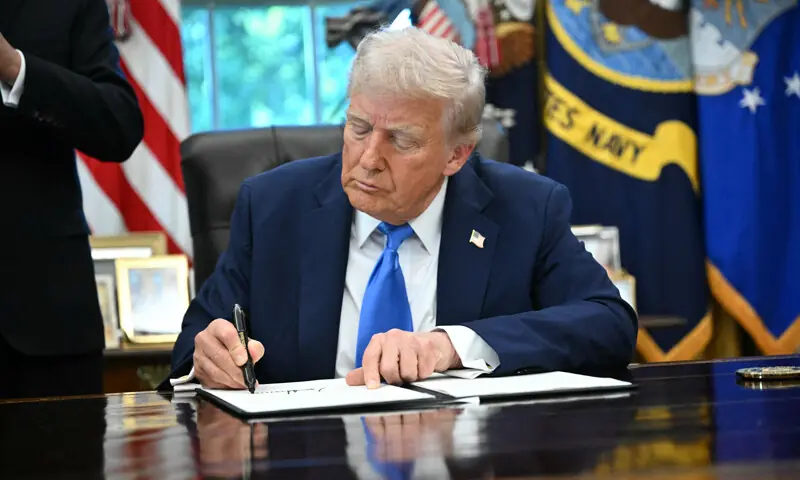
Trump’s $100,000 fee for H-1B visas, a tech industry favourite, concerns India
New fee is a one-time payment only imposed on new applicants, White House clarifies; India says visa fee hike could disrupt families.
www.dawn.com

Vkdindian1
Registered Member
US President Donald Trump signed an executive order on Friday that requires companies to pay $100,000 annually, for every foreign worker brought under the H-1B visa, up from about $1,000 at present – a 9,900% increase This could increase the visa fees to about 10% of the profits of India’s five largest recipients of H-1B visas, and prove the death knell for the country’s $283-billion IT services industry.
Tata Consultancy Services Ltd sponsored 5,364 H-1B Visas in 2025, while Cognizant Technology Solutions Corp sponsored 2,493 and Infosys 2,004, according to US Citizenship and Immigration Services data. LTI Mindtree Ltd sponsored 1,807 such visas and HCL Technologies sponsored 1,728.
A tough situation for many companies.
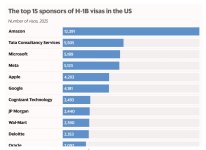
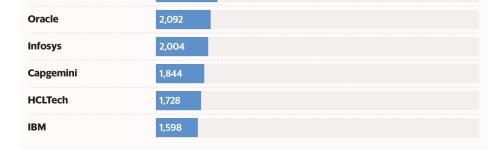
Tata Consultancy Services Ltd sponsored 5,364 H-1B Visas in 2025, while Cognizant Technology Solutions Corp sponsored 2,493 and Infosys 2,004, according to US Citizenship and Immigration Services data. LTI Mindtree Ltd sponsored 1,807 such visas and HCL Technologies sponsored 1,728.
A tough situation for many companies.


SoulSpokesman
Trusted Member
- Thread starter
- #666
@Vkdindian1
This could increase the visa fees to about 10% of the profits of India’s five largest recipients of H-1B visas, and prove the death knell for the country’s $283-billion IT services industry.
Why would a mere 10% of the annual profits destroy the industry. They make pretty good money and even at 90% current level, they will still do good. They will of course look at other steps like shifting jobs back to India, creating delivery centres in Canada, Mexico etc - use more of L1s.
Regards
This could increase the visa fees to about 10% of the profits of India’s five largest recipients of H-1B visas, and prove the death knell for the country’s $283-billion IT services industry.
Why would a mere 10% of the annual profits destroy the industry. They make pretty good money and even at 90% current level, they will still do good. They will of course look at other steps like shifting jobs back to India, creating delivery centres in Canada, Mexico etc - use more of L1s.
Regards
SoulSpokesman
Trusted Member
- Thread starter
- #667
Top Indian information technology (IT) services companies are increasingly reducing their reliance on H-1B visas, even as US President Donald Trump raised the visa fee to $100,000 on September 20.
Tata Consultancy Services (TCS), Infosys, HCLTech, Wipro, and Tech Mahindra now have between 20 percent and less than 50 percent dependency on H-1B visas to deploy workforce in North America.
H-1B visas allow US firms to hire foreign workers in specialty fields such as STEM and IT.
Moreover, approved H-1B petitions for the top seven Indian IT firms dropped 56 percent between FY15 and FY23 to 6,700. Companies such as Infosys and TCS now employ over 50 percent local staff in the US, reducing visa reliance.
Large firms have pivoted to local hiring, US delivery
Reducing reliance on visas
TCS, which earns nearly half its revenue from North America, hires more than 50 percent of its US workforce locally. Chief Executive Officer K Krithivasan told Moneycontrol earlier in January that in any given year, India’s largest IT services company gets about 3,000 to 4,000 H-1B visas. “It's a small number in the overall scheme. If there’s a decrease in H-1B availability, we can compensate or move work to India.
centres, subcontracting, and offshore delivery.
TCS' nearest rival, Infosys, has similarly cut dependence on H-1B visas, with over 60 percent of its US workforce now local. CFO Jayesh Sanghrajka said their on-site H-1B mix has dropped from roughly 30 percent to 24 percent in FY25.
HCLTech and Wipro have the lowest reliance at 20 percent, with nearly 80 percent of their US teams hired locally. HCLTech’s Chief People Officer Ramachandran Sundararajan said, “The number of H-1Bs we go through annually ranges between 500 and 1,000 at most.”
Wipro CEO Srinivas Pallia, earlier in January, said that the company has a strong H-1B inventory and is positioned to meet US demand if required.
Tech Mahindra also maintains low dependency, with only 30 percent of its US workforce on H-1B visas. CEO Mohit Joshi, in January, highlighted that the company has built large local teams and near-shore delivery centers, keeping overall visa reliance below 30 percent.
Visa demand remains strong
Despite this reduced dependency, H-1B visa applications continue to rise.
USCIS data shows that 2024 saw a 3.1 percent increase in applications, a 4 percent increase in approvals, and a 32.5 percent drop in denials compared to 2023. The approval rate hit 98.4 percent, the highest since 2021, according to staffing firm Xpheno’s co-founder Kamal Karanth.
Krishna Vij, business head-IT staffing at TeamLease Digital, attributed the demand to global digital transformation, AI, cloud computing, cybersecurity, and ongoing US STEM skill gaps.
Bigger hit for US Big Tech
Ironically, the H-1B programme’s biggest users today are not Indian outsourcing firms but American tech majors. In FY24, the top five US firms together secured nearly 28,000 approvals, with one e-commerce giant alone topping the list at 10,000 approvals in FY2025.
These firms use H-1Bs largely for specialised, high-paying roles such as AI engineers and data scientists, reflecting persistent talent shortages in the US.
Pareek Jain of EIIRTrend believes that the $100,000 H-1B fee will cause short-term disruption and margin pressure for Indian IT. While alternatives like local hiring and subcontracting still rely on H-1Bs, the medium-term outlook points to stabilisation through offshoring, nearshoring, GCCs, and AI adoption. “Agile companies are expected to fare better,” Jain wrote on X.
Regards
SoulSpokesman
Trusted Member
- Thread starter
- #668
M2C on the above:
I am shocked to read that Indian IT companies have large delivery centres in US and that almost 50% of the staff are locals. The Indian govt must encourage these companies to shift the centres to India.
Hopefully, the US tech companies will shift more jobs to India as well.
Regards
I am shocked to read that Indian IT companies have large delivery centres in US and that almost 50% of the staff are locals. The Indian govt must encourage these companies to shift the centres to India.
Hopefully, the US tech companies will shift more jobs to India as well.
Regards
Vkdindian1
Registered Member
That figure was for top 5 Indian companies. Total numbers are likely to be more.@Vkdindian1
This could increase the visa fees to about 10% of the profits of India’s five largest recipients of H-1B visas, and prove the death knell for the country’s $283-billion IT services industry.
Why would a mere 10% of the annual profits destroy the industry. They make pretty good money and even at 90% current level, they will still do good. They will of course look at other steps like shifting jobs back to India, creating delivery centres in Canada, Mexico etc - use more of L1s.
Regards
Excerpts from an article on Mint-
“TCS ended FY25 with $5.74 billion in profit, while Cognizant’s Infosys’s net income totaled $3.16 billion and $2.24 billion. Cognizant follows a January-December financial year. LTI Mindtree and HCL Technologies’ net income totaled $520 million and $2.04 billion. The revised H-1B visa fee would amount to about 10% of these five companies’ $13.7 billion of profits.
“The H-1B is definitely finished if these fees materialise,” Siddharth Pai, co-founder of Siana Capital, a venture fund manager in Bengaluru. “All companies that use this visa class will have to readjust around it, including changing business models to the extent needed. So yes, all industries using this visa class will change.”
A spokesperson for Cognizant said, “We are reviewing the President's proclamation to evaluate the potential implications. At this point, we do not have the details to respond accurately. Cognizant has established a resilient business model that creates flexibility to hire the best candidates for open roles, including robust local recruiting and hiring infrastructure.
Indian IT services players' dependence on H-1B visas has fallen substantially over the years. In fact, US firms are now the biggest sponsors of H-1B,” said Abhishek Kumar, IT Research Analyst, JM Financial Institutional Securities Ltd. American companies including Amazon, Microsoft, Meta, Apple, and Google were the largest recipients of H-1B visas in 2025. “In the current cost-constrained demand environment, it might be difficult to pass on the higher cost to clients. That could lead to some impact on margins,” Kumar added.“
A total of approximately 600,000 workers are on H1B. Imagine the total cost involved if 100,000 USD are paid for all of these. I doubt that companies would pay this kind of money to retain these workers.
Vkdindian1
Registered Member
Exact impact wouldn’t be known immediately. But, imagine the impact on 600,000 individuals who may be uprooted by this move. I assume 400,000 Indians (71% are Indians as per USCIS) are likely to be impacted by this move.M2C on the above:
I am shocked to read that Indian IT companies have large delivery centres in US and that almost 50% of the staff are locals. The Indian govt must encourage these companies to shift the centres to India.
Hopefully, the US tech companies will shift more jobs to India as well.
Regards
SoulSpokesman
Trusted Member
- Thread starter
- #671
@Vkdindian1
Let's hope these Indians come back home with their financial capital and skills. And either get employed by their employers who shift jobs as well; or they set up their own thingy.
Regards
Let's hope these Indians come back home with their financial capital and skills. And either get employed by their employers who shift jobs as well; or they set up their own thingy.
Regards
r3alist
Elite Member
Don't be like that, you have me wrong.Well party time for my brother's @Dalit @r3alist @Master Chief and of course for you, Hydra bro! Regards
BrigSmart
Registered Member
If the politicians can get a law through Congress, that is fine, but it is a huge overreach for the President to try and dismantle it on his own. In his first term, the entry ban from Muslim countries was thrown out. This is more egregious, so I don't think it will stand. The proper way to handle this, if the administration is serious , is to amend the law and put in these conditions. Trump is doing this mostly for theatrics and to convince current and future H1Bs on the fence to leave on their own. I will be very surprised if this EO does not get stayed almost immediately when the courts open next week.People already in US aren’t affected right away, but, would be affected at a later date, not to too far from now. The companies would have to sit down and make a plan right way and that is likely to be against these workers. Since, they can’t keep juggling with this uncertainty of an employee not available because of this policy. What about an employee who needs to go back to his native country to attend to any emergency?
Thuggery it is but supported by many politicians. Even courts have sensed the wind direction lately and may not come to the rescue this time.
All in all, H1B seems to be at the end of its life.
r3alist
Elite Member
The thing is, the last year or so this was more of an insistence rather than an agreed fact@A1Kaid
On top of that the senior Gulf officials talking about ending Indian labor (Israeli espionage risk and incompatible culture) and finding alternatives.
There are no viable alternatives. Indian labour is cheap, skilled and not prone to violence or terror. Some of the alternatives to Indian labour would be the reverse.
Regards
trump is now testing the above proposition
What skills will America lose


Users who are viewing this thread
Total: 1 (members: 0, guests: 1)
Pakistan Defence Latest


Country Watch Latest

Latest Posts
-
-

-

-
India successfully tests free-space Quantum Key Distribution over 5.56 km (14 Viewers)
- Latest: indo17787
-