Beijingwalker
Banned

- Thread starter
- #16
Silicon Valley undergoes a major reshuffle: from small-town exam whizzes to top AI researchers, why do Chinese people dominate AGI?
2025-09-04 19:43In the past two decades, the Internet in Silicon Valley has belonged to the Indians. With their diligence, high efficiency, and strong execution ability, they have built the software empire of the Internet era in Silicon Valley.
However, with the rise of generative AI, the talent landscape in Silicon Valley is undergoing a systematic shift. Undoubtedly, the Chinese are becoming the most important source of talent in the AGI field.
Let's take a look at the high "Chinese quotient" in Silicon Valley:
Among the initial 11 - member team of Meta's Super Intelligence Lab, 7 are of Chinese descent; among the first 12 members of xAI, 5 are Chinese, accounting for more than 40%; when Elon Musk released Grok 4, the two core figures sitting beside him were also Chinese; as for OpenAI, 6 out of the 17 key team members are Chinese.
No wonder some people joke: "Finance belongs to the Jews, and AGI belongs to the Chinese."
What's even more interesting is that the resumes of these top - tier talents are almost like a "template":
Most of them graduated from top domestic universities such as Tsinghua University and Peking University for their undergraduate studies. Then they went to prestigious schools like Princeton, Stanford, MIT, and Carnegie Mellon to pursue a doctorate. Subsequently, they naturally entered the most cutting - edge AI labs in Silicon Valley and became the backbone in pushing the boundaries of technology. This has almost become the most stable and efficient talent delivery channel in the AI era.
There is a thought - provoking question behind this: How can an education system often criticized for "lacking creativity" systematically cultivate top - tier talents who can penetrate the technological fog and find the path to AGI?
01
The Chinese Have Become the Most Valuable Talent in the United States
In the AI departments of top - tier technology companies in Silicon Valley, the proportion of Chinese among the core members is astonishingly high.The "Global Artificial Intelligence Talent Tracking Report 2.0" released by the Paulson Foundation shows that in 2022, among the top 20% of AI institutions in the United States, the proportion of Chinese researchers reached 38%, even exceeding the 37% of local Americans.
If we focus on specific companies, the presence of the Chinese becomes even more prominent.
(1) In Meta's Super Intelligence Lab, the Chinese Account for 64% of the First - Batch Core Members
In July, Meta established the Super Intelligence Lab, and the proportion of the Chinese was remarkable. Among the first - announced 11 - member core team, 7 have Chinese backgrounds.
They are almost all the technical backbones behind the key technological and product breakthroughs of OpenAI:
Bi Shuchao: Co - creator of the voice mode of GPT - 4o and o4 - mini, former head of the multimodal post - training at OpenAI;
Chang Huiwen: Co - creator of the image generation of GPT - 4o, inventor of the MaskGIT and Muse text - to - image architectures at Google;
Zhao Shengjia: Co - creator of ChatGPT, GPT - 4, and several mini - models, former head of the synthetic data team at OpenAI.
Later, the team expanded to more than 30 people. In a circulated list of 44 people, the proportion of the Chinese was close to half. According to Wired magazine, in order to recruit talent, Meta even offered a compensation package of $300 million over four years, with more than $100 million payable in the first year.
(2) In OpenAI's Gold - Medal AI Team, the Chinese Account for 35%
In OpenAI, the proportion of the Chinese is also astonishing.
In November 2022, when ChatGPT was astonishingly launched, among the 87 - member creative team, the Chinese accounted for 10.34%, reaching 9 people, and 5 of them graduated from universities in mainland China for their undergraduate studies.
Behind the many products that have been successively unveiled, there are also a large number of Chinese faces:
There are more than 30 Chinese behind GPT - 4. Among the 9 leaders of the GPT - 4o mini team, 5 are Chinese. Among the 13 - member R & D team of Sora, 4 are Chinese.
Last year, when OpenAI launched its first native multimodal model, GPT - 4o, 6 out of the 17 key team members were Chinese, from universities such as Tsinghua University, Peking University, Shanghai Jiao Tong University, and the University of Science and Technology of China.
In the latest GPT - 5 demonstration, the faces of Chinese researchers appeared three times. What's more noteworthy is that the Chinese have begun to move into management positions. For example, Mark Chen joined OpenAI in 2018, participated in core projects such as DALL·E, GPT - 4, and o1, and has now been promoted to the senior vice - president of research.
(3) Musk's "Chinese Brain Trust"
In xAI, Musk's "brain trust" also includes the Chinese. Among the 12 - member founding team, 5 are Chinese, accounting for more than 40%. At the Grok 4 launch event, the two core founding members on stage with Musk were Tony Wu and Jimmy Ba.
Among them, the former is a co - founder of xAI and has interned at Google DeepMind and OpenAI. The latter is the well - known proposer of the AdamW optimization algorithm, with more than 210,000 citations of his papers and is already a big name in the academic circle.
It can be seen that the Chinese have become the most important source of talent in the top - tier AI labs in Silicon Valley, without a doubt.
This is not accidental. According to a report from the think - tank MacroPolo, in 2019, among the top AI research institutions in the United States, the proportion of researchers with an undergraduate Chinese nationality background was 29%. Just three years later, in 2022, this figure soared to 47%, almost half, while that of the United States was only 18%.
A clear path for top - tier AI talent is emerging: Undergraduate degree from top universities such as Tsinghua and Peking + Doctorate in the United States = Global top - tier AI talent.
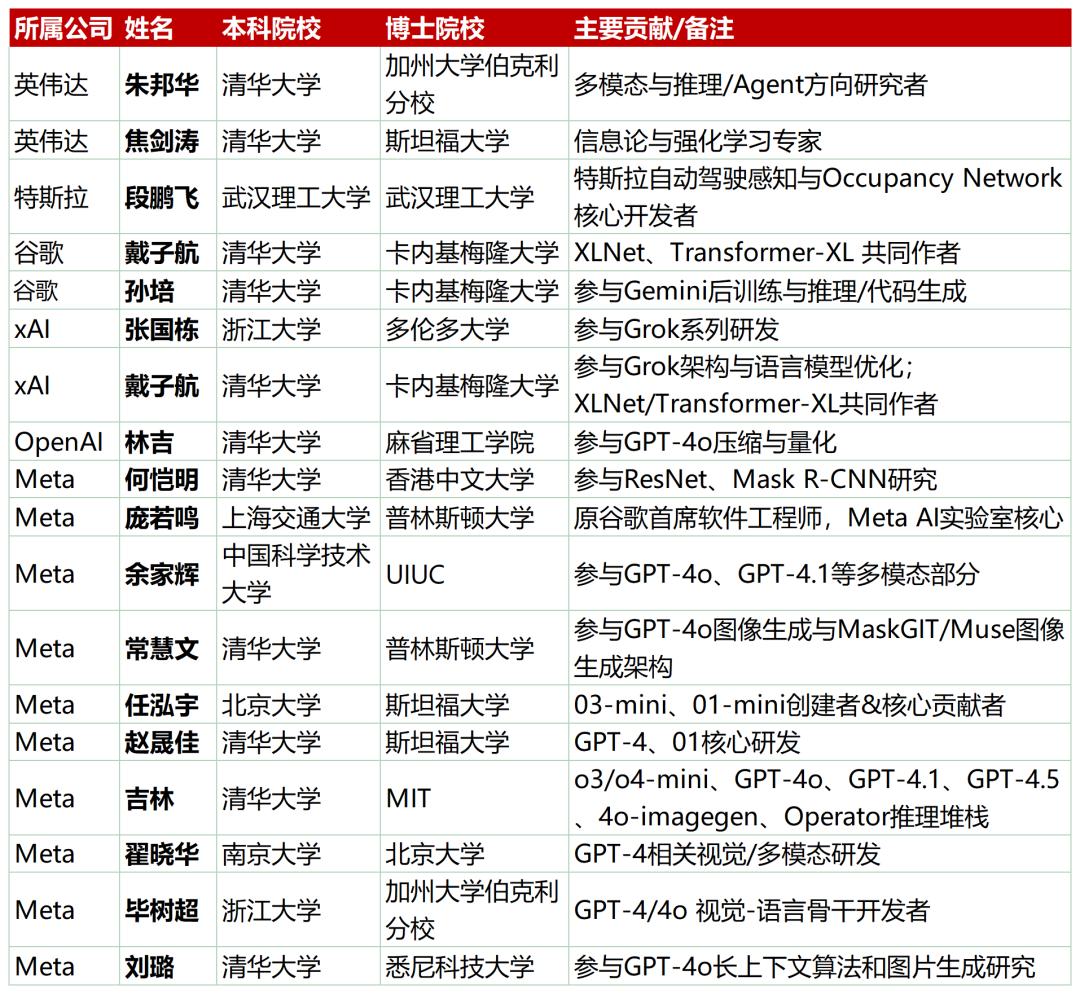
According to an incomplete statistics by Crow Master, among the 30 Chinese core researchers sorted out, 22 have a similar path:
They graduated from top domestic universities such as Tsinghua University, Peking University, the University of Science and Technology of China, and Zhejiang University for their undergraduate studies. Then they went to prestigious schools like Princeton, Stanford, MIT, and Carnegie Mellon to pursue a doctorate. After that, they entered the most cutting - edge AI labs in Silicon Valley and became the backbone in pushing the boundaries of technology.
For example, among the core members of Meta's Super Intelligence Lab, there are many such representative figures: Yu Jiahui graduated from the Juvenile Class of the University of Science and Technology of China for his undergraduate studies and studied at UIUC for his doctorate; Zhao Shengjia graduated from Tsinghua University for his undergraduate studies and Stanford University for his doctorate; Bi Shuchao graduated from Zhejiang University for his undergraduate studies and the University of California, Berkeley for his doctorate; Ren Hongyu graduated from Peking University for his undergraduate studies and Stanford University for his doctorate.
Why do these so - called "students from rural areas taking exams" who seem to have grown up in a "sea of questions" become the most scarce talent in the current AI industry?
02
Where Does the Engineer Dividend in the AI Era Come From?
In the past, when talking about AI, people used to focus on Silicon Valley. But if we look at the present, you will find that another force is growing rapidly, which is the talent accumulation in AI research in China.Now, China graduates more than 5 million students majoring in computer science and related fields every year, making it the world's largest exporter of STEM talent.
According to the Dimensions research database, currently, there are more than 30,000 active artificial intelligence researchers in China. The total number of doctoral and post - doctoral students alone is twice the total number of artificial intelligence researchers in the United States. In contrast, the United States has about 10,000 researchers, the 27 EU countries have about 20,000, and the United Kingdom has about 3,000.
This constitutes a huge talent echelon for China's AI, and it can even be said to be the new "engineer dividend" in the AI era.
More importantly, China's basic education emphasizes mathematical and physical foundations and problem - solving abilities. This long - term high - intensity training just cultivates the core qualities suitable for AI research:
First, Structured thinking, which can translate real - world problems into mathematical problems.
For example, in Olympiad math problems and physics problems, you are actually practicing translating real - world situations into formulas and equations and then solving them with mathematical methods.
In problem - solving training, students learn the ability to "remove redundant information and grasp the core variables". The same is true in AI research. Complex things such as language, images, and actions must first be translated into vectors and matrices before they can be processed by machines.
Second, Patience and resilience.
Math problems and competition problems often require a long process of thinking and calculation, and patience is a necessary quality. The same is true in AI research. Behind a single paper, there may be hundreds or thousands of experiments; models often have billions or even hundreds of billions of parameters, and parameter tuning is very time - consuming. Without patience, it is difficult to persevere in large - model experiments.
Especially when reinforcement learning replaces pre - training as the new Scaling law for models, the abilities of Chinese students are more suitable.
The characteristic of reinforcement learning is that the goal is clear (reward function), the path is not unique, and continuous trial - and - error iteration is required. In Ilya's words:
"Reinforcement learning allows AI to try new tasks with random paths. If the effect exceeds expectations, then update the weights of the neural network so that AI remembers to use this successful event more often and then starts the next attempt."
This is very similar to the logic of Olympiad math: Try a path → Fail → Correct mistakes → Summarize → Try again.
And this is exactly the rhythm that Chinese students are most familiar with. Since childhood, they have been used to breaking down big problems into small problems and then solving them step by step. Long - term mathematical and physical training has also made them very proficient in tools such as probability, optimization, and linear algebra - and these are exactly the basic skills of RL.
By the time many people graduate from undergraduate studies, they are already very familiar with matrix operations, gradient descent, and probability modeling. So when they enter research, they don't need to "make up for lost lessons" and can directly engage in algorithm innovation and implementation.
In addition, the characteristics of RL are that the results are quantifiable and the indicators are clear: reward curves, convergence speed, and test scores can all show improvements at a glance. Such a research model is particularly in line with the Chinese people's habits of being pragmatic, efficient, and pursuing certainty.
This is why the Chinese have a particularly strong presence in the field of RL.
In the RL papers of NeurIPS 2020, 30% of the first authors are of Chinese descent; in Google's RL team, one - quarter to one - third graduated from Chinese universities; in the xAI team, Zhang Guodong, Yang Ge, Jimmy Ba and others have all left achievements in top - tier RL research.
To some extent, reinforcement learning is the "natural home field" of Chinese engineers. And the rise of DeepSeek - R1 at the beginning of this year is more like a clear indication that this advantage is bearing fruit.
There is no mystery behind it. China has a large educated population, long - term mathematical and physical training from childhood to adulthood, long - term national investment in scientific research, and a motivation deeply rooted in culture - the belief that technology can transform the world.
It is these factors that together support a huge "talent pipeline", continuously sending doctoral - level researchers to top - tier universities and AI labs in the United States.
In the era of large models, Silicon Valley still needs a few "Da Vinci - like geniuses" who can invent new paradigms, but at present, it needs a large number of engineering scientists who can refine algorithms to the extreme. China's education and talent system just shows strong "hematopoietic ability" at this moment, providing a stable and solid scientific research foundation.
The competition in AI has never been a sprint on a single technological curve, but a long - term game of talent pipelines, education systems, and cultural mindsets.
When the most cutting - edge labs in Silicon Valley are full of Chinese faces, this is not only a talent phenomenon but also a civilization phenomenon. The future of AGI is not just a competition between companies, but a global civilization competition in talent allocation.
And in this competition, the Chinese have already stood in the center of the stage.
Silicon Valley's Major Reshuffle: Why Do Chinese People Dominate AGI, from Small - Town Exam Whizzes to Top AI Researchers?
The New "Engineer Dividend" in the AI Era: Unleashing Potential in the Artificial Intelligence Age

 The Take