Hangor Class Submarine | Updates & Discussion

1. Nuclear submarines are too sensitive. China is currently strongly criticizing the US for helping Australia build nuclear submarines. If China were to provide nuclear submarines to Pakistan, it would clearly be inconsistent with China's national policy. This possibility is virtually nonexistent, at least for a long time to come.

2. The Type 32 conventional submarine is not suitable for use as an attack submarine. However, if it is only used as a second-strike platform, the Type 32 conventional submarine is a reasonable choice. China's current Type 32 conventional submarine was built more than a decade ago for experimental purposes. Its platform is essentially an enlarged version of the Type 039 submarine. If new construction were to begin now, it would certainly incorporate more of China's latest technological advancements from the past decade, such as propulsion systems and VLS.

My view is: Based on the Type 32 submarine platform, customize it according to Pakistan's actual needs, rather than directly purchasing Type 32 submarines. Alternatively, based on the Type 095 nuclear-powered submarine platform, convert it to a conventional-powered submarine.

You can think of it as a completely new submarine custom-made for Pakistan.

Of course, since the PLAN itself doesn't have this need (for ultra-large displacement conventional submarines) to share the related R&D and technology costs, if Pakistan is interested, it will either need to pay substantial additional R&D costs for the modification, or it will need to purchase in sufficient quantities.

The focus is on the submarine platform itself, not a single technical feature.

However, this is merely my personal opinion. It's for entertainment purposes only and shouldn't be taken seriously.

1. Hangor-class submarines do not have a VLS. They use torpedo tubes (533mm) to launch missiles or torpedoes. There is no space for a VLS.

2. China's surface warships currently primarily use two types of VLS: the HT-1 (850mm) and the AKJ-16 (650mm).

3. Submarine-based VLSs are mainly equipped on strategic ballistic missile nuclear submarines. Official detailed parameters have not been released, but their dimensions are estimated to be very large (no less than 1500mm). They are used to launch submarine-launched ICBMs. Attack submarines use VLSs smaller than this, but no data is currently available. It is generally believed that their size is larger than the HT-1.
You’re right, they Pakistan will have to pick something off the shelf (slightly modified) as it can’t put in much funding into R&D. There is speculation that China is developing a nuclear battery plug for SSKs, so Pakistan could be the another beneficiary of this technology, after the PLAN. Not a reactor, but a limited life battery, that could have to be swapped out every 15-20 years, going based on similar technology being developed in the US. Perhaps for the foreseeable future, Pakistan could go for a version of the Type 032 (so it can carry longer range missiles), if equipped with such batteries, to ensure it can allow these subs to operate for months at depth and operating very quietly. The Type 032 is not a small submarine, so it would need to be either packed fully with large conventional batteries or have at least a couple of these nuclear batteries. I speculate that Pakistan is with for Chinese tech to mature in this regard and to get feed back after operating the Hangors class subs for some time.

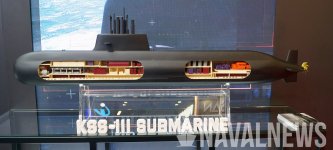
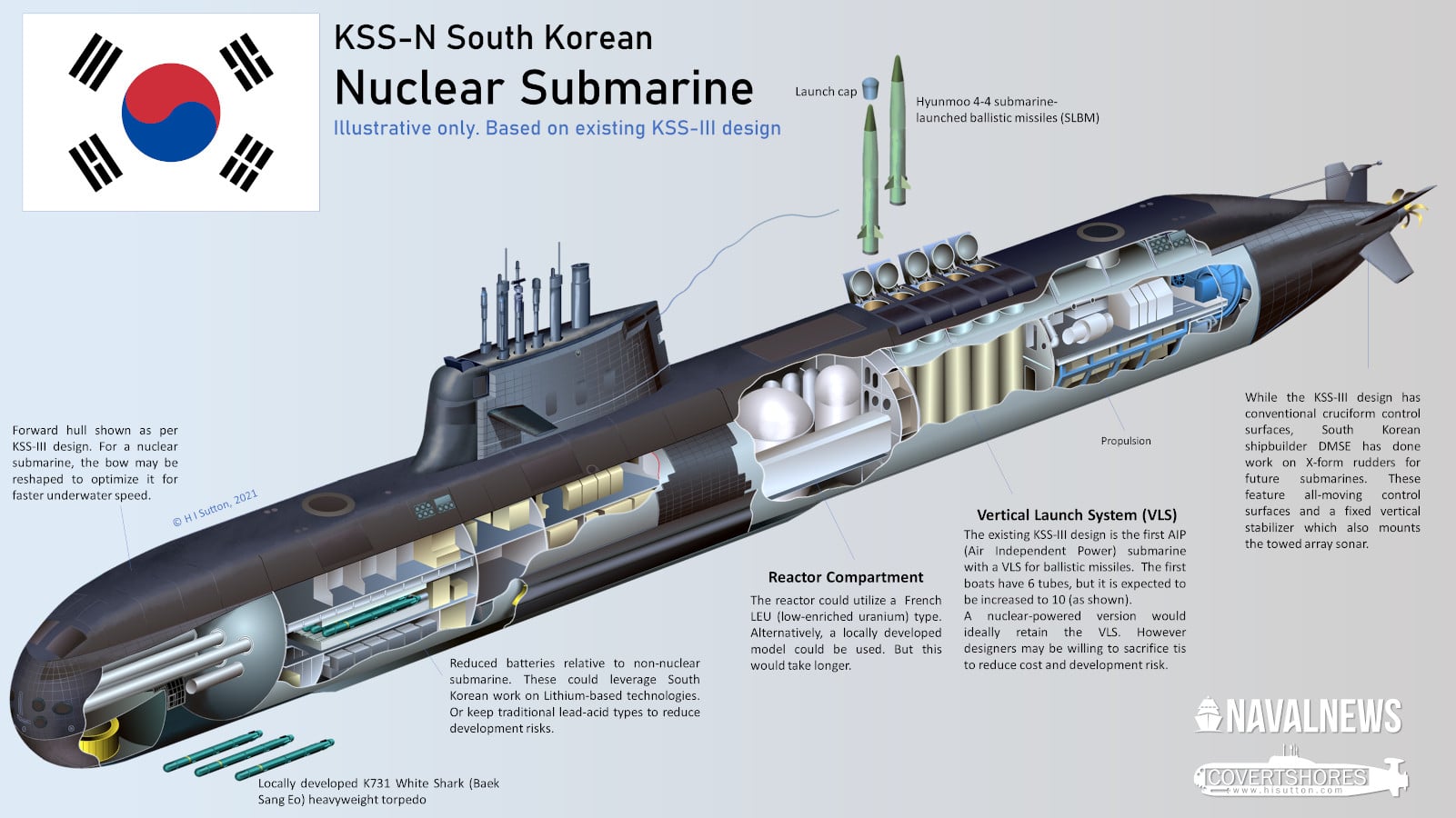
Btw, an enlarged attack boat with 8-12 VLS tubes and one nuclear battery could also be built, for the PLAN, and then an export approved version for Pakistan. It would be similar in weight as the new South Korean KSS-3 Block 2 (4000 tons), which has 10 VLS tubes of 0.9 meter diameter and 10 meter length.

China has a need to field SSKs that are even quieter, can replace all pre-Type 039B SSKs, and deal with a growing fleet among the coalition of nations looking to contain China and its SLOCs.


See the propulsion at 12:34 onwards.

To view this content we will need your consent to set third party cookies.
For more detailed information, see our cookies page.
 
Last edited:
You’re right, they Pakistan will have to pick something off the shelf (slightly modified) as it can’t put in much funding into R&D. There is speculation that China is developing a nuclear battery plug for SSKs, so Pakistan could be the another beneficiary of this technology, after the PLAN. Not a reactor, but a limited life battery, that could have to be swapped out every 15-20 years, going based on similar technology being developed in the US. Perhaps for the foreseeable future, Pakistan could go for a version of the Type 032 (so it can carry longer range missiles), if equipped with such batteries, to ensure it can allow these subs to operate for months at depth and operating very quietly. The Type 032 is not a small submarine, so it would need to be either packed fully with large conventional batteries or have at least a couple of these nuclear batteries. I speculate that Pakistan is with for Chinese tech to mature in this regard and to get feed back after operating the Hangors class subs for some time.

Btw, an enlarged attack boat with 8-12 VLS tubes and one nuclear battery could also be built, for the PLAN, and then an export approved version for Pakistan. It would be similar in weight as the new South Korean KSS-3 Block 2 (4000 tons), which has 10 VLS tubes of 0.9 meter diameter and 10 meter length.

China has a need to field SSKs that are even quieter, can replace all pre-Type 039B SSKs, and deal with a growing fleet among the coalition of nations looking to contain China and its SLOCs.


See the propulsion at 12:34 onwards.

To view this content we will need your consent to set third party cookies.
For more detailed information, see our cookies page.

Information regarding China's submarine program, especially its nuclear submarine development methods, is highly classified. Currently, almost all the information we have comes from speculation by military enthusiasts or foreign media. Therefore, we should not delve into too many details (there is insufficient credible evidence to support various viewpoints, which could easily lead to unnecessary disputes).

Regarding current submarine diving records from various countries, China's current records are:
Nuclear submarine: Type 091 (#403) nuclear-powered submarine, submerged for 90 days.
Conventional submarine: Type 32 conventional-powered submarine, submerged for 30 days.

From an engineering perspective, achieving longer underwater endurance isn't too difficult. However, it's physiologically and psychologically unsustainable for humans. Therefore, for a long time, people haven't pursued longer underwater endurance. Now, developed countries in this field have begun developing unmanned underwater vehicles, which don't face this problem.
===============================================
Back to the topic.
===============================================
According to the China-Pakistan agreement, the last four Hangor Class Submarine submarines will be completed in Pakistan.

Therefore, we can conclude that the pressure hull manufacturing technology for this class of submarines will also be transferred to Pakistan. This is one of the key construction technologies for submarines.

We are unsure whether the cooperation agreement includes technology for submarine-specific steel. That is, we cannot determine whether the steel used in the Hangor Class Submarines built in Pakistan will come from China or be sourced domestically. This is also a core technology.

As for the submarine's subsystem technologies (power engines, detection equipment, attack equipment, etc.), I believe this is not currently a priority for Pakistan.

Pakistan itself has a relatively weak technological foundation in related fields and lacks a mature industrial chain to support it. Its economic foundation also makes it difficult to support the substantial costs of independent research and development.

Pakistan has a wide range of options in the international diplomatic arena. It does not have the need or desire to independently develop related subsystems.

However, if Pakistan fully masters the technology for independently building submarine platforms and continues to evolve it, it will be a remarkable achievement in itself.

Special Note: Attack submarines (used for naval warfare) and ballistic missile submarines (used for nuclear counterattack) are completely different things. The latter can be extensively modified to become the former, but the former cannot become the latter.

Hangor-class submarines are typical attack submarines; it is meaningless to draw deep connections between them and ballistic missile submarines used for nuclear counterattack.
 
Last edited:
Information regarding China's submarine program, especially its nuclear submarine development methods, is highly classified. Currently, almost all the information we have comes from speculation by military enthusiasts or foreign media. Therefore, we should not delve into too many details (there is insufficient credible evidence to support various viewpoints, which could easily lead to unnecessary disputes).

Regarding current submarine diving records from various countries, China's current records are:
Nuclear submarine: Type 091 (#403) nuclear-powered submarine, submerged for 90 days.
Conventional submarine: Type 32 conventional-powered submarine, submerged for 30 days.

From an engineering perspective, achieving longer underwater endurance isn't too difficult. However, it's physiologically and psychologically unsustainable for humans. Therefore, for a long time, people haven't pursued longer underwater endurance. Now, developed countries in this field have begun developing unmanned underwater vehicles, which don't face this problem.
===============================================
Back to the topic.
===============================================
According to the China-Pakistan agreement, the last four Hangor Class Submarine submarines will be completed in Pakistan.

Therefore, we can conclude that the pressure hull manufacturing technology for this class of submarines will also be transferred to Pakistan. This is one of the key construction technologies for submarines.

We are unsure whether the cooperation agreement includes technology for submarine-specific steel. That is, we cannot determine whether the steel used in the Hangor Class Submarines built in Pakistan will come from China or be sourced domestically. This is also a core technology.

As for the submarine's subsystem technologies (power engines, detection equipment, attack equipment, etc.), I believe this is not currently a priority for Pakistan.

Pakistan itself has a relatively weak technological foundation in related fields and lacks a mature industrial chain to support it. Its economic foundation also makes it difficult to support the substantial costs of independent research and development.

Pakistan has a wide range of options in the international diplomatic arena. It does not have the need or desire to independently develop related subsystems.

However, if Pakistan fully masters the technology for independently building submarine platforms and continues to evolve it, it will be a remarkable achievement in itself.

Special Note: Attack submarines (used for naval warfare) and ballistic missile submarines (used for nuclear counterattack) are completely different things. The latter can be extensively modified to become the former, but the former cannot become the latter.

Hangor-class submarines are typical attack submarines; it is meaningless to draw deep connections between them and ballistic missile submarines used for nuclear counterattack.
How much work would it be for a Hangor class variant to have a VLS section (10 VLS cells) added to the design, similar to the South Korean KSS III - Block 2? China has already perfect the VLS tech on the 093B.

1763194491425.jpeg


How much work would it be for a Hangor class variant to have a VLS section (10 VLS cells) added to the design, similar to the South Korean KSS III - Block 2? China has already perfect the VLS tech on the 093B.
What we can be certain of is that the submarine needs to be lengthened.

The rumored Type 041 small nuclear-powered submarine is actually a lengthened and heavily modified version of the Type 039 conventional-powered submarine (including converting the conventional propulsion system to nuclear power). However, as I mentioned before, China's submarine-related plans and progress are highly classified information. What we know comes entirely from speculation by various media outlets.

=================================================

During the Chinese New Year of 2025, a movie called "蛟龙行动(Operation Leviathan)" was released in China.

The film's director, Dante Lam (from Hong Kong), is a seasoned and passionate military enthusiast. He is also one of the most well-known war action film directors in the Chinese-speaking world. "Operation Leviathan" is a sequel to another earlier war action film, "Operation Red Sea."

The core of this film is submarine warfare and underwater special operations. If you're interested in these topics, I recommend it. (Chinese audio + English subtitles)
To view this content we will need your consent to set third party cookies.
For more detailed information, see our cookies page.


Special Notes:
1. This film has received mixed reviews and is highly controversial in China. I personally bought a ticket to see it in theaters and was somewhat disappointed. Therefore, please disregard the plot.
2. The submarine base and submarines depicted in the film are sets built by the production team and are not real military bases or actual submarines. The set is located within a film and television base in Qingdao, China, and is open to the public for visits and close-up experiences.
3. Please watch this film from the perspective of an ordinary military enthusiast, not from a professional military technology perspective. This is a commercial film aimed at the general public.
 
What we can be certain of is that the submarine needs to be lengthened.

The rumored Type 041 small nuclear-powered submarine is actually a lengthened and heavily modified version of the Type 039 conventional-powered submarine (including converting the conventional propulsion system to nuclear power). However, as I mentioned before, China's submarine-related plans and progress are highly classified information. What we know comes entirely from speculation by various media outlets.

=================================================

During the Chinese New Year of 2025, a movie called "蛟龙行动(Operation Leviathan)" was released in China.

The film's director, Dante Lam (from Hong Kong), is a seasoned and passionate military enthusiast. He is also one of the most well-known war action film directors in the Chinese-speaking world. "Operation Leviathan" is a sequel to another earlier war action film, "Operation Red Sea."

The core of this film is submarine warfare and underwater special operations. If you're interested in these topics, I recommend it. (Chinese audio + English subtitles)
To view this content we will need your consent to set third party cookies.
For more detailed information, see our cookies page.


Special Notes:
1. This film has received mixed reviews and is highly controversial in China. I personally bought a ticket to see it in theaters and was somewhat disappointed. Therefore, please disregard the plot.
2. The submarine base and submarines depicted in the film are sets built by the production team and are not real military bases or actual submarines. The set is located within a film and television base in Qingdao, China, and is open to the public for visits and close-up experiences.
3. Please watch this film from the perspective of an ordinary military enthusiast, not from a professional military technology perspective. This is a commercial film aimed at the general public.

Thanks for sharing this movie. I went to the movie theater here in New York to see Born to Fly, to understand the mindset being promoted more than anything else. I hope to learn that as well from this video.

Back to the topic, yes the hull will have to be lengthened, both if a small nuclear reactor/battery is added and if a VLS section is added. Yes, all we can do is speculate, but considering how more formidable (and cost effective) such a platform could be, it seems only logical to try to see how far such a program is coming along.

IMHO, hints at the progress of the program will probably come from how China’s commercial nuclear industry is developing. Application of such nuclear technology will probably be seen at small industrial plants in remote areas of China; similar to what the US military has planned, small reactors for remote bases. Then, we may see these reactors on a version of the Type 055 destroyer or more likely an ice breaker, to power modern high power laser systems or in the case of an ice breaker, escort shipping convoys in the arctic. Finally, when perfected and minimized as much as possible, it will probably make its way on the subs.

Considering China’s pace of technological development, all this could happen within a 10 year time frame, with a prototype sub in the late 2030s, and full rate production in the early 2040s. Considering a service life of 30-40 years, China would be looking at retiring all pre-Type 039A Submarines (10 kilos and 13 Songs and the early 039 subs built before 2010) by then, and replacing them with subs more advanced than the 039B/C variants.
 
Last edited:
To view this content we will need your consent to set third party cookies.
For more detailed information, see our cookies page.
 
To view this content we will need your consent to set third party cookies.
For more detailed information, see our cookies page.
 
To view this content we will need your consent to set third party cookies.
For more detailed information, see our cookies page.
 

Users who are viewing this thread

Pakistan Defence Latest

Back
Top