Hangor Class Submarine | Updates & Discussion

The Akya, its quite new and prod scale is probs quite limited. Also, the Chinese would porbably be somewhat reserved in 3rd country torpedo integration, but im not sure, maybe not, its one of those things that only those involved would know.

Torpedo's are pretty significant technologically yeah, its basically the same game as submarines, make them quiet, countermeasure resistant, and also hard to detect. Just think of it as a mini submarine, all the same stuff applies.


Would be nice, PN currently operates the DM2A4's which are pretty creme of the crop as torpedos go, would love nothing more for them to grab some more, but its quite unlikely.

A DM2A4 probably costs in the range of about 4-4.5m usd nowadays. PN bought 20 per ship, so lets just assume thats what they aim for, so 160 needed, plus some for swats, so lets assume a req of about 200 units.

Nearly 100 million USD!
Damn that's expensive , but wouldn't that require integration or at least addition of a new management system as to integrate the European and Chinese tech? I'dk much about the process but won't that be opsec risky? Considering type 39s are mainstay conventional sub of PLAN?
Good to know we have some good torpedos in agostqs
 
The Akya, its quite new and prod scale is probs quite limited. Also, the Chinese would porbably be somewhat reserved in 3rd country torpedo integration, but im not sure, maybe not, its one of those things that only those involved would know.

Torpedo's are pretty significant technologically yeah, its basically the same game as submarines, make them quiet, countermeasure resistant, and also hard to detect. Just think of it as a mini submarine, all the same stuff applies.


Would be nice, PN currently operates the DM2A4's which are pretty creme of the crop as torpedos go, would love nothing more for them to grab some more, but its quite unlikely.

A DM2A4 probably costs in the range of about 4-4.5m usd nowadays. PN bought 20 per ship, so lets just assume thats what they aim for, so 160 needed, plus some for swats, so lets assume a req of about 200 units.

Nearly 100 million USD!

I dont think this is something you can buy in such quantities. We already have a ton of different lightweight and heavyweight torps for our french subs, as part of hangor deal i believe AsHMs and torps were negotiated beforehand and nowadays SL AsHMs are much bigger threat. Yj-18s can reduce the requirement for these types of heavy weight torps in picking off small IN ships and so you can assume these will be bought more of as just in case capability to hit those IN CSGs rather than standard loadout on subs
 
The Akya, its quite new and prod scale is probs quite limited. Also, the Chinese would porbably be somewhat reserved in 3rd country torpedo integration, but im not sure, maybe not, its one of those things that only those involved would know.

Torpedo's are pretty significant technologically yeah, its basically the same game as submarines, make them quiet, countermeasure resistant, and also hard to detect. Just think of it as a mini submarine, all the same stuff applies.


Would be nice, PN currently operates the DM2A4's which are pretty creme of the crop as torpedos go, would love nothing more for them to grab some more, but its quite unlikely.

A DM2A4 probably costs in the range of about 4-4.5m usd nowadays. PN bought 20 per ship, so lets just assume thats what they aim for, so 160 needed, plus some for swats, so lets assume a req of about 200 units.

Nearly 100 million USD!
Wouldn't torps have been included in the deal signed back in 2015?
 
@Ak01 @Michael
What are the capabilities of the torpedos that are coming with these ? Doe these have the heavy weight torpedos? Names and specs plz?
Are they like on par to the Italian blackshark or even American ones?
Cant we get some euro torps in those tubes as well? Maybe @Michael knows more but there shouldnt be any technical limitations in getting foreign torps in theee
The PLA Navy's domestic version of torpedoes is coded as 'Yu-x (x=1-11)'. Currently, Yu-1, 2, 3, and 4 have been retired and converted for training purposes.

The export version of torpedoes uses the code 'ET-x'.

For example:

The export code for the Yu-8 rocket-assisted torpedo is ET-80. It is a standard configuration for the 054A/P.

Currently, among all Chinese torpedo products, torpedoes launched from submarines are all heavy torpedoes. Medium torpedoes are mainly carried by surface ships and are rocket-assisted torpedoes launched via VLS. Light torpedoes are mainly carried and launched by aircraft.

China, when exporting surface ships and submarines, always includes the corresponding compatible torpedoes for export. It's just that such news is usually rarely reported.

The 039 series submarines can use the vast majority of Chinese torpedoes currently available, all of which can be exported, including the export version of the latest Yu-10 heavy torpedo. However, we do not know which specific products the Pakistan Navy has chosen.
 
Last edited:
Okay! I take back my words.

I just looked up some information. The cost of this submarine rescue ship is astonishing, completely beyond the affordability of the Pakistan Navy..........
Pakistan goverment has no money. however money is never a problem for Pakistan when they procure military equipment 😄
 
Location update on the Hangor class it was in Malaysia a few days ago

PN Type 054AP along with another warship were sent as escort ?

When is it likely to reach Karachi ?
 
Location update on the Hangor class it was in Malaysia a few days ago

PN Type 054AP along with another warship were sent as escort ?

When is it likely to reach Karachi ?
Assuming they left Malaysia 2 days ago and are cruising at 20 knots they should arrive at Karachi in two days.
 
Pakistan's Hangor class inherits main features of China's Type 039

Screenshot_20260514_134807_Firefox.jpg

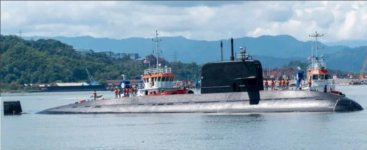
Pakistan's first Hangor-class submarine seen here approaching a naval pier at Kota Kinabalu in East Malaysia. (Royal Malaysian Navy)

Images released by the Royal Malaysian Navy (RMN) indicate that Pakistan's Hangor-class submarine has inherited almost all of the design features associated with China's Type 039 (Yuan) class.

These images – published on 9 May to mark the arrival of the first-of-class PNS Hangor at the Teluk Sepanggar Naval Base in Kota Kinabalu, Sabah – provide a rare view of the class' configuration given the limited imagery released by the Pakistan Navy.

The China-built diesel-electric submarine's (SSK's) stop in Malaysia was part of a replenishment, logistical co-ordination, and crew rest activity before continuing to Pakistan. Hangor was commissioned in Sanya, China, on 30 April.

The imagery shows a tear-shaped hydrodynamic hull optimised for submerged operations, with a conventional cruciform stern arrangement and sail-mounted horizontal diving planes. This control-surface layout is typical of Chinese conventional submarines, emphasising predictable low-speed handling and acoustic discretion.

A rectangular recessed panel is visible on the side of the sail, likely serving as an access point into the vessel. Along the submarine's upper forward casing, there are multiple slotted drainage openings arranged in horizontal rows. These free‑flooding ports are evenly spaced and follow the curvature of the hull, allowing water to drain quickly when surfaced. The casing forward of the sail slopes gently upward toward the sail base.

No external weapons or deck fittings are visible, indicating reliance on internally housed torpedoes and, potentially, missile systems launched from standard bow tubes.

 
The Hangor-class submarine program is a cornerstone of Pakistan’s maritime strategy.

According to recent reports and the Janes analysis, these vessels are a direct export derivative of China’s Type 039A (Yuan-class), specifically tailored to meet the Pakistan Navy’s (PN) operational requirements in the North Arabian Sea.

On April 30, 2026, the first vessel, PNS Hangor, was officially commissioned at a ceremony in Sanya, China.

Technical Specifications & Inherited Features

The Hangor-class inherits the core "DNA" of the Chinese Type 039A/B, focusing on stealth, endurance, and deep-strike capabilities:

Propulsion (AIP): Like the Type 039A, the Hangor-class is equipped with Stirling-cycle Air Independent Propulsion (AIP). This allows the submarine to remain submerged for up to two to three weeks without needing to snorkel (surface to breathe), significantly reducing its acoustic and thermal signature.

Size and Displacement: It is a relatively large conventional submarine, with a submerged displacement of approximately 2,800 tons and a length of 76 meters. This size allows for greater fuel capacity and more comfortable crew quarters for long-range patrols compared to the older Agosta-90B.

Acoustic Stealth: The hull features a "whale-shaped" hydrodynamic design and is covered in anechoic tiles (rubber-like coatings) that absorb sonar waves, a feature directly inherited from China's most advanced non-nuclear boats.

Armament and Strategic Role

The "main features" inherited from the Type 039 include a versatile weapons suite that shifts Pakistan's naval doctrine from coastal defense to sea denial:

Weapon Tubes: It features six 533 mm torpedo tubes capable of launching:

Yu-6 Heavyweight Torpedoes: China’s equivalent to the US Mark 48, used for anti-submarine and anti-ship warfare.

CM-708 UNB: A submarine-launched anti-ship missile with a range of approximately 290 km.

The Nuclear Leg (Babur-3): Crucially, the Hangor-class is designed to be compatible with the Babur-3 Submarine-Launched Cruise Missile (SLCM). This provides Pakistan with a credible sea-based second-strike capability, ensuring that even if land-based assets are neutralized, a nuclear deterrent remains hidden underwater.

Sensor Suite: It utilizes an integrated combat management system and a modern sonar suite (including a flank array), allowing it to track multiple targets simultaneously in the cluttered environment of the Indian Ocean.

The "Split-Build" Strategy

The program involves a total of eight submarines at a cost of approximately $4–5 billion:

4 built in China: These are being constructed by China Shipbuilding & Offshore International (CSOC). PNS Hangor is the first of these.

4 built in Pakistan: Under a Transfer of Technology (ToT) agreement, the remaining four are being assembled at the Karachi Shipyard & Engineering Works (KS&EW). This is intended to build Pakistan’s indigenous capacity to maintain and eventually design its own undersea platforms.

Strategic Impact

By 2028, when the majority of these boats are expected to be operational, Pakistan will possess one of the largest AIP-equipped submarine fleets in the region (11 total, including the upgraded Agosta-90Bs). This serves as a direct counter to India’s carrier battle groups, as the "silent" Hangor-class can lie in wait along critical sea lanes, making it a "carrier killer" and a guardian of the CPEC-linked Gwadar port.
 
One of the slowest induction is the Submarine platform upgrade
Even the Agosta Submarines were constructed at long development time

Unsure what Transfer of Technology we learned from Agosta program that we have to relearn it again with the Hangor Class submarines

However hopefully the first 4 will arrive soon
 
View attachment 197309

Two Russian Nuclear powered SSBNs converted with anti-drone net on a naval base 7400Km from Ukraine.

pretty wild how much drones have changed everything

PN might need to think of specialized docks with steel net even for docked warships (protecting its radar, missile launchers, bridge). Security measures are important given so many threats and our proximity to those threats. India, BLA, Taliban / ttp.
Subs should have their own underground pens.
 
The hangor if traveling alone can cover that distance on its AIP alone while staying submerged and being virtually undetectable.
Would take two weeks but yeah pretty cool. If you are going at 4-5 knots you will run out of air before you run out of AIP + battery power.
 
Assuming they left Malaysia 2 days ago and are cruising at 20 knots they should arrive at Karachi in two days.
20 is too high for surfaced speed. Usually around 15 is the max. For example for the Kilo-class typical surface transit speeds are 10-11 knots. You can go faster if you submerge, up to 20 knots using max battery power but then you have to recharge battery again and again.
 

Users who are viewing this thread

  • Country Watch Latest

    Back
    Top