ghazi52
THINK TANK: CONSULTANT


- Thread starter
- #106
MISSIONS AGAINST AMRITSAR RADAR
By: Sarmad Hassan Sharif
The Amritsar radar was heavily defended by light and medium AAA. In any eventuality of an attack, interceptors from the nearby airfields of Pathankot, Adampur and Halwara could also be scrambled. The general location of the radar was known, but the exact location could not be pinpointed without the help of the ELINIT RB-57F aircraft.
PAF had no practice (using ELINT RB-57s) of carrying out attacks against such high value, highly defended targets. The strategy to attack the radar was devised on ad hoc bases, in which a specialized ELINT RB-57Bs of No. 24 Squadron would try to locate the position of the radar, and would direct the F-86s Sabres to the target. However this strategy failed due to lack of practice before the war and was highly felt on the evening of 6th September 1965, when two formations of PAF Sabres, comprising four aircraft each, on two different occasions, were unable to carry out an attack against this radar. According to Fricker, “After the first abortive missions against Amritsar on 6 September, recounted earlier, in which one ELINT RB-57B had its radar antenna drive sheared close to the target, and the second had one engine knocked out by Indian AA fire, the next move came on 7 September when attempts were made to locate ‘Alfa’ radar by photographic reconnaissance. Lockheed RT-33s of No. 20 Squadron were initially used for this task, operating unescorted at low level, and their results were sufficiently accurate for the site of ‘Fishoil’ – the call sign of Amritsar radar – to be pinpointed.”
After careful re-evaluation of its strategy, PAF decided to attack the radar again on 9th September. On the afternoon Squadron Leader Muhammad Iqbal, OC No. 24 Squadron took off from Peshawar with the mission to locate the enemy radar and then direct the PAF fighter strike to destroy it. He flew at high level and reached the target with no difficulty. While he was overhead the Amritsar radar, his aircraft came under heavy AAA fire. The right wing of his RB-57B was severely damaged along with the right engine which flamed out. However, he remained calm and skillfully piloted his stricken aircraft back for Peshawar. While returning, he directed the fighter strike formation to attack Amritsar radar; however, considerable results were not achieved. On return from the mission, he did not seem to be satisfied with the results and decided to make one more attempt.
On 10th September 1965, he planned to make some practice approaches on Rahwali Radar at Gujranwala, to refine the procedure of his newly assigned role of pathfinding before launching yet another assault on the Amritsar radar. He along with his most reliable and proficient navigator, Flight Lieutenant Saifullah Lodhi, took off from Peshawar and headed for their target. The gallant crew flew initially at high level and then descended to low level as they approached Rahwali radar.
However, due to lack of coordination, while the Radar Station was expecting them, the AAA gunners at Rahwali were not aware of the practice attacks. They panicked and took their own RB-57 aircraft for an enemy Canberra (British version of B-57), which looked the same. In this utter confusion, the gunners opened fire. Squadron Leader Iqbal tried to make desperate attempts to avoid the heavy AAA fire but failed. The aircraft was hit and was severely damage. Squadron Leader Iqbal ejected but was still fired upon and received a fatal bullet hit during parachute descent. His navigator who was glued to his radarscope was monitoring the behavior of received transmissions in the rear cockpit that was covered with curtain to darken the scope. He had no chance and went down with the aircraft. Luckily, the aircraft did not catch fire and after crash, his body was retrieved. The martyrs’ bodies were brought by helicopter to their home base at Peshawar. The great warrior, humble soul, and outstanding officers were given the hero’s farewell at their funeral. They were later buried with full military honors in the presence of thousands of mourners. Both were awarded well deserved Sitara-e-Jurat posthumously. A very tragic loss of invaluable lives of pilot and navigator along with a specialized RB-57 aircraft and an incident that could be avoided through timely liaison with Air Force and Army AAA regiment.
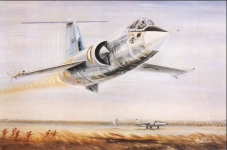
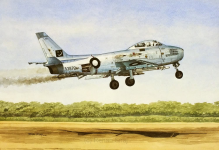
Jolted by this loss, PAF nonetheless carried out its strike against the radar. Explaining the mission, Fricker narrates, “On 10 September, the PAF followed up with a further 2 missions against Amritsar radar by a total of 12 F-86s from Sargodha, escorted by 2 F-104s as top cover. For these attacks, first by 4 F-86s escorted by two F-104s, followed by another 4 F-86s with 4 more as top cover, primary armament comprised 2.75 in rockets, but it was soon found that the dust, smoke and debris from delivery of the first aircraft's weapons restricted visibility to such an extent that it was impossible for subsequent pilots to achieve an accurate aim. Slight damage was caused to some parts of the installation but unfortunately for the PAF, 'Fishoil' was soon back on the air. At least the location of site Alfa was now known, and the Sabres at Sargodha were detailed for yet another strike against Amritsar on 11 September. Having tried and rejected napalm and rockets, the Sabres this time were to use only their 0.5in machine guns against the radar installation, for optimum accuracy and adequate striking power. The use of bombs at this stage was vetoed by the C-in-C, since the radar site was very close to the town of Amritsar, with the possibility of civilian damage and casualties.”
For the attack of 11th September, four Sabres plus a top cover of two F-104s, were to be led by Wing Commander Muhammad Anwar Shamim, with Flight Lieutenant Bhatti as his No. 3 and Flight Lieutenant Cecil Chaudhary has his No. 4. Enquiries as to the whereabouts of the Wing Leader’s No. 2 were answered by Squadron Leader Munir, who announced that Flight Lieutenant Siraj had been kind enough to stand down so that the Op Officer could come along in his place.
Squadron Leader Muniruddin Ahmed, known as ‘Bha Munir’ throughout the PAF, was one of the most popular officers. At the age of 36 in 1965, overweight, grey-haired and completely happy-go-lucky, he was regarded as an elderly gent by the youthful PAF pilots, but he set a pace which even the most energetic found difficult to rival. He was posted at Sargodha as the Wing Operations Officer during the 1965 War. He was not required to fly in combat and in any case his many administrative duties would have grounded a less volatile man. But after his family, his great passion was flying, and he managed to inveigle his way into combat missions at least once, and sometimes twice, per day. He flew on air defense, fighter sweeps and close support missions, but conceived a particular fixation against the IAF Master Radar Station just across the border from Lahore at Amritsar. So intense were his feelings about trying to knock out this major installations, that it became better known as Sargodha as ‘Munir’s Radar’.
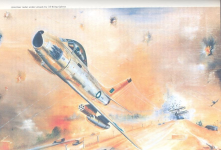
Covering the details of the mission Fricker states, "Despite poor visibility from the usual dust haze, Flight Lieutenant Bhatti, who was responsible for the navigation of this mission, brought the four Sabres out at low level precisely on track to Amritsar. Some help in identifying the target was in fact received from the Indian AA fire, which began even before the Sabres started their pull-up to attack. As planned, Flight Lieutenants Bhatti and Chaudhary began climbing to about 7,000 ft. as top cover and to draw some of the AA fire, while the two F-104s orbited even higher to prevent interference from IAF fighters.
As the first pair of Sabres started their climb, Flight Lieutenant Bhatti called on the RT, ‘Target at 3 o’clock,’ and Wing Commander Shamim replied, 'Lead and No. 2 pulling up.’ By this time, the target area was a veritable inferno of light and medium flak and within a few seconds there came another RT call, ‘Two is hit’. Flight Lieutenant Bhatti, when later describing the mission, reported: ‘No. 2, of course was Munir, but his voice on the RT was calm and unhurried. As I looked down, however, I saw three balls of flame tumbling through the air where his Sabre had already exploded. He must have taken a direct hit from a heavy AA shell and never had the chance to eject. The flaming wreckage fell on the eastern outskirts of Amritsar town, and ‘Munir’ was reported that evening by the Indians to have been found dead among the debris.’
Undeterred by the loss of ‘Munir’ and the continuing storm of flak, Wing Commander Shamim completed his strafing attack, firing long bursts into the radar aerials with his 0.5 in machine-guns. Bhatti called up and said, ‘How about me having a go,’ and the remaining two Sabres then came in to expend most of their ammunition on the radar installation before exiting, still at low level. Munir’s loss on his ninth combat mission of the war was deeply felt at Sargodha and throughout the PAF, among whom he is remembered as ‘professional to the end’, but his courage and inspiration were recognized by the posthumous award of Sitara-e-Jurat.”
Contrary to many PAF Historians, Fishoil Radar did not go off the air; however it remained intermittent for some time afterwards. The strike was still assessed as indecisive, however, by the PAF Air HQ, where it was concluded that bombing was the only effective means of doing serious and more permanent damage to the enemy radar sites, despite the element of risk to adjacent civilian property in Amritsar cantonment.
However, whoever was behind the planning that 'the radar had to be attacked by guns only and not by bombs' was responsible for the loss of Munir, as the radar was to be bombed on day one.
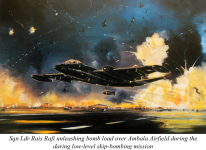
The loss of Squadron Leader Munir didn’t deter the PAF to attack the radar again. Explaining the final mission, Fricker narrates, “On 12 September, with an escort of 4 F-86s led by Flight Lieutenant Bhatti, and 2 F-104s from Sargodha flying top cover, the vulnerability of the 4 B-57 Bombers to effective enemy interception was considered acceptable, especially since the target was only just inside Indian Territory. As an additional precaution the TOT was fixed at dusk, with a rendezvous time of 1715 hours over Bhagatanwala for the 10 aircraft involved. On this occasion the attack went completely to plan.
After a low level approach from Pakistan, the B-57 formation, led by Wing Commander Bill Latif pulled up to their briefed attack height of around 7,000 ft, above the reach of light flak, to dive bomb the target. Each B-57 delivered its full load of bombs in the target area, and all the PAF aircraft returned safely, despite heavy AAA fire. This time 'Fishoil' really did go off the air, as a result of the heavy damage caused by 28,000 lbs. of bombs, and photographic reconnaissance of the target the next day revealed that the site had been vacated.”
The fact was that Fishoil was partially damaged in the B-57 attack, but was never completely destroyed. Since the position of the radar was compromised, and with the severity of attacks being increased in each mission, the Indians had no other choice but to vacate the site. This brought an end to the radar busting operations at Amritsar but at a cost of three valuable officers and two irreplaceable aircraft. Although they were destined to leave us for the heavenly abode, these losses were avoidable (in the case for the RB-57B, the loss was due to 'lack of coordination' and in case of Squadron Leader Munir, 'lack of leadership' from the leader of Amritsar Strike Element). To rub salt in the wound, Fishoil was back on air after its site was relocated within the premises of Amritsar.
Although I have nothing against any specific officer (since this is an impartial analysis), a valid question pops up in a professional as well as in a researcher’s mind about the leadership of O.C. Flying Sargodha, albeit Munir’s leader. After going through various narratives from various books including Story of PAF Heroes, Battle for Pakistan, PAF History 1988, and after detailed discussion with war veterans it seems that Munir’s Formation Leader’s combat leadership during the war was questionable, and his performance seemed to have been obscured for reason best known to his Station Commander. By all air power and military covenants the prime responsibility of a Leader is to lead his men to assigned target with accuracy, precision and always leading from the front.
The privilege of leading a four, eight or sixteen aircraft formation, it’s the prime and inescapable responsibility, as well as pride and test of the Leader to lead his formation through the tactically best way points; to arrive at the target making good TOT and placement of formation for a swift deadly attack, unchallenged by the enemy interceptors.
However, in this case, Fricker and especially the highly revered author of PAF Story 1988 who was former Station Commander during 1965 war have categorically mentioned without any compunction that the mission leader had given the responsibility of navigation to his No. 3, Flight Lieutenant Bhatti. I had placed this question in front of many war veterans, as well as currently serving fighter pilots, that seeking their candid opinion whether is it is the duty for the leader to carry out the navigation, and equally vital to lead in the attack, or it can be his discretion who to assign navigation and which member to lead the attack. The answer I received was firm, crisp and to the point i.e. it is the leader’s first and foremost responsibility to lead his formation to the assigned targets through the pre-defined waypoints.
Thus it can be concluded in all fairness that either the leader didn’t considered himself capable enough to navigate the mission, or that the leader had lost his bearings and requested his No. 3 to carry out the navigation. Both these assumptions could be the case, without any intent to denigrate the person. Ominously, as assimilated from the narrative in the very first rendition of the war episodes in ‘The Story of PAF Heroes’ and from Fricker’s narrative that when the Leader pulled up with his No. 2 over the target, he appeared to have let his No. 2 to go in first sending him to take the heavy flack. That’s what Munir apparently did as a gallant pilot.
By all established universal conventions in tactical employment it is the Leader's job to show his formation members the best attack profile, but in this case the Leader seem to have decided to stay behind his No. 2 instead of leading the attack. The Indian AA gunners focused their attack on the first attacking Sabre which dove in for attack and that was No. 2, who was instantly shot down.
The lessons learned from these missions is that one must prepare rigorously during peacetime for such missions, so that when war comes, one should know what to do, when to do and where to do. And that we might not loose valuable pilots like Squadron Leader Munir, Squadron Leader Iqbal and Flight Lieutenant Saifullah Lodhi, to such ad hoc decisions in the future.
As a student of aviation history, U would unhesitatingly commend the courage and performance of Squadron Leader Munir, who stuck around with his leader and obeyed his orders, disregarding his personal safety.
Squadron Leader Munir’s valor was reflected by the fact that he dived down in the inferno of AAA without any hint of hesitation or reluctance. Along with Squadron Leader Iqbal and Flight Lieutenant Lodhi, he laid down his life in the line of duty, setting up the standards for valor and supreme sacrifice, which serve as a valuable lesson for the future generations to come about combat leadership.
© Painting By: Gp Capt S M A Hussaini
By: Sarmad Hassan Sharif
The Amritsar radar was heavily defended by light and medium AAA. In any eventuality of an attack, interceptors from the nearby airfields of Pathankot, Adampur and Halwara could also be scrambled. The general location of the radar was known, but the exact location could not be pinpointed without the help of the ELINIT RB-57F aircraft.
PAF had no practice (using ELINT RB-57s) of carrying out attacks against such high value, highly defended targets. The strategy to attack the radar was devised on ad hoc bases, in which a specialized ELINT RB-57Bs of No. 24 Squadron would try to locate the position of the radar, and would direct the F-86s Sabres to the target. However this strategy failed due to lack of practice before the war and was highly felt on the evening of 6th September 1965, when two formations of PAF Sabres, comprising four aircraft each, on two different occasions, were unable to carry out an attack against this radar. According to Fricker, “After the first abortive missions against Amritsar on 6 September, recounted earlier, in which one ELINT RB-57B had its radar antenna drive sheared close to the target, and the second had one engine knocked out by Indian AA fire, the next move came on 7 September when attempts were made to locate ‘Alfa’ radar by photographic reconnaissance. Lockheed RT-33s of No. 20 Squadron were initially used for this task, operating unescorted at low level, and their results were sufficiently accurate for the site of ‘Fishoil’ – the call sign of Amritsar radar – to be pinpointed.”
After careful re-evaluation of its strategy, PAF decided to attack the radar again on 9th September. On the afternoon Squadron Leader Muhammad Iqbal, OC No. 24 Squadron took off from Peshawar with the mission to locate the enemy radar and then direct the PAF fighter strike to destroy it. He flew at high level and reached the target with no difficulty. While he was overhead the Amritsar radar, his aircraft came under heavy AAA fire. The right wing of his RB-57B was severely damaged along with the right engine which flamed out. However, he remained calm and skillfully piloted his stricken aircraft back for Peshawar. While returning, he directed the fighter strike formation to attack Amritsar radar; however, considerable results were not achieved. On return from the mission, he did not seem to be satisfied with the results and decided to make one more attempt.
On 10th September 1965, he planned to make some practice approaches on Rahwali Radar at Gujranwala, to refine the procedure of his newly assigned role of pathfinding before launching yet another assault on the Amritsar radar. He along with his most reliable and proficient navigator, Flight Lieutenant Saifullah Lodhi, took off from Peshawar and headed for their target. The gallant crew flew initially at high level and then descended to low level as they approached Rahwali radar.
However, due to lack of coordination, while the Radar Station was expecting them, the AAA gunners at Rahwali were not aware of the practice attacks. They panicked and took their own RB-57 aircraft for an enemy Canberra (British version of B-57), which looked the same. In this utter confusion, the gunners opened fire. Squadron Leader Iqbal tried to make desperate attempts to avoid the heavy AAA fire but failed. The aircraft was hit and was severely damage. Squadron Leader Iqbal ejected but was still fired upon and received a fatal bullet hit during parachute descent. His navigator who was glued to his radarscope was monitoring the behavior of received transmissions in the rear cockpit that was covered with curtain to darken the scope. He had no chance and went down with the aircraft. Luckily, the aircraft did not catch fire and after crash, his body was retrieved. The martyrs’ bodies were brought by helicopter to their home base at Peshawar. The great warrior, humble soul, and outstanding officers were given the hero’s farewell at their funeral. They were later buried with full military honors in the presence of thousands of mourners. Both were awarded well deserved Sitara-e-Jurat posthumously. A very tragic loss of invaluable lives of pilot and navigator along with a specialized RB-57 aircraft and an incident that could be avoided through timely liaison with Air Force and Army AAA regiment.
Jolted by this loss, PAF nonetheless carried out its strike against the radar. Explaining the mission, Fricker narrates, “On 10 September, the PAF followed up with a further 2 missions against Amritsar radar by a total of 12 F-86s from Sargodha, escorted by 2 F-104s as top cover. For these attacks, first by 4 F-86s escorted by two F-104s, followed by another 4 F-86s with 4 more as top cover, primary armament comprised 2.75 in rockets, but it was soon found that the dust, smoke and debris from delivery of the first aircraft's weapons restricted visibility to such an extent that it was impossible for subsequent pilots to achieve an accurate aim. Slight damage was caused to some parts of the installation but unfortunately for the PAF, 'Fishoil' was soon back on the air. At least the location of site Alfa was now known, and the Sabres at Sargodha were detailed for yet another strike against Amritsar on 11 September. Having tried and rejected napalm and rockets, the Sabres this time were to use only their 0.5in machine guns against the radar installation, for optimum accuracy and adequate striking power. The use of bombs at this stage was vetoed by the C-in-C, since the radar site was very close to the town of Amritsar, with the possibility of civilian damage and casualties.”
For the attack of 11th September, four Sabres plus a top cover of two F-104s, were to be led by Wing Commander Muhammad Anwar Shamim, with Flight Lieutenant Bhatti as his No. 3 and Flight Lieutenant Cecil Chaudhary has his No. 4. Enquiries as to the whereabouts of the Wing Leader’s No. 2 were answered by Squadron Leader Munir, who announced that Flight Lieutenant Siraj had been kind enough to stand down so that the Op Officer could come along in his place.
Squadron Leader Muniruddin Ahmed, known as ‘Bha Munir’ throughout the PAF, was one of the most popular officers. At the age of 36 in 1965, overweight, grey-haired and completely happy-go-lucky, he was regarded as an elderly gent by the youthful PAF pilots, but he set a pace which even the most energetic found difficult to rival. He was posted at Sargodha as the Wing Operations Officer during the 1965 War. He was not required to fly in combat and in any case his many administrative duties would have grounded a less volatile man. But after his family, his great passion was flying, and he managed to inveigle his way into combat missions at least once, and sometimes twice, per day. He flew on air defense, fighter sweeps and close support missions, but conceived a particular fixation against the IAF Master Radar Station just across the border from Lahore at Amritsar. So intense were his feelings about trying to knock out this major installations, that it became better known as Sargodha as ‘Munir’s Radar’.
Covering the details of the mission Fricker states, "Despite poor visibility from the usual dust haze, Flight Lieutenant Bhatti, who was responsible for the navigation of this mission, brought the four Sabres out at low level precisely on track to Amritsar. Some help in identifying the target was in fact received from the Indian AA fire, which began even before the Sabres started their pull-up to attack. As planned, Flight Lieutenants Bhatti and Chaudhary began climbing to about 7,000 ft. as top cover and to draw some of the AA fire, while the two F-104s orbited even higher to prevent interference from IAF fighters.
As the first pair of Sabres started their climb, Flight Lieutenant Bhatti called on the RT, ‘Target at 3 o’clock,’ and Wing Commander Shamim replied, 'Lead and No. 2 pulling up.’ By this time, the target area was a veritable inferno of light and medium flak and within a few seconds there came another RT call, ‘Two is hit’. Flight Lieutenant Bhatti, when later describing the mission, reported: ‘No. 2, of course was Munir, but his voice on the RT was calm and unhurried. As I looked down, however, I saw three balls of flame tumbling through the air where his Sabre had already exploded. He must have taken a direct hit from a heavy AA shell and never had the chance to eject. The flaming wreckage fell on the eastern outskirts of Amritsar town, and ‘Munir’ was reported that evening by the Indians to have been found dead among the debris.’
Undeterred by the loss of ‘Munir’ and the continuing storm of flak, Wing Commander Shamim completed his strafing attack, firing long bursts into the radar aerials with his 0.5 in machine-guns. Bhatti called up and said, ‘How about me having a go,’ and the remaining two Sabres then came in to expend most of their ammunition on the radar installation before exiting, still at low level. Munir’s loss on his ninth combat mission of the war was deeply felt at Sargodha and throughout the PAF, among whom he is remembered as ‘professional to the end’, but his courage and inspiration were recognized by the posthumous award of Sitara-e-Jurat.”
Contrary to many PAF Historians, Fishoil Radar did not go off the air; however it remained intermittent for some time afterwards. The strike was still assessed as indecisive, however, by the PAF Air HQ, where it was concluded that bombing was the only effective means of doing serious and more permanent damage to the enemy radar sites, despite the element of risk to adjacent civilian property in Amritsar cantonment.
However, whoever was behind the planning that 'the radar had to be attacked by guns only and not by bombs' was responsible for the loss of Munir, as the radar was to be bombed on day one.
The loss of Squadron Leader Munir didn’t deter the PAF to attack the radar again. Explaining the final mission, Fricker narrates, “On 12 September, with an escort of 4 F-86s led by Flight Lieutenant Bhatti, and 2 F-104s from Sargodha flying top cover, the vulnerability of the 4 B-57 Bombers to effective enemy interception was considered acceptable, especially since the target was only just inside Indian Territory. As an additional precaution the TOT was fixed at dusk, with a rendezvous time of 1715 hours over Bhagatanwala for the 10 aircraft involved. On this occasion the attack went completely to plan.
After a low level approach from Pakistan, the B-57 formation, led by Wing Commander Bill Latif pulled up to their briefed attack height of around 7,000 ft, above the reach of light flak, to dive bomb the target. Each B-57 delivered its full load of bombs in the target area, and all the PAF aircraft returned safely, despite heavy AAA fire. This time 'Fishoil' really did go off the air, as a result of the heavy damage caused by 28,000 lbs. of bombs, and photographic reconnaissance of the target the next day revealed that the site had been vacated.”
The fact was that Fishoil was partially damaged in the B-57 attack, but was never completely destroyed. Since the position of the radar was compromised, and with the severity of attacks being increased in each mission, the Indians had no other choice but to vacate the site. This brought an end to the radar busting operations at Amritsar but at a cost of three valuable officers and two irreplaceable aircraft. Although they were destined to leave us for the heavenly abode, these losses were avoidable (in the case for the RB-57B, the loss was due to 'lack of coordination' and in case of Squadron Leader Munir, 'lack of leadership' from the leader of Amritsar Strike Element). To rub salt in the wound, Fishoil was back on air after its site was relocated within the premises of Amritsar.
Although I have nothing against any specific officer (since this is an impartial analysis), a valid question pops up in a professional as well as in a researcher’s mind about the leadership of O.C. Flying Sargodha, albeit Munir’s leader. After going through various narratives from various books including Story of PAF Heroes, Battle for Pakistan, PAF History 1988, and after detailed discussion with war veterans it seems that Munir’s Formation Leader’s combat leadership during the war was questionable, and his performance seemed to have been obscured for reason best known to his Station Commander. By all air power and military covenants the prime responsibility of a Leader is to lead his men to assigned target with accuracy, precision and always leading from the front.
The privilege of leading a four, eight or sixteen aircraft formation, it’s the prime and inescapable responsibility, as well as pride and test of the Leader to lead his formation through the tactically best way points; to arrive at the target making good TOT and placement of formation for a swift deadly attack, unchallenged by the enemy interceptors.
However, in this case, Fricker and especially the highly revered author of PAF Story 1988 who was former Station Commander during 1965 war have categorically mentioned without any compunction that the mission leader had given the responsibility of navigation to his No. 3, Flight Lieutenant Bhatti. I had placed this question in front of many war veterans, as well as currently serving fighter pilots, that seeking their candid opinion whether is it is the duty for the leader to carry out the navigation, and equally vital to lead in the attack, or it can be his discretion who to assign navigation and which member to lead the attack. The answer I received was firm, crisp and to the point i.e. it is the leader’s first and foremost responsibility to lead his formation to the assigned targets through the pre-defined waypoints.
Thus it can be concluded in all fairness that either the leader didn’t considered himself capable enough to navigate the mission, or that the leader had lost his bearings and requested his No. 3 to carry out the navigation. Both these assumptions could be the case, without any intent to denigrate the person. Ominously, as assimilated from the narrative in the very first rendition of the war episodes in ‘The Story of PAF Heroes’ and from Fricker’s narrative that when the Leader pulled up with his No. 2 over the target, he appeared to have let his No. 2 to go in first sending him to take the heavy flack. That’s what Munir apparently did as a gallant pilot.
By all established universal conventions in tactical employment it is the Leader's job to show his formation members the best attack profile, but in this case the Leader seem to have decided to stay behind his No. 2 instead of leading the attack. The Indian AA gunners focused their attack on the first attacking Sabre which dove in for attack and that was No. 2, who was instantly shot down.
The lessons learned from these missions is that one must prepare rigorously during peacetime for such missions, so that when war comes, one should know what to do, when to do and where to do. And that we might not loose valuable pilots like Squadron Leader Munir, Squadron Leader Iqbal and Flight Lieutenant Saifullah Lodhi, to such ad hoc decisions in the future.
As a student of aviation history, U would unhesitatingly commend the courage and performance of Squadron Leader Munir, who stuck around with his leader and obeyed his orders, disregarding his personal safety.
Squadron Leader Munir’s valor was reflected by the fact that he dived down in the inferno of AAA without any hint of hesitation or reluctance. Along with Squadron Leader Iqbal and Flight Lieutenant Lodhi, he laid down his life in the line of duty, setting up the standards for valor and supreme sacrifice, which serve as a valuable lesson for the future generations to come about combat leadership.
© Painting By: Gp Capt S M A Hussaini