Navigation
Install the app
How to install the app on iOS
Follow along with the video below to see how to install our site as a web app on your home screen.
Note: This feature may not be available in some browsers.
More options
Style variation
You are using an out of date browser. It may not display this or other websites correctly.
You should upgrade or use an alternative browser.
You should upgrade or use an alternative browser.
History & Operations of Wars of Pakistan Air Force
- Thread starter ghazi52
- Start date
More options
Who Replied?


ghazi52
THINK TANK: CONSULTANT
- Thread starter
- #126
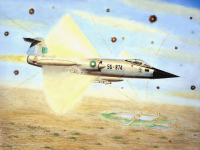
“Sonic Booms over Amritsar”
The painting depicts PAF F-104 piloted by F/L Farooq Umar, crossing sound barrier over Golden Temple, Amritsar, India.
After PAF shot down IAF Vampires over Chamb on September 1st, 1965, the PAF higher command wanted to send a clear warning message to Indians, not to mess with Pakistan and the PAF was fully capable to meet the challenges. The war was not officially declared at that time. So F/L Farooq Umar, who was on dusk CAP mission over Kashmir, was ordered to break the sound barrier over the famous Indian city. He reached the city and crossed the sound barrier at low altitude. Not satisfied, he came again, this time in opposite direction and rocked the city with massive sonic boom.
There was panic on the ground and even IAF did not come to intercept. Later that evening, All India Radio announced 8 PAF F-86s had bombed Amritsar city!!!! Despite Indian Ack ack, F-104 headed back to Sargodha unscratched and landed safely.
Courtesy: Aviation Art of Rehan Siraj
ghazi52
THINK TANK: CONSULTANT
- Thread starter
- #127
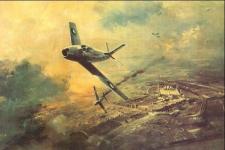
'Bo Kaata'
Faced with unexpectedly stiff resistance from Pakistan Army, the Indian offensive launched on 6th September 1965 in the Lahore-Kasur sector had floundered badly.
Having failed to capture the vital bridges on BRB Canal, XI Corps formations were unfavourably poised for further offensive operations towards Lahore. On a similar note, though Pakistan Army’s counter-offensive spearheaded by 1 Armoured Division had resulted in the capture of Khem Karan, further advance had been checked by Indian forces. For either side, the only prospect of a breakthrough under these stalemated conditions lay in meaningful intervention from the air. Control of the air was, therefore, vital for unhindered air support to land operations.
Relentless battering by the PAF had left the IAF mauled in the battle for air superiority. Having suffered several times more aircraft losses at the hands of an air force that was much smaller, the mood in the IAF was unquestionably distraught. PAF pilots thus found it opportune to fly Combat Air Patrols (CAP) with impunity, to the extent of setting up station on the border and, sometimes even inside enemy territory.
On the afternoon of 20th September, four Sabres took off from Sargodha for the usual CAP along Lahore-Kasur axis. The formation consisted of a motley of pilots – crème de la crème of different Units. The leader of the formation was Sqn Ldr Sharbat Ali Changazi, whose Mongol lineage was as conspicuous as it was daunting. He had managed to pull strings to be relieved from liaison duties with the Army and, had been attached to the Base a few days after the outbreak of the war. Entering the cockpit after months of medical unfitness following a scooter accident, Changazi was rearing for a clash in the air.
His wingman (No 2) was Flt Lt Anwaar-ul-haq Malik of No 5 Squadron, who had shot down a Mystère[2] on 7th September. Earning him the admiration and envy of his formation members, this achievement also gave Malik an air of unbridled confidence. The Deputy Leader (No 3) was Flt Lt Nazir Jilani, one of the Flight Commanders of No 11 Sqn. Flt Lt Amanullah, who was undergoing training on F-104s at the outbreak of war and had just switched back to F-86s, completed the formation as No 4.
Climbing to 20,000 ft, the Sabres headed southeast towards Kasur. The haze was bad and they could not see much of the ground. The sooner they had set up orbit, Sakesar radar warned them of IAF’s prompt reaction. “Four bogies climbing well inside enemy territory, heading north,” called the radar controller, racing everyone’s pulse.
The IAF had been working at ways to snare the Sabre CAPs for some time and, it was thought that a ‘mixed bag’ fighter sweep would do the trick. This time around, two Hunters and two Gnats were scrambled from Halwara. Sqn Ldr D P Chatterjee led No 7 Squadron’s Hunters, with Flt Lt S K Sharma as his wingman. Flt Lt A K Mazumdar and Flg Off K C Khanna formed the Gnat pair from No 2 Squadron.
Luck seemed to be in short supply as events unfolded for the sweep aircraft. Amritsar radar announced that it had lost the enemy blips on the radar scope, but directed the fighters to continue towards Amritsar and then head west. Arriving over Lahore, they found no trace of the Sabres, which was not surprising, given the poor visibility. Over enemy territory and clueless about where the blow would come from, was not the recommended method of flying a sweep mission. Worse, the Hunters and Gnats lost mutual contact too, and the pairs were on their own.
When the Sabres reached Lahore they had a dependable ground radar scanning through the hazy sky. A tight cross-cover formation also helped keep a double check on their tails as the Sabres circled over the historic city. Lahorites had earlier seen the Sabres in action on the morning of the Indian attack when No 19 Squadron had administered a classic work over to the armoured columns that threatened their city. Now, with the air situation again in control, Lahorites were ready for an encore.
During the orbit over Lahore, Amanullah spotted a couple of specks through the haze. “Two bandits about 5,000 ft below, 11 o’clock,” he warned. The sooner this call was heard, drop tanks were jettisoned and master firing switches armed, almost as reflex actions. Moments later, the specks transformed into silhouettes of two Hunters.
Jilani and Amanullah, who were closer, peeled off to dive after them. In the meantime, Changazi and Malik spotted a Hunter, which they presumed to be part of another pair that had perhaps sneaked in. Actually, it was Chatterjee who had split from his wingman during the defensive turn and, Changazi was only too pleased to tackle a singleton. Thus, within seconds of the encounter, two pockets of clashing fighters emerged – each with two Sabres jostling a Hunter.
Lahorites’ boundless passion for kite-flying, including an almost frenzied desire to bring down any other contender’s kite, has few parallels in leisurely sport. ‘Capturing’ a falling kite from the sky is considered akin to scalping and the loud-throated jeers that follow, signal bloody victory. With such zest for aerial frolics, it was no surprise that the people of Lahore thronged the roof tops when they heard the roar of jets overhead.
Changazi was the first to get his gunsight on the Hunter after out-manoeuvring it, despite a hung drop tank. After two short bursts from the Sabre’s guns the Hunter started emitting smoke, but desperate evasive manoeuvring continued for a while. Malik continued with a banter, which included a running commentary on what was going on; he noted with anxiety that the Hunter was still thrashing about despite his Leader’s relentless barrage. Changazi’s jugglery with the rudder finally offset the skid on the asymmetrically configured Sabre and, a volley landed squarely on his victim’s fuselage. The Hunter straightened out and fell into a listless dive, trailing thick black smoke. Chatterjee was apparently incapacitated as his aircraft plunged to the ground in Lahore’s Manawan locale, in full view of thousands of on-lookers.
The dramatic encounter got Malik so captivated that he forgot about ground control’s original report of four bogeys. The hitherto unseen Gnat pair had been lurking around, hoping for a chance pick-up on the Sabres. Majumdar and Khanna were doubly lucky, for not only had they caught the flash of the dogfighting aircraft, they were able to sneak behind the Sabres unnoticed. Changazi got an inkling of trouble when he heard the unmistakable noise of cannon-fire as bullets whizzed past his canopy. Aghast that the Gnats had closed in to firing range, he broke into a defensive turn. More appalling, however, his wingman was nowhere to be seen. Repeated calls to Malik went unanswered, though Jilani and Amanullah could be heard engaged with the other Hunter.
Prolonged absence from the cockpit had not dulled Changazi one bit, for he managed to shake off the agile little Gnats with ease. That, however, was hardly comforting; for the loss of his wingman had taken the sheen off his Hunter kill. Malik had, in fact, taken 30mm hits from Majumdar’s Gnat and his right wing and fuselage had been shattered, causing him to teeter on the verge of a spin. With his panels rattling, radio lost and cockpit full of smoke fumes, he desperately tried to stay aloft but to no avail. He was lucky enough to nurse the stricken aircraft away from the border and managed to eject over Lahore’s Harbanspura area; he was picked up without any major injury.
To the Lahorites, the thrill of watching aircraft come down like kites was almost juvenile. Oblivious of the identities of downed aircraft, they proclaimed spontaneous victory with their celebrated hoots. ‘Bo Kaata’ was the refrain of the day, signalling another fallen kite. There were so many aircraft pirouetting in the skies, it seemed like a re-enactment of the annual kite-flying festival heralding the onset of Basant.
Jilani and Amanullah had, in the meantime, been engaged with the Hunter flown by Sharma. While they were turning to get him, another Hunter had fired from behind, causing Amanullah to break away viciously. With eight aircraft milling around, it was hard to tell exactly what was going on. Evidence, however, seems to suggest that it was Chatterjee who had tried a pot shot at Amanullah’s Sabre, before getting embroiled with Changazi. Furthermore, once the Gnats were through with downing Malik’s Sabre, they promptly rallied around a beleaguered Sharma who had tenaciously held off the attackers for quite a while.
The dogfight had now developed exactly on the lines of the just concluded one. Jilani had thus to act fast to shoot the Hunter or else, expect bullets from the Gnats’ cannon to whiz past any time. Happily for Jilani, the combat had degenerated to the slow speed regime where the Sabre excelled. Manoeuvring with well-honed skills, Jilani managed to place his gunsight on the Hunter’s fuselage and let loose a volley. The Hunter started to spew smoke but Sharma was able to nurse his stricken aircraft into friendly territory before ejecting near Katron.
The thrilling dogfight over the skies of Lahore was an apt finale to PAF’s splendid performance in the battle for air superiority. The 2-1 tally in PAF’s favour was gratifying indeed; however, the whole formation had to pay for Malik’s downing as none of the scoring pilots was rewarded for gallantry.
The concept of group retribution had been stretched a bit far, but nevertheless, it did signify PAF’s regard for teamwork rather than individual glory. On the IAF’s side, Flt Lt Ajoy Kumar Mazumdar was awarded a well-deserved Vir Chakra for shooting down a Sabre. However, the downing of No 7 Squadron’s two Hunters added upto an atrocious total of eight aircraft lost in air combat, which was 50% of the Unit’s inventory. The fact that this was more than the entire PAF’s air combat losses, rightly established Lahorites’ victory cry as no rude jeer.
This article is an excerpted chapter from Air Cdre Kaiser Tufail's book, Great Air Battles of Pakistan Air Force, published by Ferozsons (Pvt) Ltd, 2005. It was also published in the daily newspaper Dawn (Books & Authors Supplement), 15 May 2005.
ghazi52
THINK TANK: CONSULTANT
- Thread starter
- #129
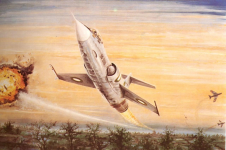
DOGFIGHT AT DAWN
By: Sarmad Hassan Sharif
Date: September 06, 1965
Time: 0530 Hours
Sector: Wazirabad-Rahwali
On 6 September 1965, it was about 0530 hours that full realization of the scale of the Indian onslaught was realized by Pakistan, by which time the early morning CAPs were already airborne to patrol over Chamb. It was about the same time when four Indian Air Force Mystères from Adampur were reported, attacking a passenger train which had just pulled at Gakhar Railway Station.
Sakesar diverted two F-104 Starfighters who were on a high level CAP. As both the aircraft reached overhead Rahwali they could not visually acquire the enemy fighters which were reported down below them. Since it was twilight, and dawn was breaking in the horizon, the ground features were not yet visible. Nonetheless, Flight Lieutenant Aftab Alam dived down while the other Starfighter remained on that altitude; acting as a radio relay.
Scanning the horizon, Aftab picked up the Mystères, which upon spotting the Starfighter, scurried in the general direction of India at deck level. The Starfighter positioned itself behind one of the trailing Mystères and fired a Sidewinder. Aftab then pulled up allegedly owing to flash from his Sidewinder missile. In this process he lost sight of the other Mystères who made good their escape. The PAF awarded the pilot with one Mystère destroyed and one Mystère damaged. The PAF History 1988 has mentioned it as the first kill by a Mach-2 fighter, as well as the first kill by a Sidewinder missile by the PAF. However, there was no kill.
I have discussed this mission with several war veterans and retired PAF pilots who have actually fired the AIM-9B Sidewinder (GAR-8) missile in combat. The missile had the limitation of firing beyond 2 G’s, but more important is the severe limitation that the heat source had to be well above the horizon and therefore the predator aircraft had to be clearly below and behind its quarry. This then limited the effectiveness of the old version of AIM-9B Sidewinder (GAR-8) against a target which had to be above the horizon to prevent lock-on to ground return heat energy. Therefore, to claim missiles kill from ultra-low levels, in this case ~ 50 ft. the F-104 had to be lower than the target, which seems impossible. As revealed later by IAF that the F-104 did not scored any hit in that mission. Yet there was a claim of one destroyed and one damaged. Since the Mystère was flying at treetop level, it was virtually impossible for a Sidewinder to home-in on the Mystère. Exiting at tree top level, the Indian Mystère escaped unscathed, as the missile hit the ground (owing to greater heat emission from the ground as compared to the aircraft exhaust). Another observation noted were the tactic which the Indians adopted after being intercepted inside Pakistani territory. Once intercepted, the Indians hugged the terrain after cleaning their configuration. This method proved successful against any Sidewinder equipped PAF interceptor, which did not have the cushion to get below the escaping intruders. Many missiles were unsuccessfully fired later on in the conflict thus validating the limited performance of AIM-9B missile, its deterrent value notwithstanding.
In this case, although an explosion was observed, it later transpired that the Indian pilot, identified as Flight Lieutenant Paddy Earle, had jettisoned his drop tanks hoping to put distance between himself and the menacing Mach-2 Starfighter. The ‘blinding flash’ was the result of the tanks exploding and was presumed by the Pak Army observer to be the destruction of the Mystère. While the three Mystères landed back at Adampur, Paddy Earle had to divert to Pathankot after escaping the menacing Starfighter, reported to have been admonished by his superiors for losing his precious drop tanks.
Copyright 2021 Sarmad Hassan Sharif. All Rights Reserved. Reproduction in whole or in part in any form or medium without express written permission of author is prohibited.
© Painting Gp Capt S M A Hussaini
ghazi52
THINK TANK: CONSULTANT
- Thread starter
- #130
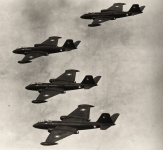
HALWARA NIGHT BOMBING MISSION
By: Sarmad Hassan Sharif
Date: September 07, 1965
Target: Halwara Air Base
The PAF bomber crews were left with quite enough opposition from intense AAA, as well as natural hazards of darkness, fatigue from repeated operations and bad weather. It was weather which defeated an earlier attempt that evening to strike Halwara airfield with three B-57s, leaving only a single bomber, flown by Flight Lieutenant Alvi, available to make a final pre-dawn strike as a last resort.
This crew had previously manned the fifth B-57 in the Pathankot strike, having failed to get off the ground for an earlier mission, but had landed back at Peshawar instead of Mauripur. Because of the congestion the B-57 could not be turned around to take-off for its next sortie until 0340 hours, which took it perilously close to daylight. Its crew made their lone way successfully to Halwara, however, and dumped their bombs in the centerline of the airfield before returning safely to Samungli, just outside Quetta.
This new airfield was being used to relieve the congestion at Peshawar, which by then was beginning to receive some attention from the IAF. Thus ended the first night’s operations by the B-57 wing, which had been fully extended and had attacked all its targets for the loss of only one aircraft.
The success of the runway strike strategy remained to be seen, but at least the B-57 crews had established a viable modus operandi, and having taken the measure of the Indian defenses, remained unimpressed.
Haris Zuberi paying tribute to the valor of these unsung heroes states, “For a relatively smaller PAF facing a much larger IAF, the performance of the aviators on the challenging initial missions was destined to set the pace for the war in the air as well as shape the psyche of the PAF air-warriors, thus proving directly decisive for the final outcome.
From the very onset the F-86 fighter squadrons in the north and B-57 bomber squadrons in the south correspondingly demonstrated parallel heroism and coined identical tales of valor.
The Shuhada (Martyrs) from the first day of the war played a most crucial role in multiplying the spirit of devotion and boosted the morale exponentially, all which was an undeniable force-multiplier for PAF against a larger enemy. These martyrs inspired their colleagues to emulate their fearlessness, redeem the losses and while hitting back hard, reinforce the gains of the initial operations achieved by their valiant lost colleagues.
The PAF was thus led by their glimmering examples of seamless devotion to duty, dauntless courage and fearless initiative in the face of grave danger on the very first night.”
Copyright 2021 Sarmad Hassan Sharif. All Rights Reserved. Reproduction in whole or in part in any form or medium without express written permission of author is prohibited.
ghazi52
THINK TANK: CONSULTANT
- Thread starter
- #131
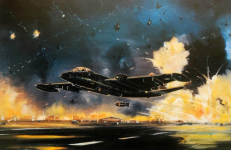
On 20 September 1965, Sqn Ldr Rais Rafi, OC No 8 Squadron, led a daring night strike on Ambala airfield deep inside India.
Flying a low-level skip-bombing profile at just 500 feet, his three-ship formation released four 1,000-lb bombs with precision, 15 minutes after a preceding B-57 attack.
The bombs skipped along the ground before exploding on their 10-second delay fuses. Navigator Flt Lt Saadat Muhammad Akhtar Khan flew alongside him as they pressed the attack through heavily defended territory.
The mission kept Indian air defences tied down at their rear bases while demonstrating the PAF’s offensive reach toward Delhi. It exemplified the courage, accuracy and resolve of PAF bomber crews who repeatedly struck deep into enemy territory.
Painting By: Gp Capt S M A Hussaini
Users who are viewing this thread
Total: 4 (members: 0, guests: 4)


