
Beijingwalker
VIP Member

Hong Kong overtakes Switzerland as hub for global offshore wealth
Mercedes Ruehl in Zurich and Arjun Neil Alim
MAY 27 2026
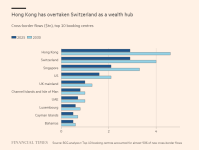
Hong Kong has overtaken Switzerland as the world’s biggest cross-border wealth hub for the first time, as an influx of investment from the Chinese mainland helped it eclipse the traditional haven.
Wealth managers in the Chinese territory booked $2.9tn of international assets in 2025, according to estimates from the Boston Consulting Group.
About 60 per cent of that came from mainland China, with BCG forecasting that the rapid increase in Asian fortunes would widen the gap between Hong Kong and Switzerland to almost $600bn by the end of the decade.
China’s growth has been bolstered by a return of equity capital markets activity in Hong Kong that has allowed companies to raise funds offshore, as well as the country’s manufacturing dominance in sectors such as electric vehicles.
But the rise of the Asian city as a cross-border hub also reflects broader shifts in global wealth flows, with clients seeking to spread their assets across multiple jurisdictions to hedge against geopolitical tensions, sanctions risks and political instability.
“This is a completely new phenomenon. I haven’t seen anything like it,” said Michael Pellman Rowland at Baseline Wealth Management, a Swiss-based independent manager with global clients.
Wealthy clients moving money offshore had traditionally been motivated by tax planning or corporate structuring, Rowland said, but since the coronavirus pandemic they had increasingly sought “jurisdictional diversification” — spreading assets across countries to protect against geopolitical and political risks.
Diversification had helped reinforce the dominance of the world’s largest “booking centres” — the hubs where banks manage and safeguard offshore wealth for international clients — according to BCG partner Michael Kahlich.
“We see two different hubs emerging,” Kahlich said, with Hong Kong and Singapore anchoring one network in Asia, and Switzerland, the UAE and the US forming a rival axis to the west.
Although Switzerland is more heavily tied to mature western European fortunes and less exposed to the fast-growing Asian wealth flows reshaping the industry, bankers said that many wealthy Asian clients still wanted assets ultimately booked in Switzerland.
Most large international banks, including Swiss private lenders, now have major booking operations in Hong Kong and Singapore to serve Asia’s growing fortunes.
But financiers question whether the country is doing enough to stay competitive, with its biggest bank, UBS, at loggerheads with regulators over new capital rules.
“The question is whether Switzerland is doing enough to actively defend its position in wealth management, or just relying on its stability. I think it is the latter,” said one UBS banker based in Zurich.
Other centres such as Dubai have also grown rapidly since the pandemic as a bridge between rival eastern and western pools of capital.
Banks including UBS, JPMorgan and Deutsche Bank have expanded aggressively in the emirate in recent years, drawn by zero income tax, relative political stability and an influx of wealthy individuals, hedge funds and family offices from across Russia, India, China, Europe and the Gulf.
But cross-border wealth booked in the UAE remains much smaller than either Switzerland or Hong Kong at $721bn last year, BCG said, even with growth of 11 per cent.
Singapore, another major beneficiary of the eastward shift in global capital, has also seen growth moderate after high-profile money laundering cases triggered a regulatory crackdown and tougher scrutiny of wealthy foreign clients.


