Navigation
Install the app
How to install the app on iOS
Follow along with the video below to see how to install our site as a web app on your home screen.
Note: This feature may not be available in some browsers.
More options
Style variation
You are using an out of date browser. It may not display this or other websites correctly.
You should upgrade or use an alternative browser.
You should upgrade or use an alternative browser.
Houthis threaten Pakistan with missiles if it joins Saudi Arabia
- Thread starter clutch
- Start date
More options
Who Replied?


RescueRanger
Meme Lord
Will the Houthis align themselves with TLP and BLA and attack Pakistan with missiles?

PAKISTANFOREVER
Trusted Member

Will the Houthis align themselves with TLP and BLA and attack Pakistan with missiles?
Pakistan NEEDS to keep WELL AWAY from this mess. We ALREADY have enough MASSIVE issues with afghandu and indian terrorism.

clutch
Elite Member
- Thread starter
- #4
I agree Pakistan should focus on its own neighborhood. We have enough problems with Afghan terrorists and Indian terrorism and Indian designs to take over Kashmir etc. Pakistan needs to fix its own house and don't get entangled in foreign wars. That's the last thing Pakistan needs.Pakistan NEEDS to keep WELL AWAY from this mess. We ALREADY have enough issues with afghandu and indian terrorism.
Houthis attacking Pakistan will be India's wildest dreams coming true....
pakistanitarzan
Registered Member
From Gemini:
Geographically and technically, no, the Houthis do not possess operational ballistic missiles or long-range strike assets capable of reaching Pakistan.
Here is a breakdown of why:
1. Distance Constraints
The distance between Yemen (where the Houthi movement is based) and Pakistan (such as Karachi or major military installations) is roughly 3,500 to 4,000 kilometers (about 2,200 to 2,500 miles) depending on the specific launch and target points.
2. Missile Capabilities
Short- and Medium-Range Missiles: The vast majority of the Houthi arsenal consists of short-range ballistic missiles, anti-ship cruise missiles, and loitering munitions (drones) designed for regional targets in Yemen, the southern Red Sea, Saudi Arabia (such as Riyadh or Abha), and parts of the United Arab Emirates. These typically have ranges spanning from a few hundred up to roughly 1,500–2,000 kilometers at most (such as variants of the Quds or Toufan/Ghods missiles).
Intercontinental Range: Reaching Pakistan would require Intercontinental Ballistic Missile (ICBM) or very long-range strategic cruise missile technology, which the Houthis do not possess.
Context on Recent Tensions
While regional friction and threats have surfaced—particularly following the activation of the trilateral "Mecca Defense Pact" between Saudi Arabia, Pakistan, and Turkey, which led to rhetorical threats from Houthi figures directed at countries participating in operations—these threats remain political posturing rather than a feasible military capability against mainland South Asia.
Geographically and technically, no, the Houthis do not possess operational ballistic missiles or long-range strike assets capable of reaching Pakistan.
Here is a breakdown of why:
1. Distance Constraints
The distance between Yemen (where the Houthi movement is based) and Pakistan (such as Karachi or major military installations) is roughly 3,500 to 4,000 kilometers (about 2,200 to 2,500 miles) depending on the specific launch and target points.
2. Missile Capabilities
Short- and Medium-Range Missiles: The vast majority of the Houthi arsenal consists of short-range ballistic missiles, anti-ship cruise missiles, and loitering munitions (drones) designed for regional targets in Yemen, the southern Red Sea, Saudi Arabia (such as Riyadh or Abha), and parts of the United Arab Emirates. These typically have ranges spanning from a few hundred up to roughly 1,500–2,000 kilometers at most (such as variants of the Quds or Toufan/Ghods missiles).
Intercontinental Range: Reaching Pakistan would require Intercontinental Ballistic Missile (ICBM) or very long-range strategic cruise missile technology, which the Houthis do not possess.
Context on Recent Tensions
While regional friction and threats have surfaced—particularly following the activation of the trilateral "Mecca Defense Pact" between Saudi Arabia, Pakistan, and Turkey, which led to rhetorical threats from Houthi figures directed at countries participating in operations—these threats remain political posturing rather than a feasible military capability against mainland South Asia.
r3alist
Elite Member
But Saudi economic strength is important to PakistanI agree Pakistan should focus on its own neighborhood. We have enough problems with Afghan terrorists and Indian terrorism and Indian designs to take over Kashmir etc. Pakistan needs to fix its own house and don't get entangled in foreign wars. That's the last thing Pakistan needs.
Houthis attacking Pakistan will be India's wildest dreams coming true....
RescueRanger
Meme Lord
You needed AI to tell you this?From Gemini:
Geographically and technically, no, the Houthis do not possess operational ballistic missiles or long-range strike assets capable of reaching Pakistan.
Here is a breakdown of why:
1. Distance Constraints
The distance between Yemen (where the Houthi movement is based) and Pakistan (such as Karachi or major military installations) is roughly 3,500 to 4,000 kilometers (about 2,200 to 2,500 miles) depending on the specific launch and target points.
2. Missile Capabilities
Short- and Medium-Range Missiles: The vast majority of the Houthi arsenal consists of short-range ballistic missiles, anti-ship cruise missiles, and loitering munitions (drones) designed for regional targets in Yemen, the southern Red Sea, Saudi Arabia (such as Riyadh or Abha), and parts of the United Arab Emirates. These typically have ranges spanning from a few hundred up to roughly 1,500–2,000 kilometers at most (such as variants of the Quds or Toufan/Ghods missiles).
Intercontinental Range: Reaching Pakistan would require Intercontinental Ballistic Missile (ICBM) or very long-range strategic cruise missile technology, which the Houthis do not possess.
Context on Recent Tensions
While regional friction and threats have surfaced—particularly following the activation of the trilateral "Mecca Defense Pact" between Saudi Arabia, Pakistan, and Turkey, which led to rhetorical threats from Houthi figures directed at countries participating in operations—these threats remain political posturing rather than a feasible military capability against mainland South Asia.
pakistanitarzan
Registered Member
Yes brother. I wasnt sure of what capability they possess.You needed AI to tell you this?
clutch
Elite Member
- Thread starter
- #9
From Gemini:
Geographically and technically, no, the Houthis do not possess operational ballistic missiles or long-range strike assets capable of reaching Pakistan.
Here is a breakdown of why:
1. Distance Constraints
The distance between Yemen (where the Houthi movement is based) and Pakistan (such as Karachi or major military installations) is roughly 3,500 to 4,000 kilometers (about 2,200 to 2,500 miles) depending on the specific launch and target points.
2. Missile Capabilities
Short- and Medium-Range Missiles: The vast majority of the Houthi arsenal consists of short-range ballistic missiles, anti-ship cruise missiles, and loitering munitions (drones) designed for regional targets in Yemen, the southern Red Sea, Saudi Arabia (such as Riyadh or Abha), and parts of the United Arab Emirates. These typically have ranges spanning from a few hundred up to roughly 1,500–2,000 kilometers at most (such as variants of the Quds or Toufan/Ghods missiles).
Intercontinental Range: Reaching Pakistan would require Intercontinental Ballistic Missile (ICBM) or very long-range strategic cruise missile technology, which the Houthis do not possess.
Context on Recent Tensions
While regional friction and threats have surfaced—particularly following the activation of the trilateral "Mecca Defense Pact" between Saudi Arabia, Pakistan, and Turkey, which led to rhetorical threats from Houthi figures directed at countries participating in operations—these threats remain political posturing rather than a feasible military capability against mainland South Asia.
Also from Gemini:
The Houthis possess the technological capability to strike the extreme southwestern edge of Pakistan—specifically the port of Gwadar—but major population centers like Karachi, Lahore, and Islamabad are physically beyond their maximum missile range. Geopolitically, a direct attack is highly improbable and would only occur under a drastic shift in regional alliances.
The Technology and Geographic Reality
The Houthi arsenal is primarily engineered to threaten Saudi Arabia, the UAE, and Israel. Striking Pakistan requires pushing their longest-range systems to their absolute limits.
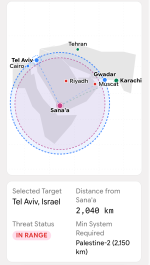
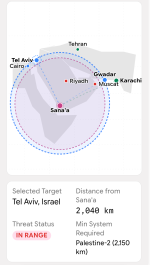
* The Distance: The distance from Houthi-controlled Yemen (e.g., Sana'a) to the closest point in Pakistan (Gwadar in Balochistan) is approximately 2,100 kilometers. The distance to Karachi is over 2,550 kilometers.
* Ballistic Missiles: The Houthis' longest-range ballistic missiles, such as the Toufan and the hypersonic-claimed Palestine-2 (based on Iranian Ghadr and Kheibar Shekan designs), have a maximum proven range of 1,950 to 2,150 km. These are the systems used to strike central Israel (a distance of roughly 2,040 km).
* Cruise Missiles and Drones: The Quds-4 land-attack cruise missile and the Yaffa or Samad-3 long-range UAVs have claimed operational envelopes of 2,000 to 2,500 km.
The Verdict: Gwadar sits exactly at the outer boundary of the Houthis' longest-range weapons. To reach it, missiles would have to fly across the Arabian Sea, likely carrying a reduced payload to maximize fuel capacity. Karachi, Pakistan's naval headquarters, and the rest of the country are out of range.
Potential Scenarios for an Attack
Pakistan and the Houthis have no direct conflict. In 2015, Pakistan's parliament explicitly voted against joining the Saudi-led military coalition in Yemen, a decision that kept Islamabad out of the Houthi crosshairs. For the Houthis to target Pakistan, one of the following unprecedented scenarios would need to unfold:
1. Direct Naval Clashes in the Arabian Sea
This is the most plausible theoretical trigger. The Pakistan Navy routinely operates in the Arabian Sea and Gulf of Aden, frequently commanding multinational task forces (like Combined Task Force 150 and 151). If a Pakistani warship were to forcefully intercept Iranian weapons shipments bound for Yemen, or actively engage Houthi drones targeting commercial shipping, the Houthis could retaliate by firing anti-ship ballistic missiles at Pakistani vessels or launching a warning strike toward the Balochistan coast.
2. Reversal of Pakistani Neutrality
If Pakistan were to abandon its neutral stance on Yemen and provide direct military basing, intelligence, or active combat support to a US- or Saudi-led coalition conducting strikes on Houthi infrastructure, the Houthis would likely designate Pakistan as a legitimate target, just as they have with the UAE and Saudi Arabia.
3. Spillover from an Iran-Pakistan Conflict
The Houthis operate as a prominent faction within Iran's "Axis of Resistance." In early 2024, Iran and Pakistan exchanged brief cross-border airstrikes targeting militant groups. If a full-scale armed conflict were to erupt between Tehran and Islamabad, Iran could theoretically direct the Houthis to open a peripheral front by harassing Pakistani shipping in the Arabian Sea. However, because Iran shares a direct land border with Pakistan, it would have little tactical need to rely on a proxy 2,000 kilometers away to strike
Pakistani soil.
Attachments

RescueRanger
Meme Lord
Brother the Al-Mandab has a range of approx. 300km their Burkan-2H has a range between 1000 KM.Yes brother. I wasnt sure of what capability they possess.
RescueRanger
Meme Lord
ALSO FROM PAKISTAN:Also from Gemini:
The Houthis possess the technological capability to strike the extreme southwestern edge of Pakistan—specifically the port of Gwadar—but major population centers like Karachi, Lahore, and Islamabad are physically beyond their maximum missile range. Geopolitically, a direct attack is highly improbable and would only occur under a drastic shift in regional alliances.
The Technology and Geographic Reality
The Houthi arsenal is primarily engineered to threaten Saudi Arabia, the UAE, and Israel. Striking Pakistan requires pushing their longest-range systems to their absolute limits.
* The Distance: The distance from Houthi-controlled Yemen (e.g., Sana'a) to the closest point in Pakistan (Gwadar in Balochistan) is approximately 2,100 kilometers. The distance to Karachi is over 2,550 kilometers.
* Ballistic Missiles: The Houthis' longest-range ballistic missiles, such as the Toufan and the hypersonic-claimed Palestine-2 (based on Iranian Ghadr and Kheibar Shekan designs), have a maximum proven range of 1,950 to 2,150 km. These are the systems used to strike central Israel (a distance of roughly 2,040 km).
* Cruise Missiles and Drones: The Quds-4 land-attack cruise missile and the Yaffa or Samad-3 long-range UAVs have claimed operational envelopes of 2,000 to 2,500 km.
The Verdict: Gwadar sits exactly at the outer boundary of the Houthis' longest-range weapons. To reach it, missiles would have to fly across the Arabian Sea, likely carrying a reduced payload to maximize fuel capacity. Karachi, Pakistan's naval headquarters, and the rest of the country are out of range.
Potential Scenarios for an Attack
Pakistan and the Houthis have no direct conflict. In 2015, Pakistan's parliament explicitly voted against joining the Saudi-led military coalition in Yemen, a decision that kept Islamabad out of the Houthi crosshairs. For the Houthis to target Pakistan, one of the following unprecedented scenarios would need to unfold:
1. Direct Naval Clashes in the Arabian Sea
This is the most plausible theoretical trigger. The Pakistan Navy routinely operates in the Arabian Sea and Gulf of Aden, frequently commanding multinational task forces (like Combined Task Force 150 and 151). If a Pakistani warship were to forcefully intercept Iranian weapons shipments bound for Yemen, or actively engage Houthi drones targeting commercial shipping, the Houthis could retaliate by firing anti-ship ballistic missiles at Pakistani vessels or launching a warning strike toward the Balochistan coast.
2. Reversal of Pakistani Neutrality
If Pakistan were to abandon its neutral stance on Yemen and provide direct military basing, intelligence, or active combat support to a US- or Saudi-led coalition conducting strikes on Houthi infrastructure, the Houthis would likely designate Pakistan as a legitimate target, just as they have with the UAE and Saudi Arabia.
3. Spillover from an Iran-Pakistan Conflict
The Houthis operate as a prominent faction within Iran's "Axis of Resistance." In early 2024, Iran and Pakistan exchanged brief cross-border airstrikes targeting militant groups. If a full-scale armed conflict were to erupt between Tehran and Islamabad, Iran could theoretically direct the Houthis to open a peripheral front by harassing Pakistani shipping in the Arabian Sea. However, because Iran shares a direct land border with Pakistan, it would have little tactical need to rely on a proxy 2,000 kilometers away to strike
Pakistani soil.
WE HAVE DANDA TOO!
RescueRanger
Meme Lord
No issue nothing burger of a thread.
Users who are viewing this thread
Total: 36 (members: 10, guests: 26)
Pakistan Defence Latest
-
 Federal cabinet gives nod to imposition of emergency in KP; summary sent to president (37 Viewers)
- Latest: Distant_Observer
-

-

-

-
Country Watch Latest


Latest Posts
-
Federal cabinet gives nod to imposition of emergency in KP; summary sent to president (37 Viewers)
- Latest: Distant_Observer
-
-

-

-
Houthis threaten Pakistan with missiles if it joins Saudi Arabia (35 Viewers)
- Latest: Hakikat ve Hikmet