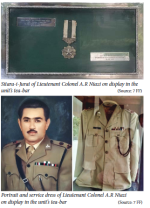
This battle is very close to our family, many of my uncles and their cousins were officers during the 1965 war including my dada's brother who we all lovingly called Dadu (Late Lt. Col Abdul Rabb Niazi SJ, took part in the battle of BRBL/ Chawinda and Jassoran.
--
The below is a collection of his memories as Published in the Journal of Military History at the Pakistan Army Institute of Military History, Rawalpindi.
--
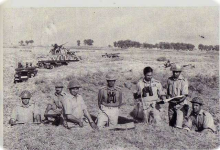
After intense and tireless participation in Khem Karan operations, 3rd Armoured Brigade was ordered to move to Sialkot Sector on 10th September, due to enemy
pressure.
Meanwhile, the situation at Lahore deteriorated, and 7 FF1 was tasked to report to Headquarters 10 Division. The unit played a decisive role in the defensive battles at Bambawali-Ravi-Bedian Link Canal (BRBL) and Lahore Syphon on night 10-11 September.
On 12th September, 7 FF3 along with 23 Cavalry (less a squadron) were placed as counter attack/counter penetration force of 10 Division. The unit was ordered to move to Gujranwala on 15th September, since the situation at Lahore was stabilized. This meant the induction of the unit in Sialkot; a third major war theatre within a week.
On 16th September, the battalion moved by road while the armoured personnel carriers (APCs) were transported by train under Major Jamal Shah. Both the convoys linked up at Gujranwala railway station, and moved to the concentration area in Gujranwala. The battalion took up defensive position near Piro Chak, about 10 miles east of Chawinda, where it remained deployed for the next couple of days.
Battle of Jassoran
On 19th September 1965, at around 1200 hours, Lieutenant Bilal Rana, a brilliant and outstanding young subaltern (later Major Bilal Rana, SJ, shaheed, ex 3 Commando Battalion, who met shahadat at Chandpur, East Pakistan in December 1971), was ordered to report along with ‘B’ Company to 19 Lancers (19 L). my dadu Major (later lieutenant colonel) Abdul Rabb Niazi, was second-in-command of the unit, but earlier at Lahore he had voluntarily assumed additional duties of Officer Commanding ‘B’ Company, where the tables were turned by the heroics of the company on the night of 10-11 September.
He was back again to lead the company. No briefing or further information was given. The exact location of 19 L was neither provided nor known, however with the guidance of an engineer detachment, APCs cautiously moving in single file along the route, the company finally reached the destination around 1500 hours.
Task Force.
Lieutenant Colonel Abdul Rehman, Commanding Officer (CO), who moved separately in his jeep, had already reached. Officers of 19 L were also unaware of the exact task until arrival of Major Bakhtawar Khan in the late afternoon. He was second-in-command of 14 FF8 and was appointed commander of a task force comprising an armoured infantry rifle company each from 7 FF and 14 FF9, and a squadron minus (two troops of tanks) of 19 L. Headquarters
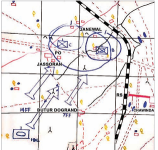
Armoured Division had tasked it to capture Jassoran (a village near Chawinda railway station), exploit up to Janewal, and evict the enemy. The attack was jointly planned by
the commanding officers of 19 L and 7 FF, in consultation with the task force commander, which was carried out on the map.
 The Preparatory Phase.
It was a complex situation. The task involving three different units, was being conveyed and explained by the Commander Task Force himself. There
was no one present from the higher HQ.
No reconnaissance was carried out, neither was any fire plan formally constituted, nor did the commanding officer of any of the participating units brief them personally. There was no formal link-up between the participating troops of both the Armoured Infantry Battalions (AIBs), and no pre-planning discussion was held. The positions and direction of attack were explained on a map.
It was told that the objective was a company position with some automatics, however during the attack it turned out that it was a company plus, with a machine gun section, which included a medium machine gun (MMG) position as well, and was supported by tanks. A smart young subaltern joined as an artillery observer. In the absence of a fire support plan, artillery cover was not likely.
Air support was already unavailable, however corps artillery provided fire support during the operation.
The Attack and the Capture of Jassoran.
The attack commenced around 1700 hours, supported by a troop of tanks of 19 L under Lieutenant Iftikhar Adam. By the time attacking troops neared the target, it was close to sunset, which turned it into a dusk attack. As soon as tanks came in the open, Lieutenant Adam’s tank was hit. He and his crew bailed out safely, but that was the end of tanks in direct support, and the armour went into fire support role.
Soon both the companies of 7 FF and 14 FF were not in sight of each other, and the enemy’s artillery and automatic fire intensified. As the target came nearer, the enemy fire seemed like rain, with a whistling sound, but miraculously it was not harming the assaulting wave. This unbelievable miracle boosted the confidence and morale of attacking troops. The enemy was taken aback by the unabated advance, despite the heavy fire of automatics. Watching the attacking force crossing their formidable wall of fire, created panic in the Indian line of defence.
They vacated their well dug out trenches and fled. Major A.R Niazi ordered his men to occupy the trenches and open fire on the fleeing enemy. By this time, it was getting dark and an amazing scene was being witnessed. Enemy troops were falling in large numbers, under the heavy roar of an automatic.
Lance Naik Omar Din of 7 FF was behind the enemy’s deserted MMG, taking the fleeing enemy troops like a duck-shoot. Luckily, Omar Din had undergone a course on MMG just prior to the war, and knew how to operate it (The MMG still lies in the quarter guard of 7 FF as a war trophy).
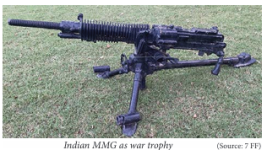
What initially looked like the enemy taking cover on the ground, was found to be nearly 100 casualties during exploitation stage, where Janewal was cleared and the area up to railway line was secured. Two enemy tanks were hit by rocket launchers.
After mopping up, positions were readjusted to occupy the defences. Soon the enemy’s counter attack came, which was successfully thwarted. At night, the listening post of 7 FF apprehended Major S.P. Wadhawa, an Indian artillery officer. He was in possession of a map marked with Indian artillery positions.
After initial interrogation, ‘B’ Company was ordered by battalion headquarters to escort the apprehended officer to Headquarters 6 Armoured Division. Subedar (later Subedar Major) Sher Bahadur of 7 FF, who escorted the prisoner, later said that the divisional headquarters were surprised to see the map.
At first light, a major counter attack was launched by the enemy, but the tanks and infantry were both well prepared to face it, and subjected it to accurate fire. The enemy withdrew after suffering heavy casualties.
The general area around Chawinda was secured, and was never threatened for the remaining part of the war. Allah Almighty Sent Victory. My dadu Col. Abdul Rabb wrote in his memoirs,
‘we actually witnessed what is generally perceived regarding the 1965 War, that Allah Almighty sent divine support. On that evening, we not only witnessed but experienced it.
The artillery shells were landing in close proximity, but splinters were ineffective. We could physically feel bullets blistering through our legs, under the arms, and whistling near the neck and ears.
The ground felt like cotton, tank shells blowing cold wave closer to our bodies, but divine power kept us unharmed. The impregnable defensive wall of fire crumbled before us like sand. We were later told by the CO that it was anticipated as a mopping up operation at the start of planning, but it ended up in a full-fledged attack.'
Post Operation Sequel
It was later learnt that ‘B’ Company 7 FF actually came in contact with a whole company of 6 Maratha Light Infantry. ‘C’ Company of 14 FF had landed against another
platoon plus strength. Later reports confirmed presence of troops of 6 Maratha Light Infantry, 20 Rajput and 5 Jammu and Kashmir (J&K) Rifles, which confirmed that it was a well dug out and heavily defended position.
Major General Yashwant Deva in his book ‘The Saga of Grit and Cold Courage’, has acknowledged the deaths of 37 personnel from the three battalions on night 19/20 September 1965.
The casualties suffered by ‘B’ Company of 7 FF during the entire operation were three shaheed and four wounded while ‘C’ Company of 14 FF had one shaheed and two wounded.
In all, one tank, one MMG, two machine guns, one jeep and a heavy cache of small arms and ammunition were captured by ‘B’ Company alone. Enemy’s overall casualties were well over 200.
Lieutenant General Vijay Oberoi, ex Indian vice chief, in his article ‘Marathas in the 1965 Indo Pak War’ writes about 6 Maratha Light Infantry, that two
officers, including the CO, two JCO’s (junior commissioned officers) and 36 OR (other ranks) were killed; two officers and 30 OR were wounded; and two officers, four JCO’s and 110 OR were taken prisoner.
Witness to the Victory. Major General (later Lieutenant General and foreign minister) Sahibzada Yakub Khan took command of 1st Armoured Division a day before. He witnessed the attack himself from a dominating view point, in his command tank. The next day he called my dadu Major Niazi to the divisional headquarters. The colonel staff greeted him with the remarks,
‘What have you done with the Indians? You have literally butchered them’.
He then told him that the general was very happy and wanted to see him in person. The general officer commanding (GOC) rose from his chair and gracefully shook hands, which was an unexpected pleasant surprise. In a In a commanding yet friendly tone, he told him that he had personally witnessed the attack, and was extremely proud of the outstanding performance of the Chattaks.
He not only recommended my dadu Major A. R Niazi for Sitara-i-Jurat (SJ), but got it approved from the General Headquarters.
Battalions’ Feat of Glory. One SJ, one Tamgha-i-Jurat (TJ) and two Imtiazi Sanad were awarded to individuals of ‘B’ Company 7 FF, although recommendation for three
TJs and three imtiazi sanads were forwarded.
Lance Naik Omar Din was awarded Imtiazi Sanad, although he deserved a TJ, considering his role in use of MMG, and inflicting a large number of casualties. Lieutenant Bilal Rana, Naik Lal Badshah and Lance Naik Omar Din were awarded gallantry certificates by GOC 1st Armoured Division.
Major Bakhtawar and Major (later major general) Khawaja Rahat Latif from 14 FF were awarded Imtiazi Sanad.
--
My Dadu being awarded the SJ by the President of Pakistan in 1966
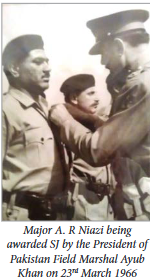 His SJ and his uniform still hang today in the Unit's Tea Bar