Deepening deterrence: India’s expanding SSBN capability
India’s expanding fleet of nuclear-powered ballistic missile submarines and progress with new basing infrastructure reflects its maturating sea-based nuclear deterrent and credible second-strike capabilities.
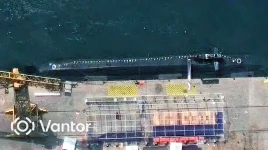
On 3 April 2026, the Indian Navy commissioned INS Aridhaman (S4), its third nuclear-powered ballistic missile submarine (SSBN), at Visakhapatnam on the Bay of Bengal.
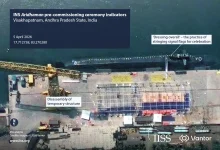
Despite widespread reporting by local media, there was no official confirmation, with New Delhi remaining secretive about its growing SSBN capabilities. Nonetheless, satellite imagery analysis by the IISS corroborates reporting, with imagery from 5 April showing an SSBN – almost certainly INS Aridhaman – with maritime signal flags strung along its hull. Known as ‘dressing overall’, the practice is reserved for special celebratory events.
 Towards a credible deterrent capability
INS Aridhaman (S4) will serve alongside the already commissioned INS Arihant (S2) and INS Arighaat (S3). India’s fourth SSBN, S4*, which is expected to be named INS Arisudan, was launched in October 2024 and is undergoing sea trials.
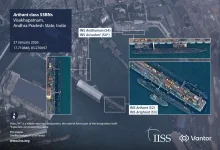
Assessments regarding the status of India’s naval deterrence are mixed. Indian authorities credit their SSBNs as having undertaken ‘deterrence missions’ – with the lead boat Arihant completing a first patrol in late 2018. However, their growing fleet is not yet fully operational in a commonly understood Continuous At-Sea Deterrent (CASD) role, with imagery from January 2026 showing all four hulls alongside at Visakhapatnam.
Though a continuous patrolling cycle is theoretically possible with three boats rotating between patrol, repair, and training, this leaves little redundancy or flexibility, especially considering that each stage is likely to vary in duration. Commissioning S4*, potentially in 2027, will ease operational pressures and allow at least one boat to be continuously on patrol. In conjunction, the other SSBNs can progress through repair and training cycles while the fourth boat remains in reserve, in case of operational or technical issues. The commitment to four
Arihant-class SSBNs strongly suggests that the navy plans on such a cycle, though there are also
plans for a new class of S5 SSBNs.
As such, only once all four
Arihant-class boats are commissioned will India have the foundations for a robust nuclear triad, though purists may go further and insist that, because of the seeming capability differences between the
Arihant class’s two batches, Indian strategists may need to wait for the S5s to enter service before the navy has an undeniably robust CASD. In addition to the boats themselves, other factors, such as India’s evolving submarine-launched ballistic missile (SLBM) capability and growing
Very Low Frequency (VLF) communications systems, are also key to a survivable second-strike capability.
Given these constraints, it is likely that India’s SSBN fleet is still working towards a full CASD capability, with patrols increasing as new boats enter service, and as the navy absorbs new learnings into its operations. Political considerations seemingly also play a role in reported deployments, as Indian leaders seek to manage nuclear signalling. For example, although INS
Arihant was sortied during the 2019 Pulwama–Balakot crisis, SSBN deployments were notably absent from reporting of the May 2025 crisis, despite considerable Indian naval
operations.
For India, the development of its SSBN capability has already been a nearly half-century-long journey, with work on a domestic nuclear submarine programme starting in the 1970s. Initially focused on delivering a conventionally armed nuclear-powered attack submarine (SSN), following a series of Indian and Pakistani nuclear tests in 1998 – including Pakistan’s first – in 1999, Indian leaders released a
Draft Report of National Security Advisory Board on Indian Nuclear Doctrine, outlining plans for a nuclear triad, including a sea leg. This led to a decision to
adapt the existing design for an SSBN. Other options – including placing short-range
Dhanush ship-launched ballistic missiles on offshore patrol vessels – were also briefly explored before
being cancelled.
The decision to adapt its SSN design resulted in the two lead boats,
Arihant and
Arighaat, only having four vertical launch tubes – a relatively small number by modern SSBN standards. These vessels were initially armed with K-15
Sagarika SLBMs. While the small diameter of the K-15 allowed three rounds to be accommodated in each launch tube, the missile had a relatively short range of only 700 kilometres, which heavily restricted patrol and launch areas for targeting Pakistan, with much of the country remaining firmly out of reach. This led to the development of the 3,500 km-range K-4 missile as a replacement.
The design of the latter two boats,
Aridhaman and S4*, in contrast, features eight vertical launch tubes. Consequently, to accommodate the longer missile compartments they are around 18 metres longer with an associated increased displacement compared to the earlier boats.
For India, the development of its SSBN capability has already been a nearly half-century-long journey, with work on a domestic nuclear submarine programme starting in the 1970s. Initially focused on delivering a conventionally armed nuclear-powered attack submarine (SSN), following a series of Indian and Pakistani nuclear tests in 1998 – including Pakistan’s first – in 1999, Indian leaders released a Draft Report of National Security Advisory Board on Indian Nuclear Doctrine, outlining plans for a nuclear triad, including a sea leg. This led to a decision to adapt the existing design for an SSBN. Other options – including placing short-range Dhanush ship-launched ballistic missiles on offshore patrol vessels – were also briefly explored before being cancelled.
The decision to adapt its SSN design resulted in the two lead boats, Arihant and Arighaat, only having four vertical launch tubes – a relatively small number by modern SSBN standards. These vessels were initially armed with K-15 Sagarika SLBMs. While the small diameter of the K-15 allowed three rounds to be accommodated in each launch tube, the missile had a relatively short range of only 700 kilometres, which heavily restricted patrol and launch areas for targeting Pakistan, with much of the country remaining firmly out of reach. This led to the development of the 3,500 km-range K-4 missile as a replacement.
The design of the latter two boats, Aridhaman and S4*, in contrast, features eight vertical launch tubes. Consequently, to accommodate the longer missile compartments they are around 18 metres longer with an associated increased displacement compared to the earlier boats.
Finding a new home
Visakhapatnam has been home to India’s SSBNs for several decades, with the four
Arihant-class boats all constructed, fitted out and operating within close proximity. Housing an SSBN base within a wider congested port complex may pose operational and physical security challenges, with mobile floating shelters providing limited concealment and little in the way of protection.
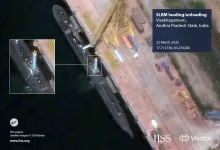
However, over at least the last 15 years, work has been slowly progressing on a more remote and secure home, some 50 km south of Visakhapatnam. While the new naval base, known as INS Varsha, is expected to host other elements of the Indian Navy’s Eastern Naval Command’s growing fleet of surface combatants, it is expected principally to serve as a nuclear submarine support facility for India’s SSBN fleet. In addition to the existing fleet, INS Varsha seems prepared to accommodate India’s next generation of SSBNs, with two S5 SSBNs already under construction at Visakhapatnam, according to local
media.
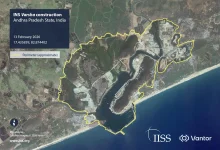
Information on the secretive base remains sparse, but one element that is increasingly apparent from satellite imagery is the widely reported construction of an underground submarine facility, with two large tunnel entrances visible. Recent imagery indicates water within the tunnels, suggesting completion of the waterway, and a logical next step would be to remove the cofferdams used to hold back the water during construction. Though the layout of the facility is not clear beyond these two – presumed linked – water entrances, some 1.5 km apart, it is also ringed by over a dozen apparent road-access tunnel entrances, indicating the potential for a much vaster underground support complex for SSBN operations.
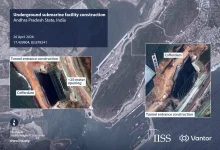
While housing the facility underground provides additional natural protection for berthed submarines and infrastructure, it also aids in the concealment of deployed numbers from space surveillance. There are numerous precedents for underground submarine basing, and this is a feature of China’s People’s Liberation Army Navy base at Hainan Island.
Outlook
The commissioning of India’s third SSBN is an indisputable milestone in the country’s ambitions to establish a credible minimum deterrence, with the additional boat marking a further step towards enhanced survivability and a credible second-strike capability. That said, India’s vision of credible minimum deterrence remains a work in progress, as the country begins to implement CASD, finalises basing at INS Varsha and rolls out planned VLF communications systems for the Indian Ocean region. Yet, even with these limitations, India is planning for its next generation of capabilities, as the country makes slow but deliberate progress in its nuclear deterrence.
Note: 'S4*' is a widely reported designation; the asterisk forms part of the designation itself.
https://www.iiss.org/online-analysi...-deterrence-indias-expanding-ssbn-capability/


