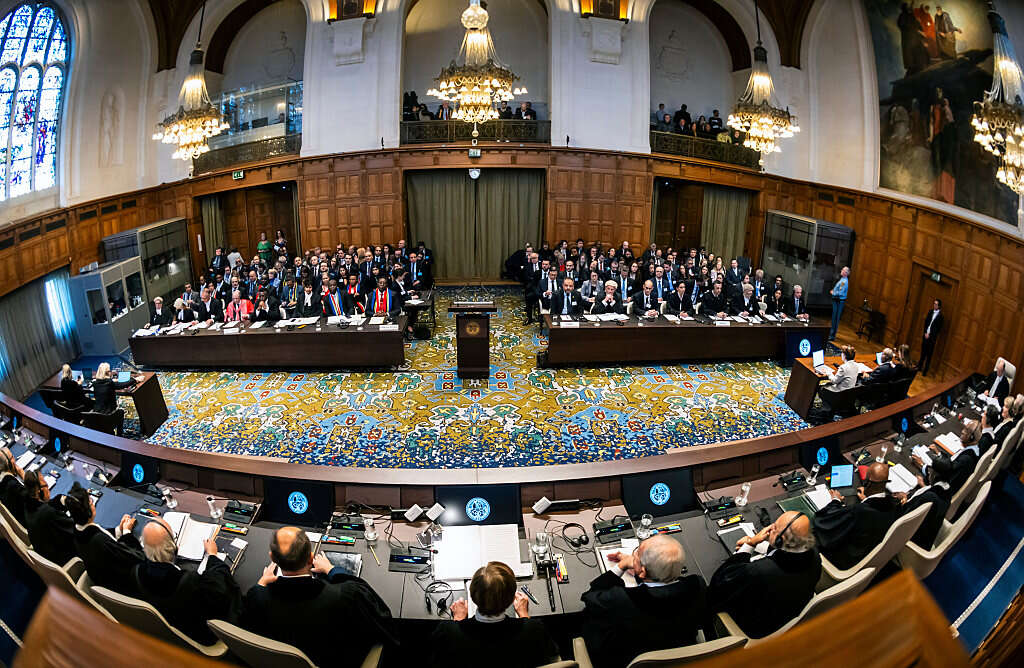
ICJ ruling on SA's case against Israel

I don't need to throw mud here, this is a Pakistani forum, I expect hate for the only Jewish country from a Muslim forum anyway. It's sad, but it is what it is. Luckily, in a 100 years, the people spreading hate and their ideologies will die out and agnosticism and atheism will be the order of the day in a peaceful world.
Why over a 100 years ago... Herzl himself an atheist vied for zion?
Think about it Truthseer why anyone, ANYONE be antisemitic, anti Jewish?
Why you think you are responsible for your acts but for some, if you call the act wrong... labeled, why?

Here's an anecdote, around 15 or so years ago, I met in New York an African American lady, or so I "assumed", both first and last names were very Jewish, Yiddish in fact... So I had a smirk on my face and I asked about the origins of her name and She replied essentially saying, "people make assumptions on appearance yet reality is way different and complex..." I didn't get it first and said I just was intrigued on the genesis of your name as it is very Jewish and she replied the same ... I said, Are you Jewish? She said yes and there are many more of African origin... at that point I realized well of course and I said yes, such as the Ethiopian ones...

Jist... start calling things what they are, right or wrong...
since you can't tell a Semite apart they'll let you know that by extension, you are antisemite...

Back to the topic.
 
Last edited:
PLEASE STAY ON TOPIC, WHICH IS THE ICJ RULING, NOT HISTORY OF OTHER EVENTS OR PLACES.
 
He knows, just diverting from the discussion.

Will our rule obsessed mod do anything I wonder? The topic is the current icj case.

@VCheng

Edit to add, he did.

Please report any violations of rules. Moderators cannot be everywhere all the time, but ALL reports are adjudicated as quickly as possible given that we are all spread out over numerous time zones. Thanks.
 
Now is the time to target Israel in every body, state etc

Major pressure on all companies, protests in front of everywhere and everything Israel is part of

Reinvigorate the BDS movement across the world
 
What is so terrible, Uganda of all countries voted against...
DISSENTING OPINION OF JUDGE SEBUTINDE
...It is not a legal dispute susceptible of judicial settlement by the Court  Some of the preconditions for the indication of provisional measures have not been met  South Africa has not demonstrated, even on a prima facie basis, that the acts allegedly committed by Israel and of which the Applicant complains, were committed with the necessary genocidal intent, and that as a result, they are capable of falling within the scope of the Genocide Convention  Similarly, since the acts allegedly committed by Israel were not accompanied by a genocidal intent, the Applicant has not demonstrated that the rights it asserts and for which it seeks protection through the indication of provisional measures are plausible under the Genocide Convention  The provisional measures indicated by the Court in this Order are not warranted...
...one should not make the mistaken assumption that the Court has already determined that it has jurisdiction to entertain South Africa’s claims on the merits or that it has already found those claims to be admissible. Both of those issues are to be determined at a later phase of the case, after South Africa and Israel have each had an opportunity to submit arguments in relation thereto...
... for the purposes of the provisional measures Order, the Court’s prima facie jurisdiction is limited to the Genocide Convention and does not extend to alleged breaches of international humanitarian law...
...On 7 October 2023, thousands of members of the Harakat al-Muqawama al-Islamiya (“Islamic Resistance Movement” or “Hamas”), a Palestinian Sunni Islamic political and military organization governing the Gaza Strip, invaded the territory of the State of Israel under cover of thousands of rockets fired indiscriminately into Israel and committed massacres, mutilations, rapes and abductions of hundreds of Israeli civilians, including men, women and children...
...Israel argues that not every conflict is genocidal, nor does the threat or use of force necessarily constitute an act of genocide within the meaning of Article II of the Genocide Convention. Israel maintains that, in view of the ongoing threat, brutality and lawlessness of Hamas that it continues to face, it has an inherent and legitimate duty to protect the Israeli people and territory, in accordance with international humanitarian law, from attack by an armed group or groups that have openly declared their intention to annihilate the Jewish State. In Israel’s view, South Africa’s present request for the indication of provisional measures is tantamount to an attempt to deny Israel its ability to meet its legal obligation to defend its citizens, rescue its hostages still in Hamas custody and to enable the over 110,000 internally displaced Israelis to safely return to their homes. In its oral observations, Israel requests the Court to reject South Africa’s Request for the indication of provisional measures and to remove the case from the General List.
The Court has, through its jurisprudence, progressively developed legal standards or criteria to determine whether it should exercise its power under Article 41 of its Statute to indicate provisional measures. In the present case, the Court should determine (1) whether it has prima facie jurisdiction to entertain the alleged dispute between the Parties (Allegations of Genocide under the Convention on the Prevention and Punishment of the Crime of Genocide...(2) whether the rights asserted by South Africa are plausible and have a link with the requested measures...and (3) whether the situation is urgent and presents a risk of irreparable prejudice to the rights asserted...
I am not convinced that all the above criteria for the indication of provisional measures have been met in the present case. In particular, South Africa has not demonstrated, even on a prima facie basis, that the acts allegedly committed by Israel, and of which the Applicant complains, were committed with the necessary genocidal intent and that, as a result, they are capable of falling within the scope of the Genocide Convention. Similarly, when it comes to the rights that the Applicant asserts and for which South Africa seeks protection through the indication of provisional measures, there is no indication that the acts allegedly committed by Israel were accompanied by a genocidal intent and that, as a result, the rights asserted by the Applicant are plausible under the Genocide Convention. What distinguishes the crime of genocide from other grave violations of international human rights law (including those enumerated in Article II, paragraphs (a) to (d), of the Genocide Convention) is the existence of the “intent to destroy, in whole or in part, a national, ethnical, racial or religious group, as such”. Accordingly, the acts complained of by South Africa, as well as the rights correlated to those acts, can only be capable of “falling within the scope of the said Convention” if a genocidal intent is present, otherwise such acts simply constitute grave violations of international humanitarian law and not genocide as such...
...The Respondent further argues that any genocidal intent alleged by the Applicant is negated by (1) Israel’s restricted and targeted attacks of legitimate military targets in Gaza; (2) its mitigation of civilian harm by warning them through leaflets, radio messages and telephone calls of impending attacks; and (3) its facilitation of humanitarian assistance. Israel also argues that the statements relied upon by South Africa as containing genocidal rhetoric were all taken out of context and in fact were made in reference to Hamas, not the Palestinian people as such. Moreover, Israel argued that any other persons who might have made statements containing genocidal rhetoric were completely outside the policy and decision-making processes of the State of Israel.
...As stated above, the tragic events of 7 October 2023 as well as the ensuing war in Gaza are symptoms of a more deeply engrained political controversy between the State of Israel and the people of Palestine. Having examined the evidence put forward by each of the Parties, I am not convinced that a prima facie showing of a genocidal intent, by way of indicators, has been made out against Israel. The war was not started by Israel but rather by Hamas who attacked Israel on 7 October 2023 thereby sparking off the military operation in Israel’s defence and in a bid to rescue its hostages. I also must agree that any “genocidal intent” alleged by the Applicant is negated by (1) Israel’s restricted and targeted attacks of legitimate military targets in Gaza; (2) its mitigation of civilian harm by warning them through leaflets, radio messages and telephone calls of impending attacks; and (3) its facilitation of humanitarian assistance... the scale of suffering and death experienced in Gaza is exacerbated not by genocidal intent, but rather by several factors, including the tactics of the Hamas organization itself which often entails its forces embedding amongst the civilian population and installations, rendering them vulnerable to legitimate military attack...
 
To view this content we will need your consent to set third party cookies.
For more detailed information, see our cookies page.
 

Lebanon's Salam, ICJ judge turned prime minister

by Naharnet Newsdesk 3 hours ago

W460

Nawaf Salam, Lebanon's new prime minister, is a leading international judge who won support for staying out of the political infighting that has paralyzed the crisis-hit country in recent years.

The 71-year-old, who until now was presiding judge at the International Court of Justice in The Hague, hails from a prominent Beirut political family.

He had previously been put forward to form a cabinet in the deeply divided Mediterranean country, but Hezbollah had repeatedly objected, with opponents of the group hoping Salam would be able to reform state institutions long under its grip.

Hezbollah has since been badly weakened by its recent war with Israel and the loss of a key ally in Syria's Bashar al-Assad, enabling new Lebanese President Joseph Aoun on Monday to task Salam with forming a government.

The group and its ally Amal again objected to Salam, but for the first time, other political parties previously allied to the Shiite movement have endorsed him.

"Nawaf Salam is widely respected for his academic rigor, independent views, and commitment to justice and human rights," said Lebanese analyst Imad Salameh.

"His ability to maintain equal distance from Lebanon's divided parties, while embodying principles of justice and governance, makes him a symbol of hope for a more accountable and inclusive future."

As the country's economy was collapsing in 2019, mass protests erupted demanding an overhaul of a ruling class accused of corruption and largely unchanged since the 1975-1991 civil war.

But they petered out as the Covid pandemic hit, before a massive explosion at the Beirut port ravaged the capital in 2020.

- 'Reformist' -

Born in Beirut in 1953, Salam studied law and political science, including at Harvard in the United States and Sciences Po in France.

He was made Lebanon's ambassador to the United Nations in 2007, when anti-Hezbollah politician Fouad Siniora was prime minister, and stayed in the post for a decade.

Politicians opposed to Hezbollah would go on to suggest several times that Salam head a new government.

He became president of the ICJ in February last year.

"His role at The Hague bolsters his profile as a reformist capable of addressing corruption and inefficiency, aligning him with the demands of Lebanon's citizens for accountability and transparency," said Salameh.

Salam's prolific writings include a 2004 essay about reforming the Lebanese electoral system.

In July, he announced that the ICJ had found that Israel's continued presence in the Palestinian territories was "illegal" and called for an end to "its unlawful presence as rapidly as possible".

The statement was not binding, but came amid mounting concern over the death toll and destruction in Israel's war against Hamas, sparked by the Palestinian group's attack on October 7, 2023.

Israel slammed the decision as "lies", while Palestinians said it was a "watershed moment".

- 'Right path' -

Salam's selection comes after lawmakers -- under international pressure, especially from the United States and Saudi Arabia -- finally elected Aoun as president following a two-year vacancy in the role.

Lebanese university professor Ali Mrad said support for Salam's nomination reflected "the real changes that Lebanon is experiencing".

Mrad said that picking a premier with international values, reformist qualities and a track record of having taken a firm stand on the Palestinian issue, could set Lebanon on the "right path".

Salam follows in the footsteps of his uncle Saeb, who headed the government four times between 1952 and 1973, and his cousin Tammam, who was premier from 2014 to 2016.

His wife Sahar Baassiri is a former Lebanese envoy to the UN cultural and education fund in Paris.
 

Major shift at ICC as pro-Israel judge poised for presidency

First African female ICJ judge Julia Sebutinde, who rejected South Africa's genocide claims, poised for presidency.

By ILH Staff

Published on 01-14-2025 09:45
Last modified: 01-14-2025 10:28


Major shift at ICC as pro-Israel judge poised for presidency
ICJ Judge Julia Sebutinde | Photo: Courtesy


In a significant shift at the International Court of Justice (ICJ), Judge Julia Sebutinde is poised to assume the presidency, marking another milestone in her groundbreaking career. The Ugandan jurist, who recently made headlines for her robust defense of Israel against South Africa's genocide allegations in the Gaza war, will take the helm following current President Nawaf Salam's departure to form Lebanon's next government.


Born Julia Semusso in February 1954 in Uganda's Central Province to a civil servant father and homemaker mother, Sebutinde's journey to The Hague reflects a remarkable career in international justice. Her ascent began with her 1996 appointment to Uganda's Supreme Court, where she distinguished herself by leading three pivotal anti-corruption investigations in her homeland.

The judge's international prominence grew with her 2005 appointment to the Special Court for Sierra Leone war crimes tribunal, where she played a crucial role in the landmark trial of Liberian President Charles Taylor. Her appointment to the ICJ in February 2012 broke new ground as she became the first woman from Africa to serve on the court.


courtofjustice.jpg
The International Court of Justice holds public hearings in the case South Africa v. Israel, Jan. 11 and 12, 2024 at the Peace Palace in The Hague (UN Photo/ICJ-CIJ/ Frank van Beek)

Sebutinde's recent ruling on the Israel-Hamas war has particularly resonated in international legal circles. She dismissed South Africa's requests for temporary injunctions to halt the Gaza war, asserting that the conflict between Israel and the Palestinian people is fundamentally political rather than legal in both its nature and historical context, and therefore falls outside the court's purview for resolution.

Her stance, however, has created diplomatic ripples. Uganda's UN Ambassador Adonia Ayebare publicly distanced his government from her position, emphasizing that her ICJ decision does not reflect Uganda's official stance on the situation.

The transition in leadership comes at a crucial juncture, with Israel scheduled to present its defense brief against South Africa's case in July. According to the court's statutory framework, the president – elected every three years through a panel member vote – oversees the institution's administrative affairs and chairs its panels, wielding a decisive vote in cases of judicial deadlock.

The Lebanese parliament's recent acceptance of newly elected President Joseph Aoun's request to task Salam with government formation has necessitated this change in ICJ leadership. As Salam steps down, the UN faces the additional task of selecting a new judge to represent the Asia region on the court.

Sebutinde and Salam were both elected to their ICJ positions in February 2024, making this rapid transition particularly noteworthy in the court's history. Her elevation to the presidency not only marks a personal achievement but also comes at a critical time for international justice and Middle East diplomacy.
 
...Having regard to the Order of 14 April 2025, whereby the Court extended the time-limit for the filing of the Counter-Memorial of Israel to 12 January 2026, and to the Order of 20 October 2025, whereby the President of the Court extended this time-limit to 12 March 2026,

Having regard to the Counter-Memorial of Israel filed within the time-limit as extended;

Whereas, on 29 April 2026, a meeting was held by the President of the Court with the representatives of the Parties pursuant to Article 31 of the Rules of Court, in order to ascertain their views on the subsequent procedure in the case; Whereas, at the meeting, the Agent of South Africa indicated that his Government considered that a second round of written pleadings was warranted; whereas he requested that the Court accord the Applicant at least 18 months to file its Reply given the complexity of the case, the voluminous nature of the Counter-Memorial (including its annexes) and the fact that, in addition to addressing the merits of the case, it contained objections to the jurisdiction of the Court and the admissibility of the Application;

Whereas, at the same meeting, the Deputy Agent of Israel stated that his Government considered that a second round of written pleadings was not necessary; whereas he submitted that, in the event that the Court were to direct a second round of written pleadings, Israel did not object to a period of 18 months being granted to South Africa to prepare its Reply, provided that the same amount of time be accorded to Israel to prepare its Rejoinder;

Taking into account the views of the Parties,

Directs the submission of a Reply by the Republic of South Africa and a Rejoinder by the State of Israel;

Fixes the following time-limits for the filing of these written pleadings:

22 November 2027 for the Reply of the Republic of South Africa;

22 May 2029 for the Rejoinder of the State of Israel; and

Reserves the subsequent procedure for further decision.


Users who are viewing this thread

Pakistan Defence Latest

Back
Top