IMF - International Monetary Fund Program Updates

Last week, the international money lender had approved the latest review of Pakistan’s reform programme. The decision paved the way for disbursements of about $1.1bn from the EFF and $220m from the RSF, bringing total payouts under the two arrangements to roughly $4.8bn.

While the funding provides crucial short-term support, the IMF’s statement emphasised an evolving and uncertain outlook, cautioning that Pakistan’s recent gains are exposed to heightened global volatility, particularly spillovers from the conflict in the Middle East.

“The authorities’ strong implementation, despite the Middle East war, has maintained economic stability and improved financing and external conditions,” the Fund noted in its statement.

However, it cautioned that the shocks emanating from the Middle East war underlined the continued importance of maintaining strong policies to continue building resilience and of moving ahead with structural reforms to achieve sustainable long-term growth.

IMF Deputy Managing Director and Acting Chair Nigel Clarke reinforced this cautionary tone, stressing the need for both discipline and accelerated reforms.

“Amid a more challenging and highly uncertain external environment since the onset of the war in the Middle East, Pakistan needs to maintain strong macroeconomic policies while accelerating reform efforts, which are critical to managing further shocks and fostering higher sustainable medium-term growth,” he said.
 

Finance minister discusses budget preparations with visiting IMF mission

News Desk
May 13, 2026

1778669852858.png

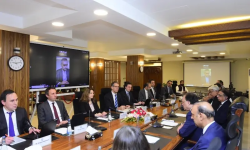
Finance Minister Muhammad Aurangzeb holds a meeting with the International Monetary Fund visiting delegation, led by IMF chief Chief Iva Petrova, in Islamabad on May 13, 2026. —Financegovpk/X

Finance Minister Muhammad Aurangzeb on Wednesday discussed preparations for the upcoming federal budget and the country’s broader reform agenda with the International Monetary Fund (IMF) visiting Islamabad, the finance ministry said.

He briefed the delegation on the country’s macroeconomic outlook, fiscal strategy, reform priorities, and the government’s ongoing efforts to ensure sustainable economic stability and long-term growth, the ministry said on the social media platform X.
 
To view this content we will need your consent to set third party cookies.
For more detailed information, see our cookies page.
 
Aurangzeb also reiterated the government’s commitment to deepening reforms aimed at strengthening macroeconomic stability without compromising long-term growth prospects.

“In this regard, he underscored the importance of moving Pakistan away from recurring boom-and-bust cycles through structural reforms, productivity enhancement, deregulation, and improved export competitiveness,” it said.

Aurangzeb further stated that the government’s reform agenda had been carefully calibrated in consultation with international experts and economists. He emphasised that the ongoing policy measures were not driven by short-term considerations, but formed part of a broader and technically grounded economic transformation strategy endorsed at the highest level, the ministry added.

The finance minister also briefed the mission on the country’s continued engagement with international development partners, including ongoing economic cooperation initiatives with China and efforts aimed at mobilising long-term investment aligned with the country’s strategic economic priorities.

According to the ministry, the visiting IMF mission, led by Iva Petrova, acknowledged the “positive progress made by Pakistan in maintaining macroeconomic stability despite a challenging global and regional environment”.
 

IMF wants interest rates to go Up
 

IMF sets 11 new conditions, including parliamentary approval of FY2027 Budget

Demands fiscal discipline, governance reforms, and energy tariff adjustments

May 15, 2026
By Tahir Amin

ISLAMABAD: The International Monetary Fund (IMF) has slapped 11 new Structural Benchmarks (SBs) on Pakistan including parliamentary approval of a fiscal year 2027 budget in line with IMF staff agreement to meet programme targets, notification of the semi-annual gas tariff adjustment, the annual power tariff adjustment and enhancing NAB’s autonomy and transparency by submitting to parliament amendments to the NAB ordinance to establish an open, merit-based, rigorous and competitive selection process of senior management.

This was revealed in the report third review under the Extended Fund Facility and second review under the Resilience and Sustainability Facility, bringing the number to 55 condition under the program.

New SBs are proposed to monitor the program’s structural agenda, including on approval of the FY27 budget, improving revenue administration, strengthening the anti-corruption and public procurement frameworks, continuing regular adjustments to gas and power tariffs, maintaining the generosity of the UCT program, preparing a roadmap for gradual FX liberalization and enhancing regulatory transparency and predictability.


IMF sets Rs17.1tr federal revenue target for 2026-27

Khaleeq Kiani
May 16, 2026

• Proposes Rs430bn new budgetary measures
• Suggests 18pc hike in petroleum levy target
• Asks provinces to mobilise extra Rs430bn
• Links power tariff relief to BISP
• Sees economic growth at 3.5pc
• Estimates average inflation at 8.4pc
• Seeks hike in BISP payment to Rs18,000 with 40pc population vulnerable


ISLAMABAD: With Rs430 billion in new budgetary measures and an 18 per cent higher petroleum levy, the International Monetary Fund (IMF) has targeted Pakistan’s federal revenues at Rs17.145 trillion for 2026-27, along with a series of administrative and policy measures committed by the government for the federal and provincial budgets to be passed by the parliament.

In its staff report on completion of third review of $7bn Extended Fund Facility (EFF) and second review of $1.4bn Resilience and Sustainability Facility (RSF), the fund has projected total federal revenues for FY27 at Rs17.144tr — over Rs2.03tr higher than the current fiscal year, up 13.5pc.
 

IMF macroeconomic projections for 2026-27

May 19, 2026
By Dr Hafiz A Pasha

Pakistan has successfully concluded the third review of the IMF Programme. An installment of USD 1.2 billion has also been received.

The IMF Staff Report of this review has also been released recently. It contains the macroeconomic projections for 2025-26 up to 2030-31. Further, it includes the Extended Fund Facility (EFF) policy discussions with the government, programme modalities and staff appraisal.

There are three special boxes in the Report. The first is on the impact of the Middle East war. The second is on the potential for further revenue mobilization and the third on energy pricing in Pakistan.

There is need to focus on the contents of these special boxes and derive their implications for macroeconomic developments in 2026-27. Thereafter, the IMF projections for 2025-26 and 2026-27 are presented in this article and the next article. An assessment is made of the validity of these projections.

The IMF report states that Pakistan is highly exposed to spillovers from the war in the Middle East, first in the form of higher cost of energy imports and, second, in the event of sustained disruptions in the availability of fuel imports there will be a significant impact on economic activity.
 
The other impact is likely due to fertilizer import disruptions, especially of DAP. The next impact could be lower remittances. 55 percent are from the GCC economies and are likely to decline significantly, especially from the UAE and impact significantly on the balance of payments. A possible third impact could be a decline in short-term commercial financing from GCC banks.

Turning to the second box on potential for further revenue mobilization, the concentration of the tax base in a few sectors is highlighted and the expansion of the tax base to agricultural income, real estate and business services is recommended. Further, the scope is identified for eliminating sales tax expenditures, improving compliance and substantially increasing provincial revenues.

The third box on energy pricing in Pakistan focuses on fuel prices, electricity prices and gas prices. An analysis is undertaken of the energy pricing policies in the country.

These three boxes highlight the impact of exogenous events like the Middle East war and of taxation and energy pricing policies. The issue is whether these impacts are adequately reflected in the macroeconomic projections for 2025-26 and 2026-27.
 
The real issue is with the IMF projection of the GDP growth rate at 3.5 percent in 2026-27. This implies only a marginal effect of the Middle East war on the growth momentum in the economy.

It does not reflect the big shortfall in fertilizer use in the forthcoming Kharif season and the continued occurrence of power loadshedding due to shortage of fuel inputs. Of course, the size of the impact will depend on the length of the war and the timing of the opening of the Strait of Hormuz.

A perhaps more realistic projection is for the GDP growth rate is of a fall to 2.5 percent in 2026-27, in comparison to the expected outcome of 3.6 percent in 2025-26. This will not imply any increase in the real per capita income next year and a rise in the unemployment rate from close to 7 percent in 2024-25 to above 9 percent in 2026-27.
 
The Consumer Price Index has risen sharply since the commencement of the war, due particularly to the quantum jump in POL prices. The rate of inflation in the CPI on a year-to-year basis was 7.0 percent in February 2026, rising to 10.9 percent by April 2026.

The average rate of inflation in the first ten months of 2025-26 was 6.2 percent. The IMF projection implies that the inflation rate in the last two months of 2026-27 will be 12.2 percent. This is consistent with the trend up to April 2026.

However, the issue is with the rate of inflation projection for 2026-27. The IMF expects it to average 8.4 percent next year. However, it is likely to be close to 12 percent at the end of 2025-26. A fall to 8.4 percent average next year will require a sharp drop in the rate of inflation month by month in 2026-27.

A more realistic projection is for the average rate of inflation to average 12 percent in 2026-27. This is reinforced by the IMF estimation of depreciation in the value of the rupee of over 15 percent in 2026-27.
 

Users who are viewing this thread

Back
Top