India Economy Thread

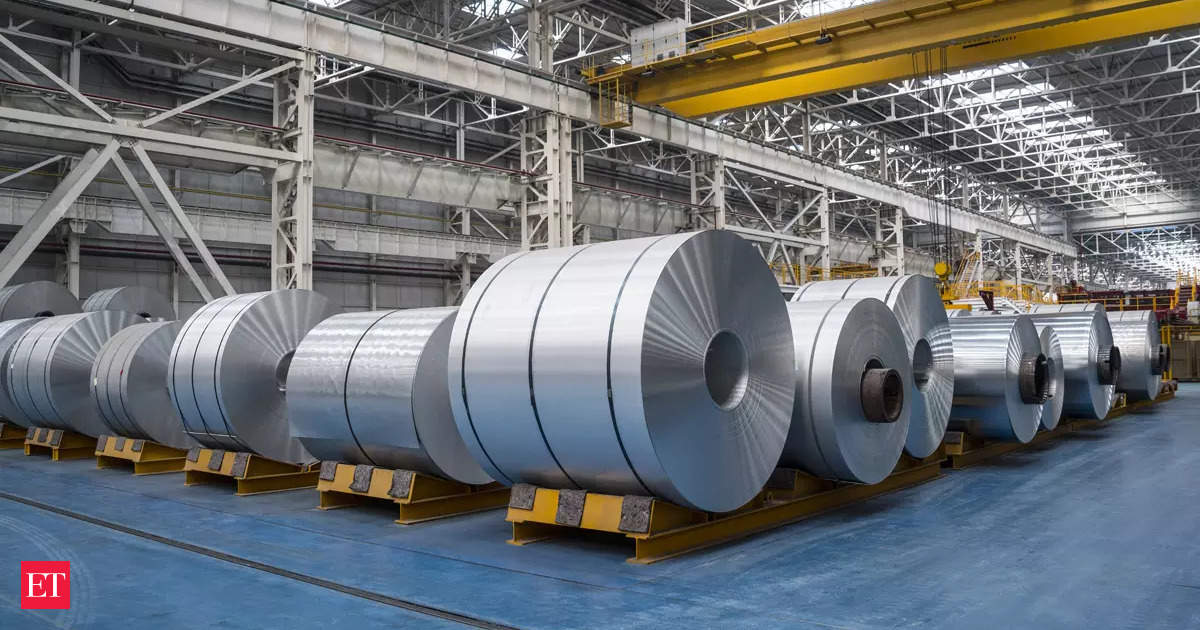
Hindalco raises FY25 capex target to ₹6,000 crore
India data center boom to drive 10 million sq ft realty demand by 2026

Read more at:


Jio Financial plans Rs 36,000 cr ($4.5 billion) deal with Reliance Retail


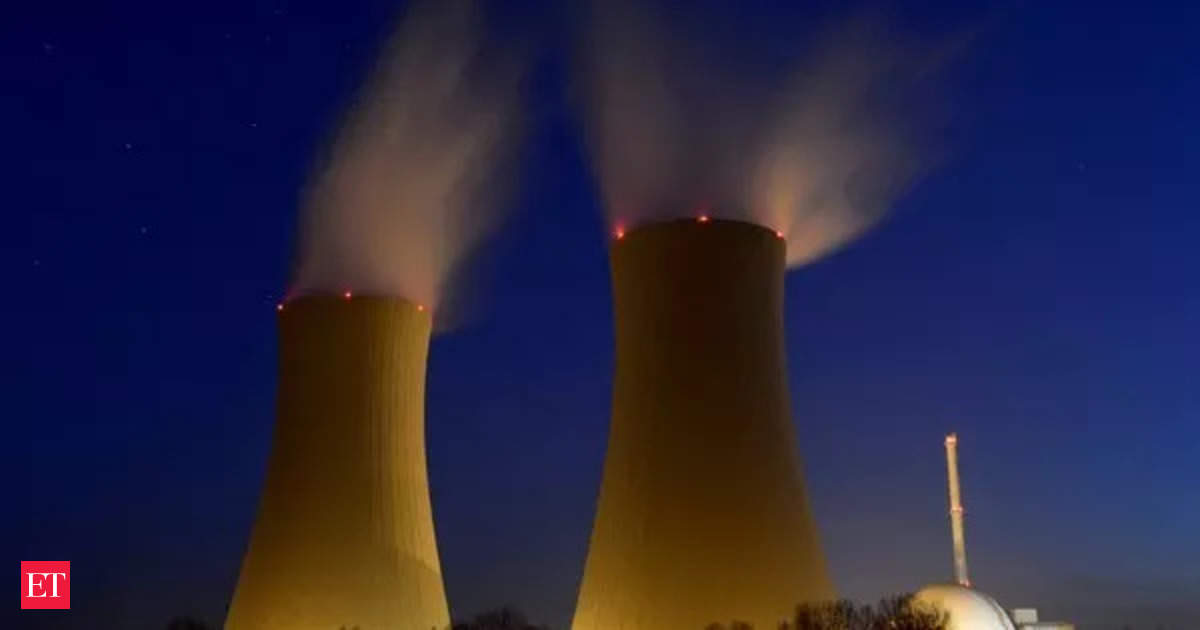
Ready to build high-capacity nuclear power units in India: Russia


To view this content we will need your consent to set third party cookies.
For more detailed information, see our cookies page.

To view this content we will need your consent to set third party cookies.
For more detailed information, see our cookies page.

To view this content we will need your consent to set third party cookies.
For more detailed information, see our cookies page.

To view this content we will need your consent to set third party cookies.
For more detailed information, see our cookies page.

To view this content we will need your consent to set third party cookies.
For more detailed information, see our cookies page.

1716610102157.png
 
To view this content we will need your consent to set third party cookies.
For more detailed information, see our cookies page.

To view this content we will need your consent to set third party cookies.
For more detailed information, see our cookies page.

To view this content we will need your consent to set third party cookies.
For more detailed information, see our cookies page.

To view this content we will need your consent to set third party cookies.
For more detailed information, see our cookies page.

To view this content we will need your consent to set third party cookies.
For more detailed information, see our cookies page.
 

India big gainer from China plus one strategy! 'Goods exports to almost double to $835 billion'; here’s why​

1716968480378.png
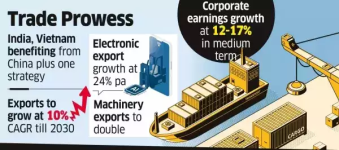
India and Vietnam are emerging as key beneficiaries of the “China plus one” strategy, a global initiative aimed at diversifying supply chains away from heavy reliance on China. According to a recent report by Nomura, this strategic shift is expected to open up new avenues for growth across Asian economies.

Nomura’s analysis suggests a significant uptick in India’s goods export potential, projecting a surge to $835 billion by 2030, a substantial leap from the $431 billion recorded in 2023. Central to this growth trajectory is India’s robust domestic market, which is proving to be a magnet for companies seeking alternatives to China for their manufacturing and supply chain operations.

Industries spanning electronics, apparel, toys, automobiles, capital goods, and semiconductor manufacturing are increasingly eyeing India as a favourable investment destination, drawn by the prospect of tapping into its vast consumer base.

Of these sectors, electronics is anticipated to experience the most rapid expansion, with exports poised to register a staggering compound annual growth rate of 24 per cent, reaching $83 billion by 2030. Similarly, machinery exports are forecasted to more than double, climbing from $28 billion in 2023 to $61 billion by the end of the decade.

Nomura underscores that despite relatively modest production-linked incentive (PLI) disbursements, India remains primed for deeper integration into global value chains. The country’s appeal lies in a combination of factors, including its expansive market size, rapid economic growth, competitive labour costs, and stable political and economic landscape. These factors collectively position India as an attractive destination for manufacturing consumer goods, both for domestic consumption and export purposes.

Companies and their Chinese manufacturing partners who have moved away from China, and into Vietnam and India have seen some impressive numbers. More and more EU & US-based companies therefore want their manufacturing partners to move to India and Vietnam. Just last week, reports surfaced according to which, US-based EV maker Tesla has asked its partners to focus on India and Vietnam.

Moreover, Nomura predicts that India’s share of global trade will see a notable uptick, rising to 2.8 per cent by 2030, driven by the growing competitiveness of its production capabilities. This anticipated surge in trade is expected to contribute to an overall improvement in India’s trade balance and current account, potentially leading to currency appreciation.

Nomura’s research also highlights a growing interest among investors in both India and Vietnam. US-based companies, particularly in the electronics sector, are among the prominent players investing in India, while Japan and Korea are also making substantial investments across various sectors such as auto, consumer durables, and electronics. These investments are driven by the desire to leverage India’s expanding domestic market and utilize the country as a strategic manufacturing hub.

Looking ahead, the strengthening of India’s manufacturing sector and its increasing share in global exports are poised to bolster corporate sector growth, sustaining robust earnings growth rates of 12-17 per cent over the medium term.
 
Can a Chinese poster explain likely iPhone sales in china?

If the Chinese market moves away that would hurt apple, there are record sales however in china
 
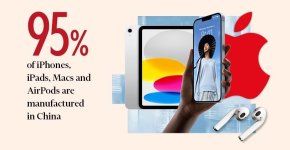
Most Components Are Still Made In Cina.China Has Complete Value Chains Within It's Borders.It Has A Manufacturing Ecosystem Developed Over 4 Decades.India Does Not Have That.All It Will Take Is For Xi Is To Impose Export Duties On Those Components Or Even Ban Them Completely
 
Most Components Are Still Made In Cina.China Has Complete Value Chains Within It's Borders.It Has A Manufacturing Ecosystem Developed Over 4 Decades.India Does Not Have That.All It Will Take Is For Xi Is To Impose Export Duties On Those Components Or Even Ban Them Completely
These are of course unique and cannot be replicated. Given the cultural, spiritual and moral superiority of one nation over all others in the world, their success in replicating western systems built over centuries in only four decades can never be repeated by others starting from a higher level and building identical supply chains in half the time.
 
Most Components Are Still Made In Cina.China Has Complete Value Chains Within It's Borders.It Has A Manufacturing Ecosystem Developed Over 4 Decades.India Does Not Have That.All It Will Take Is For Xi Is To Impose Export Duties On Those Components Or Even Ban Them Completely
Even for iphone in assembled many of the components are from outside china such as South Korea, Taiwan, Japan ….
 
Can a Chinese poster explain likely iPhone sales in china?

If the Chinese market moves away that would hurt apple, there are record sales however in china
However, Apple’s sales in China are actually falling
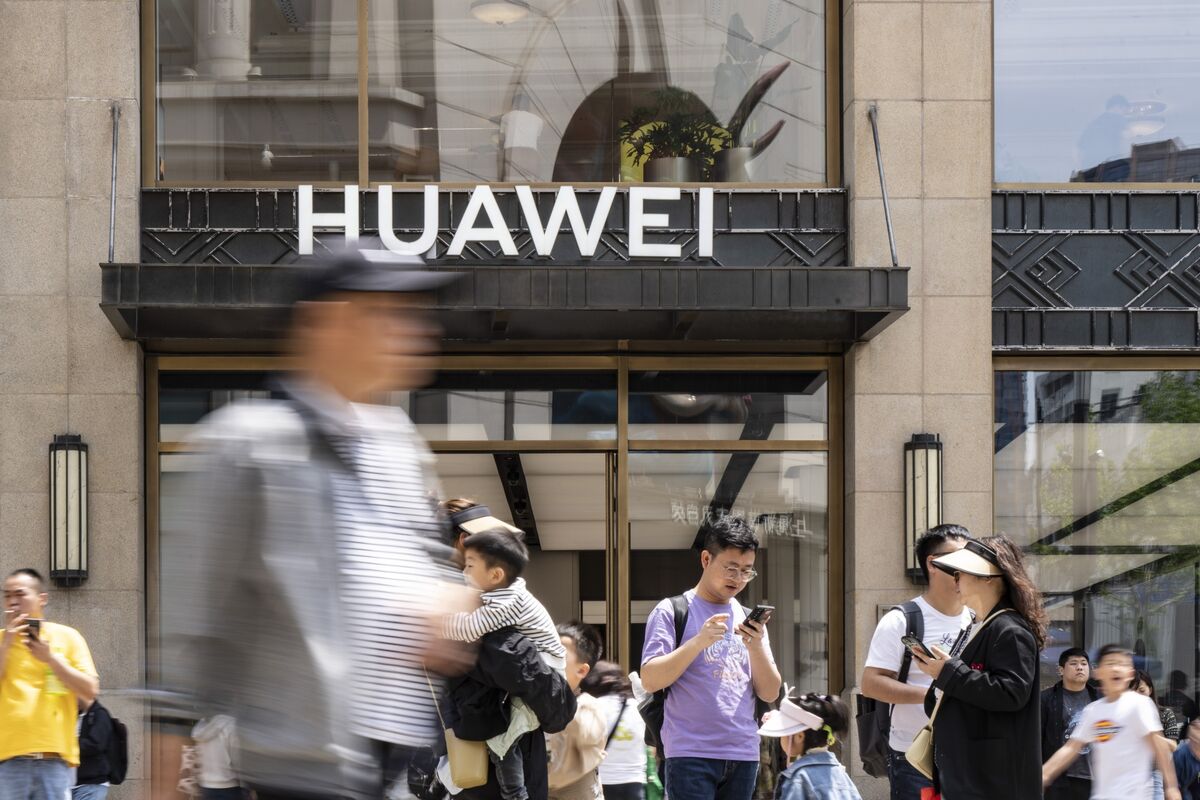
Apple’s struggles were most worrisome in China, the world’s second-largest smartphone market, where sales fell 8 percent. The iPhone’s popularity there has waned since Huawei, which the Trump administration restricted from working with U.S. technology firms, introduced a new smartphone with 5G abilities last year. Last quarter, Apple’s share of smartphones sold in China fell 4 percent, according to Counterpoint, a technology research firm.
 
Even for iphone in assembled many of the components are from outside china such as South Korea, Taiwan, Japan ….
IMG-20230619-WA0003(4).jpg
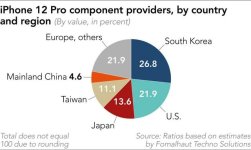
The most expensive parts of a phone such as Processor, memory chip, camera lens and touchscreen are all made in either Japan, SK or Taiwan. Some other critical parts such as gyroscope come from Germany and other countries. If I remember correctly, even for China the IPhone indigenization percentage by value is around 20-25%. Until 2019, it was actually less than 10%. Only recently did China start manufacturing batteries, speakers etc for the IPhone which increased their percentage.

I hope at least in the next few years we can develop expertise in medium value components such as batteries and speakers.Now even though the percentage of Chinese components has increased. You can see, for most of the countries it is around 20%.

What is the threshold of value addition, for a country to be considered an iPhone manufacturers. The supplers are distributed accross the global & none of them have a majority stake (50% value addition) in iphone manufacturing.

Most ICs like DRAM, Flash, Processors, MEMS, camera module and even display which is semiconductor and battery cells are made in Taiwan, US, Japan or Korea.
These items are the crown jewels of those countries, and also make a large portion of the Bill-of-Materials cost of a phone and super spy like Chinese also has troubles stealing said tech, so at best they are limited to low end production of such items, like their ICs will use a larger technology node( SMIC of China theoretically can do 14nm chip production, their production in reality is 20nm and below, meanwhile you have TSMC at 5nm ), their displays will be LCD instead of OLED or MicroLED or whatever hot shit there is now.

The only state of the art Chinese production of this is of NAND Flash by Samsung in Xian and SK Hynix somewhere else in China.

What parts they add into their phones depends on what $$$ it's going to sell for, high-end phones with cutting edge specs will have higher percentage of imported components which are indeed state of the art, lower end phones will have greater chinese contribution, like the screen may come from BOE displays which is a chinese vendor for example.

But even with low end phones they cannot fully supplant the Ebul Phoreners and go full Atmanirbhar Cheen, market forces and customer preferences discourage it, also the capabilities of their companies.
 
However, Apple’s sales in China are actually falling
Apple’s struggles were most worrisome in China, the world’s second-largest smartphone market, where sales fell 8 percent. The iPhone’s popularity there has waned since Huawei, which the Trump administration restricted from working with U.S. technology firms, introduced a new smartphone with 5G abilities last year. Last quarter, Apple’s share of smartphones sold in China fell 4 percent, according to Counterpoint, a technology research firm.
This will be interesting to see, can the Indian market replace lost Chinese sales?
 
View attachment 44066
The most expensive parts of a phone such as Processor, memory chip, camera lens and touchscreen are all made in either Japan, SK or Taiwan. Some other critical parts such as gyroscope come from Germany and other countries. If I remember correctly, even for China the IPhone indigenization percentage by value is around 20-25%. Until 2019, it was actually less than 10%. Only recently did China start manufacturing batteries, speakers etc for the IPhone which increased their percentage.

I hope at least in the next few years we can develop expertise in medium value components such as batteries and speakers.Now even though the percentage of Chinese components has increased. You can see, for most of the countries it is around 20%.

What is the threshold of value addition, for a country to be considered an iPhone manufacturers. The supplers are distributed accross the global & none of them have a majority stake (50% value addition) in iphone manufacturing.

Most ICs like DRAM, Flash, Processors, MEMS, camera module and even display which is semiconductor and battery cells are made in Taiwan, US, Japan or Korea.
These items are the crown jewels of those countries, and also make a large portion of the Bill-of-Materials cost of a phone and super spy like Chinese also has troubles stealing said tech, so at best they are limited to low end production of such items, like their ICs will use a larger technology node( SMIC of China theoretically can do 14nm chip production, their production in reality is 20nm and below, meanwhile you have TSMC at 5nm ), their displays will be LCD instead of OLED or MicroLED or whatever hot shit there is now.

The only state of the art Chinese production of this is of NAND Flash by Samsung in Xian and SK Hynix somewhere else in China.

What parts they add into their phones depends on what $$$ it's going to sell for, high-end phones with cutting edge specs will have higher percentage of imported components which are indeed state of the art, lower end phones will have greater chinese contribution, like the screen may come from BOE displays which is a chinese vendor for example.

But even with low end phones they cannot fully supplant the Ebul Phoreners and go full Atmanirbhar Cheen, market forces and customer preferences discourage it, also the capabilities of their companies.
Too many wrong data
According to Bloomberg, TechInsights' disassembly confirmed
Huawei's new phone PURA70
The chip is Kirin 9010 7nm process from SMIC
NAND storage from Yangtze Memory Technologies Co
6.6-inch OLED straight screen from BOE, Visionox
 

Apple moves closer to China despite supply chain shifts

Japan, Taiwan and U.S. supplier numbers dip as iPhone maker expands in Southeast Asia
CHENG TING-FANG and LAULY LI, Nikkei Asia tech correspondentsAPRIL 26, 2024 04:00 JST
APRIL 26, 2024 04:00 JST

微信图片_20240426121708.jpg

TAIPEI -- Apple is deepening its ties with China even as it further expands production in Southeast Asia and India, highlighting the balancing act the iPhone maker is striking between politics and business.

Apple increased its China-headquartered suppliers and Chinese manufacturing sites in 2023 while using fewer suppliers from Taiwan, the U.S., Japan and South Korea, a Nikkei Asia analysis of Apple's latest official list of suppliers shows.


Users who are viewing this thread

Pakistan Defence Latest

Country Watch Latest

Latest Posts

Back
Top