India Economy Thread

Why don't you stop using old data. It's not 2019 anymore. https://worldpoverty.io/
You can see the target change vs real change. India is the fastest growing economy in the world right now.

View attachment 70861

This is the current rate. 5 years later.

View attachment 70866

I don't know what he failed but why did you choose an article from 2019? What is 2023 count? Show him!

2019 data is very much reliable to see current situation since all economy were down for 2020 and 2021, 2022 was not that great either.

To add some perspective I am talking, India economy was down at around Minus 8-9 percent rate in 2020

Nonsense. India had a crippling lockdown. Poverty "grew" in India during that period. It was lower pre 2019 and it is lower again. Pakistan never had a lockdown for example.

The article is from 2019. Thats like 5 years ago. Since there was pandemic, its models and figures are not really relevant or even useful.

India's social indicators are remarkably better than Pakistan.. Those would be impossible if India had worse poverty compared to Pakistan.

Indian live about 5 years more than Pakistani.

India's infant mortality rate is less than HALF of Pakistan. 25 vs 54.

India's literacy rate (59% in 2019) is 10-15 percentage points lower than India (76%).


This is patently false.

UBS global wealth report shows :

India's MEDIAN wealth per adult is USD 3750
Pakistan has merely USD 2076.

90% of adults in Pakistan have wealth less than 10,000 dollars, while 76% of adults in India have wealth less than 10,000 dollars.

Overall Indians are richer than Pakistan.

Pakistan also does not have any reliable poverty headcount data beyond 2018 for income poverty. That excludes any increase in poverty since pandemic or recents year long double digit inflation. Simply put, we do not even know how many Pakistani are poor.
The article was published in 2019; however, it uses data from 2011, information is outdated.

 

Rail Vikas Nigam​

Rail Vikas Nigam Limited (RVNL) is an Indian central public sector enterprise (PSU) which works as the construction arm of the Ministry of Railways for project implementation and transportation infrastructure development. It was incorporated in 2003 to meet the country's surging infrastructural requirements and to implement projects on a fast-track basis as well as for creating a Railway equipment construction company. RVNL is a Navratna PSU in India under the administrative control of the Ministry of Railways, Government of India.

The organization undertakes project execution from concept to commissioning and creates project-specific SPVs. RVNL’s mandate includes the mobilization of extra-budgetary resources (EBRs) through a mix of equity and debts via these SPVs.


1728428801594.png

RVNL has an illustrious legacy spanning over more than twodecades. It started with the objective of bridging the infrastructure gap inIndian Railways by fast track execution of Railway projects. After successfully achieving this objective by completing more than 150 Railway projects, and successfully executing new Railway projects under the innovative PPP model by setting up of a number of Special Purpose Vehicles (SPVs), RVNL today has migrated from original mandate of 'rail infra' projects, to the ever expanding opportunities of All Infra i.e. from #Local RailInfra to #GlobalAllInfra. Today, RVNL is fast setting its footprints in all possible infrastructure projects, both within the country and overseas.Our journey began with the mission to bridge the infrastructure gap within Indian Railways by implementing projects focused on creating and enhancing rail infrastructure capacity swiftly, as well assecuring extra-budgetary resources for Special Purpose Vehicle (SPV) projects.Our operations commenced in 2005, and since then, we have consistently earnedan Excellent rating from the Department of Public Enterprises for consecutiveyears.

  • Training Institutes
  • Others
  • Track Renewal
  • Other Safety Works
  • Railway Safety Works
  • Traffic Facilities
  • Road over Bridges
Open Imagination

Indian Railways Institute of Financial Management

Training

Vallarpadam –Idapally longest rail Bridge

Bridge Work
Open Imagination

Obulavaripalli- Krishnapatnam Project

New Line
Open Imagination

Jakhapura- Haridaspur 3rd Line


1728429116748.png

Contributions towards NMB Rehabilitation & Welfare Trust for Seamen]​


Public is hereby informed that SCI contributes from its OWN Fund towards “NMB Rehabilitation & Welfare Trust for Seamen” from time to time as per the applicable NMB Agreement signed between INSA & Seafarers' Unions. NO deduction in this regard was/is being made from the wages of any seafarers.


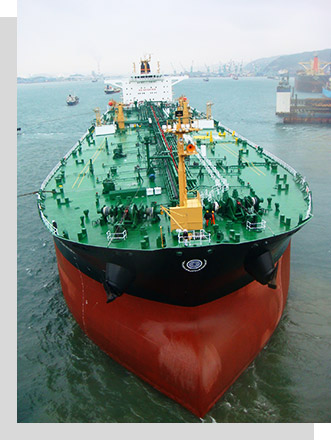
SCI is the largest Tanker owner in India, with a well-diversified fleet of crude oil tankers consisting of all sizes: MR, LR-I, LR-II, Aframax, Suezmax and VLCC Tankers. SCI's Tanker tonnage paralleled the growth of Indian oil industry since the mid-1970s. Till late 1990s the tonnage predominantly catered to Indian crude oil and product transportation. This was done keeping in view the specific constraints of terminals/ports in India and infrastructural limitations like draft, availability of tankages, length/capacity of jetties, etc.

SCI's Tanker Commercial Department looks after scheduling and deployment of Tankers for feeding crude oil to various Indian oil refineries. Lighterage operations on the east and west coasts are also undertaken to facilitate quick turnaround of Tankers, which otherwise cannot call on ports due to port restrictions/limitations.

The department also ensures commercial deployment of in-chartered tonnage, to meet its obligations of lifting cargo under the Contract of Affreightment (COA).
#


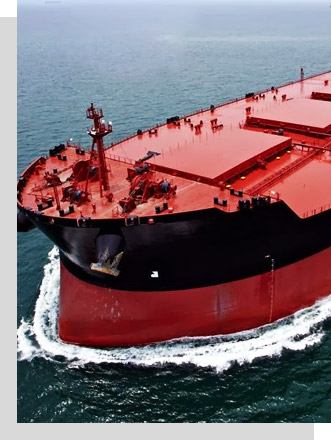
SCI is presently the major Bulk Carrier operator in India, with an assortment of 15 Bulk Carriers, spanning the Handymax, Supramax, Panamax and Kamsarmax sizes of vessels. The average fleet age of the Bulk Carriers is about 9 years, but individual vessels range from 8 years to 10 years in age.

At the time of acquisition, the vessels had been ordered after carefully considering the need and utility of these vessels for India-centric trade. However, there is no physical constraint for these vessels cross-trading worldwide. They carry a variety of cargo like iron ore, coal, coke, grain, fertilizer, steel products, plywood, bauxite, etc.


#


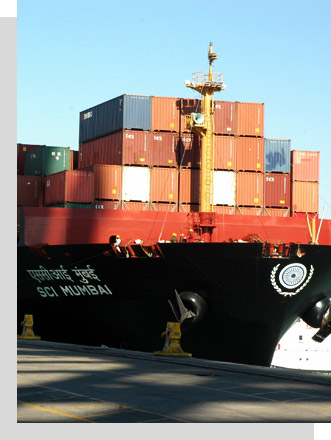
The SCI is the only Indian shipping company providing overseas Liner Break-bulk services to the Indian trade. The SCI arranges carriage of Break-bulk cargoes on a space charter basis from various regions across the globe including USA and Far East. This is offered for imports and exports in & out of India, which include shipments of Over-Dimensional Cargoes (ODC)/ Project cargoes/Heavy Lift cargoes/IMO Class I Cargoes and containers.

The SCI has on its panel many reputed forwarders/ Shipping Lines having their own regular service in different sectors. This enables the SCI to cater to the needs of the customers to provide timely shipments and also shipments from every part of the world.

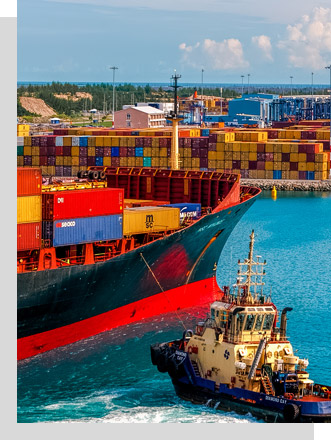
The SCI’s Breakbulk Department also makes arrangements for shipment of containerised cargo from those ports, where SCI does not have a regular container service. These arrangements are made on slot charter basis with other major container operators.

Contact :

PIC :
Shri Indrajeet Nagar,

DGM Incharge,

Breakbulk/UC/Project/FCL/LCL Cargo Dept
Shipping House, 14th Floor, 245, Madam Cama Road, Mumbai - 400 021.
Ph : +91 (0) 22 2277 2450, +91 (0) 22 2202 8095,
Mobile : +91 7045 526 804, 75061 01647.
[email protected]
Email : [email protected]

#


Passenger Services

Domestic Passenger-cum-Cargo Services


In addition to international operations, SCI operates and manages 27 domestic passenger and cargo transportation services between the Mainland- Andaman & Nicobar group of islands and inter-island vessels, on behalf of the Government of India.

#


SCI is a pioneer in the field of lighterage operations in India. A dedicated "Lighterage Cell" was set up in 1975, acquired the necessary equipment and physically conducted open sea Ship-to-Ship (STS) lighterage operations on the coast of India.

Offshore STS lighterage operations were thus introduced on the Indian coast by SCI in 1975 developed to maximise utilisation of large tankers which could not enter the port at their fully laden draft. The operations soon became the backbone of crude oil transportation and supplies to Indian refineries.
#


Centralised Dry Dock Cell (CDDC) was formed in May 2018 under Bulk Carrier & Tanker Division.

CDDC facilitates dry-docking/repairs of SCI owned and managed vessels from SCI empanelled yards with coordination from all SCI operating divisions for efficient and economical dry-docking vessels.

CDDC performs Pre dry-docking planning, Post Tendering planning, Evaluation and Stemming of vessel as per schedule.
#
 
Regardless of the veracity of figures

This is ALL that India needs to secure itself.
Not fancy weapons

It’s people need to be able to drive its economy

All about those states that are behind in Hindi Belt learning/adopting from South + Deep west on social development and investment.

TN greatest chief minister was Kamaraj as he (among other things) established the midday meal scheme, which was much later made country wide in the 80s, 90s and early 2000s (supreme court ruling making it obligatory for all states public +public-assisted primary schools).

In fact there is very little chance my father would have received good public primary education without kamaraj tenure in TN, as my dad was in family with many siblings and family budget was very stretched for various reasons. It was important it was free of cost at this level.

Kerala also made 100% literacy rate and universal school access a huge priority....it has been able to circumvent its far-left policy framework cost on industrialisation/investment to the degree it has because of it (compare and contrasting with say West Bengal).

India would have been vastly different place if same intensity of social development with education as focus permeated in the hindi belt (especially given its population bulk here)....along with urbanisation+industrialisation focus of TN (regional) political parties and bureaucracy subsequently to harness that. Hindi belt in contrast suffered from an "all in" effect of Delhi politics and Delhi also hosting centralised federal govt at same time.

North is playing catch up now....and lot of northern labour also comes to south for work and remits internally in interim to help this along too (and pressuring change back home). Better late than never. Hopefully what works well becomes as bipartisan and institutional as possible and centralised federal govt is made more minimalist and focused (as to what central govt administration is there for) over time too.
 
Income (absolute) poverty is increasingly far less relevant as a measure when it drops to single digit prevalence due to various permeation of basic economic expansion and basic social welfare.

It only looks at (market exchanged and then PPP converted) income, rather than actual consumption that is being done with that income and the access to basic means to get out of poverty (health, education) and overall intensity of the poverty.

A cursory glance at south asia using vlogs etc, does it look like the poverty is just single digit or the larger quarter, third, half of population that can be found in MPI index?

There is a reason the UN has spent a large amount of resource in developing and promoting it as a measure (taking over from earlier Oxford institute for MPI and others):


Pakistan ought to address why it is at 38% (2017-2018 data).

India similarly should address why it is at 16% (2019-2021 data).

These are far more relevant measures concerning the larger bulk of deprived folks, compared to income poverty which is approaching 0 for both countries (but remains a large issue in say sub saharan africa).
 
No more spamming the same dumb reply (without taking time to read the content posted if you want to discuss/debate)....or thread derailment or other repetitive trolling.

Learn to read and process something if you want to have an actual discussion.
 
No, you are wrong. You don't have to teach me basic mathematics.

With such a huge population you are bound to produce some rich people like Ambani.

Those outliers.
India has 6 times more population than Pakistan has.

India has more land, and natural resources, so in raw net amount India will do better in some human indices. This should be a given.

So please cut the crap.

India's HUGE population of 1.42 billion people drives the Indian economy, which is bound to be larger than Pakistan's.

Does Pakistan have 1/6th of India's total GDP ?
or 1/6th of India's exports ?
or 1/6th of India's FOREX ?
or 1/6th of India's foreign debt ?
 
We know it's a troll thread. That @Muji.Iqbal had to dig up 2019' s data to satisfy his bruised Pakistsniyat.

Even Pakistan does not make the list for having a large amount of poverty.
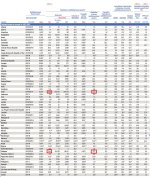
Maybe because you don't understand concept of percentage and per capita.…..

2019 data is very much reliable to see current situation since all economy were down for 2020 and 2021, 2022 was not that great either.

To add some perspective I am talking, India economy was down at around Minus 8-9 percent rate in 2020

Yes, and it bounced back with 20% growth after covid shock.
You used to make lots of Ind-Indo comparison threads previously, but when Indian growth went past ahead Indonesia, you lost all the enthusiasm.

True, we should treat everyone with justice and dignity.

However Indians on their forums love to compare India to Pakistan.

So I am just returning the favour.
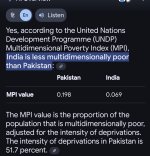
Screenshot_20241008_223615_Brave.jpg
 
Does Pakistan have 1/6th of India's total GDP ?
or 1/6th of India's exports ?
or 1/6th of India's FOREX ?
or 1/6th of India's foreign debt ?
These do no have all that much to do with the poverty being talked about directly.

They mostly affect the upper quintile or so of the population to improve their livelihoods further...

.... but without proper social development + investment into the bottom half or more of the pyramid bulk there is not enough transmission to genuine supply side to help them really get out of it quickly....and adding to sustainable long term development corpus too.

There are huge differences between Indian states on this. Gujarat for example has lagging social indicators that affects its poverty performance relative to its economic growth (i.e the benefits from stuff to do with GDP are relatively disproportional):


There are many countries in developing world that are poorer than India in the macro total but do better on social development fundamentals and thus poverty rate measures.

Pakistan having a better income poverty measurement is one example of it.....but there are many countries that can outdo India even comprehensively at lower GDP/capita level and so on because of India's large size and large spread + non-cohesiveness in fundamental social development patterns and investments.

The global hunger index often also comes up. But the "real time data" from the poshan tracker says much of the underlying data is much lower:


Which begs the question why is Poshan tracker data so much different to the data from NFHS that GHI uses? The underlying improvement cannot have been over the (2 -3 years?) short period of time in question between both. I guess lets see what the next NFHS says.

Though the raw survey sample is essentially 640k households (so however many data points for say children that is) for the latest NFHS ....compared to 72 million data points in poshan tracker for children (govt says). Under 5 yr old in both cases.

These are big voids in end regarding India statistical measuring basically.
 

Users who are viewing this thread

Back
Top