India extended 37 Line of Credit worth USD 14 bn to 5 countries in neighbourhood

India's Lines of Credit to neighbours increased more than fourfold since 2014 to $14.7 billion​


NEW DELHI: India’s Lines of Credit (LOC) to its neighbours have increased more than fourfold since 2014. From $3.27 billion in 2014, it rose to $14.7 billion in 2020. The bulk of India’s worldwide soft lending, almost 50 per cent of India’s global envelope, goes to its partners in the neighbourhood. The largest concessional credit given by India to any single country has been to Bangladesh.

"We have extended three LOCs for $8 billion to Bangladesh, the largest concessional credit given by India to any single country. We are also developing two Indian Economic Zones at Mirsarai and Mongla in Bangladesh," said Commerce and
Industry Minister Piyush Goyal on Tuesday during the inaugural session of the India-Bangladesh Stakeholders meet.

Sri Lanka too has been majorly dependent on loans from India, due to its failing economy.

Sri Lanka has received support totalling over $1.4 billion of which $400 million was a currency swap and $500 million was loan deferment and $500 million LOC for fuel imports. A further $1 billion assistance under negotiations is being processed which is likely to be cleared by the time Sri Lanka’s Finance Minister Basil Rajapaksa visits India later this month.

The other countries that have received LOCs in the neighbourhood are Nepal ($1.65 billion), Myanmar (476 million) and Maldives ($1.3 billion).

"The Neighbourhood First Policy, at the instance of the Prime Minister, accords the highest priority to our relations with Afghanistan, Bangladesh, Bhutan, Nepal, Maldives, Myanmar, Pakistan and Sri Lanka. It is these countries - with the
exception of Pakistan - that we work most closely with," said Foreign Secretary Harsh Vardhan Shringla, while speaking about India’s neighbourhood at the Lal Bahadur Shastri National Academy of Administration on Wednesday. Development assistance in the form of concessional LOCs is extended by India under the Indian Development and Economic Assistance Scheme (IDEAS) through the Exim Bank of India.

In all, 306 LOCs worth $30.59 billion have been extended to 65 countries across the globe. The projects cover infrastructure, power generation, irrigation, healthcare and capacity building. Until now, 322 LOC projects have been completed and 277 are under implementation.

"Countries in our neighbourhood are of special significance to us. Our ties with these countries are underpinned by a shared history and culture. Policy initiatives taken by India - and its neighbours – have implications for each other," Shringla said.
"India also realizes its prosperity and growth are linked to that of its neighbours. We cannot develop unless our neighbours develop," he added.


Double post
 
Wow India looking like making its way to becoming a superpowa

we find Indians are more comparable to Africans........ (y)

the work of Superpower, the P5s, its the Beijing & the Moscow from our side in P5s of UN and NPT type Cold War time political platforms/political ratios we keeping upto now......

here, the Political ratio we define in terms of Religion-Race-Nationality-Languages-Regions etc...... :coffee:
 
Last edited:
Double post
 
India should include Pakistan in the list of recipient countries as this would increase its influence and control (especially the money-hungry Pakistan Army) in Pakistan.
 
India should include Pakistan in the list of recipient countries as this would increase its influence and control (especially the money-hungry Pakistan Army) in Pakistan.

India has paid more than half of debt of Sri Lanka - Afghanistan - Bangladesh by using it's foreign reserve., as per the information we have.....
India gave line credit to these 3 countries with interest only as per inflation rate, with very long time of debt recovery 🙂
 
October 17, 2024
India has extended a new Line of Credit for INR 487.60 Crores to the Government of Mauritius for financing of a water pipeline replacement project. This is the first-ever ₹ denominated Line of Credit to have been extended by India for project financing to any country under the Indian Development and Economic Assistance Scheme (IDEAS). The project envisages replacement of approx. 100 km of obsolete water pipeline in Mauritius.

2. The GOI-supported Line of Credit will be financed by the State Bank of India at concessional terms. External Affairs Minister of India, Dr. S. Jaishankar, made the formal offer to his Mauritian counterpart, Mr. Maneesh Gobin, which has now been accepted by the Government of Mauritius.

3. This is yet another reflection of India’s long-standing commitment to overall socio-economic development of countries in the Global South. India’s development projects continue to be driven by the aspirations and needs of its partner countries.

 
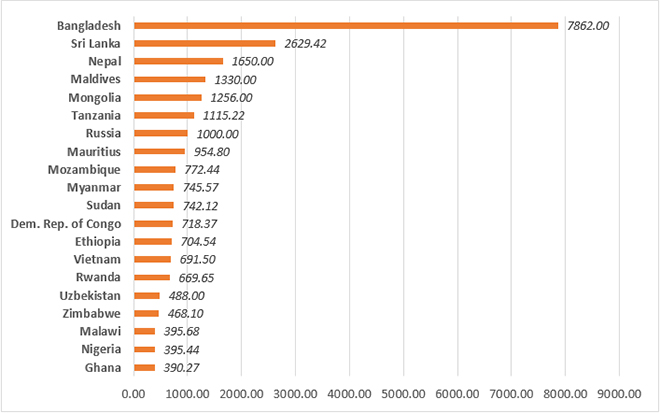
FIGURE 4: Top 20 Beneficiary Countries of Indian Lines of Credit, 2001-2022 (in US$ million)

* Amounts are till May 2022.
Source: Ministry of External Affairs Dashboard for LOC

Breaking Misconceptions
There are lingering misconceptions about India’s LOCs, and they will be discussed in turn in the following paragraphs.[28]

Misconception 1: India needs money for its own development; why should it offer loans to others?

When the MEA launched the DPA in January 2012, the press coverage and public engagements were limited. However, critical questions were asked about the rationale for extending high volumes of loans overseas while domestic social spending continued to be one of the lowest globally.[29] This criticism is not justified.
First, LOCs are loans borrowed by other partner countries that are liable to pay them back. Let us assume that country X approaches India for a loan about a particular development project. Let us further assume that going rate of interest for borrowing globally is 7 percent. India directs country X to the Exim Bank (subject to the approval of the project proposal), which is mandated to provide the LOCs. The Indian government offers to pay 3 percent of the interest payment, as the development partner of the country X.
If the project value is US$ 100 million, country X is liable to annually pay US$ 4 million for interest payments, along with principal repayment tranches after the moratorium period of five years. The Indian government will pay US$ 3 million of the interest payment annually, and that is the only commitment of government. But, with an annual pledge of US$ 3 million the Indian government is able to create financial leverage of US$ 100 million for other partner countries in its development cooperation. Moreover, the Indian government starts paying its pledged interest payment subsidy to the Exim Bank only when country X is satisfied with the project completion and starts repaying the loan amount. Till then, it is a sovereign guarantee provided by the Government of India only on the subsidised interest payments part. No money is paid before the project implementation.


Misconception 2: Even then, the Indian government is still paying (as interest payments subsidy) for another country’s development; why should the country pay for the development of others?

LOCs contain a clause that goods and services (including consultancy services) worth 75 percent value of the contract have to be sourced from India; therefore, these LOC-funded projects bring benefits to the domestic economy. Country X will benefit as the development project is of its choice. Once the project is completed through efficient project management (recall the third of the trinity of objectives), India gains tremendous goodwill in country X, which helps improve the diplomatic relationship and gives India some degree of geopolitical advantage.

Misconception 3: Exim Bank is wholly owned by the Indian government. Therefore, Exim Bank funds are public money. Is spending public money and putting it at risk for another country’s development project economically wise?

One of Exim Bank’s primary tasks is to raise money from domestic and international financial markets. The bank’s domestic resource base includes rupee bonds, certificates of deposit, commercial papers, and term deposits. It also raises money internationally via foreign currency bonds, foreign currency loans, and long-term swaps, apart from bilateral loans from other banks and financial institutions. Its foreign currency resources in diverse currencies include assets based on Australian dollar, Euro, Great Britain pound, Japanese yen, Mexican peso, Offshore Renminbi, Singapore dollar, South African rand, Swiss franc, Turkish lira, and the US dollar.[30]
The Exim Bank creates its own fund from domestic and global financial markets for extending loans. In a way, the bank brings in a form of foreign direct investment (FDI) while raising financial resources. A part of that fund portfolio is employed gainfully in the LOC projects. These are not public money coming directly from the coffers of the Indian Government.


Misconception 4: Is 75 percent value of the project in fact utilised to source goods and services originated in India?

According to MEA estimates, the clause that requires a partner country to source Indian goods and services worth 75 percent of the project cost, is satisfied for almost 94 percent of the completed projects under the LOCs.[31] This is actively monitored by the nodal ministries and departments. Exceptions can be made, however.
Suppose a road project under the LOC is sanctioned in a Caribbean country. It will be impractical to suggest that raw materials like cement is sourced from Indian manufacturers, simply for the reason that it will entail high economic costs. In these exceptional cases, the 10-percent relaxation clause sets in automatically. The LOCs provided by the Exim Bank for different development projects in other countries can be classified in two categories: (a) construction loans; and (b) supply loans. For construction loans, the 10-percent relaxation will set in wherever it is justified and applicable. For the supply loans, however, 100 percent Indian products are used—for example, if 100 electric buses are to be shipped to country Y under a particular project, all those buses will be made in India.

LOCs, SDGs, and India’s G20 Presidency
LOCs are an important driver of India’s development cooperation model based on a framework that is participative, response-based and demand-driven. Since the UN General Assembly adopted the Sustainable Development Goals (SDGs) in 2015, many countries started to align their development cooperation strategies with the SDG Agenda.
While India has not explicitly done so, ORF’s research has found that its sectoral development initiatives in partner countries have historically been closely aligned with the SDGs.[32] For example, in Africa, as well as in neighbouring countries like Nepal, Bangladesh, Afghanistan, and Bhutan, India has actively facilitated capacity-building and technical training (SDG 17) under the ITEC (Indian Technical and Economic Cooperation) programme. LOC projects in other partner countries cover sectors like education (SDG 4), health (SDG 3), and infrastructural support (SDG 9).[33]

ORF research that examined India’s development partnerships from 1947, discovered that the country’s development partnerships have been “naturally” aligned with what would later come to be known as the global sustainability agenda.[34] Such interconnected nature of the SDGS in India’s development cooperation strategies evolved in an organic way rather than pushed through explicit policy-driven initiatives.[35]
As SDG alignment emerges organically in India’s development cooperation, the link between SDGs and the G20 agenda has become more explicit and definitive in recent times.
The G20 Action Plan on the 2030 Agenda for Sustainable Development was adopted under the Chinese Presidency in 2016. Member countries committed to contribute to implementation through “collective and individual efforts, at home and abroad” with a “focus on sector and themes of the Agenda where the G20 has comparative advantage and can add value as a global forum for economic cooperation”.[36]

Another UNDP-OECD report, “G20 contribution to the 2030 Agenda: Progress and Way Forward”, found that actions—mandated by the forum in supporting the sustainability Agenda—increased in quantitative terms since the adoption. G20 would continue to play an important and unique role towards fulfilling the Agenda for Sustainable Development.[37] The G20 Bali Leaders’ Declaration (2022) clearly stated: “(G20) recommit to accelerate achievement of the SDGs, achieving prosperity for all through sustainable development.”[38]
An organic chain has therefore evolved, connecting India’s development cooperation and the SDGs. Officially, sustainability is now seamlessly woven into the G20 framework. India’s presidency can make it a more meaningful and focused endeavour, and LOCs are likely to play a pivotal role in ensuring this transition.

Conclusion
As India’s economy flourished, the country’s stakes in global geopolitics and geoeconomics also grew. Today, India’s role in actively influencing global rules-of-the-road have become amplified. This includes its framework for development cooperation. India’s model is unique and stands apart from the model that guides the traditional OECD-DAC countries. Based on a demand-driven and participative structure, India works at being an equal, effective and long-lasting development partner.
Diplomatic relationships and strategic interests have their own role to play in this development dynamics. Continuing the South-South cooperation legacy, India has performed fairly well in effectively using the LOCs.
India’s G20 presidency ushers in an important opportunity. With all three countries in the current G20 Troika being developing and emerging economies, the Indian presidency can initiate the process of firm alignment of development cooperation strategies with the SDGs. Lines of credit can serve both as an example and an important instrument in this endeavour.

[a] Indonesia was past; India is current; and Brazil will take over next.
https://www.orfonline.org/research/...ment-cooperation-and-g20-presidency/#_ftnref2 Net official development assistance (ODA) consists of disbursements of loans made on concessional terms (net of repayments of principal) and grants by official agencies of the members of the Development Assistance Committee (DAC), by multilateral institutions, and by non-DAC countries to promote economic development and welfare in countries and territories in the DAC list of ODA recipients. It includes loans with a grant element of at least 25 percent (calculated at a rate of discount of 10 percent). Net official aid refers to aid flows (net of repayments) from official donors to countries and territories in part II of the DAC list of recipients: more advanced countries of Central and Eastern Europe, the countries of the former Soviet Union, and certain advanced developing countries and territories. Official aid is provided under terms and conditions similar to those for ODA. Part II of the DAC List was abolished in 2005. The collection of data on official aid and other resource flows to Part II countries ended with 2004 data.
[c] FOB is “Free on Board” – the buyer bears the risk once the seller ships the product. CFR is Cost and Freight – the seller needs to arrange for the carriage of goods by sea to a port of destination and provide the buyer with necessary documents for collection from the carrier. CIF is Cost, Insurance and Freight – the seller has to cover the costs, insurance and freight of the buyer’s order while the cargo is in transit. CIP is Carriage and Insurance Paid To – the seller pays for freight and insurance to deliver to a seller-appointed party at an agreed-upon location.

 
Last edited:
I’m glad to see that this line of credit wasn’t extended to Pakistan. As for Bangladesh, I believe India should have a greater influence in its internal politics.

we have report that India was willing for contribution in Pakistan's foreign debt, by reducing it by using India's foreign reserve....
Pakistan is believed to be now having close relation with India...... :coffee:
 
Indian government LoC to BD was 1.3 billions in last 12 years. They do like to announce big numbers. But only small portion of it is actually realized. For example, the announced LoC to BD was around $8 billions.

It has provided $500 millions LoC to BD for military hardware procurement 8 years ago. Of course army won't simply use it. It remains in Indian banks.

As for assistance $, it is usually around $20-30 millions each year. This year around $14 millions) If bhakts are so worked up on it, it can be paid back very easily.

here we have a report on Indian involvement in Bangladesh's infrastructure projects like Ports, Multimodal, Northeast Road Connectivity, Railways, Inland Waterways etc :coffee:


India, Bhutan approve 61 projects worth​


New Delhi: India and Bhutan have approved 61 projects worth Rs.4,958 crore to be implemented during the Himalayan country’s 13th five-year plan, for which New Delhi is providing Rs.10,000 crore as development support. :coffee:

The projects, covering sectors such as connectivity, infrastructure, energy, health, education, capacity building, industrial parks, sports, digital economy, e-mobility and space technology, were approved during the India-Bhutan Development Cooperation Talks co-chaired by foreign secretary Vikram Misri and his Bhutanese counterpart Pema Choden in Thimphu.

Misri, who assumed his position on July 15, made his first foreign visit to Bhutan from July 19-20, reflecting the importance attached by New Delhi to its ties with Thimphu. India had doubled its financial support for Bhutan’s five-year plan in March.

The Bhutan government conveyed its appreciation for the support that India continues to provide for the country’s socio-economic development. During the Development Cooperation Talks, the two sides discussed various components of the assistance and implementation modalities for development projects being assisted by the Indian government, according to a joint statement issued at the conclusion of Misri’s visit.

The Bhutanese side presented “Project Tied Assistance” proposals and the first tranche of such projects to be implemented during the 13th five-year plan. Following this, the two sides approved 61 projects worth Rs.4,958 crore.

The two foreign secretaries virtually inaugurated 19 schools that were built during the 12th five-year plan.

The Bhutan government informed the Indian side about activities proposed to be taken up under the Economic Stimulus Programme (ESP). In line with a request from the Bhutan government, the Indian side agreed to “positively consider frontloading the full amount” of Rs.1,500 crore for the ESP in the first one-and-half years, subject to progress in implementing the proposals, the joint statement said.

“The talks were held in a friendly and cordial atmosphere in keeping with the well-established tradition of regular exchanges and unique bonds of friendship and cooperation between the two countries,” it added.


Lines of Credit for Development Projects​

Development assistance in the form of concessional Lines of Credit (LOCs) is extended by the Government of India under the Indian Development and Economic Assistance Scheme (IDEAS) through the Exim Bank of India. In total, more than 300 LOCs worth US$ 32 billion have been extended to 68 countries across the world. These Lines of Credit cover around 600 projects in sectors like railways, roads, agriculture, industry, airport, sports stadiums, port, hospitals, disaster management, hydroelectricity, power transmission and Information Technology.

Out of the total LOCs of US$ 32 billion, in keeping with the high priority we attach with the neighbouring countries under the "Neighbourhood First” Policy, we have extended LOCs worth US$ 7.862 billion to Bangladesh, US$ 1.65 billion to Nepal, more than US$ 2 billion to Sri Lanka, US$ 745 million to Myanmar and US$ 1.43 billion to Maldives. :coffee:

There is a special focus on regional connectivity initiatives in the neighbourhood under GoI LOCs as these can act as force multipliers to accelerate regional growth & development, promote people-to-people contact and encourage trade and commerce.

GoI has extended 196 LOCs worth US$ 12 billion to 42 African countries. The rest of our LOCs have been allocated across Latin America at US$ 811 million, Oceania at US$ 155 million and Commonwealth of Independent States at US$ 1.84 billion. ☕

India has always cooperated and collaborated with Global South, be it power projects in Sudan, Burundi and Rwanda, sugar plants in Ethiopia and Malawi,technology parks in Mozambique, Cote d’Ivoire and Eswatini, and, campuses built by India universities in Tanzania and Uganda, Metro project in Mauritius,Hanimaadhoo International Airport in Maldives, railway projects in Bangladesh and Sri Lanka, parliament building of Gambia etc. Lines of Credit as an instrument enable Government of India to cooperate with partner countries for infrastructure development and betterment of the lives of people of the partner countries.

 
1733960824758.png

Lines of Credit​

39. GOI has agreed to provide four lines of credit to the Government of Nepal for US$ 100 million, US$ 250 million, US$ 550 million and US$ 750 million. These lines of credit were signed in June 2006, September 2007 and September 2016, for execution of infrastructure development projects as prioritized by Government of Nepal. Last India-Nepal LOC Review Meeting took place in Kathmandu on 10 August 2023. :)

40. India’s Lines of Credits have financed 36 road projects, another 6 projects in hydropower and transmission lines and several others in housing and reconstruction, which are spread all across Nepal.(y) Many of these projects are either completed or are nearing completion, including some iconic projects such as Solu Corridor Transmission Line, Koshi Corridor Transmission Line, Muzaffarpur - Dhalkebar Transmission line, Devighat hydroelectric project etc. It has been decided to fund Bheri Corridor, Nijgadh-Inaruwa and Gandak Nepalgunj Transmission lines and associated substations under LOC at an estimated cost of US$679.8 million.

Tourism​

37. India is the largest source country for tourism into Nepal. Indians visit Nepal for its lofty mountains, hospitality and cultural diversity. A large numbers of Indians are also attracted to Nepal for religious tourism. The same is true for the Nepalese who visit tourist places, shrines and temples located in the farthest corners of India.

38. A Memorandum of Understanding (MoU) on Cooperation in the field of Tourism was signed between the two Governments on 25 November, 2014 in Kathmandu. The MoU aims to deepen and broaden cooperation in the field of tourism and also promote cooperation and direct communication between the stake holders of tourism and hospitality industry for enhancing tourism cooperation and strengthening economic development and employment generation.


Users who are viewing this thread

Pakistan Defence Latest

Back
Top