Indian Politics and Internal News

Wow Just Wow .

Muslim Community Expressed Their Love By Carrying Posters Of

Muslim Community Expressed Their Love By Carrying Posters Of© Getty
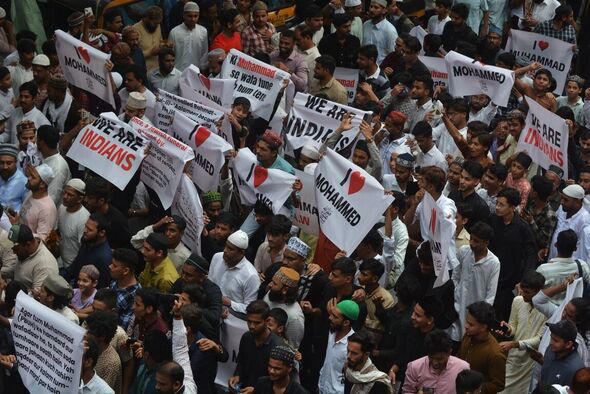
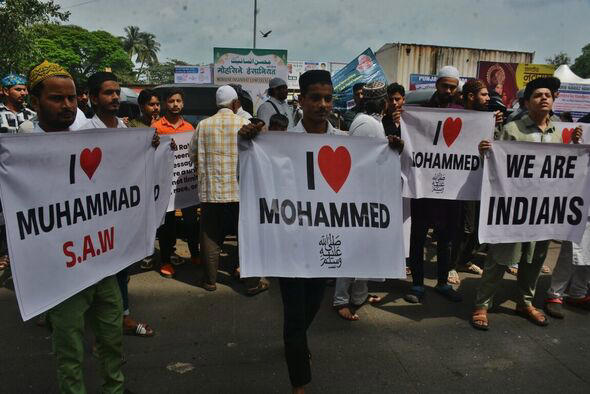
Over 2,500 Muslims have been charged with "public order" offences in India for openly expressing their love of the Prophet Muhammed. During the last month, Indian police have reportedly raided homes and public spaces to arrest Muslim men suspected of writing "I Love Muhammed" on posters, t-shirts and social media. Prime Minister Narendra Modi's Hindu Nationalist party launched the blitz of prosecutions, which has seen some perpetrators' homes bulldozed, to the end of clamping down on threats against "public order".

At least 22 cases have been brought against over 2,500 Muslims in the South Asian country, with at least 40 arrested across states governed by the Modi's Bharatiya Janata Party (BJP), the non-profit Association for Protection of Civil Rights (APCR) said. The slew of arrests was sparked by the erection of an illuminated board paying tribute to Muhammed while Muslims were observing Eid al-Milad al-Nabi, the celebration of his birth, in the city of Kanpur on September 4. Dozens were pursued on charges of promoting enmity on the grounds of religion in the historic region, an offence which carries a sentence of up to five years in jail.


I Love Mohammed March In Mumbra Thane

I Love Mohammed March In Mumbra Thane© Getty
The incident sparked backlash from prominent Muslim figures in India, with protests breaking out across the country, including in the northern city of Bareilly, where 75 demonstrators, including an iman, were taken into custody on September 26.

Buildings belonging to those accused of threatening "public order" were also bulldozed by local authorities, Al Jazeera reports.

While India's constitution grants citizens a right to express freedom of religion, activists have argued that such rights have not always been afforded to Indian Muslims, hundreds of whom have lost their homes to similar demolitions, often without prior warning, in recent years.

Nadeem Khan, national coordinator of the ACPR, said officials were tactically clamping down on the "I Love Muhammed" slogan by pursuing suspects on non-religious charges.

"They know that there is no law that criminalises just the mere expression of 'I Love Muhammed'," he said. "Everyone should understand that the government cannot criminalise a religion like this."

"Targeting people for slogans such as 'I Love Muhammed', which is peaceful and devoid of any incitement or threat, does not meet the threshold for criminal restriction under either Indian constitutional law or international human rights law," Aakar Patel, chair of Amnesty International's India board, added.

Public order concerns must be addressed proportionately and cannot justify the blanket suppression of religious identity or expression. The role of the state is to safeguard rights equally, not to police expressions of belief. Upholding constitutional and international commitments is not optional; it is a legal obligation."

The BJP has been contacted for comment.

 
Another example of RSS fascism.

These bigotted donkeys are going to fail at it miserably just as the Zionists have failed utterly in their efforts to muzzle the expression of support for the Palestinians.

In this day and age, resorting to Gestapo like tactics (fully expected from these RSS bigots) is not only counter-productive but it is next to impossible to implement.
 
@Master Chief @hussain0216 @Waz @PAKISTANFOREVER @harpy1 @Vkdindian1 @CallSignMaverick

MHTMH


Indian politicians like to claim that their governance innovations — particularly digital public infrastructure that’s shared between the state and the private sector — are widely admired. They can even point to the occasional testimonial from the leader of another developing nation.

But last week they bagged an unusual prize: UK Prime Minister Keir Starmer declared that India’s digital “unique ID” system, called Aadhaar, was a “massive success,” and that he hoped to learn from it in rolling out Britain’s equivalent.

Starmer was visiting India and met with Aadhaar’s architect, Nandan Nilekani — who is also the non-executive chairman of the IT services giant Infosys Ltd. He hopefully spent some of that time asking how best to avoid political blowback when the program inevitably metastasizes into something much larger than planned.

When Aadhaar was first proposed almost two decades ago, it was meant to be strictly voluntary — an additional, light-weight form of identification for those who struggled to access government services. The UK government has promised something similar: The card will only be mandatory for those about to start a new job to prove that they have a legal right to work.

But, of course, some Britons might want to use it for other things. It would be a convenient replacement for more complicated forms of identity verification. As Starmer said: “I don’t know how many times the rest of you have had to look in the bottom drawer for three bills when you want to get your kids into school or apply for this or apply for that — drives me to frustration.”

Judging from India’s experience, however, British bureaucrats will be as willing to expand the use of digital ID. They will wind up redesigning the access to services around the presence of the ID — whether to save money, eliminate fraud, or reduce wait times. First, you’ll need it for your taxes, then for your pension, and then you’ll be encouraged to link it to your National Health Service account.

Every additional step will appear reasonable, defensible, incremental. But it will end up with the ID being effectively mandatory. Today, it’s virtually impossible to get anything done in India without an Aadhaar.

I held out on getting one for the longest possible time. It was only when, in 2018, India’s Supreme Court permitted the income-tax department to require taxpayers to submit their ID numbers that I gave in.

The UK probably has more safeguards against such mission creep than India did. Our judges put the “right to dignity,” which they said universal ID enabled, over a right to privacy, and British judges might well disagree.

But it’s also true, in retrospect, that most of our worries about the Aadhaar were overdone. Indian officials in recent years have faced multiple (unproven) accusations of snooping on their citizens — but none of these allegations involved the use of the digital ID system.

Whether our data is truly secure may not be certain. In 2023, there were reports that over 800 million Aadhaar database entries were on sale in the untamed depths of the internet. We braced ourselves for an epidemic of identity theft, but nothing out of the ordinary happened. While fraud using stolen Aadhaar numbers is indeed an ongoing problem, it’s also a very small subset of the universe of terrifying scams that Indians have to navigate daily.

Meanwhile, the digital ID’s benefits are easy for even skeptics to see. Millions of previously unserved people have been able to enter the formal financial system — take out loans, save in specialized accounts, and receive payments from far away.

Most importantly, many poor Indians no longer struggle to prove their identity to access government-rationed food or cash transfers. The middlemen who used to take a cut of these benefits in return for easier access are now reduced to helping them set up their Aadhaar accounts.

And the private sector has taken to the digital ID system like a duck to water. Bank accounts can be opened in seconds. SIM cards for mobile phones, which once took days to organize in security-conscious India, can now be accessed almost instantly. I am still reluctant to hand out my Aadhaar number, and use alternatives wherever possible. But, truthfully, that behavior is more reflexive than it is considered.

Prime Minister Narendra Modi is quick to sense when his voters are happy. The Aadhaar project was started before he took office, but he quickly adopted it and has run on its benefits ever since. The fact that he regularly trumpets it as an achievement is perhaps the most significant indication of how popular it now is.

Starmer must be a little startled by how loud the opposition to an ID card is in Britain — all but two of the European Union’s 27 countries have something similar. But the chances are that, if he perseveres, the British will get used to it. I certainly have.

Regards
 
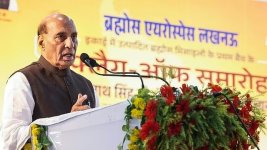
1760910454002.jpeg
Defence Minister Rajnath Singh speaks during the flagging off ceremony of the first batch of BrahMos missiles manufactured at the BrahMos Aerospace unit, in Lucknow, Uttar Pradesh.

Defence Minister Rajnath Singh on Saturday asserted that "every inch of Pakistan's territory" lies within the range of the BrahMos missile, adding that what transpired during Operation Sindoor was "just a trailer."

Speaking after flagging off the first batch of BrahMos missiles manufactured at the new BrahMos Aerospace facility in Lucknow, Singh said the missile system had moved far beyond the trial stage and now stands as the strongest practical proof of India’s national security.

“BrahMos proved its effectiveness during Operation Sindoor. Victory has become our habit. What happened during that operation was just a trailer, and even that made Pakistan realise what India is capable of. If India could give birth to Pakistan, I need not say what else it can do,” the Defence Minister stated.

He described BrahMos as a key pillar of the armed forces and a symbol of India’s capability to turn its strategic ambitions into reality.

Singh also addressed challenges arising from disruptions in the global supply chain, especially spare parts, which he said were increasingly being used as "weapons" by supplier countries. “We are overcoming these challenges,” he affirmed.

The BrahMos Aerospace facility in Sarojini Nagar, Lucknow, which was inaugurated on May 11, is equipped with state-of-the-art infrastructure for missile integration, testing, and quality assurance. The first batch of missiles from this facility marks a significant milestone for the Uttar Pradesh Defence Industrial Corridor (UPDIC) and India’s push for self-reliance in defence manufacturing.

“This facility will manufacture around 100 missiles every year, supplying them to the Army, Navy, and Air Force,” Singh said. “Built on approximately 200 acres at a cost of about Rs 380 crore, it will also generate employment for hundreds of people.”

Rajnath Singh revealed that the BrahMos team had signed contracts worth approximately Rs 4,000 crore with two countries in the past month. He noted that, in the coming years, experts from around the world would visit Lucknow, transforming the city into a hub of knowledge and leadership in defence technology."

The turnover of the Lucknow unit is expected to reach Rs 3,000 crore from the next financial year, with GST collections around Rs 500 crore,” he added.

Rajnath Singh emphasised that India is now at a stage where it is not only strengthening its national security but also proving to the world that it is a credible partner in defence and technology.

He highlighted that achievements like the BrahMos missile system have shown that "Made in India" is no longer just a slogan but a globally recognised brand. “Whether it's the export of BrahMos to the Philippines or future cooperation with other countries, India is now playing the role of a giver, not just a taker. This is the true essence of Aatmanirbhar Bharat—the vision with which the Modi government began its journey in 2014,” Singh said.

He added that Prime Minister Narendra Modi has envisioned an India that is fully developed, self-reliant, and ready to lead the world by 2047, with the defence sector playing a decisive role in achieving that goal.

Further, Rajnath Singh called for a clear project roadmap to integrate small entrepreneurs into the defence ecosystem.

“The Uttar Pradesh Defence Industrial Corridor will only achieve full success when small industries grow alongside large companies,” he said. “I am confident that UP will not only become a manufacturing hub in the future but also emerge as a new epicentre of innovation and employment for entrepreneurs—both small and large.”

Uttar Pradesh Chief Minister Yogi Adityanath, in his address, described BrahMos as a missile of Aatmanirbharta (self-reliance), fulfilling the nation’s defence needs.

He expressed gratitude to Prime Minister Narendra Modi and Defence Minister Rajnath Singh for enabling Lucknow to play a central role in India’s journey towards self-reliance in defence manufacturing.

Yogi Adityanath said the missiles produced in Lucknow represent an assurance of safety and prosperity for the people of India. He also highlighted progress across all six nodes of the UP Defence Industrial Corridor, noting that over 15,000 youth had gained employment through the initiative.
 
Hindutvatis think that Pakistan can be defeated in its entirety by use of BrahMos.
 
Helicopter Gets STUCK in Wet Concrete 😂 India at its Finest

To view this content we will need your consent to set third party cookies.
For more detailed information, see our cookies page.


Indian president’s helicopter sinks after landing in freshly poured concrete​

 
So?
Any helicopter will get stuck if it lands in a pad where concrete was poured just a couple of hours back.
 
So?
Any helicopter will get stuck if it lands in a pad where concrete was poured just a couple of hours back.
the thing is not knowing the halipad is under repair or construction
 

Users who are viewing this thread

Back
Top