India's Counter After China Halted Its Bullet Train

The correct term is “Chinese-manufactured,” not “Chinese TBM.”

Next time, if you export an iPhone manufactured in China, please don't start claiming that the iPhone was innovated or Apple company own by China.
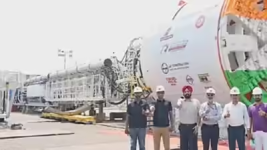
ok. Seven Chinese companies, including STEC and CRTG, are supplying TBM and Related equipment to India.

Is it understandable? Do we need a link? Can I now call them "Chinese TBM" now?
 
Last edited:
bro. What he meant was "before". Before 2020. India has been using Chinese TBM to build the Mumbai subway.
If you ask me, I actually think it was a good thing in the long run. China delaying the export of Chinese-manufactured TBMs to India exposed India's dependence on foreign supply chains. At least now India is developing its own indigenous TBM capability instead of remaining dependent on imports.

BEML and DMRC are already working toward developing indigenously designed and manufactured TBMs, and BEML has initiated the process for technology/design support.

So sometimes such disruptions can actually push a country to develop its own capability. 1787757687484.png
 

Attachments

  • 1787757632529.png
    1787757632529.png
    109.5 KB · Views: 0
A country that even imports its train wheels. It always likes to talk about technology with us.
 
If you ask me, I actually think it was a good thing in the long run. China delaying the export of Chinese-manufactured TBMs to India exposed India's dependence on foreign supply chains. At least now India is developing its own indigenous TBM capability instead of remaining dependent on imports.

BEML and DMRC are already working toward developing indigenously designed and manufactured TBMs, and BEML has initiated the process for technology/design support.

So sometimes such disruptions can actually push a country to develop its own capability. View attachment 212672
In fact, it is a technology from China. Indian companies have established technological cooperation with Chinese companies. STEC. CRTG...etc
 
India begging China for technology? Why would India be begging China for technology that China didn't even invent or own? These TBMs were German technology, from German company Herrenknecht. .. isnt that funny to say it?
搜狗截图20260826232916.png
 
If you ask me, I actually think it was a good thing in the long run. China delaying the export of Chinese-manufactured TBMs to India exposed India's dependence on foreign supply chains. At least now India is developing its own indigenous TBM capability instead of remaining dependent on imports.

BEML and DMRC are already working toward developing indigenously designed and manufactured TBMs, and BEML has initiated the process for technology/design support.

So sometimes such disruptions can actually push a country to develop its own capability. View attachment 212672
Bro. Really. India has always relied on Chinese technology.

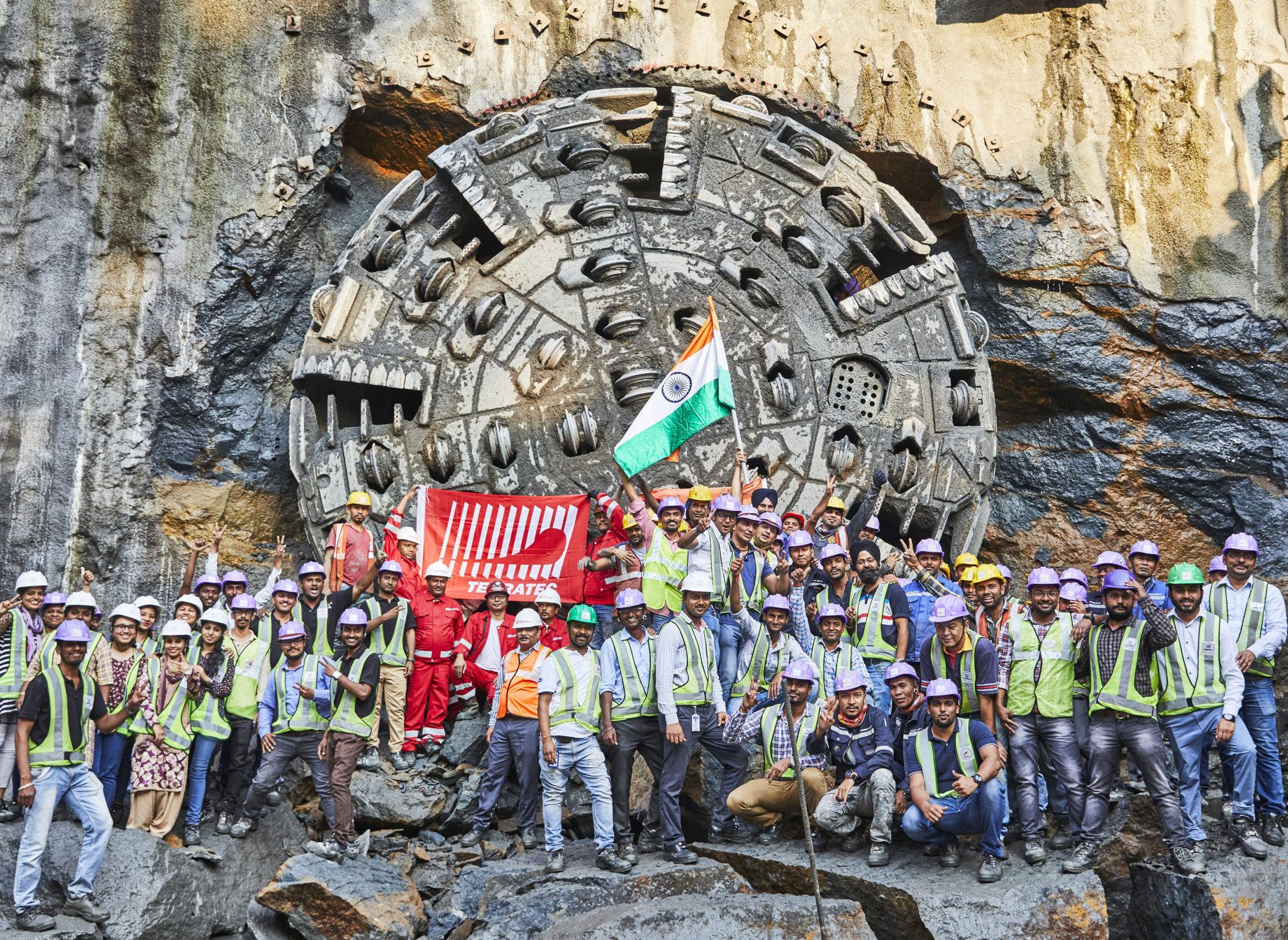
In mid-February the J. Kumar – China Railway No. 3 Engineering Group (CRTG) JV celebrated the breakthrough of its 6.68m diameter TERRATEC dual-mode hard rock TBM on Mumbai Metro Rail Corporation Ltd’s (MMRCL) Line 3 project, in India.

 
TBM will be a thing of the past, BBM will rule

World's first boring and blasting machine unveiled in Central China, for pumped storage project
By Global Times
Published: Aug 03, 2026 08:34 PM

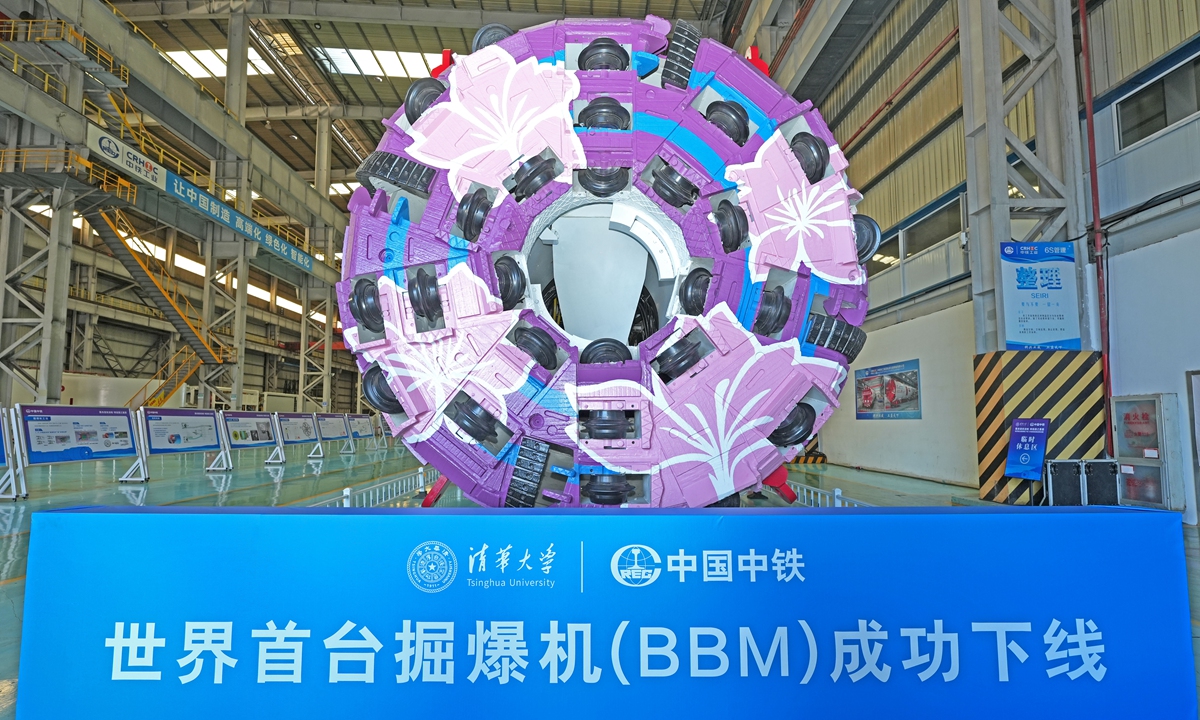
World's first boring and blasting machine rolls off the production line at a manufacturing base of China Railway Science & Industry Group in Wuhan, Central China's Hubei Province, on August 1, 2026. Photo: Courtesy of CRSIC

World's first boring and blasting machine rolls off the production line at a manufacturing base of China Railway Science & Industry Group in Wuhan, Central China's Hubei Province, on August 1, 2026. Photo: Courtesy of CRSIC

The world's first boring and blasting machine (BBM) officially rolled off the production line at a manufacturing base of China Railway Science & Industry Group in Wuhan, Central China's Hubei Province, on Saturday, filling the gap in integrated tunneling equipment for tunnels with complex geological conditions, the Global Times learned on Monday.

Jointly developed by Tsinghua University and China Railway Science & Industry Group (CRSIC), a subsidiary of China Railway Group Ltd, the equipment integrates the strengths of two mainstream tunneling methods - tunnel boring machine (TBM) and the drilling and blasting method - offering a novel technological solution for long and large tunnel construction under complex geological conditions.

It represents a major breakthrough in China's high-end underground engineering equipment sector through industry-university-research collaboration, China Railway Science & Industry Group said in a statement sent to the Global Times on Monday.

The construction of long and large tunnels has long been plagued by complex geological challenges, including large deformation of soft rock, severe rock bursts, and water and mud inrushes, domestic news portal stdaily.com reported Monday. The traditional drilling and blasting method poses significant safety management pressures with limited construction efficiency, while hard-rock TBMs lack adaptability in unfavorable ground conditions, making it difficult to combine the advantages of both methods.

The R&D team adopted an innovative hollow cutterhead structure. Through the coordinated operation of the hollow cutterhead and the central cutterhead, the machine can flexibly switch between multiple operating modes, the CRSIC said in its statement. "The BBM can seamlessly alternate between modes - including pre-blasting followed by excavation, pre-excavation followed by blasting, and full-face boring - thus offering flexible adaptability to a wide range of field conditions."

According to China News Service, the birth of the BBM will solve a world-class challenge in complex tunnel construction. Qin Pengxiang, a research fellow with the State Key Laboratory of Hydroscience and Engineering at Tsinghua University, said that lab results showed that the excavation efficiency will be increased by 30 percent compared with traditional TBM.

The machine is also equipped with multiple proprietary technologies that significantly enhance its comprehensive tunneling capability in complex tunnels, according to the company. Its retractable side cutters allow flexible adjustment of the excavation cross-section and improve the efficiency of in-tunnel relocation and passage. The adaptive telescopic tail shield accommodates various segment specifications, enabling variable-diameter lining assembly in rock burst and large-deformation sections to ensure support structure stability.

An explosion-proof shield buffers blasting impacts, effectively protecting the main machine and internal precision components. A dual independent belt conveyor system sorts and transports excavated muck and aggregates separately, optimizing the construction organization process.

China is accelerating the development of a modern infrastructure system, advancing the coordinated deployment of six major infrastructure networks encompassing transportation, energy, and water conservancy. This BBM breaks away from the conventional design approaches of similar domestic and international equipment, with the entire machine and its core components featuring fully independent intellectual property rights, domestic news portal stdaily.com reported on Monday, citing an official with the Wuhan Municipal Science and Technology Innovation Bureau.

The BBM will be deployed in a project to build a pumped storage hydropower station for engineering demonstration purposes.

The research team will continue to optimize the BBM's performance based on field measurement data collected on-site, stdaily.com reported.

 
Bro. Really. India has always relied on Chinese technology.

In mid-February the J. Kumar – China Railway No. 3 Engineering Group (CRTG) JV celebrated the breakthrough of its 6.68m diameter TERRATEC dual-mode hard rock TBM on Mumbai Metro Rail Corporation Ltd’s (MMRCL) Line 3 project, in India.

Even if India needs to manufacture TBMs locally, do you really think India would necessarily have to enter into a technology agreement with a Chinese company? Why couldn't India partner with a German company such as Herrenknecht, an American company such as Robbins? Even China has done the same in the past and manufacturing it

just leave it... everyone knows manufacturing. – China. is leading.
 
TBM will be a thing of the past, BBM will rule

World's first boring and blasting machine unveiled in Central China, for pumped storage project
By Global Times
Published: Aug 03, 2026 08:34 PM

World's first boring and blasting machine rolls off the production line at a manufacturing base of China Railway Science & Industry Group in Wuhan, Central China's Hubei Province, on August 1, 2026. Photo: Courtesy of CRSIC's first boring and blasting machine rolls off the production line at a manufacturing base of China Railway Science & Industry Group in Wuhan, Central China's Hubei Province, on August 1, 2026. Photo: Courtesy of CRSIC

World's first boring and blasting machine rolls off the production line at a manufacturing base of China Railway Science & Industry Group in Wuhan, Central China's Hubei Province, on August 1, 2026. Photo: Courtesy of CRSIC

The world's first boring and blasting machine (BBM) officially rolled off the production line at a manufacturing base of China Railway Science & Industry Group in Wuhan, Central China's Hubei Province, on Saturday, filling the gap in integrated tunneling equipment for tunnels with complex geological conditions, the Global Times learned on Monday.

Jointly developed by Tsinghua University and China Railway Science & Industry Group (CRSIC), a subsidiary of China Railway Group Ltd, the equipment integrates the strengths of two mainstream tunneling methods - tunnel boring machine (TBM) and the drilling and blasting method - offering a novel technological solution for long and large tunnel construction under complex geological conditions.

It represents a major breakthrough in China's high-end underground engineering equipment sector through industry-university-research collaboration, China Railway Science & Industry Group said in a statement sent to the Global Times on Monday.

The construction of long and large tunnels has long been plagued by complex geological challenges, including large deformation of soft rock, severe rock bursts, and water and mud inrushes, domestic news portal stdaily.com reported Monday. The traditional drilling and blasting method poses significant safety management pressures with limited construction efficiency, while hard-rock TBMs lack adaptability in unfavorable ground conditions, making it difficult to combine the advantages of both methods.

The R&D team adopted an innovative hollow cutterhead structure. Through the coordinated operation of the hollow cutterhead and the central cutterhead, the machine can flexibly switch between multiple operating modes, the CRSIC said in its statement. "The BBM can seamlessly alternate between modes - including pre-blasting followed by excavation, pre-excavation followed by blasting, and full-face boring - thus offering flexible adaptability to a wide range of field conditions."

According to China News Service, the birth of the BBM will solve a world-class challenge in complex tunnel construction. Qin Pengxiang, a research fellow with the State Key Laboratory of Hydroscience and Engineering at Tsinghua University, said that lab results showed that the excavation efficiency will be increased by 30 percent compared with traditional TBM.

The machine is also equipped with multiple proprietary technologies that significantly enhance its comprehensive tunneling capability in complex tunnels, according to the company. Its retractable side cutters allow flexible adjustment of the excavation cross-section and improve the efficiency of in-tunnel relocation and passage. The adaptive telescopic tail shield accommodates various segment specifications, enabling variable-diameter lining assembly in rock burst and large-deformation sections to ensure support structure stability.

An explosion-proof shield buffers blasting impacts, effectively protecting the main machine and internal precision components. A dual independent belt conveyor system sorts and transports excavated muck and aggregates separately, optimizing the construction organization process.

China is accelerating the development of a modern infrastructure system, advancing the coordinated deployment of six major infrastructure networks encompassing transportation, energy, and water conservancy. This BBM breaks away from the conventional design approaches of similar domestic and international equipment, with the entire machine and its core components featuring fully independent intellectual property rights, domestic news portal stdaily.com reported on Monday, citing an official with the Wuhan Municipal Science and Technology Innovation Bureau.

The BBM will be deployed in a project to build a pumped storage hydropower station for engineering demonstration purposes.

The research team will continue to optimize the BBM's performance based on field measurement data collected on-site, stdaily.com reported.
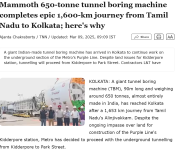
That's called real improvements over present technology.
 
Even if India needs to manufacture TBMs locally, do you really think India would necessarily have to enter into a technology agreement with a Chinese company? Why couldn't India partner with a German company such as Herrenknecht, an American company such as Robbins? Even China has done the same in the past and manufacturing it

just leave it... everyone knows manufacturing. – China. is leading.
Bro. You've been struggling too much to accept the truth...

India even has to import urea and train wheels from China. You tell me. Can India master TBM technology? Just because you can cooperate with the West... You underestimate technology too much and overestimate India too much.
 
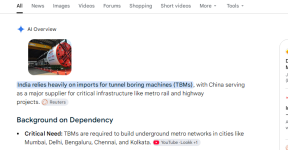
India relies heavily on imports for tunnel boring machines (TBMs), with China serving as a major supplier for critical infrastructure like metro rail and highway

搜狗截图20260826234813.png
 
Bro. You've been struggling too much to accept the truth...

India even has to import urea and train wheels from China. You tell me. Can India master TBM technology? Just because you can cooperate with the West... You underestimate technology too much and overestimate India too much.
Bro, you're confusing current dependence with an inability to develop the technology. India importing urea or train wheels from China today doesn't mean India is incapable of manufacturing them. Countries import products all the time simply because it is currently more economical or efficient than producing them domestically.

My point about TBMs is exactly the same. I never said India could master TBM technology overnight. I'm saying there is no reason to assume that India is incapable of developing it. China itself didn't develop every advanced industrial technology from scratch. It imported technology, partnered with foreign companies, built manufacturing capabilities, absorbed the know-how, improved it and eventually developed its own technologies.

Remember, even after decades of massive investment and technology development, China is currently ranked 10th globally in the Global Innovation Index. India is also making steady progress, moving from 48th in 2020 to 38th in 2025.

My point is simple: countries develop technological and industrial capabilities progressively. China didn't reach its current position overnight, and India won't either. You can criticize India's current capabilities, but today's ranking or imports don't determine where India can be 10, 20, or 30 years from now.

China's own journey is actually a good example of this.
 
Bro, you're confusing current dependence with an inability to develop the technology. India importing urea or train wheels from China today doesn't mean India is incapable of manufacturing them. Countries import products all the time simply because it is currently more economical or efficient than producing them domestically.

My point about TBMs is exactly the same. I never said India could master TBM technology overnight. I'm saying there is no reason to assume that India is incapable of developing it. China itself didn't develop every advanced industrial technology from scratch. It imported technology, partnered with foreign companies, built manufacturing capabilities, absorbed the know-how, improved it and eventually developed its own technologies.
The whole world knows that not every country can become China and does what China did.
 
The whole world knows that not every country can become China and does what China did.
Try to understand the economics. Why would every country manufacture TBMs locally when proven machines are already available internationally at a lower cost? Many countries need only a few TBMs for specific projects, so importing is far more practical than building an entire domestic industry.

China developed a major TBM industry partly because its huge domestic demand justified it. Not every country has that scale.

So importing a TBM doesn't mean a country lacks the capability to develop the technology—it may simply be the more economical choice. TBM technology itself is over a century old, although modern machines have evolved significantly with advanced automation, sensors, materials and control systems.

And overall, I agree. China successfully positioned itself in the 1980s and 1990s by offering cheap labour, large-scale manufacturing capacity and favourable facilities. It then gradually absorbed and developed the technology. Many countries missed the opportunity, but China caught it with both hands and turned that advantage into remarkable industrial and technological progress.
 

Users who are viewing this thread

Pakistan Defence Latest

Country Watch Latest

Back
Top