Indonesia Agricultural Sector Development

Prabowo Pushes for Food Storage at Village Level to Tackle Inflation​


Maria Gabrielle Putrinda

December 9, 2024 | 9:17 pm

1733885740394.webp
President Prabowo Subianto meets Japan-Indonesia Association delegates at the State Palace in Jakarta on Dec. 6, 2024. (antara Photo/Muhammad Adimaja)

Jakarta. President Prabowo Subianto said that achieving food self-sufficiency is a central strategy for controlling inflation in Indonesia. Speaking at a coordination meeting on inflation control at the Home Affairs Ministry in Jakarta on Monday, Prabowo emphasized that food security should extend to the sub-district level.


“Food self-sufficiency is key—every village should have its own food storage,” Prabowo said, describing this as a long-term national strategy.


Prabowo also acknowledged the country's success in keeping national inflation below 3 percent despite global uncertainties, calling this an achievement to be grateful for. "We should be thankful that our inflation rate is below 3%. It is an accomplishment," he stated.


In November 2024, year-on-year inflation was 1.55 percent, well below the government's target of 2.5 percent.

Additionally, the president praised the nationwide simultaneous planting initiative, which supports the government's broader strategy to enhance national food resilience. He expressed optimism about Indonesia's ability to face economic challenges and urged ministries and regional governments to continue innovating in their efforts to control inflation.


"Let’s continue. We are grateful that inflation is under control, but the key is production. I am optimistic that we can overcome challenges if we approach them responsibly,” Prabowo concluded.


Separately, Deputy of Home Affairs Minister Bima Arya Sugiarto outlined the Ministry’s strategy to support President Prabowo's goal of achieving food self-sufficiency at the regional level. Bima explained that the Ministry is coordinating with local governments to allocate budgets for agricultural programs, land development, and irrigation systems to ensure food security.


“To achieve food self-sufficiency, we are coordinating with local governments, at least to allocate budgets for activities conducted by agricultural instructors,” Bima said.


Bima added that the Home Affairs Ministry is also working with regional governments to ensure the provision of land, agricultural supplies, and infrastructure for irrigation.


“This intervention starts at the local level, coordinated with all stakeholders. This is something unique to Indonesia,” Bima said.


Chief of Food Affairs Zulkifli Hasan outlined Indonesia’s food security goals for 2025, which include halting imports of key food commodities such as rice, sugar, salt, and corn for animal feed.


By 2025, Indonesia plans to meet domestic demand for these commodities through local production. The target includes 2.6 million tons of domestic sugar production, 2.25 million tons of consumption salt, and 16.68 million tons of corn, with the surplus expected to be exported. Domestic rice production is projected to reach 32 million tons, surpassing the national requirement of around 31 million tons, thus ensuring Indonesia’s self-sufficiency.


Imports of Key Food Commodities to End Next Year​


Didik Fibrianto

December 20, 2024 | 4:28 am

To view this content we will need your consent to set third party cookies.
For more detailed information, see our cookies page.

Sumedang, West Java


Malang. The Indonesian government plans to halt imports of certain food commodities starting next year to bolster self-sufficiency programs, a senior minister announced on Thursday.


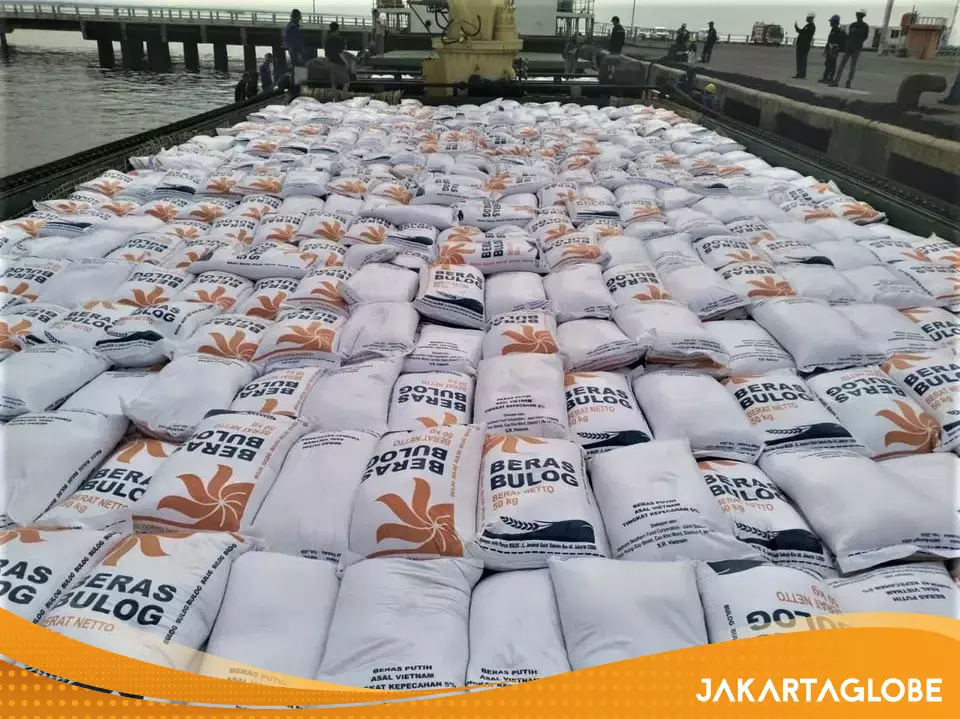
“Beginning next year, there will be no imports of sugar, rice, table salt, or corn feed for animals. We must achieve self-sufficiency in as many commodities as possible, in line with the president’s directives,” said Zulkifli Hasan, the Coordinating Minister for National Food Security.


Speaking to sugarcane farmers in Gondanglegi District, Malang Regency, East Java, Zulkifli explained that the import restrictions aim to protect local farmers and encourage them to boost productivity by ensuring stable and profitable prices in domestic markets.


“Today, we have achieved a safe level of food supply, thanks to the hard work of our farmers,” the minister said.

During the visit, Zulkifli was accompanied by Sis Apik Wijayanto, the CEO of the state-owned food holding company, ID Food.


Sis Apik noted that closer partnerships with sugarcane farmers have increased the company’s sugar production by 17 percent this year, reaching 306,000 tons.


ID Food has set a target to raise sugar production to 350,000 tons next year and plans to expand sugarcane plantations to cover 65,000 hectares.


“Increased participation by younger generations in sugarcane farming will accelerate our goal of achieving self-sufficiency in sugar,” Sis Apik added.

 
Indonesia to hike crude palm oil export levy to 10%


By Bernadette Christina / Reuters

JAKARTA (Dec 19): Indonesia will increase its export levy for crude palm oil (CPO) to 10% from the current 7.5% to finance higher biodiesel subsidies, its chief economic minister said on Thursday.

The levy will be implemented once the relevant finance ministry regulation has been issued, Airlangga Hartarto said.

Indonesia, the world's top palm oil producer, collects levies to help subsidise its mandatory biodiesel programme, in which bio-content will be increased to 40%, called B40, starting Jan 1 from the current 35%.

The higher blend is expected to increase the subsidy requirement.

BPDPKS, the agency in charge of collecting and managing the palm oil funds, estimated in November that increasing the mandatory blend of biodiesel to 40% would increase the subsidy requirement by 68%.

"There will be funding from BPDPKS ... First, we will increase the levy to 10%," Airlangga said when asked about the subsidy financing.

Palm oil currently costs around US$400 per metric tonne more than crude oil.

Indonesia currently imposes a 7.5% levy for CPO exports, while the levy for more refined palm oil products is charged at between 3% and 6% of the reference price.

Airlangga did not elaborate on the new levy rates for refined palm oil products.

Palm oil group Gapki is concerned a higher levy will reduce the competitiveness of Indonesian exports, chairman Eddy Martono said.

"Compared to Malaysian palm oil, ours is more expensive due to levy, export tax and the domestic obligations. These are all burdensome," he said.

The benchmark palm oil contract in Kuala Lumpur, which fell as much as 3.58% earlier on Thursday, pared most of its losses after Airlangga's comment. It was trading 0.33% lower at 0937 GMT.

A senior official at the energy ministry said the government planned to allocate 15.62 million kilolitres of unblended biodiesel to fuel retailers next year, up from 13.4 million kilolitres allocated for B35 this year.


Japan Announces $99 Million Loan for Indonesian Fishing Ports​


Jayanty Nada Shofa

December 24, 2024 | 7:50 pm

To view this content we will need your consent to set third party cookies.
For more detailed information, see our cookies page.


Jakarta. Japan announced Tuesday that it had agreed to give about 15.5 billion Japanese yen or nearly $99 million worth of loans to Indonesia to improve its fishing ports.


The funding would go into the feasibility study for the development of Indonesian ports, including one in the country’s most modern city Jakarta. The loan deal is also quite timely as President Prabowo Subianto wants the country to be self-sufficient in food production by 2027.


“This program aims to increase the catch volume [in Indonesian ports] while improving the quality of its marine products through cold supply chains. … It is exactly in line with Prabowo’s food self-sufficiency agenda,” Hajime Ueda, the economic affairs minister at the Japanese Embassy to Indonesia, told reporters in Jakarta.


The freshly announced funding would cover ports in eight locations, namely Jakarta, Banda Aceh, Riau’s Bagansiapiapi, Natuna, Central Java’s Pekalongan, North Sulawesi’s Likupang, Papua’s Biak, and South Papua’s Merauke. They will kick off with a feasibility study and the so-called “detailed design” process on the aforementioned locations, which typically aims to lay out the project objectives and activities. These studies will identify which fishing port classifies as “high priority” for the rehabilitation works of its landing docks, fishery processing facility, and cold storage, among others.


The loan has a fixed rate of 1.8 percent. Japan has also set a fixed annual interest rate of 0.2 percent for the consulting service portion. Indonesia has 30 years to pay off its debt, but Tokyo has granted Jakarta a 10-year grace period. Like most Japanese official development assistance (ODA) financing, the $99 million loan is untied. In other words, Indonesia does not have to exclusively procure Japanese goods and services for this project.


The Central Statistics Agency (BPS) data shows that archipelagic Indonesia has 532 fishing ports spread across the country. Most are located in Aceh, of which its capital Banda Aceh is one of the $99 million funding target area.

Japan International Cooperation Agency (JICA) is in charge of administering the funding. This is also not the first time for the agency to lend some money to Indonesia. The Jakarta Globe also asked how confident JICA was in Indonesia’s ability to pay off its growing debt.


JICA's chief representative for Indonesia Sachiko Takeda said: “We usually take a look at the country’s growth forecasts and debt repayment ability. We believe that Indonesia can pay it off in the future.”


The $99 million funding follows similar projects, including a 2.5 billion yen worth of Japanese grant for a fishing port development project. In 2020, Indonesia and Japan inked technical cooperation on fishing port facilities and markets on the former’s remote islands: Sabang, Natuna, Morotai, Saumlaki, Moa, and Biak. The project is mostly completed, and this has opened up the possibility of these ports using the increased catch to supply Prabowo’s upcoming nutritious meal campaign. Ueda said that Japan had also had talks with the National Nutrition Agency, which is in charge of overseeing the free meal program.


“The increased catch [in the ports that we cooperate on] means that the fishermen can sell the relatively expensive fish in markets, including for exports. But they can use the more affordable fish to supply the free meal program at local schools. Fish is also a major source of protein, and it can help tackle stunting,” Ueda said.


Gov't Promises Rp 20 Million (1,230 USD) Monthly Revenue for Transmigration Participants​

Antara

January 10, 2025 | 8:47 am


To view this content we will need your consent to set third party cookies.
For more detailed information, see our cookies page.

Wajak Kidul Village, East Java


Jakarta.
Farmers participating in the government's inter-island migration program can earn around Rp 20 million (1, 230 USD) per family per month, Transmigration Minister Iftitah Sulaiman Suryanegara said on Thursday.


The transmigration program seeks to relocate farmers from densely populated areas or where farming lands are limited to other islands with untapped agricultural areas to tackle demographic and poverty problems. It was first implemented on a massive scale during the 32-year tenure of Soeharto's presidency.


The current administration is reviving the program in part to boost agriculture productivity and achieve national self-sufficiency in food.


"We do not want farmers participating in the program to be seen as second-class citizens anymore. They are the backbone of the nation's development," Iftitah was quoted by Antara as saying.


The government promised to equip participants with modern agricultural tools and machinery and provide intensive farming training and management. Each family will receive a house and farming lands to work on.


"This is no longer just a concept, but it has been proven on the ground. With technology and agricultural machinery, young farmers from Aceh to Papua can make a net income of Rp 15 million to Rp 20 million per month," the minister said.


The transmigration program is conducted in collaboration with the Agriculture Ministry, which plans to create 500,000 hectares of new paddy fields in strategic areas across Indonesia. The ministry has launched the "Food Brigade" program, in which every 200 hectares of land will be managed by 15 trained farmers equipped with modern tools to boost food crop output.


Agriculture Minister Andi Amran Sulaiman has set an ambitious target for Indonesia's rice production, aiming to reach 32 million tons by 2025 and to stop rice imports starting next year.


The Agriculture Ministry is implementing various strategies, including food estate programs and modern farming practices, to achieve this target.


Simplified Rules Let S. Sumatra Farmers Easily Get Subsidized Fertilizers​

The Jakarta Globe

January 13, 2025 | 6:54 pm

To view this content we will need your consent to set third party cookies.
For more detailed information, see our cookies page.


Jakarta. The simplified rules have enabled farmers across the country, including South Sumatra, to get their subsidized fertilizers, according to the state-run fertilizer maker Pupuk Indonesia.


The subsidized fertilizer has already made its way to Indonesian farmers since the beginning of the year. This distribution is expected to help Indonesia become more self-sufficient in its food production by 2027.


"The national fertilizer supply current stands at 1.5 million tons. We also have enough fertilizers for South Sumatra," Pupuk Indonesia's president director Rahmad Pribadi was quoted as saying in a statement on Monday.


The supply is as follows: there is approximately 980,000 tons of the so-called NPK fertilizers. Pupuk Indonesia has also prepared 607 million tons of urea fertilizers. South Sumatra also has 24,590 tons of subsidized fertilizers, about 9,111 tons of which are urea fertilizers. The rest are 15,460 tons of NPK Phonska fertilizer, 4 tons of NPK cacao fertilizers, and 15 tons of organic fertilizers.


South Sumatra is also home to the Pupuk Sriwidjaja Palembang or Pusri facility, according to Rahmad. This facility should enable Pupuk to channel more fertilizers into the province if necessary. Pupuk Indonesia also makes daily checks on its warehouses, including those located in the regencies or cities.


As of Jan. 10, about 165,688 tons of the subsidized fertilizers already reached the farmers' hands. This is equivalent to 1.73 percent of the government's target of 9.55 million tons. In South Sumatra alone, the distributed volume already reached 6,052 tons for all types of subsidized fertilizers. This is about 2.1 percent of what the government had set for the province.


"In 2024, South Sumatran farmers received a total of 262,199 tons of subsidized fertilizers. The government decides to allocate more subsidies and raise it to 294,079 tons," Rahmad said.


Deputy Agricultural Minister said that the government had already simplified the distribution mechanism so the fertilizers were already available in local kiosks on Jan. 1.


"So, not only do we increase the allocated subsidized fertilizers to 9.5 million tons, we have also simplified the distribution. The administration process also takes less time," Sudaryono said.


Any farmers who have yet to register on the farmer group digital platform e-RDKK needs to sign up as soon as possible via their respective farmer groups. This way, their data will be available on the so-called agricultural support management system or Simluhtan.


Analyst Welcomes Import Ban on Four Basic Commodities​


Antara

January 17, 2025 | 12:59 pm

To view this content we will need your consent to set third party cookies.
For more detailed information, see our cookies page.

Highway development in rural areas, Central Java


Jakarta. The government's decision to ban imports of rice, corn, sugar, and salt was lauded by an analyst, who said Indonesia has abundant resources for these four commodities.


Ragimun, lead economic and finance researcher at the National Research and Innovation Agency (BRIN), said the policy can be implemented immediately with confidence because of the high level of availability for those commodities.


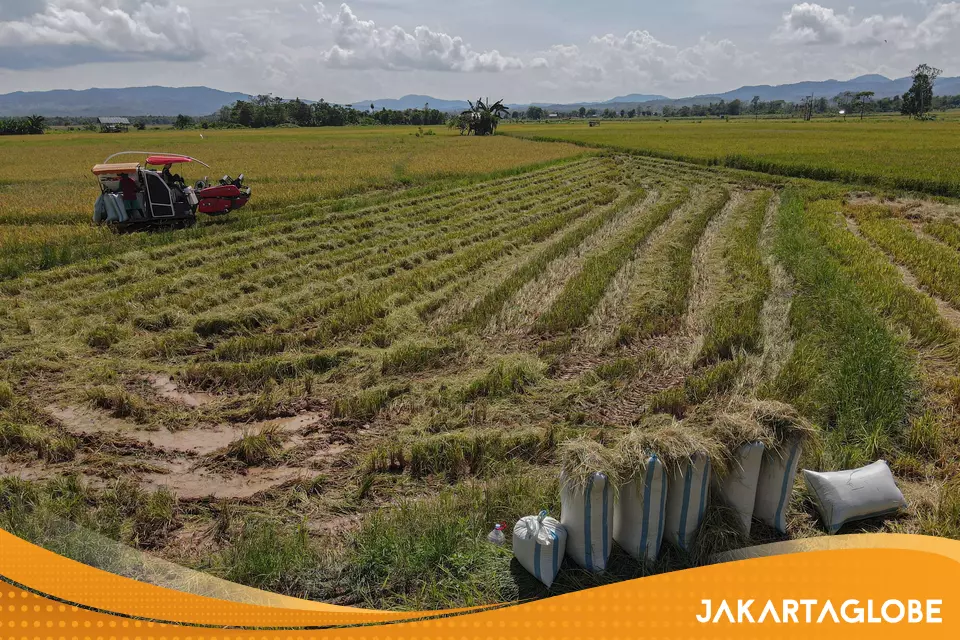
He predicted that domestic demands for rice and corn could be met during the next harvest season. Data from the Central Statistics Agency (BPS) indicated that national rice production reached 30.34 million tons last year from 10.05 million hectares of paddy fields.


Annual dry corn production stood at 15.21 million tons according to the latest data in 2023.


He also noted that to meet the demand for sugar and salt in the industrial sector, a more specific and gradual strategy needs to be implemented, as the specifications required by industries differ from those for household consumption. In addition, Ragimun suggested that regulations related to the distribution of these four food commodities should be tightened to support the acceleration and optimization of Indonesia's food self-sufficiency program.


“The strategy for fulfilling the industrial needs, particularly for salt and sugar, must be implemented gradually,” he explained.


Previously, Chief Food Security Minister Zulkifli Hasan announced that the government would impose an import ban on rice, corn, sugar, and salt starting in 2025. He said the policy aims to accelerate food self-sufficiency programs through strategic steps such as farmer counseling, financial support, regulatory revisions, provision of superior seeds, and strengthening supply chains.


B40 Mandatory use is finally started in January (Biofuel). B50 is targeted to start next year in 2026. B40 is expected to save 9 billion USD foreign exchange every year (oil/diesel import).

If B50 is implemented, Indonesia doesnt need to import Diesel anymore

To view this content we will need your consent to set third party cookies.
For more detailed information, see our cookies page.


To view this content we will need your consent to set third party cookies.
For more detailed information, see our cookies page.
 

Prosecutors Hand Over 221,000 Hectares of Seized Palm Plantations to State-Owned Firm​


Zhulfakar

March 11, 2025 | 7:45 am


Jakarta. The Attorney General’s Office (AGO) officially transferred 221,000 hectares of seized palm plantations to the State-Owned Enterprises Ministry on Monday, following their recovery from a major corruption scandal.


The decision aims to protect thousands of workers employed at the former Duta Palma Group plantations and maintain operational stability, a senior prosecutor said.


The seized plantations, located in West Kalimantan and Riau, will now be managed by the state-run company Agrinas Palma Nusantara, under the ministry’s supervision, according to Febrie Adriansyah, the Deputy Attorney General for Corruption Investigation.


"We want to preserve the value of these state assets, prevent disruptions in plantation operations, and, most importantly, safeguard workers’ jobs," Febrie said during a press conference in Jakarta.

Febrie emphasized that the legal proceedings related to the corruption case could take a long time before reaching a final and binding verdict. Meanwhile, the state has a responsibility to ensure continued productivity and employment at the plantations.


The seizure was deemed necessary to prevent theft, looting, or illegal ownership transfers during the ongoing legal process, he added.


“We are ensuring that these palm plantations continue to operate normally while also maintaining control over their security," Febrie said.


The management of the seized plantations during the takeover will be closely monitored by state auditors to ensure transparency, he added.


The Attorney General’s Office has identified nine corporate suspects involved in the corruption scandal, which centers on the misuse of land concessions. These companies collectively operated under the Duta Palma Group.


Analysis-The end of cheap palm oil? Output stalls as biodiesel demand surges


By Rajendra Jadhav, Bernadette Christina and Ashley Tang


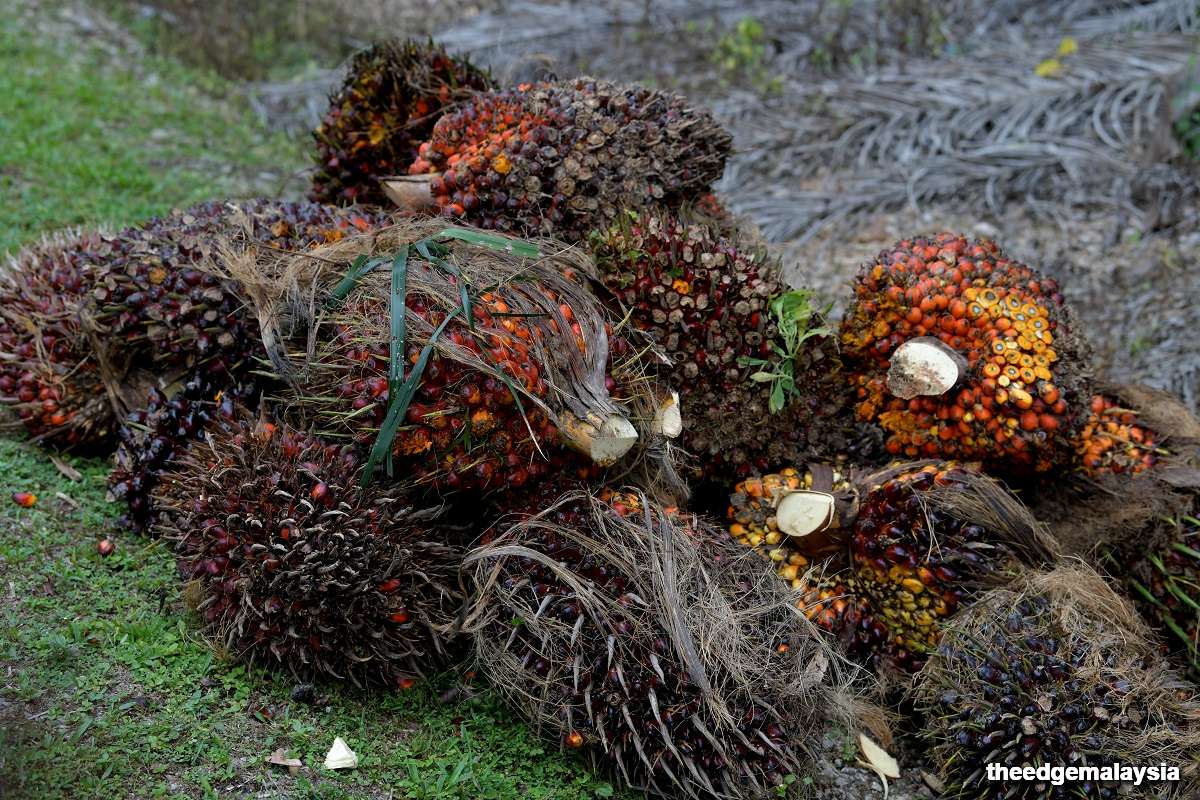
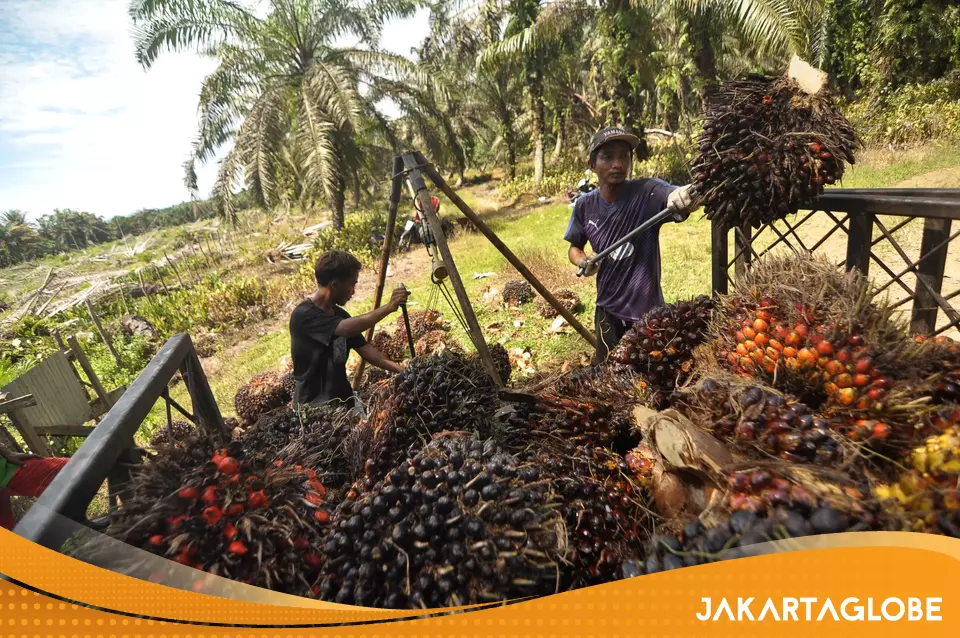
KUALA LUMPUR/JAKARTA (Reuters) - Prices of cooking oil could be buoyed up for years by stagnating production and a biodiesel push in top producer Indonesia that are making traditionally cheap palm oil costlier, eliminating an advantage that also curbed prices of rival oils.

Used in everything from cakes and frying fats to cosmetics and cleaning products, palm oil makes up more than half of global vegetable oil shipments and is especially popular among consumers in emerging markets, led by India.


After decades of cheap palm oil, thanks to booming output and a battle for market share, output is slowing and Indonesia is using more to make biodiesel, respected industry analyst Dorab Mistry said.


"Those days of $400-per-ton discounts are gone," added Mistry, a director of Indian consumer goods company Godrej International. "Palm oil won't be that cheap again as long as Indonesia keeps prioritising biodiesel."


Indonesia increased the mandatory mix of palm oil in biodiesel to 40% this year, and is studying moving to 50% in 2026, as well as a 3% blend for jet fuel next year, as it seeks to curb fuel imports.


The biodiesel push will reduce Indonesia's exports to just 20 million metric tons in 2030, down a third from 29.5 million in 2024, estimates Eddy Martono, chairman of the southeast Asian nation's largest palm oil association, GAPKI.

Jakarta's biodiesel mandate, coupled with lower production because of floods in neighbouring Malaysia, has already lifted palm oil prices above rival soyoil, prompting buyers to cut purchases.


In India, the largest buyer of vegetable oils, crude palm oil (CPO) has commanded a premium over crude soybean oil for the past six months, sometimes exceeding $100 per ton. As recently as late 2022, palm oil traded at discounts of more than $400.


Indians were paying $1,185 a ton for crude palm oil last week, up from less than $500 in 2019.


Higher vegetable oil prices could complicate governments' efforts to rein in inflation, whether in palm oil-reliant nations or those dependent on rival soybean, sunflower, and rapeseed oils.


STUNTED GROWTH


Palm oil production, dominated by Indonesia and Malaysia, nearly doubled every decade from 1980 to 2020, fuelling criticism over deforestation to add plantations.


During that time, average annual production growth of more than 7% was roughly in line with demand.


But Malaysia's palm oil production stagnated more than a decade ago because of lack of space for new plantations and slow replanting, while deforestation concerns have slowed growth in Indonesia.


Government to Merge SOEs into Agriculture and Fisheries Holding Agrinas​


Ricki Putra Harahap

March 25, 2025 | 5:16 am


Jakarta. The Indonesian government is preparing to establish a new state-owned holding company focused on agriculture and fisheries by merging three existing state-owned enterprises (SOEs) into an entity called Agrinas, a senior official said on Monday.


The three SOEs to be consolidated -- Virama Karya, Yodya Karya, and Indra Karya -- will be merged and financially supported by the newly established sovereign wealth fund Danantara.


“The establishment of Agrinas is being prepared by the Marine Affairs and Fisheries Ministry and the Agriculture Ministry,” said Zulkifli Hasan, the Coordinating Minister for Food Security.


During a meeting with President Prabowo Subianto to discuss the plan, Zulkifli said that several ideas had emerged, including the development of 20,000 hectares of coastal fishponds and 1 million hectares of palm plantations.

He added that the upcoming holding company would also be tasked with building rice milling facilities to strengthen national food production.


On the same occasion, Danantara CEO Rosan Roeslani said Agrinas will not receive funding from the state budget, but will instead be fully financed by Danantara, which collects and manages dividends from all SOEs.


“Agrinas will fall under the oversight of Danantara, and its funding will not come from the Finance Ministry,” Rosan said.

 
There is already Palm Co which is also state owned company, so look like there will be two big SOE companies in palm oil sector with the creation of Agrinas ?

======================

Indonesia's PalmCo plans $500 million IPO this year -sources​

By Bernadette Christina and Yantoultra Ngui
June 12, 20235:25 PM GMT+7Updated 2 years ago


JAKARTA/SINGAPORE (Reuters) - Indonesian palm oil producer PalmCo plans an initial public offering in Jakarta in the fourth quarter which could raise about $500 million, two sources familiar with the matter said.
PalmCo is a unit of state agricultural group Perkebunan Nusantara (PTPN) III and Bloomberg first reported the IPO, citing PTPN President Director Mohammad Abdul Ghani in an interview.

When contacted by Reuters on Monday, Bambang Agustian, PTPN's corporate secretary, confirmed the company is targeting a fourth-quarter listing, but declined to comment on the proceeds.

"The IPO funds will be allocated for investment that is related to increasing company value, such as technical culture improvement, investing in downstream business and the use of renewable energy in relation to decarbonisation efforts," he told Reuters.

The company has appointed Mandiri Sekuritas, DBS, BNP Paribas and CIMB as underwriters for PalmCo's IPO, he added.

The listing will help to solidify Indonesia's IPO market as one of the world's hottest this year. First-time share sales raised $1.58 billion by the end of April, second only to China in the Asia-Pacific region excluding Japan, and ahead of traditional powerhouse Hong Kong, according to Refinitiv data.

PalmCo was carved out along with SugarCo, which handles PTPN's sugar business, and SupportingCo, which manages assets ranging from coffee to tea plantations, as part of the Indonesian government's national strategic plan.

It has a total of 560.078 hectares of oil palm plantations in Indonesia, according to its website.

Besides PalmCo, other state companies expected to go public in Indonesia this year include Pertamina Hulu Energi, the upstream arm of national energy firm Pertamina, which could raise at least 20 trillion rupiah ($1.35 billion), and fertiliser company Pupuk Kalimantan Timur which could raise $500 million.


Correction, Palm Co currently is the largest Palm Oil Plantation in the world, it has 560,078 hectares, not 560.000 hectares. Look like Reuters dont know that Indonesia has different usage of dot and comma where the meaning is in reverse compared to English
 
Indonesia government captured palm oil land previously managed by private companies and given to state owned agriculture company Agrinas.

This is because the private sector taken land illegally from protected forests. This ilegall action has been going on for so long and now Government take measure and handed over all of them to state owned Agrinas to be managed.

Total land to be given to state owned Agrinas is over 1 million hectares, but currently only around half of them have been given. This will be done gradually.


-----------------------

Agrinas Receives Again 216,000 Ha Palm Oil Land Results Of Mastery Of PKH Task Force
CNN Indonesia
Wednesday, 26 Mar 2025 13:36 WIB
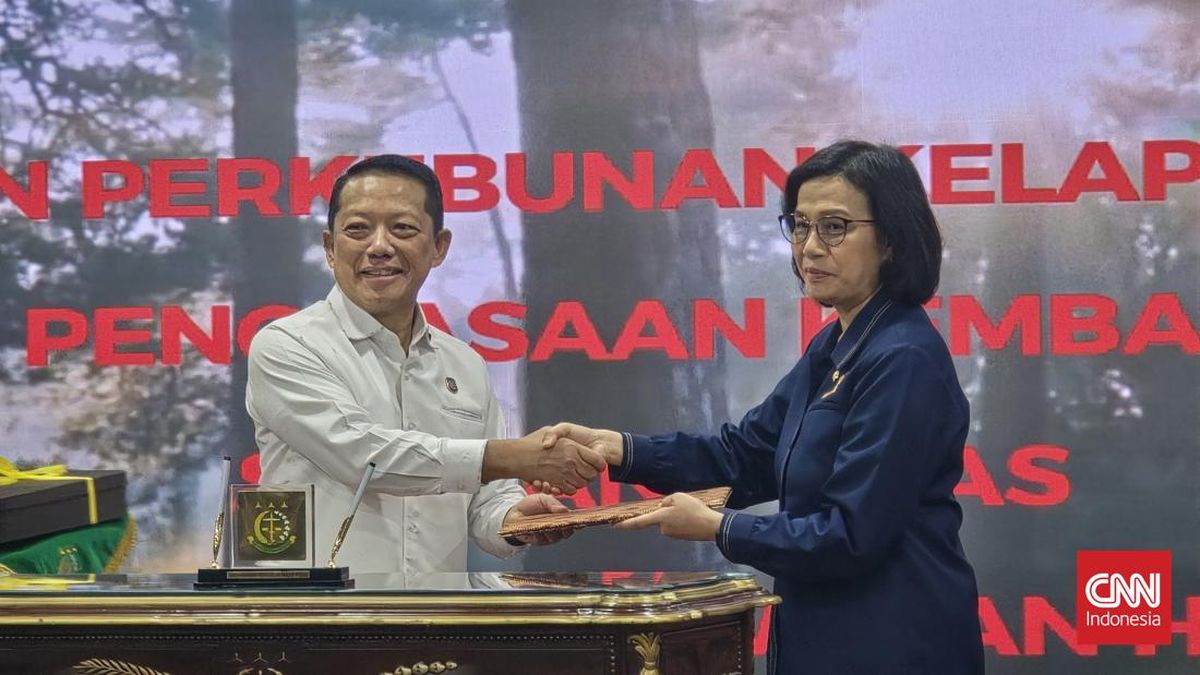
1743092921335.jpeg
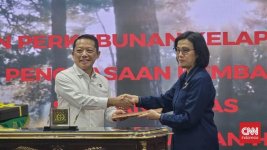
Young Attorney General for Special Crimes of the Attorney General's Office Febrie Adriansyah and Minister of Finance Sri Mulyani. PT Agrinas Palma Nusantara again received a state forest land management permit that was successfully controlled again by the PKH Task Force covering an area of 216,000 ha. (CNN Indonesia/Taufiq Hidayatullah)

Jakarta, CNN Indonesia --

PT Agrinas Palma Nusantara (Persero) again received a state forest land management permit that was successfully controlled again by the Forest Area Order Task Force (PKH) covering an area of 216,000 hectares.

Head of the PKH Task Force and Young Attorney General for Special Crimes for the Attorney General's Office Febrie Adriansyah said the land handed over was the result of the re-controlling of the state forest from the hands of 109 rogue companies.

"On this day the PKH Task Force is preparing to hand over the area of the forest area which will be handed over an area of 216,997.75 hectares consisting of 109 companies," Febrie said in a press conference in Jakarta, Wednesday (26/3).

Through the handover, Febrie said that until now there are 437,000 hectares of state land that has been restored to the PKH Task Force and managed by Agrinas.

The delivery of 221.8 hectares of state forest land was received by Agrinas from the PKH Task Force on Monday (10/3) which was previously controlled by the Palma Group.

Furthermore, Febrie said from the target of the control of 1.177 million hectares of state forest land, which has been realized until Sunday (23/3) reached 1.001 million hectares.

He added that the handover and re-controlling of the state-owned forest land was carried out in order to realize the orderly forest governance as instructed by President Prabowo Subianto.

"What we have mastered to this day is 1,100,674.14 hectares. The land we control is spread across 9 provinces, 64 districts and consists of 369 companies, "he explained.

Febrie admitted that there are still many obstacles faced in the process of re-controlling state-owned forest land. The first obstacle, he said, the PKH Task Force has not been able to collect fines when recurring the state forest land.

"Due to the change of PP No. 24 of 2021 on Procedures for Improving Administrative Sanctions and Non-Tax State Receipts derived from administrative fines in the field of forestry is still under discussion," said Febrie.

Second, there are still some legal issues that are in the process of identification. One of them is related to assets that are used as dependents on the bank.

“This will also be at risk in general. But this is what we are trying to solve it with the Ministry of SOEs," he said.

Agrinas Palma is one of the three companies resulting from the transformation of three State-Owned Enterprises (SOEs) works. The three SOEs that have undergone the change are Virama Karya, Yodya Karya, and Indra Karya.

After the transformation, the three will operate with a new name, namely PT Agrinas Jaladri Nusantara (fisherman), PT Agrinas Pangan Nusantara (padi), and PT Agrinas Palma Nusantara (palm oil plantation). These changes are scheduled to be effective from the beginning of 2025.

Head of the National Food Agency Arief Prasetyo Adi insists this transformation decision is not a sudden step, but rather through a process of careful consideration and planning.

He asked that further questions about this policy be directed to the Ministry of SOEs that have authority in the management of state companies.

"It is planned, the three SOEs (So Agrinas) are certainly already with consideration, there is already planning. Later it may be specific to be able to ask the Ministry of SOEs, "said Arief at the Coordinating Ministry for Food, Central Jakarta, Monday (17/3).

Furthermore, he ensured that the change in the function of SOEs is aimed at improving the welfare of the community and strengthening national food security. Therefore, he asked that the public not doubt this policy.

"There are three, for palm oil, for rice, and for fisheries. Ask the same Minister of SOEs. But that's for good luck," he added.

 
Good data

PTPN (one of SOE's in agriculture companies) palm oil land = 600, 000 Hectares
Small Holders (common people) palm oil land = 6 million Hectares (45%)
Total national palm oil land = 16 million Hectares
Total national palm oil production = 50 million tons per year
The total production can be increased into 80 million tons per year if productivity is increased by replacing old tree with younger tree.

Source:


Users who are viewing this thread

Back
Top