Navigation
Install the app
How to install the app on iOS
Follow along with the video below to see how to install our site as a web app on your home screen.
Note: This feature may not be available in some browsers.
More options
Style variation
You are using an out of date browser. It may not display this or other websites correctly.
You should upgrade or use an alternative browser.
You should upgrade or use an alternative browser.
Indonesia and Geopolitics
- Thread starter Indos
- Start date
- Status
- Not open for further replies.
More options
Who Replied?

Indos
INT'L MOD
- Thread starter
- #63
Prabowo landed in Washington DC, USA, to meet US President and possibly President Elect Trump as well.
He is greeted by Indonesian officials who have already been in US, including Gerindra Party Deputy Chairman, and also Indonesian citizens, including some university students who study in US
He is greeted by Indonesian officials who have already been in US, including Gerindra Party Deputy Chairman, and also Indonesian citizens, including some university students who study in US
Indos
INT'L MOD
- Thread starter
- #65
Joint sea drills with Russia signal start of Indonesian foreign policy shift
Tuesday . November 12, 2024
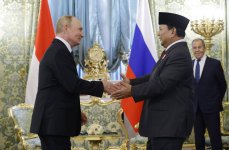
- Indonesia's new president, Prabowo Subianto, has called for stronger ties with Moscow despite Western pressure on Jakarta
- Prabowo has visited more than a dozen countries including China and Australia, where he struck a key security deal
- Jakarta has also kickstarted a process to join the BRICS group of emerging economies
JAKARTA: Indonesia’s first joint military drills with Russia this week signal that new President Prabowo Subianto will seek a bigger role for Jakarta on the world stage as part of a significant foreign policy shift, analysts say.
Indonesia has long maintained a neutral foreign policy and refuses to take sides in the Russia-Ukraine conflict or US-China rivalry, but Prabowo has called for stronger ties with Moscow despite Western pressure on Jakarta.
“It is part of a broader agenda to elevate ties with whomever it may be, regardless of their geopolitical bloc, as long as there is a benefit for Indonesia,” said Pieter Pandie, researcher at the Center for Strategic and International Studies.
The southeast Asian ASEAN bloc, which Indonesia is a member of, held joint drills with Russia in 2021, but individual member nations have never held joint exercises with Moscow.
Jakarta has billion-dollar trade ties with Moscow, but major arms imports have stalled in recent years, according to weapons watchdog SIPRI, following Western sanctions on Russia after it seized Crimea in 2014 and invaded Ukraine in 2022.
Still, Prabowo has kept alive a $1.1 billion Russian fighter jet deal he agreed in 2018 as defense minister, despite the reported threat of US sanctions.
Jakarta also refused to budge when Western nations lobbied Indonesia to disinvite Russia from the G20 summit it hosted in 2022.
Prabowo met Russian President Vladimir Putin at the Kremlin in July, later announcing joint naval drills that experts say indicate how Moscow will grow in significance as part of a broader foreign policy.
The five-day drills begin Monday in eastern Java where Moscow will send three corvette-class warships, a medium tanker ship, a military helicopter, and a tug boat.
“They reaffirm that we will not alienate one or two countries in the geopolitical arena,” said Anton Aliabbas, professor at the Paramadina Graduate School of Diplomacy.
Diversifying partners
During his Kremlin visit, Prabowo — a 73-year-old ex-general — said he wanted to deepen the relationship with Russia.
“We consider Russia as a great friend and I would like to continue to maintain and enhance this relationship,” Prabowo told Putin.
Before his inauguration last month, Prabowo said he wanted to build a “web of strong friendships.”
To that end he visited more than a dozen countries including China and Australia, where he struck a key security deal, and Jakarta has since kickstarted a process to join the BRICS group of emerging economies.
The new leader has already been tested at sea, with a Chinese coast guard vessel being driven away three times from Indonesian-claimed waters by Jakarta’s ships last month.
For Indonesia, the chance to host one of the world’s most advanced navies is clear.
It will allow “capacity building to be obtained” and for Jakarta to “exchange ideas” on maintaining Russian equipment it already owns, said Curie Maharani Savitri.
Indonesia has Russian-made amphibious tanks, helicopters, missiles and fighter jets in its arsenal.
Different goals
Jakarta and Moscow have different maritime goals, with Indonesia facing threats of smuggling and piracy while Russia is looking for willing allies.
Pieter said he expects the exercises to not be as advanced as annual Super Garuda Shield drills Indonesia hosts with the US and other allies.
“I think it’s an introductory phase to the military relationship between the two, especially on the naval side,” he said.
But the drills may still raise eyebrows in Washington, which has been trying to diplomatically isolate Russia.
The US embassy in Jakarta declined to comment on the drills.
For Prabowo they allow him to send a message about his new policy in the early days of his presidency, said Pieter.
“Historically, the US has been the partner of choice for military exercises. But... Indonesia has been trying to diversify its partners,” he said. “And I think there’s an overall bigger trend of that.”
Indos
INT'L MOD
- Thread starter
- #66
Strengthen solidarity with Palestine: Indonesia to OIC
November 11, 2024 18:08 GMT+700
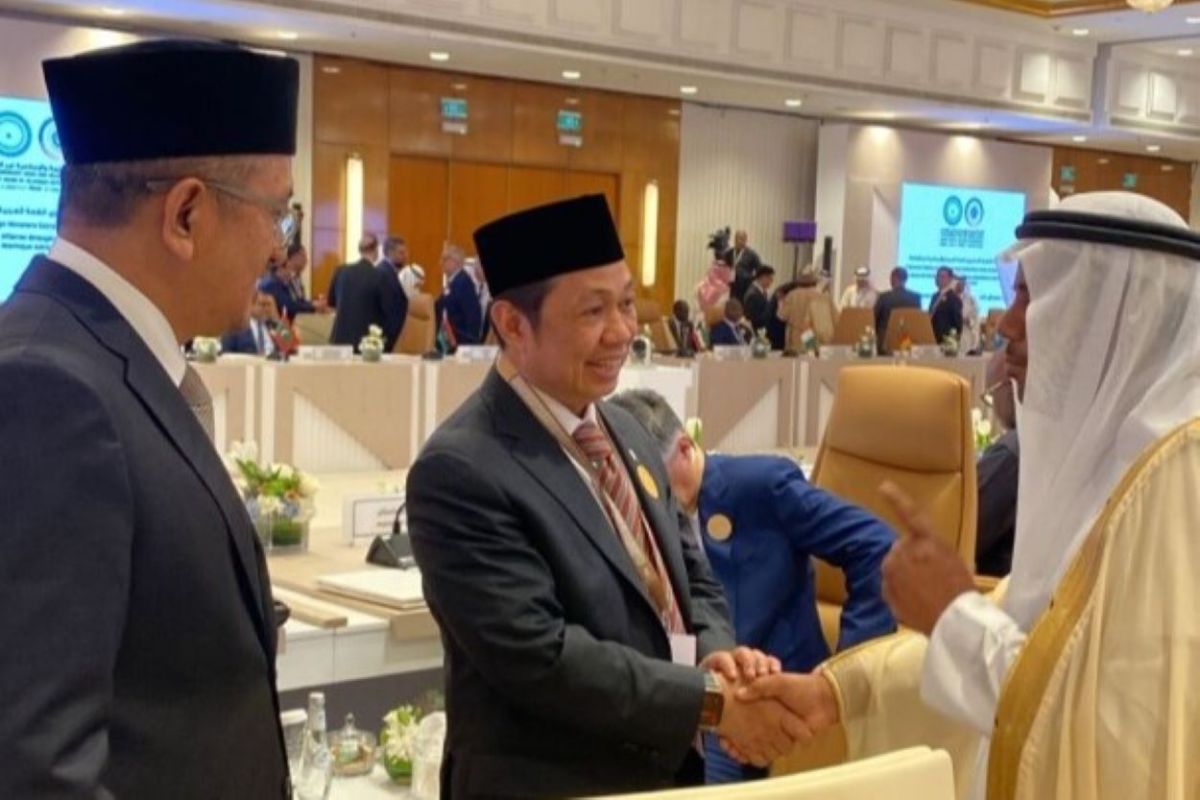
Jakarta (ANTARA) - Deputy Foreign Minister Anis Matta called on the Islamic World to strengthen solidarity with the struggle of the Palestinian people and take concrete actions to defend their independence.
"The Palestinian struggle to achieve independence is the basis for the formation of the OIC (Organisation of Islamic Cooperation)," he highlighted during the OIC-Arab League Extraordinary Summit preparatory meeting in Riyadh, Saudi Arabia, on Sunday.
"That is why 'we are all Palestinians' and must help the Palestinian struggle," he added.
In a statement released by the Ministry of Foreign Affairs on Monday, Matta emphasized the importance of real action by the OIC and Arab League member countries to stop Israel's never-ending oppression of the Palestinian people.
"Words must be immediately carried out in real action, including in ensuring ongoing humanitarian assistance for Palestine," he said.
The OIC and Arab League are holding an extraordinary summit on Monday to discuss efforts to stop Israel's atrocities in Palestine and Lebanon.
Related news: OIC, Arab League seeking firm UNSC resolution on Gaza war: FM
According to Matta, the summit is being held in a crucial situation amid the current geopolitical dynamics.
He further said that he is representing President Prabowo Subianto, who is currently in the US on a state visit, at the summit.
The summit preparation meeting was led by Saudi Arabia and attended by representatives of OIC and Arab League member countries, such as Algeria, Iran, Lebanon, Egypt, Palestine, and Turkey.
Indonesia's participation at the OIC-Arab League Summit is in line with the mandate of the 1945 Constitution to consistently reject colonialism and strive for world peace.
It also reflects President Prabowo's commitment to realizing Palestinian independence, according to the Ministry of Foreign Affairs' statement.
Related news: D-8 member countries must unite to help Palestine: Foreign Minister
Strengthen solidarity with Palestine: Indonesia to OIC
Deputy Foreign Minister Anis Matta called on the Islamic World to strengthen solidarity with the struggle of the Palestinian people and take concrete ...
 en.antaranews.com
Indos
INT'L MOD
- Thread starter
- #68
Indonesian president meets Biden and speaks with Trump, pledges cooperation
By Stanley Widianto and Jeff MasonNovember 13, 2024
5:34 AM GMT+7
Updated 6 hours ago
JAKARTA/WASHINGTON, Nov 12 (Reuters) - Indonesia's President Prabowo Subianto met with U.S. President Joe Biden at the White House on Tuesday and offered his congratulations to President-elect Donald Trump by phone during an official visit to Washington.
"I will work very hard to strengthen Indonesian-United States relationship, and I would like to work towards this end that we have a strong cooperation," said Prabowo.
Prabowo, who has said he will pursue a non-aligned foreign policy, met with Biden in the Oval Office after posting a video of his call to Trump.
He arrived in Washington straight from China, where he had met with President Xi Jinping on his first overseas trip since taking office last month.
Washington sees Indonesia, the most populous country in Southeast Asia, as an important partner in a region where its rival Beijing has deep trade and investment ties. Indonesia is also the world's most populous Muslim-majority country.
While China is a key economic partner for Indonesia, Jakarta has also become a big buyer of U.S. arms, and it wants to sell the West more metals from its mines.
At the White House, Biden said the two leaders were discussing climate, conflict in the Middle East and the South China Sea.
Indonesia said on Monday it does not recognize China's claims over the vast majority of the South China Sea, despite signing a maritime development deal with Beijing.
"We continue to encourage Indonesia to work with their legal experts to make sure any agreement they make with (the People's Republic of China) is in accordance with international law, especially the UN Convention on the Law of the Sea," said White House spokesperson Karine Jean-Pierre at a press briefing.
TRUMP CALL
Prabowo's office said he made the call to Trump on Monday after arriving in Washington. It did not immediately respond when asked if he is scheduled to meet Trump in person.
"Wherever you are, I'm willing to fly to congratulate you personally, sir," Prabowo said in the video of the call posted on his social media accounts.
"We'll do that, anytime you want," Trump replied.
Trump described his own election victory as amazing, and said it gave him a big mandate.
He also said the Indonesian president was "very respected," and praised his English, to which Prabowo, a former special forces commander, replied: "All my training is American, sir."
Prabowo also met with several U.S. company representatives in Washington, his office said, including from Freeport McMoRan (FCX.N)
, opens new tab and energy company Chevron (CVX.N)
, opens new tab, and urged the companies to invest in Indonesia.
The Reuters Daily Briefing newsletter provides all the news you need to start your day. Sign up here.
Reporting by Stanley Widianto in Jakarta and Jeff Mason in Washington; Writing by Trevor Hunnicutt; Editing by John Mair, David Gregorio and Rosalba O'Brien
Our Standards: The Thomson Reuters Trust Principles.
Indos
INT'L MOD
- Thread starter
- #71
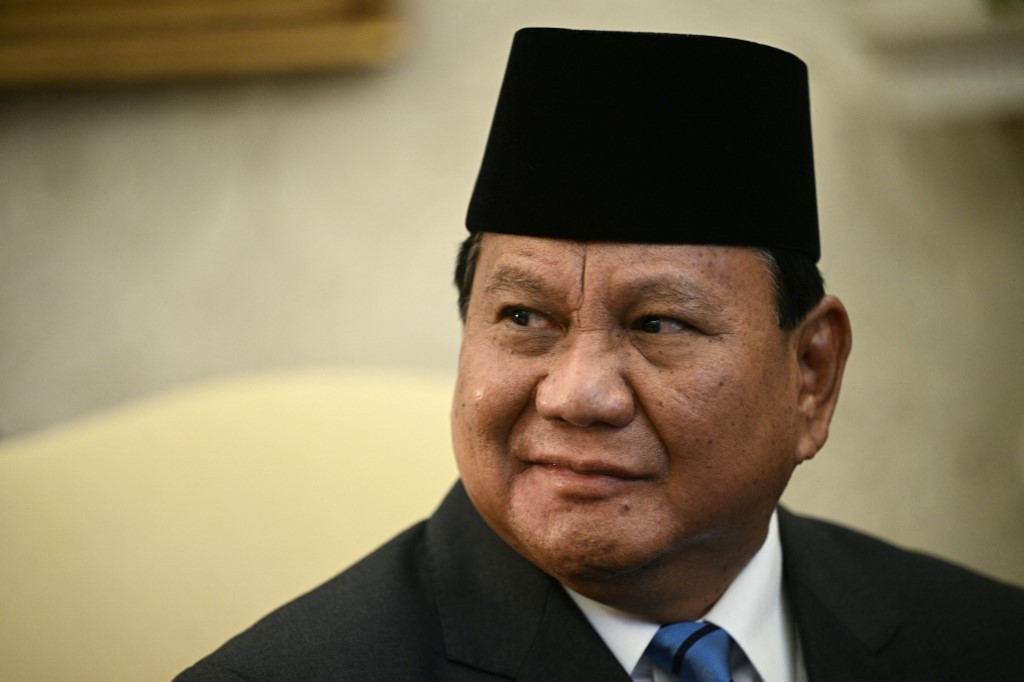
Prabowo holds meeting with CIA chief in Washington
State news agency Antara reported that the meeting took place inside the Wisma Indonesia guest house in the eastern part of the capital city.
News Desk (The Jakarta Post)Premium
Jakarta
Wed, November 13, 2024
Prabowo holds meeting with CIA chief in Washington - Americas - The Jakarta Post
State news agency Antara reported that the meeting took place inside the Wisma Indonesia guest house in the eastern part of the capital city.
Indos
INT'L MOD
- Thread starter
- #73
The Inward-Looking Regional Power: Indonesia’s Economy-First Diplomacy
Politics Economy Dec 18, 2023Aizawa Nobuhiro [Profile]
Indonesia is often seen as the de facto leader of the 10 ASEAN nations. In 2023, it took over the ASEAN chair at a time when difficult political issues divide the body. Despite high expectations for this powerful regional player, however, Indonesia did not exert strong leadership on regional issues during this year.
High Expectations for Indonesia
As ASEAN chair, 2023 provided an excellent opportunity for Indonesia to demonstrate regional leadership and reverse the recent decline of the international credibility of the Association of Southeast Asian Nations. After all, just one year prior, as G20 chair, Indonesia had demonstrated its diplomatic skill by persuading both the American and Chinese leaders to attend the 2022 Bali Summit and issue a joint statement. This was despite fears that the G20 framework would fall into dysfunction against the background of intensifying US-China strategic competition and conflicts of opinion over the war in Ukraine. Indonesia’s success therefore enhanced its reputation as a global diplomatic player and heightened expectations that Indonesia would similarly lead on Southeast Asian regional issues.ASEAN has in recent years had to deal with significant intra-bloc tensions over the conclusion of a South China Sea Code of Conduct with China and the relationship with Myanmar following the 2021 military coup. Indonesia’s 2023 Chairmanship represented perhaps the best chance in years to find a resolution to these issues without dividing ASEAN.
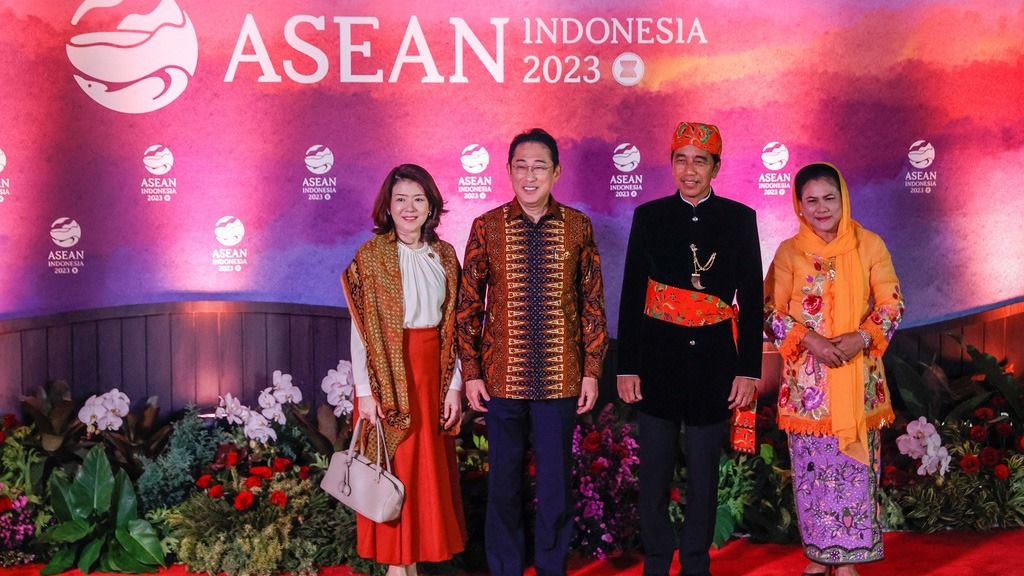
In the end, however, President Joko Widodo (Jokowi) devoted few political and diplomatic resources in 2023 to resolving ASEAN’s pressing concerns. The theme chosen by Indonesia for the forty-third ASEAN Summit was “ASEAN Matters: Epicentrum of Growth.” During the summit, Indonesia placed particular emphasis on the leaders’ Gala Dinner, which in its staging seemed to take precedence even over the summit meetings. Instead, this choice enhanced the optics of leadership and Indonesia’s “brand” of diplomacy as a convening power that had notably been on show in Indonesia’s 2022 diplomatic successes. Despite serving as chair, Indonesia seemed to shy away from a more ambitious agenda focused on confronting long-standing tensions and reinvigorating ASEAN.
Jokowi’s Risk-Averse Diplomacy
From a narrower risk-management point of view, however, it may well have been a wise decision. If Jakarta judged that ASEAN’s issues were too difficult to be plausibly resolved, then it made sense to avoid emphasizing them during the summit. Doing so might only bring tensions out into the open, thereby not only jeopardizing Indonesia’s recent hard-won international credibility but potentially hurting ASEAN itself at a sensitive time. The risk of the message becoming “ASEAN Doesn’t Matter” might hurt ASEAN both politically and even economically in the long term.As the United States and China abandon the concept of ASEAN centrality in their own Southeast Asia policies and switch to more bilateral and unilateral approaches to the region, it is ultimately now up to ASEAN member states to preserve the group’s diplomatic value. As global governance becomes increasingly dysfunctional, ASEAN potentially still has a strategically important role to play in the maintenance of regional peace and stability.
What was required of Indonesia in 2023 as the regional hegemon was therefore to ensure the ongoing commitment to ASEAN of Southeast Asian countries—all with diverse geopolitical interests—and to build confidence in the organization. That is what Jokowi did in April 2021, when, on behalf of the 2021 chair Brunei, Indonesia brought Min Aung Hlaing (commander-in-chief of Myanmar’s armed forces) to Jakarta for crisis talks following the February 2021 Myanmar military coup.
The Paramount Importance of Economic Interests
To understand further why Indonesia did not follow through on an ambitious leadership agenda in 2023, we must also take into account the role of domestic politics and interests—much as we do when considering the foreign policy behavior of the United States or China.One of the defining characteristics of the Jokowi administration has been its focus on economic growth, both for buttressing its legitimacy and for building Jokowi’s political legacy. Most notable is Indonesia’s national growth strategy, Visi Indonesia Emas 2045 (Golden Indonesia 2045 Vision). Formulated in 2017, it identifies several economic goals for Indonesia to achieve by 2045, Indonesia’s centennial as an independent sovereign state. These aims include economic growth of 5%–6% per year, a GDP per capita of $29,000 for a population of over 300 million, becoming the world’s fourth largest economy, and breaking out of the middle-income trap to join the ranks of developed, high-income countries.
To this end, Jakarta has mobilized its political resources by concentrating on infrastructure building and human-resource development. Foreign policy and diplomacy have, in turn, been formulated in service of realizing these long-term outcomes. Key elements of this strategy have been attracting foreign direct investment, successfully implementing overseas initial public offerings of companies for financing infrastructure, upgrading industries, and expanding exports. Diplomatic strategy inevitably focused on relations with potential investment partners—first with the world’s top two economies, the United States and China, followed by enhanced relations with other large economic powers such as Japan.
Further, when King Salman of Saudi Arabia visited Jakarta in March 2017, Jokowi pulled out all diplomatic stops to give him a truly royal welcome. When it became clear that Saudi Arabia’s investment in Indonesia would fall far short of expectations, though, the Indonesian president did not shy away from expressing his resentment publicly.
The fact that President Jokowi has not attended a single UN General Assembly since his inauguration in 2014 suggests that security and/or shared values are not a high priority for his administration. Indonesia’s foreign policy successes in the Jokowi era have for the most part been primarily evaluated on a profit-loss basis for the domestic economy.
Pandemic Slows Economic Growth
The Golden Indonesia 2045 Vision growth strategy was set forth in 2017, and the predominant focus on the economy was only reinforced by the COVID-19 pandemic. The pandemic-induced slowdown has made it a challenge for Indonesia to reach the original goal of 5.1% year-on-year growth, ensuring that it escapes the middle-income trap by 2038 while the country is still enjoying its demographic bonus. The negative growth experienced in 2020 alone means that 7% annual growth is now required to achieve the long-term target.There are some tail winds for the Indonesian economy, though. The relocation of the capital from Jakarta to Nusantara, set to finish by 2045, will stimulate both the public and private sectors, and an industrial strategy aimed at positioning Indonesia as an international hub for the manufacture of electric vehicle batteries has been adopted to attract private investment. However, the feasibility of such policies is still questioned. Furthermore, Indonesia still currently relies on sales of natural resources like coal for its foreign currency reserves, due in part to commodity price increases following the COVID-19 pandemic and the invasion of Ukraine. With a growth rate of currently less than 5% per year, the goal of joining the ranks of developed countries by 2045 will be hard to achieve. Some Indonesian economists have even expressed their concern by coining the term Indonesia Cemas (Anxious Indonesia) in place of Indonesia Emas (Golden Indonesia) contained in the headline of the 2045 economic growth strategy.
Diplomacy as a Tool for Attracting Investment
As a response, President Jokowi is focusing on even more aggressive diplomacy to attract investment. When he visited Washington in 2022 to attend the first-ever ASEAN-United States Special Summit, he announced on the official presidential website that his major achievements—perhaps even more than meeting US President Joe Biden—included meetings with Elon Musk and other American business leaders. During his visit to Beijing to attend the Belt and Road Summit in October 2023, Jokowi repeatedly touted his call for investment in the new capital and the downstream nickel industry for battery production.Furthermore, during the September 2023 ASEAN Summit, Jokowi appeared to be focused more on making the ASEAN Indo Pacific Forum a success than on the ASEAN plenary session. He called on participants to invest in green infrastructure, sustainable financing schemes, and digital transformation. By doing so, Jokowi positioned the ASEAN Summit as an arena for investment opportunities rather than geopolitics. In essence, he redefined the “open” descriptor of Japan and the United States’ “Free and Open” Indo-Pacific visions as meaning “open to investment opportunities” for governments and companies from all over the world.
Given the above, the position of Japan and ASEAN in Indonesia’s current foreign policy strategy is clear. Indonesia urgently needs to accelerate investment and concrete economic cooperation so it can sustain high growth over the long term. Any Japan-focused or ASEAN-related foreign policy initiatives and cooperation proposals will therefore need to address this core element of Indonesia’s national strategy. How they do so will directly impact how Jakarta prioritizes their importance.
This does not mean that Indonesia is completely indifferent to domestic social issues or security challenges. Rather, in the current ordering of Indonesia’s foreign policy priorities, the realization of economic gains on a country-by-country basis is ranked higher than shared political or religious values, human rights, democracy promotion, or even the interests of the Southeast Asian region and regional stability. This has been a constant during the Jokowi administration and will continue until a new president takes over in 2024.
Focus on the Presidential Election
Over the last 25 years, Indonesia has held the freest and fairest elections in Southeast Asia, and 2024 promises to be no different. Due to constitutional limits, a new government is guaranteed to take over in 2024 for the first time in a decade. Depending on who becomes president, Jakarta’s definition of the national interests animating Indonesia’s foreign policy and strategy may continue in line with that seen during the Jokowi administration, or it could change significantly.Until now, the Indonesian government has avoided explicitly committing itself to realizing the goal of becoming a global great power. Given the current trend in world affairs of major powers prioritizing their own economies, Indonesia’s own economy-first approach is not all that surprising. It is important to remember that Indonesia is a de facto regional power and has the potential to be a global great power. It boasts a massive population, and its economy is already by far the largest in the Southeast Asia region. Therefore, for Japan and other ASEAN nations, which already recognize Indonesia’s geopolitical importance, closely monitoring the nation’s domestic political trends will remain of the utmost importance irrespective of any foreign policy pronouncements on great power ambitions.
(Originally published in Japanese. Banner photo: Indonesian President Joko Widodo and his wife Iriana welcome Prime Minister Kishida Fumio and his wife at the ASEAN Summit Gala Dinner in Jakarta on September 6, 2023. © Reuters.)
The Inward-Looking Regional Power: Indonesia’s Economy-First Diplomacy
Indonesia is often seen as the de facto leader of the 10 ASEAN nations. In 2023, it took over the ASEAN chair at a time when difficult political issues divide the body. Despite high expectations for this powerful regional player, however, Indonesia did not exert strong leadership on regional...
 www.nippon.com
Indos
INT'L MOD
- Thread starter
- #75
Region: Asia
Tags: Great Power Competition
by Julian Spencer-Churchill
December 23, 2024
The archipelagic nation would be critical for blockading China in the event of an invasion of Taiwan. However, Jakarta is wary of complete alignment with the United States.
he United States cannot deter a Chinese attack on Taiwan nor win a long war without Indonesia. In conjunction with Australia, Indonesia could ensure a virtually impassable maritime blockade of Chinese commerce, enforced with only land-based aircraft and light patrol ships and backed up by the U.S. Navy’s littoral combat ships. Its collaboration would also be crucial for the protection of all convoys proceeding to friendly Asian littoral states routed through the Timor and Arafura Seas.
Even on its own, democratic Indonesia, with a population of 280 million, a robust GDP of $1.3 trillion, an active military of over 400,000, and a historical suspicion of China, is a natural obstacle to Beijing’s aspirations in Southeast Asia. In January of 2018, U.S. Secretary of Defense James Mattis described Indonesia as a “maritime fulcrum” in East Asia. In November of 2024, President-elect Donald Trump had a very positive conversation with Indonesia’s new President, Prabowo Subianto, who had received his staff officer training in the United States in the 1980s.
U.S. aircraft carriers are the cornerstone of the blue water navy and guarantors of trans-oceanic commerce. Diverting these capital platforms to enforce a close blockade of the Chinese littoral in the event of a multi-year war over Taiwan is risking the United States’ preeminent great power status. A network of usable airbases already being constructed in the Philippines, such as at San Vincente Naval Airfield, are less than 600 kilometers from the Taiwan Strait and are a far more cost-effective staging area from which to interdict a Chinese amphibious crossing with combat aircraft and drones. At these distances, U.S. Air Force aircraft will be able to operate with maximum bomb load-outs and without the need for refueling. They will also benefit from the radar masking of their approach by Taiwan’s central mountainous ridgeline.
China’s principal anti-carrier systems are its estimated thirty 1,800 km range DF-21D missiles and approximately 140 4,000 kilometer range DF-26 anti-ship ballistic missiles, plus an H-6 bomber carried DF-21 variant in development, with a reaction time of less than twenty-five minutes. China’s Type 055 Renhai destroyer can also deliver the 1,000-kilometer range YJ-21 hypersonic anti-ship ballistic missile. A 2,000-kilometer range system will cover Luzon, the Strait of Malacca, and all of the Bay of Bengal, problematizing the use of U.S. carriers there to enforce a blockade, and a 4,000-kilometer range system will encompass Guam, all of Indonesia, and the Central Indian Ocean.
On September 25, 2024, China launched an 11,500-kilometer-range DF-31AG ICBM into the Pacific for the first time since 1980. This may have been a test of China’s space-based surveillance system to track surface ships. The low probability of a successful strike on a U.S. aircraft carrier increases substantially over the course of an entire blockade campaign, as weather, accidents, miscommunications, chance satellite observation, submarine interceptions, and electronic detection turn a possibility into a high aggregate cost probability of a disabling and subsequent sinking.
While unlikely to be decisive, like any form of sanctioning or interruption of trade, a complete naval blockade of China will contribute significantly to war termination by disrupting China’s export trade, which has grown from $2.2 trillion in 2013 to $3.3 trillion in 2023. Most of China’s imports of $2.16 trillion, 80 percent of its oil, and 90 percent of its overall trade are moved by ships. China is aware of its vulnerability to a blockade and has taken measures to achieve energy and food self-sufficiency. Beijing plans to double its fleet of nuclear reactors to 150 by 2035.
By cultivating trade and connecting infrastructure to Russia through its overland route, Moscow will be able to provide oil, gas, grain, and key military technologies, even if Washington has the political will to bar the Bering Strait passage to Moscow’s tanker fleet. Beijing has passed legislation requiring local authorities to take responsibility for food reserves, as well as other measures promoting greater domestic productivity. China projects a further 16 to 30 percent increase in caloric demand by 2050 from the growth of its middle class. Of China’s $235 billion in food imports, its three principal suppliers of its largest commodity, soybeans, are Brazil, the United States, and Argentina.
The closure of Indonesia’s Strait of Malacca, through which passes $3.5 trillion in trade aboard 80,000 ships annually, like the 1967 closure of the Suez Canal, would impose an extra monthly re-routing of shipping cost of $2.8 billion, not including the increased cost of insurance. One-third of the world’s shipping, including 23.7 million barrels of oil per day and a substantial portion of the trade of the littoral Asian democracies, transit through the adjacent South China Sea. Needless to say, a war over Taiwan will severely disrupt global supply chains.
Indonesia’s four main straits are easily interdicted by boarding teams carrying patrol ships and helicopters and mobile land-based anti-ship missile platforms. The Strait of Malacca is only 2.7 kilometers wide at its narrowest choke point. The other three principal straits, from west to east, are the ten kilometers wide Sunda, the twenty kilometers wide Lombok, both of which were blocked by Indonesia in 1988, and the ninety kilometers wide Makassar. Other straits further east are the ninety-kilometer-wide Lifamatola, the thirty-five-kilometer-wide Wetar, the thirty-kilometer-wide Ombai, and the 20-kilometer-wide Dampier.
According to the 2024 International Institute for Strategic Studies’ Military Balance, excluding frigates and coast guard equivalents (Bakamla and KPLP), Indonesia’s available strait policing forces consist of eight Exocet and sixteen torpedo-armed corvettes, fifteen missile-armed patrol craft (out of 159 patrol vessels), eight mine countermeasure ships, drone-ships, eleven Panther and eight AH-64 Apache helicopters, and about thirty maritime patrol aircraft. Given the narrowness of most of the straits, even an instrument as extreme as the use of nuclear weapons could not undo a land-based Indonesian blockade.
Beijing’s option of directly seizing the Strait of Malacca would be possible but complex. Unlike Japan’s sweep through Southeast Asia in 1941, the major powers, including the United States, have been careful not to become irretrievably committed to conflicts elsewhere in Ukraine and the Middle East. China has six Marine Brigades, a Naval Special Forces Brigade, and six Army Marine brigades, totaling some 40,000 troops. This presumes China would then train new substitute army formations for an amphibious assault on Taiwan.
Because China’s supply line through the South China Sea would be so precariously exposed to aerial interdiction, even supposing a neutral Vietnam, it would be necessary to seize the airfields of Western Taiwan, Luzon, Palawan, Natuna Island, and several hundred kilometers of Sumatra’s east coast. China would only need to land at Lingayen Gulf and defeat the Philippines’ under-armored 5th and 7th Divisions to neutralize the airbases in northern Luzon and push to Manila.
Any prospect of securing the 800-kilometer Malacca Strait would require a diplomatic victory to obtain Malaysia and Singapore as bandwagoning allies of a Chinese attack against U.S. interests. A PLAN (People’s Liberation Army Navy) landing would still confront three Indonesian maneuver brigades and four brigade equivalents of battalions, backed up by two Kostrad strategic reserve divisions in Java.
The United States, Australia, and Japan have anticipated this possibility and have since conducted joint exercises with Indonesia on Sumatra. In November 2023, the United States and Indonesia announced a Joint Comprehensive Strategic Partnership aimed at improving maritime cooperation and as a lead-in to the signing of a future Defense Cooperation Arrangement. Accordingly, Jakarta is in negotiations for the purchase of 24 F-15EXs and additional F-16s.
At the same time, Jakarta’s relations with Beijing have worsened since China extended its territorial claims to the Exclusive Economic Zone of Indonesia’s Natuna Island. To comply with U.S. investment tax incentives, Indonesia has further imposed high tariffs on a number of Chinese imports and decreased Chinese shareholding in Indonesian nickel-mining concerns (the world’s largest reserves) related to electric vehicles.
Indonesia, after General Suharto’s 1965 counter-coup against the Communist-influenced Sukarno regime, was a key Cold War ally, securing East Timor from Soviet domination, which had befallen other newly independent Portuguese colonies. Indonesia also plays a useful counter-balancing role against the influence of China, primarily because of its size, in Malaysia and Singapore. Current Malaysian prime minister Anwar Ibrahim has criticized Western hostility to the rise of China, tilting Kuala Lumpur towards Beijing as it seeks its economic investment.
In a 2022 poll, 39 percent percent of Malaysians viewed China favorably. Singapore, whose 75 percent Chinese population is deeply sympathetic with China, was 67 percent favorable towards Beijing in a 2022 Pew Research Center poll. Although Singapore has shared a Defense Cooperation Agreement with the United States since 2015, providing basing for U.S. LCSs and P-8s, its principal strategy of hedging makes it liable to shift its support to Beijing if the United States appears weak.
Washington’s influence is, however, limited by Jakarta’s policy of non-alignment. Indonesia, Malaysia, and Singapore have all resisted U.S. efforts to subject the Strait of Malacca to international administration. China remains the largest trading partner with all of ASEAN as well as Indonesia and is a major contributor to a $132 billion industrial project and hydropower plant in Kalimantan. Indonesia is also torn between coordinating its response to China with India and privileging its historical alliance with Pakistan, an ally of Beijing.

 nationalinterest.org
Tags: Great Power Competition
Indonesia And Taiwan’s Defense
by Julian Spencer-Churchill
December 23, 2024
The archipelagic nation would be critical for blockading China in the event of an invasion of Taiwan. However, Jakarta is wary of complete alignment with the United States.
he United States cannot deter a Chinese attack on Taiwan nor win a long war without Indonesia. In conjunction with Australia, Indonesia could ensure a virtually impassable maritime blockade of Chinese commerce, enforced with only land-based aircraft and light patrol ships and backed up by the U.S. Navy’s littoral combat ships. Its collaboration would also be crucial for the protection of all convoys proceeding to friendly Asian littoral states routed through the Timor and Arafura Seas.
Even on its own, democratic Indonesia, with a population of 280 million, a robust GDP of $1.3 trillion, an active military of over 400,000, and a historical suspicion of China, is a natural obstacle to Beijing’s aspirations in Southeast Asia. In January of 2018, U.S. Secretary of Defense James Mattis described Indonesia as a “maritime fulcrum” in East Asia. In November of 2024, President-elect Donald Trump had a very positive conversation with Indonesia’s new President, Prabowo Subianto, who had received his staff officer training in the United States in the 1980s.
U.S. aircraft carriers are the cornerstone of the blue water navy and guarantors of trans-oceanic commerce. Diverting these capital platforms to enforce a close blockade of the Chinese littoral in the event of a multi-year war over Taiwan is risking the United States’ preeminent great power status. A network of usable airbases already being constructed in the Philippines, such as at San Vincente Naval Airfield, are less than 600 kilometers from the Taiwan Strait and are a far more cost-effective staging area from which to interdict a Chinese amphibious crossing with combat aircraft and drones. At these distances, U.S. Air Force aircraft will be able to operate with maximum bomb load-outs and without the need for refueling. They will also benefit from the radar masking of their approach by Taiwan’s central mountainous ridgeline.
China’s principal anti-carrier systems are its estimated thirty 1,800 km range DF-21D missiles and approximately 140 4,000 kilometer range DF-26 anti-ship ballistic missiles, plus an H-6 bomber carried DF-21 variant in development, with a reaction time of less than twenty-five minutes. China’s Type 055 Renhai destroyer can also deliver the 1,000-kilometer range YJ-21 hypersonic anti-ship ballistic missile. A 2,000-kilometer range system will cover Luzon, the Strait of Malacca, and all of the Bay of Bengal, problematizing the use of U.S. carriers there to enforce a blockade, and a 4,000-kilometer range system will encompass Guam, all of Indonesia, and the Central Indian Ocean.
On September 25, 2024, China launched an 11,500-kilometer-range DF-31AG ICBM into the Pacific for the first time since 1980. This may have been a test of China’s space-based surveillance system to track surface ships. The low probability of a successful strike on a U.S. aircraft carrier increases substantially over the course of an entire blockade campaign, as weather, accidents, miscommunications, chance satellite observation, submarine interceptions, and electronic detection turn a possibility into a high aggregate cost probability of a disabling and subsequent sinking.
While unlikely to be decisive, like any form of sanctioning or interruption of trade, a complete naval blockade of China will contribute significantly to war termination by disrupting China’s export trade, which has grown from $2.2 trillion in 2013 to $3.3 trillion in 2023. Most of China’s imports of $2.16 trillion, 80 percent of its oil, and 90 percent of its overall trade are moved by ships. China is aware of its vulnerability to a blockade and has taken measures to achieve energy and food self-sufficiency. Beijing plans to double its fleet of nuclear reactors to 150 by 2035.
By cultivating trade and connecting infrastructure to Russia through its overland route, Moscow will be able to provide oil, gas, grain, and key military technologies, even if Washington has the political will to bar the Bering Strait passage to Moscow’s tanker fleet. Beijing has passed legislation requiring local authorities to take responsibility for food reserves, as well as other measures promoting greater domestic productivity. China projects a further 16 to 30 percent increase in caloric demand by 2050 from the growth of its middle class. Of China’s $235 billion in food imports, its three principal suppliers of its largest commodity, soybeans, are Brazil, the United States, and Argentina.
The closure of Indonesia’s Strait of Malacca, through which passes $3.5 trillion in trade aboard 80,000 ships annually, like the 1967 closure of the Suez Canal, would impose an extra monthly re-routing of shipping cost of $2.8 billion, not including the increased cost of insurance. One-third of the world’s shipping, including 23.7 million barrels of oil per day and a substantial portion of the trade of the littoral Asian democracies, transit through the adjacent South China Sea. Needless to say, a war over Taiwan will severely disrupt global supply chains.
Indonesia’s four main straits are easily interdicted by boarding teams carrying patrol ships and helicopters and mobile land-based anti-ship missile platforms. The Strait of Malacca is only 2.7 kilometers wide at its narrowest choke point. The other three principal straits, from west to east, are the ten kilometers wide Sunda, the twenty kilometers wide Lombok, both of which were blocked by Indonesia in 1988, and the ninety kilometers wide Makassar. Other straits further east are the ninety-kilometer-wide Lifamatola, the thirty-five-kilometer-wide Wetar, the thirty-kilometer-wide Ombai, and the 20-kilometer-wide Dampier.
According to the 2024 International Institute for Strategic Studies’ Military Balance, excluding frigates and coast guard equivalents (Bakamla and KPLP), Indonesia’s available strait policing forces consist of eight Exocet and sixteen torpedo-armed corvettes, fifteen missile-armed patrol craft (out of 159 patrol vessels), eight mine countermeasure ships, drone-ships, eleven Panther and eight AH-64 Apache helicopters, and about thirty maritime patrol aircraft. Given the narrowness of most of the straits, even an instrument as extreme as the use of nuclear weapons could not undo a land-based Indonesian blockade.
Beijing’s option of directly seizing the Strait of Malacca would be possible but complex. Unlike Japan’s sweep through Southeast Asia in 1941, the major powers, including the United States, have been careful not to become irretrievably committed to conflicts elsewhere in Ukraine and the Middle East. China has six Marine Brigades, a Naval Special Forces Brigade, and six Army Marine brigades, totaling some 40,000 troops. This presumes China would then train new substitute army formations for an amphibious assault on Taiwan.
Because China’s supply line through the South China Sea would be so precariously exposed to aerial interdiction, even supposing a neutral Vietnam, it would be necessary to seize the airfields of Western Taiwan, Luzon, Palawan, Natuna Island, and several hundred kilometers of Sumatra’s east coast. China would only need to land at Lingayen Gulf and defeat the Philippines’ under-armored 5th and 7th Divisions to neutralize the airbases in northern Luzon and push to Manila.
Any prospect of securing the 800-kilometer Malacca Strait would require a diplomatic victory to obtain Malaysia and Singapore as bandwagoning allies of a Chinese attack against U.S. interests. A PLAN (People’s Liberation Army Navy) landing would still confront three Indonesian maneuver brigades and four brigade equivalents of battalions, backed up by two Kostrad strategic reserve divisions in Java.
The United States, Australia, and Japan have anticipated this possibility and have since conducted joint exercises with Indonesia on Sumatra. In November 2023, the United States and Indonesia announced a Joint Comprehensive Strategic Partnership aimed at improving maritime cooperation and as a lead-in to the signing of a future Defense Cooperation Arrangement. Accordingly, Jakarta is in negotiations for the purchase of 24 F-15EXs and additional F-16s.
At the same time, Jakarta’s relations with Beijing have worsened since China extended its territorial claims to the Exclusive Economic Zone of Indonesia’s Natuna Island. To comply with U.S. investment tax incentives, Indonesia has further imposed high tariffs on a number of Chinese imports and decreased Chinese shareholding in Indonesian nickel-mining concerns (the world’s largest reserves) related to electric vehicles.
Indonesia, after General Suharto’s 1965 counter-coup against the Communist-influenced Sukarno regime, was a key Cold War ally, securing East Timor from Soviet domination, which had befallen other newly independent Portuguese colonies. Indonesia also plays a useful counter-balancing role against the influence of China, primarily because of its size, in Malaysia and Singapore. Current Malaysian prime minister Anwar Ibrahim has criticized Western hostility to the rise of China, tilting Kuala Lumpur towards Beijing as it seeks its economic investment.
In a 2022 poll, 39 percent percent of Malaysians viewed China favorably. Singapore, whose 75 percent Chinese population is deeply sympathetic with China, was 67 percent favorable towards Beijing in a 2022 Pew Research Center poll. Although Singapore has shared a Defense Cooperation Agreement with the United States since 2015, providing basing for U.S. LCSs and P-8s, its principal strategy of hedging makes it liable to shift its support to Beijing if the United States appears weak.
Washington’s influence is, however, limited by Jakarta’s policy of non-alignment. Indonesia, Malaysia, and Singapore have all resisted U.S. efforts to subject the Strait of Malacca to international administration. China remains the largest trading partner with all of ASEAN as well as Indonesia and is a major contributor to a $132 billion industrial project and hydropower plant in Kalimantan. Indonesia is also torn between coordinating its response to China with India and privileging its historical alliance with Pakistan, an ally of Beijing.
Indonesia And Taiwan’s Defense
The archipelagic nation would be critical for blockading China in the event of an invasion of Taiwan. However, Jakarta is wary of complete alignment with the United States.
nationalinterest.org
- Status
- Not open for further replies.
Users who are viewing this thread
Total: 1 (members: 0, guests: 1)
Pakistan Defence Latest
-
Federal cabinet gives nod to imposition of emergency in KP; summary sent to president (51 Viewers)
- Latest: HAIDER
-
-

-
-


