Indonesia Infrastructure Development

The Ins and Outs of the Patimban Access Toll Road, a Rp 5.02 Trillion Project Made a Government Priority​


By Hilda B Alexander
5–6 minutes

24/08/2025, 16:00 WIB


To view this content we will need your consent to set third party cookies.
For more detailed information, see our cookies page.

Patimban Access Road Project, West Java


JAKARTA, KOMPAS.com
– The Patimban Access Toll Road has been designated as one of the government’s priority Public–Private Partnership (PPP) projects for 2026.


As its name suggests, the toll road is being built to facilitate logistics access to Patimban Port in Subang, West Java.


The 37.05-kilometer toll road, which consists of five sections, is divided between the government and a private operator.


Also read: Profile of the Probowangi Toll Road, a Government Priority Project Targeted for Completion in 2026


The private portion is managed by PT Jasamarga Akses Patimban (JAP), covering 14.11 kilometers across Sections 1 and 2.


Meanwhile, the government is responsible for 22.94 kilometers, spanning Sections 3 to 5.


The five sections of the Patimban Access Toll Road include:


  • Section 1: Junction Cipeundeuy–SS Cipeundeuy, 2.65 km
  • Section 2: SS Cipeundeuy–SS Pasir Bungur, 10.06 km
  • Section 3: SS Pasir Bungur–SS Tambak Dahan, 16.10 km
  • Section 4: SS Tambak Dahan–SS Pusakanegara, 7.11 km
  • Section 5: SS Pusakanegara–Patimban, 1.13 km

Also read: With Toll Road Completed by Late 2025, Probolinggo–Besuki Trip Will Take Only 30 Minutes


The government’s 22.94 km portion is divided into four construction packages: Package I (7.69 km), Package II (6.2 km), Package III (5.5 km), and Package IV (3.55 km).


To view this content we will need your consent to set third party cookies.
For more detailed information, see our cookies page.

Patimban Access Road Development, Package 3


The Patimban Access Toll Road carries an investment value of Rp 5.02 trillion, with a 50-year concession period.


As one of the National Strategic Projects (PSN), its purpose is to strengthen accessibility to and from Patimban Port.


The toll road will also be connected to the Cikopo–Palimanan (Cipali) Toll Road at the Cipeundeuy Junction (KM 89+475).


Also read: Who First Proposed Building Toll Roads in Indonesia? Here’s the History


“With the Patimban Access Toll Road, we hope to see smoother connectivity and logistics flows, increased export activity from industrial zones in Cikarang–Cibitung–Karawang, and broader regional development in Subang Regency and surrounding areas,” said Yuanita Kiki Sani, Head of the West Java Toll Road Implementation Unit (Satker PJBH), as quoted from the Directorate General of Highways website.


To view this content we will need your consent to set third party cookies.
For more detailed information, see our cookies page.

To view this content we will need your consent to set third party cookies.
For more detailed information, see our cookies page.

Patimban Seaport Development Progress (July 2025)​


Ten Priority PPP Toll Roads​


The Ministry of Public Works and Housing (PUPR) will focus on 10 PPP toll road projects in 2026.


This is outlined in Book II of the State Budget Financial Notes and Draft State Budget (RAPBN) for Fiscal Year 2026.


According to the document, 16 toll road projects are being developed under the PPP scheme, but only 10 remain under active construction.


Also read: Profile of the Serang–Panimbang Toll Road, a Rp 8.58 Trillion Priority PPP Project


The 10 priority toll roads are:


  1. Krian–Legundi–Bunder–Manyar (KLBM) Toll Road
  2. Serang–Panimbang Toll Road
  3. Semarang–Demak Toll Road
  4. Solo–Yogyakarta–NYIA Kulonprogo Toll Road
  5. Kediri–Tulungagung Toll Road
  6. Probolinggo–Banyuwangi Toll Road
  7. Jakarta–Cikampek II Selatan Toll Road
  8. Yogyakarta–Bawen Toll Road
  9. Patimban Port Access Toll Road
  10. JORR Elevated Cikunir–Ulujami Toll Road

To view this content we will need your consent to set third party cookies.
For more detailed information, see our cookies page.

BYD Factory construction in Subang, West Java


A New PPP Scheme​


The government is preparing a new PPP framework for infrastructure projects.


According to Rachman Arief Dienaputra, Director General of Infrastructure Financing, the Minister of Public Works and Housing, Dody Hanggodo, has directed that the government will no longer provide construction support under PPP schemes.


“The Minister has confirmed that there will be no government support for construction in PPPs. We must rely on toll revenues,” Rachman said in South Jakarta on Tuesday (August 19, 2024).


Also read: Kediri–Tulungagung Toll Road by Gudang Garam Set as a 2026 Priority Project


Instead, government support will be provided in the form of area development.


Through regional development, toll road projects are expected to attract more users and provide stronger returns for private operators.


“This means benefits from regional development can help increase toll revenues and shorten concession periods,” Rachman explained.


Also read: Serang–Panimbang Toll Road Made a National Priority for 2026, Targeted for Full Operation in 2027


Currently, toll road projects being prepared for auction include the Gilimanuk–Mengwi Toll Road and the Gedebage–Tasikmalaya–Cilacap (Getaci) Toll Road.


For reference, based on the 2026 State Budget Financial Notes, the government plans to build 28.19 km of new toll roads in 2026.


Additionally, it will build 194.75 km of new national roads, preserve 1,507.08 km of existing national roads, and construct 3,954.74 meters of bridges.


Central Java coast line road development


To view this content we will need your consent to set third party cookies.
For more detailed information, see our cookies page.


To view this content we will need your consent to set third party cookies.
For more detailed information, see our cookies page.


East Java road development

To view this content we will need your consent to set third party cookies.
For more detailed information, see our cookies page.


West Java

To view this content we will need your consent to set third party cookies.
For more detailed information, see our cookies page.


East Kalimantan rural areas development

To view this content we will need your consent to set third party cookies.
For more detailed information, see our cookies page.
 
9 New Toll Road Sections Totaling 308.70 Km to Operate Next Year – Here’s the List


Shafira Cendra Arini - detikFinance
Kamis, 11 Sep 2025 13:02 WIB


To view this content we will need your consent to set third party cookies.
For more detailed information, see our cookies page.

Toll road development in Central Java

Jakarta


The Ministry of Public Works (PU) has set a target for 2026, with an additional 308.70 kilometers of new toll roads expected to become operational. This would bring the cumulative total of new operational toll roads from 2020 to 2026 to 1,385.03 km.


Director General of Highways at the Ministry of PU, Roy Rizali Anwar, said that from 2020 to 2024, a total of 932.60 km of new toll roads had already become operational. Currently, several construction projects are still ongoing.


With the completion of several projects, 143.73 km of new toll roads are expected to open this year. That would bring the cumulative total of new operational toll roads ( newly built from 2020) by the end of 2025 to 1,076.33 km.


“Then, the operational target in 2026 is an additional 308.70 km of new toll roads,” Roy said during a Hearing Meeting (RDP) with Commission V of the Indonesian House of Representatives (DPR RI) in Senayan, Central Jakarta, on Thursday (September 11, 2025).

New Toll Roads Targeted for Completion in 2026​


  • Solo–Yogyakarta–NIA Kulonprogo: 14.73 km
  • Kediri–Tulungagung: 6.82 km
  • Probolinggo–Banyuwangi: 38.48 km
  • Ciawi–Sukabumi: 13.70 km
  • Kayu Agung–Palembang–Betung: 69.19 km
  • Jakarta–Cikampek II South: 54.75 km
  • Serang–Panimbang: 41.63 km
  • Yogyakarta–Bawen: 15.10 km
  • Betung Tempino–Jambi: 54.30 km

“Thus, cumulatively, the total new toll roads operational from 2020 until the end of 2026 are targeted to reach 1,385.03 km,” Roy added.

 
Some dams development

Bener Dam, Central Java

To view this content we will need your consent to set third party cookies.
For more detailed information, see our cookies page.


Karian Dam, Banten Province (Intended for pipe water supply for Greater Jakarta Area/ including North Jakarta)

To view this content we will need your consent to set third party cookies.
For more detailed information, see our cookies page.


Karian Dam is important for Jakarta to reach 100 % pipe water coverage. This is intended to save Jakarta from land subsidence due to ground water extraction

-----------------

Pramono Urges Public Works Ministry to Speed Up Karian Project: “If Completed, Jakarta’s Water Needs Will Be Met”


By Faieq Hidayat
09/09/2025, 13:00 WIB

To view this content we will need your consent to set third party cookies.
For more detailed information, see our cookies page.

Karian Dam, Banten Province


JAKARTA, KOMPAS.com
– Governor of Jakarta Pramono Anung has urged the Ministry of Public Works (PU) to accelerate the completion of the Karian Project in Banten.


According to Pramono, once the project is completed—along with the Jatiluhur reservoir and several new water treatment plants (IPA)—the clean water needs of residents in Jakarta and surrounding areas will be met.


He made this statement while inaugurating the Pesanggrahan Water Treatment Plant (IPA) together with Deputy Minister of Public Works Diana Kusumastuti in Cilandak District, South Jakarta, on Tuesday (September 9, 2025).


“If Karian is finished, Jatiluhur is finished, and new IPAs like this are built, I’m confident that Jakarta—and not only Jakarta, but also the surrounding areas—will have their clean water needs fulfilled,” Pramono said.

Cooperation Between Provinces​


Pramono stressed that ensuring clean water supply cannot be handled by one region alone. Cooperation among Jakarta, Banten, and West Java is essential so that residents in all three provinces can benefit.


He emphasized that the Karian and Jatiluhur reservoirs will play a major role in supporting clean water management in Jakarta, Banten, and West Java.

To view this content we will need your consent to set third party cookies.
For more detailed information, see our cookies page.

Jatiluhur Dam, West Java

At present, he noted, South Tangerang already receives part of its water supply from Jakarta, while Bekasi benefits from the Buaran Water Treatment Plant.


During the inauguration, Pramono asked Diana about the timeline for completing the Karian Project. However, Diana did not provide a clear answer and only smiled.


“Since Ms. Diana (Deputy Minister of Public Works) is here, when can we complete Karian? We’re eager to see it finished. If Pesanggrahan is completed, how come Karian isn’t yet, Ms. Diana?” Pramono remarked.

Pesanggrahan IPA Adds Supply Capacity​


The inauguration of the Pesanggrahan IPA marks an additional supply capacity of clean water for 10 urban villages in South and West Jakarta.


The project began construction in 2023 with a budget of more than Rp 200 billion.


Toll road development in East Java

To view this content we will need your consent to set third party cookies.
For more detailed information, see our cookies page.


Toll road and ring road development in Central Java

To view this content we will need your consent to set third party cookies.
For more detailed information, see our cookies page.
 
Last edited:
Here’s the English translation of the article you shared:


Patimban Container Terminal Operations Accelerated, Capacity to Reach 800,000 TEUs
By Herdi Alif Al Hikam
3–4 minutes


To view this content we will need your consent to set third party cookies.
For more detailed information, see our cookies page.

Patimban Port, West Java


Jakarta –


Patimban Port has become one of Indonesia’s National Strategic Projects (PSN) in the logistics sector. The operations of the port, located in Subang, West Java, continue to be accelerated in its development.


One key aspect is the construction of Package 6, which focuses on the container terminal. Takahiro Arai, General Manager of Sales & Marketing at PT Patimban Global Gateway Terminal (PGT), stated that the Patimban Container Terminal will be fully operational in January 2026.


“The container terminal is scheduled to begin operations in January 2026 with one unit of Mobile Harbour Crane (MHC),” Arai explained in his statement on Friday (Sept 26, 2025).


Its capacity will be gradually increased, with the addition of two more MHC units in April 2026, and three Ship-to-Shore (STS) cranes plus nine Rubber-Tyred Gantry (RTG) cranes in December 2026.


“With these additions, the container terminal’s capacity will surge from 250,000 TEUs to 800,000 TEUs by the end of December 2026,” Arai said.


This information was conveyed directly to tenants in the Subang Smartpolitan industrial area, managed by PT Suryacipta Swadaya. This industrial zone aims to maximize the logistics supply chain built around Patimban Port.


Suryacipta believes that direct connectivity within a single ecosystem will create optimal synergy for its investors. This advantage is particularly significant for Subang Smartpolitan, a 2,717-hectare integrated township designed for industrial and commercial activities, including residential, education, healthcare, retail, and more.


“We are very optimistic about the progress achieved by Patimban Port. This infrastructure is one of the backbones of the logistics ecosystem we offer to our clients and tenants,” said Abednego Purnomo, Vice President of Sales Marketing & Tenant Relations at Suryacipta.


Efficient logistics access to Patimban Port has been a key factor influencing investment decisions by multinational companies in Subang Smartpolitan, from Kids Play Indonesia to Chinese electric vehicle giant BYD Motor Indonesia.


This advantage will be further enhanced as Subang Smartpolitan will eventually have its own dedicated toll gate on the Patimban Access Toll Road, cutting travel time to only about 30 minutes.


The synergy between Subang Smartpolitan’s development and Patimban Port is expected to accelerate investment, create jobs, and contribute significantly to national economic growth. Both are part of the government’s broader vision to achieve economic equity by creating new growth centers beyond the Greater Jakarta (Jabodetabek) region.

 
2 big public transportation projects that are still going on in Jakarta are MRT (underground) extension and LRT (elevated) extension.

You can see LRT project if you patience enough to see this youtuber who drive around Jakarta. While MRT project in Thamrin road can be seen in the beginning of the video.

There is still other big project like road development in North Jakarta that is built to ease the logistic movement from port, but it is not covered in this video

To view this content we will need your consent to set third party cookies.
For more detailed information, see our cookies page.


Indonesia’s First Multi-Level Underground Railway Tunnel Completed​


By Nurul Hamami
(4–5 minutes read)
Home > Loko | Tuesday, October 7, 2025, 07:13 WIB


Each tunnel measures approximately 390 meters in length with a diameter of about six meters.


1759819512520.jpeg
The CP202 team (Contract Package 202) and contractors pose in front of TBM 2 (tunnel boring machine) that built the southbound tunnel heading toward Lebak Bulus, Thursday (Oct 2). (Photo: PT MRT Jakarta/Bima)


JAKARTA — PT MRT Jakarta has completed construction of Indonesia’s first-ever multi-level underground railway tunnel.


This milestone follows the completion of the second tunnel connecting Harmoni Station and Sawah Besar Station at the end of September 2025, using Tunnel Boring Machine (TBM) 2.


Earlier, TBM 1 had finished building Indonesia’s deepest railway tunnel connecting the same two stations in late August 2025.


According to MRT Jakarta’s official website (October 6), both tunnels represent the country’s first multi-level underground rail tunnel construction.


Each tunnel stretches about 390 meters in length with a diameter of roughly six meters. Both TBMs began boring from the north side of Harmoni Station toward the south side of Sawah Besar Station.


  • TBM 1 operated at a depth of 28 meters below ground.
  • TBM 2 operated at around 10 meters below ground.
  • TBM 2 was active from July to September 2025, while TBM 1 worked from May to August 2025.

After completing these two tunnels, TBM 1 and TBM 2 will continue excavating the tunnel connecting Sawah Besar Station and Mangga Besar Station, spanning 790 meters.


  • TBM 1 is scheduled to finish by June 2026.
  • TBM 2 is expected to complete its section by September 2026.

Although both machines share similar functions and specifications, TBM 2 features an additional capability not found in TBM 1 — the obstacle-cutting system.


This feature is necessary for boring through four RC pile foundations located beneath a pedestrian bridge between Harmoni and Sawah Besar Stations, as well as a concrete sheet pile at the canal crossing between Sawah Besar and Mangga Besar Stations.


The construction of these stations and multi-level tunnels forms part of Contract Package 202 (CP202), which includes the building of Harmoni, Sawah Besar, and Mangga Besar Stations, and the underground tunnel stretch from Harmoni to Mangga Besar, totaling 1.8 kilometers (including tunnels and stations).


At a depth of up to 28 meters below ground, the Sawah Besar and Mangga Besar station tunnels will become the deepest underground rail structures ever built in Indonesia.


--------------

Public Transportation is very important for Jakarta

Rush Hours, late afternoon

To view this content we will need your consent to set third party cookies.
For more detailed information, see our cookies page.


After a while approaching night

To view this content we will need your consent to set third party cookies.
For more detailed information, see our cookies page.
 
Last edited:
9 Toll Roads to Open in 2026: New Arteries Transforming Regional Economies
Hilda B. Alexander
5–7 minutes

1767513379070.png

JAKARTA, KOMPAS.com – The year 2026 is projected to be a bumper year for infrastructure development in Indonesia.

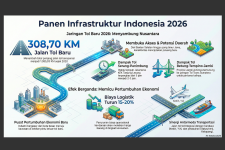
According to a report by Roy Razali Anwar, Director General of Highways at the Ministry of Public Works (PU), a total of 308.70 kilometers of new toll roads will officially begin operations.

“These new sections will increase the cumulative total of operational toll roads to 1,385.03 kilometers since 2020,” Roy said, as quoted by Kompas.com on Sunday (4/1/2026).

The opening of these routes is widely seen as a major connectivity boost that could trigger explosive regional growth.


List of 9 New Toll Roads Operating in 2026​

1. Serang–Panimbang Toll Road​

  • Sections: Section 2 (Rangkasbitung–Cileles) and Section 3.1 (Cileles–Panimbang)
  • Length: 41.63 kilometers
  • Impact: A game changer for South Banten, cutting travel time from Jakarta to the Tanjung Lesung Special Economic Zone (KEK) from 5 hours to just 2–3 hours.
  • Regional Potential: Ends the isolation of Pandeglang and Lebak, transforming the coastal tourism industry into a world-class destination competitive with Bali.

2. Yogyakarta–Bawen Toll Road​

  • Sections: Section 1 (Sleman–Banyurejo) and Section 6 (Ambarawa–Bawen)
  • Length: 15.10 kilometers
  • Impact: A key connector of the Joglosemar “golden triangle” (Yogyakarta–Solo–Semarang), easing the heavy congestion on the busy Magelang national road.
  • Regional Potential: Accelerates food logistics between Central Java and Yogyakarta Special Region (DIY) and strengthens access to the super-priority Borobudur destination.

3. Betung–Tempino–Jambi Toll Road​

  • Section: Section 2 (Tungkal Jaya–Bayung Lencir)
  • Length: 54.30 kilometers
  • Impact: Critically important as it finally connects Jambi Province to the main Trans-Sumatra Toll Road (JTTS) network.
  • Regional Potential: Speeds up the transport of plantation commodities (rubber and palm oil) from Jambi to Bakauheni Port, long hampered by slow eastern Sumatra routes.

4. Solo–Yogyakarta–YIA Kulon Progo Toll Road​

  • Sections: Package 1.2B (Prambanan–Purwomartani) and Package 2.2B (Trihanggo–Sleman)
  • Length: 14.73 kilometers
  • Impact: Directly connects Yogyakarta city to the Trans-Java Toll Road network.
  • Regional Potential: Reduces severe congestion on Yogyakarta’s North Ring Road and accelerates access for tourists and business travelers to Yogyakarta International Airport (YIA).

5. Kediri–Tulungagung Toll Road​

  • Section: Kediri Airport Access
  • Length: 4.82 kilometers
  • Impact: Though short, this section has high strategic value as a key supporter of Dhoho Kediri Airport.
  • Regional Potential: Creates a new logistics ecosystem in southern East Java, positioning Kediri, Tulungagung, and Blitar (Mataraman region) as new economic growth centers beyond Surabaya.

6. Jakarta–Cikampek II South Toll Road​

  • Sections: Package 2 (Setu–Sukabungah) and Package 3 (Sukabungah–Sadang)
  • Length: 54.75 kilometers
  • Impact: A permanent solution to chronic congestion on the existing Jakarta–Cikampek Toll Road, serving as the main alternative route from Jakarta to Bandung via Sadang.
  • Regional Potential: Revitalizes industrial zones in South Bekasi, East Bogor, and Karawang, while speeding up goods distribution to East Priangan.

7. Ciawi–Sukabumi Toll Road​

  • Section: Section 3 (Cibadak–West Sukabumi)
  • Length: 13.70 kilometers
  • Impact: Puts an end to the legendary traffic jams on the “Bogor–Sukabumi” route.
  • Regional Potential: Transforms Sukabumi into a new logistics and manufacturing hub in West Java due to sharply reduced transport costs, while improving access to the Ciletuh Geopark tourism area.

8. Kayu Agung–Palembang–Betung Toll Road​

  • Section: Kramasan to Betung (3 priority segments)
  • Length: 69.19 kilometers
  • Impact: Completes the missing link in South Sumatra, ensuring smoother travel from Palembang toward Jambi and Riau without reliance on congested national roads.
  • Regional Potential: Strengthens Palembang’s position as the main logistics hub in southern Sumatra.

9. Probolinggo–Banyuwangi Toll Road​

  • Sections: Gending to Besuki (Sections 1–3)
  • Length: 38.48 kilometers
  • Impact: Represents the easternmost endpoint of the massive Trans-Java Toll Road project.
  • Regional Potential: Accelerates logistics connectivity between Java and Bali via Ketapang Port and boosts growth in fisheries and agriculture across East Java’s “Tapal Kuda” region.

Multiplier Effects​

The opening of 308.70 kilometers of toll roads in 2026 is about more than just cutting travel time.

It is expected to reduce logistics vehicle operating costs by 15–20 percent, which in turn should help lower consumer prices in regional markets.

In addition, industries are expected to shift away from major cities such as Jakarta and Surabaya toward new toll exits in smaller cities.

Synergies between toll roads and key infrastructure—such as Kediri and Yogyakarta airports, as well as Ketapang and Bakauheni ports—could create a broader, more efficient distribution network.

2026 will be the year when Indonesia becomes “smaller” in distance, yet significantly “larger” in economic scale.


Prabowo Inaugurates 1,151 km of Regional Roads Across 37 Provinces​


Celvin Moniaga Sipahutar, Imamudin
June 23, 2026 | 1:35 pm


To view this content we will need your consent to set third party cookies.
For more detailed information, see our cookies page.

Small city in East Java


Sampang, East Java. President Prabowo Subianto inaugurates 1,151 kilometers of regional roads across Indonesia, underscoring the government’s push to strengthen rural connectivity and lower logistics costs in the world’s largest archipelago.

The infrastructure project spans 37 provinces, covering Sumatra, Java, Kalimantan, Bali, and Nusa Tenggara, as well as Maluku, North Maluku, and Papua. The total value of the works is estimated at Rp 5.41 trillion ($302.35 million).

Speaking at the inauguration of the Kedungdung–Bringkoning road section in Sampang, East Java, on Tuesday, Prabowo said regional roads are a key driver of grassroots economic activity.

“I am proud and happy that the construction of 1,151 km of regional roads across 37 provinces has been completed,” he said. “Regional roads are the lifeline of the people’s economy.”

The Kedungdung–Bringkoning segment is one of the completed projects under the program. The road was widened over a 1.5-kilometer stretch to a width of 7 meters, with an investment of around Rp 14 billion.


Prabowo said improved road infrastructure plays a central role in enabling the movement of goods from rural producers to markets and industrial centers. Better connectivity, he added, helps farmers, plantation workers, and fishermen distribute their products more efficiently while also improving access to essential goods in remote areas.


“Transportation costs will be lower if roads are adequate and if there is connectivity between production centers and residential areas,” he said.


Users who are viewing this thread

Pakistan Defence Latest

Latest Posts

Back
Top