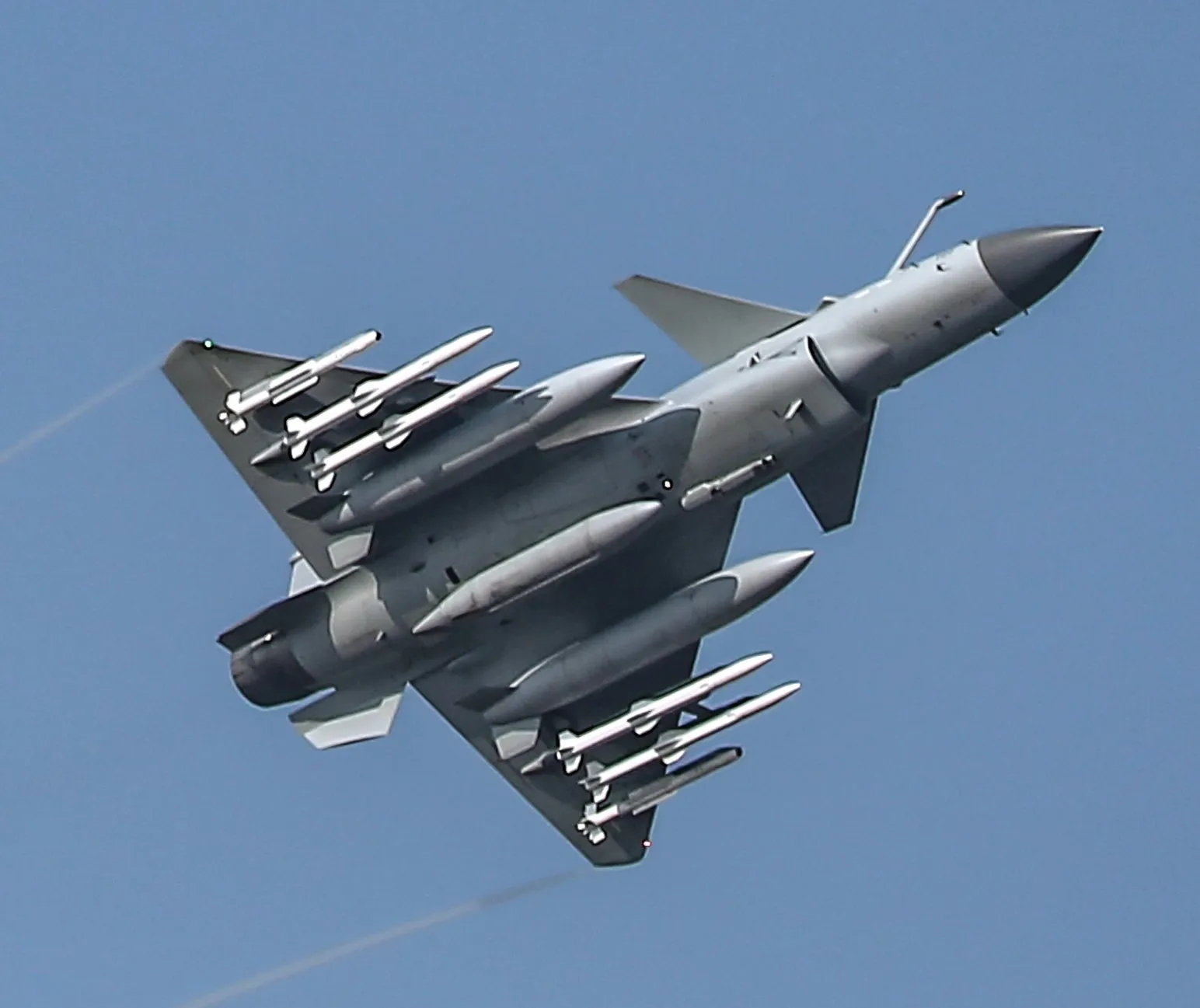
Indonesia’s Air Chief Says “Just Wait” on J-10 Fighters as China Ties Draw Focus
Mohammad Tonny Harjono’s brief response renews scrutiny of possible Chengdu J-10 arrivals, with implications for Indonesia’s interception capability, military supply chains and defence ties with China.
On
Oct 5, 2026
— Indonesia’s unresolved Chengdu J-10 fighter acquisition has regained strategic urgency after Air Chief Marshal Mohammad Tonny Harjono urged patience over possible arrivals, renewing questions about how Chinese combat aircraft could reshape Jakarta’s air defence and military supply chains.
The Indonesian Air Force Chief of Staff’s response, “Tunggu saja,” or “Just wait,” offered neither a delivery commitment nor a procurement total, leaving the political signal stronger than the publicly established evidence of an executable fighter contract.
A reported arrival window of approximately six months points towards April 2027, but remains an unofficial expectation rather than a government schedule, making any immediate assessment of Indonesia’s future airpower conditional on aircraft selection, contractual completion and operational preparation.
The central military question concerns whether Jakarta would receive second-hand J-10B fighters or newer J-10CE aircraft, because their different radars and missile compatibility would determine whether the purchase primarily replenishes airframes or introduces a more demanding beyond-visual-range interception capability.
That distinction carries regional consequences because Indonesia must defend an extensive archipelago and maritime approaches with a mixed fighter inventory, while the addition of Chinese aircraft would create another support ecosystem alongside existing American, Russian, French and Korean platform
Parliamentary defence commission member Dave Akbarshah Fikarno Laksono supported the acquisition direction by linking regional tensions to stronger interception requirements, while emphasising supply chains, training and support, a political argument whose operational credibility depends on the undisclosed procurement package.
Indonesia’s free and active foreign policy provides the political framework for considering Chinese fighters, but supplier diversification would only strengthen strategic autonomy if spare parts, weapons replenishment and technical assistance remain available throughout sustained operations and periods of diplomatic pressure.
Earlier public references to 12, 24 or 42 aircraft have not converged into an authoritative fleet total, preventing reliable calculations of squadron strength, basing requirements, pilot demand or the additional sorties Indonesia could generate from a Chinese fighter force.
Budget signals are similarly difficult to reconcile, with discussion of more than US$9 billion alongside a narrower financing account allocating up to US$1.6 billion to J-10B fighters, figures that cannot responsibly be treated as equivalent acquisition commitments or unit prices.
Defence Minister Sjafrie Sjamsoeddin’s October 2025 statement that the aircraft “will be flying over Jakarta soon” was subsequently tempered by “we are still considering,” illustrating why procurement rhetoric must remain separate from the evidence needed to establish delivery readiness.
Indonesia’s air force chief has said “Just wait” when questioned about possible Chengdu J-10 arrivals, leaving delivery details unresolved while highlighting the airpower and logistics implications of introducing Chinese fighters. Indonesia’s air chief says “Just wait” on possible J-10 fighter...

defencesecurityasia.com