Indonesian Energy sector

Indonesia Explores Installing Solar Panels Along Railway Tracks, Hashim Invites Saudi Investors​


Firda Dwi Muliawati
17 November 2026


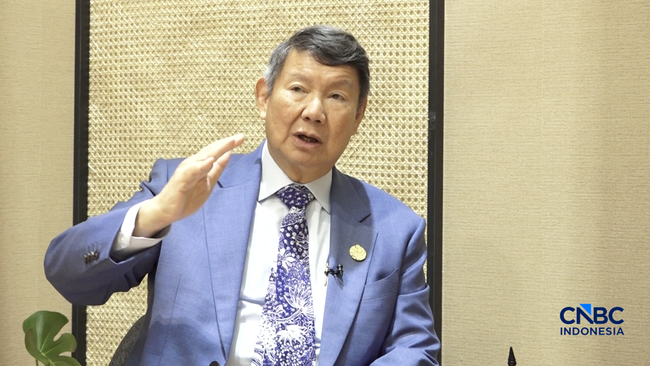
Hashim, Arsari Group Founder, and also brother of Prabowo Subianto


Jakarta, CNBC Indonesia
– Presidential Special Envoy for Climate and Energy Hashim Djojohadikusumo revealed that investors from Saudi Arabia have expressed interest in a proposed project to install solar panels along Indonesia's railway network, with a potential electricity generation capacity of 5.4 gigawatts (GW).

The initiative aligns with the government's target of developing 100 gigawatts-peak (GWp) of solar power capacity.

Hashim said he had personally introduced the project to a Saudi Arabian investor and met with the investor directly. The government is currently studying the feasibility of utilizing railway infrastructure operated by PT Kereta Api Indonesia (KAI) as locations for solar panel installations.

"This is something I am personally investigating and studying. I have introduced the idea to an investor from Saudi Arabia, and we have already met. Perhaps we can utilize railway tracks, installing solar panels between the rails and alongside the tracks. According to Kereta Api Indonesia, this alone could generate 5.4 GW," Hashim explained in an interview with CNBC Indonesia on the sidelines of COP31 in Antalya, Türkiye, as quoted on Monday, November 16, 2026.

The proposal to install solar panels along railway tracks, potentially involving Saudi Arabian investors, emerged because developing 100 GWp of solar power capacity would require tens of thousands of hectares of land.

Hashim noted that securing hundreds or thousands of hectares of land on Java Island would be particularly challenging, given limited land availability and high prices.

"However, we need to consider how many tens of thousands of hectares of land would be required for 100 GWp. On Java Island, finding hundreds or thousands of hectares of land is extremely difficult," he explained.

Despite the challenges of acquiring land in Java, the government has prepared the necessary regulations, while state electricity company PLN is ready to sign power purchase agreements (PPAs) to support the target of achieving a 76% share of new and renewable energy in the 2025–2034 Electricity Supply Business Plan (RUPTL).

The government emphasized the importance of identifying alternative sites that are both practical and economically affordable.

"So, we really have to be realistic. We need to find suitable land, and it must be affordable. Much of the land on Java Island has already become expensive," Hashim said.

In addition to studying solar panel installations along railway tracks, the government is exploring the use of several reservoirs, including Cirata, Saguling, and Kedung Ombo, for solar power development.

The government continues to explore innovative approaches to overcome land constraints while maintaining progress toward its solar power development target.

"So, we have to be innovative. There are also several other locations and opportunities that we could potentially utilize. We must continue finding innovative solutions," Hashim concluded.


This is the chance to produce nukes in silence.

There are a lot of muslim nations with civil nuclear tech and knowhow supported by other countries but they dont take the opportunity to misuse this to produce nukes in silence.

Pakistan did this well.

Imagine Indonesia with nukes. No one in Asia would dare to come near their coast and claim parts of their EEZ.

You could blow those Chinese fishermen up with a torpedo and they would go back home watching Shaolin movies crying about the great Mete Han (Modu Chanyu) who fucked them up centuries ago.

Indonesia already have two or three nuclear research reactors for several decades.

What we wants now is nuclear reactor for power plant.
 

Eni–Petronas Venture Searah to Invest Over $14 Billion in Indonesia's Oil and Gas Sector​


Nurbaiti
19 November 2026

1795240663081.png

Executive Brief​

  • Searah Ltd., a joint venture between Eni and Petronas, plans to allocate more than 70% of its total US$20 billion capital expenditure to oil and gas projects in Indonesia over the next five years.
  • Searah's oil and gas production in Indonesia currently stands at approximately 100,000 barrels of oil equivalent per day (boepd), with a target to quadruple output to 400,000 boepd.
  • Searah is accelerating oil and gas developments in East Kalimantan and East Java, including the North Hub and South Hub projects, while strengthening natural gas supplies in East Java through Searah Ketapang.


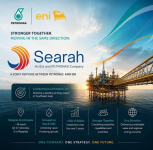
JAKARTA, Bisnis.com — Searah Ltd., a joint venture between Italian energy company Eni and Malaysia's Petronas, plans to invest more than US$14 billion in Indonesia's upstream oil and gas sector over the next five years, accounting for more than 70% of its total planned capital expenditure of US$20 billion.

Searah Group Chief Executive Officer Azahari Mohd. Shuid said Indonesia is a strategic market for the company, which manages 19 oil and gas assets across Indonesia and Malaysia. Fourteen of those assets are located in Indonesia and are operated through two entities, Searah Muara Bakau and Searah Ketapang.

"Our long-term commitment to Indonesia is reflected in our five-year investment plan, with more than 70% of our capital expenditure allocated to oil and gas projects in the country," Azahari said recently.

He explained that Searah was established to combine the strengths of Eni and Petronas in the upstream oil and gas business.

Eni contributes expertise in deepwater exploration, field development, and accelerated project delivery, while Petronas brings extensive experience in regional oil and gas production.

The partnership is expected to create an upstream energy company with international-standard technical capabilities and greater flexibility in decision-making and project execution.

Searah currently produces approximately 350,000 barrels of oil equivalent per day (boepd) on a net equity basis, including around 100,000 boepd from its Indonesian assets.

Of the Indonesian total, Searah Muara Bakau contributes approximately 80,000 boepd, while Searah Ketapang accounts for the remaining 20,000 boepd.

The company aims to quadruple production from its Indonesian assets to 400,000 boepd.

At the group level, Searah is targeting production of more than 500,000 boepd by 2028 through the optimization of existing assets, development of new fields, and expanded exploration activities.

Azahari said Searah aspires to become a leading independent energy company in the Asia-Pacific region. To achieve this, it will prioritize faster project execution, asset optimization, and disciplined capital management.

Accelerating Gas Projects in East Kalimantan​

East Kalimantan is a major focus of Searah's Indonesian expansion, with Searah Muara Bakau preparing several gas field developments to increase supply and sustain production over the long term.

Searah Muara Bakau CEO Mirko Araldi said October 2026 marked an important milestone for the company, with several projects and operational activities making significant progress.

Production from the Jangkrik North East-6ST well began on October 9, 2026, with an initial output of 60 million standard cubic feet per day (MMscfd).

The Maha project subsequently began production on October 30, contributing approximately 230 MMscfd of natural gas.

Alongside the optimization of producing fields, Searah Muara Bakau is accelerating development of the North Hub project, which includes the Geng North and Gehem fields.

"The project is planned to involve the drilling of 16 wells, with production targeted to begin in 2028," Araldi said.

North Hub will also feature a floating production, storage, and offloading (FPSO) facility described as one of the largest of its kind in the world.

The facility is designed to process up to 1,000 MMscfd of natural gas and 80,000 barrels of condensate per day, with storage capacity of 1.4 million barrels.

Elsewhere, Searah Muara Bakau is developing the South Hub project, comprising the Gendalo and Gandang fields in the Kutai Basin.

The project involves drilling seven wells, with production scheduled to begin in 2028.

By utilizing existing infrastructure at the Jangkrik field, the company expects to improve development efficiency while maintaining gas production at approximately 750 MMscfd.

Exploration also remains a key component of Searah's strategy to sustain Indonesia's long-term oil and gas production.

Searah Muara Bakau is currently drilling the Jangkrik NE Upside-1 exploration well in the West Ganal area.

The company has also completed the acquisition of 12,000 square kilometers of 3D and 4D seismic data.

The seismic surveys are expected to help identify undeveloped hydrocarbon resources in the Kutai Basin, considered one of Southeast Asia's most promising oil and gas regions.

Strengthening Natural Gas Supply in East Java​

Beyond East Kalimantan, Searah is expanding its upstream operations in East Java through Searah Ketapang to support growing regional demand for natural gas.

Searah Ketapang CEO Yuzaini M. Yusof said gas demand in East Java is projected to reach approximately 800 MMscfd in 2026.

One of the company's principal assets is the Bukit Tua field, which has been producing since 2015.

As of June 2026, the field's net equity production reached approximately 3,000 barrels of liquids per day and more than 30 MMscfd of natural gas.

"We have operated the Ketapang production-sharing contract since 2015, with production continuing for more than 11 years. We have also secured a 20-year extension of the contract, covering the period from 2028 to 2048," Yuzaini said.

Meanwhile, the Bukit Panjang project has reached a final investment decision (FID), making it one of Searah Ketapang's priority developments.

First gas production is targeted for 2028, with peak output expected to reach 50 MMscfd.

Yuzaini added that a proposed liquefied petroleum gas (LPG) processing facility featuring two production units could increase LPG output to more than 250 tonnes per day.

In addition to developing existing assets, Searah Ketapang is evaluating further exploration opportunities in North Ketapang and Bobara, Papua.

The company is also conducting further assessments of the Barokah exploration discovery in North Ketapang.

Exploration in eastern Indonesia and relatively underdeveloped oil and gas basins forms part of the company's strategy to expand the country's hydrocarbon resource base.

Participation in the Masela LNG Project​

Searah Ketapang is also a partner in the development of the Masela project, one of Indonesia's strategic natural gas developments.

The project targets annual liquefied natural gas (LNG) production of 9.5 million tonnes, alongside a domestic pipeline gas supply of 150 MMscfd.

Masela is also expected to produce approximately 35,000 barrels of condensate per day.

The project forms part of Searah's broader involvement in Indonesia's upstream oil and gas industry, spanning established production assets, new field developments, and exploration opportunities.


Bakrie's ENRG Expands Into US Oil Market With $200 Million HighPeak Investment​


Erta Darwati
November 23, 2026 | 12:36 pm


1795421708151.png
(Photo Courtesy of Energi Mega Persada).

Jakarta. Energi Mega Persada (ENRG), an oil and gas company controlled by the Bakrie Group, has completed a $200 million investment in US-based HighPeak Energy, marking its expansion into the American oil and gas market.

The investment was made through ENRG subsidiary Tunas Harapan Perkasa. HighPeak Energy (NASDAQ: HPK), headquartered in Fort Worth, Texas, focuses on hydrocarbon exploration and development in the Midland Basin in West Texas.

According to an independent assessment by GaffneyCline & Associates as of April 1, 2026, HighPeak holds 288 million barrels of oil equivalent (MMboe) in proven and probable (2P) reserves and 102 MMboe in contingent resources (2C), bringing its combined reserves and resources to 390 MMboe.

ENRG President Director and Chief Executive Officer Syailendra S. Bakrie said the completion of the investment reflected the company's commitment to pursuing growth through both organic expansion and acquisitions or strategic investments.

"We will continue to expand our business consistently to create additional value for shareholders," Syailendra said in an official statement on Monday.

ENRG Vice President Director and Chief Financial Officer Edoardus Ardianto said the company expected to generate synergies between its existing asset portfolio and HighPeak's operations, particularly through operational practices, technology transfer and knowledge sharing.

Founded in 2001 and listed on the Indonesia Stock Exchange (IDX) since 2004, ENRG operates in the upstream oil and gas sector.

Following the completion of the HighPeak investment, ENRG now has 14 oil and gas assets across Indonesia, Mozambique and the United States. These comprise nine operated assets, four partnership assets and one strategic investment.

As of June 30, 2026, ENRG's portfolio comprised approximately 427 MMboe in combined 2P reserves and 2C resources. Separately, its investment in HighPeak is expected to provide additional economic exposure equivalent to around 47 MMboe in 2P reserves and 2C resources after conversion.


Searah's Seismic Survey Reveals 34.52 TCF of Potential Gas Resources in Kutai Basin​


By Rio Indrawan
Selasa, 24/11/2026

1795498137277.png


JAKARTA — Oil and gas exploration in the Kutai Basin, East Kalimantan, is showing significant prospects. Preliminary results from a large-scale seismic survey conducted by Searah have identified potential natural gas resources of 34.52 trillion cubic feet (TCF) across open areas and exploration blocks.

Djoko Siswanto, head of the Special Task Force for Upstream Oil and Gas Business Activities (SKK Migas), said the seismic survey results indicated the presence of significant hydrocarbon resources.

"Thank God, the results of the seismic survey conducted by Searah, which was directly reviewed by the Minister of Energy and Mineral Resources and the Director General of Oil and Gas aboard the seismic survey vessel, indicate substantial potential oil and gas resources," Djoko said in a statement on November 24.

The TGS Ramform Sovereign seismic survey vessel conducted 3D and 4D seismic surveys in the waters off East Kalimantan.

The large-scale seismic survey is part of efforts to strengthen exploration activities, discover new oil and gas resources, and ensure the sustainability of future production.

Djoko explained that the seismic survey covers approximately 12,000 square kilometers using TGS Multisensor Broadband technology. Approximately 72% of the survey area comprises open areas in the deep waters of the Kutai Basin, while the remaining 28% covers active oil and gas blocks, including West Ganal, Rapak, Muara Bakau, Peri Mahakam, and East Sepinggan.

"Total investment in the survey amounts to approximately US$100 million," Djoko said.

According to Djoko, the seismic survey in open areas was conducted with the approval of the Minister of Energy and Mineral Resources under Eni's firm commitments, combined with its firm commitment activities in other blocks, as well as ministerial approval for an extension of the exploration period.

Based on preliminary interpretations, potential Gas Initially in Place (GIIP) in the open areas is estimated at 4.76 TCF under a P50 estimate.

"Meanwhile, 29 prospects and one lead have been identified within the exploration blocks, with a combined preliminary GIIP estimate of 29.76 TCF," Djoko said.

The combined preliminary estimate of potential gas resources across the two areas therefore amounts to approximately 34.52 TCF. However, this figure represents estimated gas in place and cannot yet be classified as proven reserves.

The next stage involves more detailed seismic data processing and analysis to determine the most promising exploration drilling locations. This process will be carried out in the United Kingdom, with support from supercomputing facilities in Milan, Italy.

"We hope that the data processing and identification of exploration drilling locations can be completed in 2027. The locations considered most promising will subsequently become exploration drilling targets," Djoko said.

SKK Migas hopes that the seismic survey will be followed by successful exploration drilling that confirms substantial natural gas reserves.

"We ask for prayers and support so that the upcoming exploration drilling successfully establishes proven reserves of at least 2 TCF," Djoko said.


Users who are viewing this thread

Back
Top