Inside Exercise RHINO BIZZ — the British Army's recce-strike experimentation

Burhaan7487

Registered Member
Joined
Dec 15, 2023
Messages
64
Reaction score
90
Reputation
1,174.4
Country of Origin
Country of Residence
To view this content we will need your consent to set third party cookies.
For more detailed information, see our cookies page.


British soldiers deploy to BATUS, Canada for Exercise RHINO BIZZ — the Army's largest live recce-strike experimentation to date. Around 350 personnel from 2 PARA Battlegroup and 16 Air Assault Brigade combine drones, AI-enabled targeting, and electronic warfare in a contested training environment.

This is fifth generation land warfare being built now, not promised for the future. Soldiers work alongside five embedded industry mission partners, testing live equipment in the field: FPV drones, autonomous systems, and the CAIN digital network connecting sensors to shooters in real time.Go behind the scenes with the operators, coders, planners, and decision-makers making it happen — including medics using drones to deliver blood supplies in austere environments, and paratroopers using e-bikes with uncrewed systems to strike fast and extract.

Human led. Technology enabled. This is what modern service looks like.

Introduction to British Army Paratroopers 00:00-02:58
Who is the Phantom Platoon 02:58-05:18
Battlespace management system 05:18-06:47
Medics using drones to deliver blood 06:47-09:13
Counter UAS 09:13-10:31
History of Rhino Bizz 10:31-12:12
Using e-bikes 12:12-14:49
 
To view this content we will need your consent to set third party cookies.
For more detailed information, see our cookies page.


British soldiers deploy to BATUS, Canada for Exercise RHINO BIZZ — the Army's largest live recce-strike experimentation to date. Around 350 personnel from 2 PARA Battlegroup and 16 Air Assault Brigade combine drones, AI-enabled targeting, and electronic warfare in a contested training environment.

This is fifth generation land warfare being built now, not promised for the future. Soldiers work alongside five embedded industry mission partners, testing live equipment in the field: FPV drones, autonomous systems, and the CAIN digital network connecting sensors to shooters in real time.Go behind the scenes with the operators, coders, planners, and decision-makers making it happen — including medics using drones to deliver blood supplies in austere environments, and paratroopers using e-bikes with uncrewed systems to strike fast and extract.

Human led. Technology enabled. This is what modern service looks like.

Introduction to British Army Paratroopers 00:00-02:58
Who is the Phantom Platoon 02:58-05:18
Battlespace management system 05:18-06:47
Medics using drones to deliver blood 06:47-09:13
Counter UAS 09:13-10:31
History of Rhino Bizz 10:31-12:12
Using e-bikes 12:12-14:49

1000025252.png
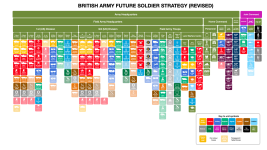
Based on revised their own ORBAT the UK Army cannot function in an extended conflict beyond 3 weeks at the most.

Heavily reliant on US/NATO/EU FOR for any credible presence on the ground.

These clips make for nice visuals but the UK Army is severely underfunded and severely under staffed to be anything more than a self defence force or to assist in limited operations.
 
@RescueRanger agreed, a sad state of affairs. The thing I am more looking at though is innovation, and how doing things differently and integrating new technologies, methods and training can achieve objectives (even if they are limited).
 
The focus for the UK should be the Navy, and the Airforce. We are an island nation, and having large standing armed forces or heavy land equipment makes very little sense for us in the past, now or the future. That is probably reflected in the current ORBAT in terms of focus areas, though the Navy/Airforce are too small but the ratio to the army is ok.

In terms, of our contribution to mainland Europe as part of NATO, it should be a highly deployable air force with AWACS/SIGINIT/EW platforms and small high tech expeditionary forces with a focus to blunt land invasion quickly using high end systems like Apaches etc at best in select areas. Europe is large enough to field large land forces without the UK.

An oversized airforce and oversized navy should be our focus, not on how many tanks and IFV's etc we can field.

"The last time the mainland of Britain was successfully invaded by a hostile foreign force was February 22 to 24, 1797, an event known as the Battle of Fishguard"..

We should focus on what few pennies are left for defense these days to the two service of Airforce/Navy more than the army for these reasons.

( IMHO ..)
 

Users who are viewing this thread

Country Watch Latest

Latest Posts

Back
Top