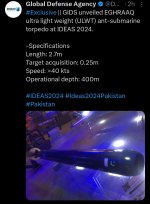
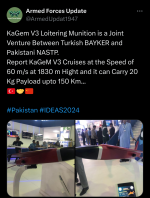
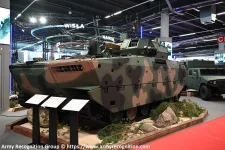
International Defence Exhibition and Seminar (IDEAS)

I think many lessons can be learnt from Ukraine but not all. It is essentially trench warfare and missile now. Pak v India will be fast moving with mass armour. Ukraine (even with western tanks) cannot compete here, hence why a big stalemate.
 
I was just watching an IDEAS 2024 walkthrough tour by this channel Guns Freak on Youtube. Came across this glimpse of PFX (vaporwave) photo on PAC/NASTP booth. So nothing yet materialized and if anyone visited any info available on PFX?

Personally from the Vaporwave photo looks like some structural/airframe change.

Youtube video link:
IDEAS 2024 | 19 - 22 NOV 24 | KARACHI PAKISTAN | WALK THROUGH (Part 1)

View attachment 82300

That looks like a photo of FCAS. I wouldnot read to much into - just a poor diagram by someone asked to prepare a presentation who does not understand the subject matter.
 
Anything interesting from NASTP this year?

Since we dont know what projects they have been tasked with, it is difficult to assess where they are ?

I am not expecting much from them though.

Good engineers and engineering takes time, aswell as the building of intellectual property that can be used to build systems and platforms. That money spent on NASTP would have been better spent on core R&D on places like NRTC/NESCOM who seem capable of delivering things.

I think of NASTP more of a money laundering scam for property than the development of core R&D capabilities.
 
Last edited:
Since we dont know what projects they have been tasked with, it is difficult to assess where they are ?

I am not expecting much from them though.

Good engineers and engineering takes time, aswell as the building of intellectual property that can be used to build systems and platforms. That money spent on NASTP would have been better spent on core R&D on places like NRTC who seem capable of delivering things.

I think of NASTP more of a money laundering scam for property that the development of core R&D capabilities.
NASTP is just getting started it will probably be a few year before we some results.
 
Since we dont know what projects they have been tasked with, it is difficult to assess where they are ?

I am not expecting much from them though.

Good engineers and engineering takes time, aswell as the building of intellectual property that can be used to build systems and platforms. That money spent on NASTP would have been better spent on core R&D on places like NRTC/NESCOM who seem capable of delivering things.

I think of NASTP more of a money laundering scam for property than the development of core R&D capabilities.
NASTP is working on loitering munitions & kind of drone that i forgot about.. they also have some small role in pfx...
 

Attachments

  • Screenshot_20241120-092918~2.png
    Screenshot_20241120-092918~2.png
    781.8 KB · Views: 25
Agreed, but especially for HIT, you are missing the forest for the trees. Firstly, HIT does have a research equivalent, the Military Vehicles Research & Development Establishment (MVRDE).
You should read the At the Forward Edge of Battle, which is about Pakistan's Armored Corps. HIT and POF began military R&D in Pakistan. MVRDE did a survey of all AFV destroyed and damaged in 1965 and 1971 and then made specifications for what they thought was needed for our peculiar circumstances (rather than taking Western or Chinese knock off CCCP vehicles). The T59M series resulted from that and HIT obtained a license for the L7 105MM gun manufacture and POF after testing against T72 armour plate (which isn't still clear how they got it) designed HE and eventually DU APFSDS.
And while @Toxic and @Samurai may well be angry at lack of new IFV options, the thing is HIT is constrained by what the Army wants and it has made several IFV proposals over 30 years which have gotten nowhere because the Army is very dubious about the whole IFV concept. They feel the cost and complexity is not consummate with the increased capability and it doesn't have sufficiently increased survivability versus a APC.

So again, these bodies are constrained by doctrine,

(@Panzerkiel can explain it better).
"the Army is very dubious about the whole IFV concept"

But still I don't understand why PA is so skeptic about IFV concept? Its mostly a staple of mechanized warfare/combined arms (alongside APC) and most of the established militaries around the world are modernizing/adopting IFV to equip their mechanized units.
And who says that IFV doesn't have survivability compared to APC? They are made to be more survivable (+ lethal) because of their role of direct fire support which would put them directly under enemy line of fire, but that armor config obviously depends on the requirements.

Just today there is news about Brazil modernizing its armed forces by planning to buy Polish BWP Borsuk IFV.

Source:
Brazil Eyes Polish BWP Borsuk IFV armored vehicles
Borsuk.webp
 
To view this content we will need your consent to set third party cookies.
For more detailed information, see our cookies page.

................

To view this content we will need your consent to set third party cookies.
For more detailed information, see our cookies page.
 
"the Army is very dubious about the whole IFV concept"

But still I don't understand why PA is so skeptic about IFV concept? Its mostly a staple of mechanized warfare/combined arms (alongside APC) and most of the established militaries around the world are modernizing/adopting IFV to equip their mechanized units.
And who says that IFV doesn't have survivability compared to APC? They are made to be more survivable (+ lethal) because of their role of direct fire support which would put them directly under enemy line of fire, but that armor config obviously depends on the requirements.

Just today there is news about Brazil modernizing its armed forces by planning to buy Polish BWP Borsuk IFV.

Source:
Brazil Eyes Polish BWP Borsuk IFV armored vehicles
View attachment 82318
You need to remember, until 2022, the PA (along with IA and the IDF) had the most experiience Armoured Warfare than anyother Army since WW2.

Analysis of 1965 and 1971 battles (alongwith the smaller actions in UN peacekeeoing and the Afghan border) showed that Anti tank was the biggest killer of AFVs, followed by Arty and then Tanks.
The PA (and IA) used an absolute petting zoo of AFV in the wars, from Type-59, to M47/48, to upgraded Shermans, to WW2 era Tank destroyers like the Jackson and Hellcat. Plus older armoured scouts like the Stuarts.
So they had a very good idea as to survibability depending on range and weapon used, versus armour.

The PA conclusion was:
i. IFV were less survivable than a tank, so they couldn't really accompany them to the line of contact.
ii. They would have to dismount further back, not too much further forward than APC could go to. Like if say (made up numbers for illustration) an APC had to dismount 1000 yards before contact line to have a reasonable survivability chance, an IFV could go perhaps 700 yards. This was not enough of an increase to offset the increased costs and complexity of the system, with the reduced number of mounts (8 v 13).

iii. Firepower was a plus.

iv. All in all, the PA came to the conclusion that if they uograded the base model M113 to carry additional firepower and have some increased protection, they would gain most of the benefits of an IFV, while having none of the drawbacks.
 
To view this content we will need your consent to set third party cookies.
For more detailed information, see our cookies page.
 
You need to remember, until 2022, the PA (along with IA and the IDF) had the most experiience Armoured Warfare than anyother Army since WW2.

Analysis of 1965 and 1971 battles (alongwith the smaller actions in UN peacekeeoing and the Afghan border) showed that Anti tank was the biggest killer of AFVs, followed by Arty and then Tanks.
The PA (and IA) used an absolute petting zoo of AFV in the wars, from Type-59, to M47/48, to upgraded Shermans, to WW2 era Tank destroyers like the Jackson and Hellcat. Plus older armoured scouts like the Stuarts.
So they had a very good idea as to survibability depending on range and weapon used, versus armour.

The PA conclusion was:
i. IFV were less survivable than a tank, so they couldn't really accompany them to the line of contact.
ii. They would have to dismount further back, not too much further forward than APC could go to. Like if say (made up numbers for illustration) an APC had to dismount 1000 yards before contact line to have a reasonable survivability chance, an IFV could go perhaps 700 yards. This was not enough of an increase to offset the increased costs and complexity of the system, with the reduced number of mounts (8 v 13).

iii. Firepower was a plus.

iv. All in all, the PA came to the conclusion that if they uograded the base model M113 to carry additional firepower and have some increased protection, they would gain most of the benefits of an IFV, while having none of the drawbacks.
The key thing is experience from the 1965 and 71 technology has vastly evolved from that, large tank battles are a thing of the past with things like drones and loitering munitions large tank formations are sitting ducks, just look at how Russia got a reality check.
 
To view this content we will need your consent to set third party cookies.
For more detailed information, see our cookies page.
 

Users who are viewing this thread

Pakistan Defence Latest

Back
Top