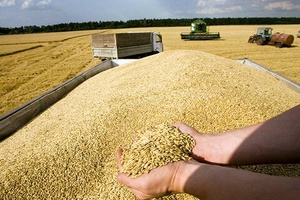
Iran Economy

Some people here just can't see the statistics and think by talk every thing can be fixed they don't understand that the economy even in 2000 years ago was tied with commerce and good relation with others without that nothing can be done
They ate chicken too. Because they wanted to sell to a powerful us. Today they don’t.

Eat cake for now.
 
They ate chicken too. Because they wanted to sell to a powerful us. Today they don’t.

Eat cake for now.
Be careful
Historical fact, The one who suggested if people don't have bread can eat cake literally lost his head
 
Finally one good news if the Iranian data is actually correct :unsure:!! :

Iran is now again self sufficient in Wheat production (almost)..

We were deficient around 3 million tons last year if I remember it correctly..Every one million ton of wheat is around 1/4 of billion dollars (yes it is not cheap)..so finally we learned to pay our farmers the price they want and they produced and money stays in the country..:)

گندم در آستانه خودکفایی کامل​

بر اساس آمارهای شرکت بازرگانی دولتی ایران، میزان خرید تضمینی گندم امروز صبح به 11 میلیون تن رسید که یک گام کوچک با خودکفایی فاصله دارد.
https://farsnews.ir/Behruz_noori/1723287136753566963
گروه اقتصادی خبرگزاری فارس؛ «خرید تضمینی گندم از کشاورزان تا صبح امروز شنبه 20 مرداد به 11 میلیون تن رسیده است». مدیر عامل شرکت بازرگانی دولتی سعید راد امروز خبر داد.پیش از این وزارت جهاد کشاورزی گفته بود که 11.5 میلیون تن گندم اگر بخریم به خودکفایی کامل می‌رسیم.
https://farsnews.ir/Behruz_noori/1723287136842701757
خرید گندم تضمینی تا شهریور ادامه دارد و روزانه حدود 150 هزار تن گندم از کشاورزان خریداری می‌شود.امسال نسبت به سال گذشته 17 درصد رشد داشته و 1.5 میلیون تن بیشتر شده است. ارزش گندم‌های خریداری شده 193 هزار میلیارد تومان است و تاکنون 94 هزار میلیارد تومان پرداخت شده است.هزینه برگزاری المپیک پاریس 11 میلیارد یورو است و با پول خرید تضمینی گندم می‌توان سه المپیک برگزار کرد.
 

Iran’s Economic Challenges: A Bleak Outlook for Employment and Prosperity​

By Mahmoud Hamidi, 18th August 2024

In a recent report published by Etemad newspaper on August 17, Hassan Taei, the former vice president of development, entrepreneurship, and employment at Iran’s Ministry of Labor, painted a concerning picture of Iran’s economic future. His insights shed light on the significant challenges facing the country’s job market and overall prosperity.

Taei emphasized that for Iran to achieve a relatively prosperous society, its labor force would need to more than double, increasing from the current 26 million to 55 million people. However, he described this goal as “impossible” given the country’s economic stagnation since 2004.

“An economy that hasn’t managed to grow by an average of 1 percent since 2004 cannot create a million job opportunities,” Taei stated. He explained that creating a million jobs would require generating 300 new positions daily, a feat he deems unfeasible for Iran’s current economic situation.

This sobering assessment comes in the wake of criticism directed at the government’s statistics by the state-run newspaper Donya-e Eghtesad in May. The publication argued that the government’s claims of reduced unemployment rates were misleading, as they did not correlate with increased economic growth or noticeable improvements in citizens’ lives.

Taei highlighted a troubling trend where skilled workers, including industrial workers and experts, are leaving their positions in public and private companies to work in less specialized fields such as ride-sharing services or as delivery couriers. This shift is partly attributed to the fact that the minimum wage for workers subject to labor law is approximately one-third of the poverty line.

The former official noted that only 3 million job opportunities were created in the last 20 years. He stressed the need for developing education, expertise, and knowledge to create jobs, emphasizing that this goes beyond merely offering credentials and should focus on increasing the level of knowledge and specialization.

Looking ahead, Taei projected that Iran’s population will reach 95 million by 2031. To meet international standards, he suggested that the working population should be at least 50 million, with an inflation rate around 9 percent and a labor force participation rate exceeding 70 percent. Currently, Iran’s participation rate stands at about 41%.

Taei also pointed out that the current subsistence rate in Iran is close to four, meaning one person’s income supports four people. Given these conditions, he believes that even creating 300 jobs daily is not feasible in Iran.

To address these challenges, Taei emphasized the need for continuous reform of the administrative system to facilitate efficient economic activities. He argued that job creation is not merely an economic policy but a product of a system, requiring institutional foundations and coherent intellectual and executive frameworks.

In conclusion, Taei highlighted that real democracy, efficient bureaucracy, and genuine development are organic links of an advanced society – elements he suggests are lacking in Iran.

https://irannewsupdate.com/news/eco...-bleak-outlook-for-employment-and-prosperity/
 
Iran’s Economic Growth Target Deemed Unrealistic, Experts Warn
By Poorang Novak, 16th August 2024

Iran’s ambitious goal of achieving 8% economic growth, as outlined in its Seventh Development Plan, has come under scrutiny from economic experts and officials. Mehdi Sadeghi Niaraki, the vice president of the Iranian Chamber of Commerce, has raised significant doubts about the feasibility of this target, highlighting the enormous financial challenges the country faces.

Speaking at a meeting of the Tehran Chamber of Commerce on August 13, Niaraki stated that reaching the 8% growth target would require an astronomical investment of approximately $83.4 trillion (five quintillion tomans). To put this figure into perspective, he explained that achieving such growth would necessitate an annual investment of $100 billion. However, the total lending capacity of Iran’s banks and financial institutions in 2023 was only about $93.5 million (5,500 billion tomans), illustrating the vast gap between the country’s financial capabilities and its economic aspirations.

The economic landscape in Iran appears even more challenging when considering recent financial data. Niaraki revealed that according to the Central Bank, Iran’s net foreign exchange account was negative by about $15 billion in the first nine months of 2022. This deficit underscores the country’s struggle to maintain a positive balance in its international financial dealings. Furthermore, foreign investment in Iran has remained modest, with an average of only $1.5 billion annually between 2011 and 2022, indicating a lack of international confidence in the Iranian economy.

The state-run website Tejarat News has also questioned the logic behind the 8% growth target. The website pointed out that even a more modest 4.5% economic growth would require a 15% investment growth, a figure that seems out of reach given Iran’s economic history. To highlight the improbability of achieving such growth, Tejarat News noted that Iran’s economy has never experienced investment growth exceeding 7%, making the 8% target appear particularly unrealistic.

While Iran’s Central Bank reported an average economic growth rate of 4.3% from 2021 to 2023, experts caution against interpreting this as a sign of sustainable economic progress. The total economic growth over these three years amounted to about 13%, meaning that the gross domestic product at the end of 2023 had grown by 13% compared to 2020. However, economists argue that this growth appears to be driven primarily by short-term factors, particularly oil exports, rather than long-term, structural improvements in the economy.

Several key concerns have been highlighted in the analysis of Iran’s economic situation:

  1. High capital-to-production ratio: At 3.75, this figure indicates low capital productivity in Iran’s economy, suggesting inefficiencies in how capital is utilized across various sectors.
  2. Negative growth in capital stock: Both the oil and gas sector and the industrial sector have experienced negative growth in their capital stock. This means that the amount of capital in these crucial sectors has been decreasing annually, contradicting the notion of sustainable growth.
  3. Oil-dependent growth: The economic growth appears to be primarily driven by currency fluctuations resulting from crude oil exports. This source of growth is considered unstable and highly dependent on external factors such as global oil prices and geopolitical situations.
  4. Sectoral disparities: In the winter of 2023, the Iranian Statistics Center reported negative growth (-7%) in industries and mines (excluding oil) and minimal growth (0.6%) in the agricultural sector. In contrast, the oil sector experienced a growth of 14.7%, further emphasizing the economy’s reliance on crude oil sales.
  5. Services sector stagnation: The growth rate of the service sector was reported at a modest 1.5%, indicating limited expansion in this crucial area of the modern economy.
  6. Industrial production decline: The Parliament Research Center has reported a downward trend in industrial production, based on data from companies registered in the stock market. This decline in a key productive sector raises concerns about the overall health of the economy.
Experts argue that the proposed 8% growth target in the Seventh Development Plan appears to lack a solid foundation in economic realities. They suggest that the plan’s authors may not fully grasp the complexities of Iran’s economy, its growth drivers, and its actual capacities. The disparity between the ambitious target and the country’s economic performance history raises questions about the planning process and the expertise of those setting these goals.

To put the challenge in perspective, achieving even a 1.7% economic growth would require a 1.7% growth in capital stock, necessitating a 4.5% growth in investment. The leap to an 8% target, therefore, seems to be disconnected from Iran’s economic realities and historical performance.

The nature of Iran’s recent economic growth also raises concerns about its sustainability. The increase in GDP over the past three years has been largely allocated to household expenses (13.5%), with little change in government expenses and investment. This pattern suggests that the growth is not being channeled into productive sectors that could drive long-term economic development.

Furthermore, the heavy reliance on oil exports as a growth driver is problematic. For this source of growth to continue, either exports must increase or oil prices must rise, neither of which can be guaranteed considering global market dynamics and geopolitical factors. This underscores the political, rather than economic, nature of Iran’s current growth trajectory.
 
To view this content we will need your consent to set third party cookies.
For more detailed information, see our cookies page.
 
To view this content we will need your consent to set third party cookies.
For more detailed information, see our cookies page.
 
To view this content we will need your consent to set third party cookies.
For more detailed information, see our cookies page.
 
Iranian domestic production since US maximum pressure sanctions in 2018:

Refrigerators:
- 2018: 1.3 million
- 2022: 2.7 million (+108% in 4 years)

Washing machines:
- 2018: 0.6 million
- 2022: 1.7 million (+183% in 4 years)
 
Iranian domestic production since US maximum pressure sanctions in 2018:

Refrigerators:
- 2018: 1.3 million
- 2022: 2.7 million (+108% in 4 years)

Washing machines:
- 2018: 0.6 million
- 2022: 1.7 million (+183% in 4 years)
Are these domestic production or label stamped? I understand many importers simply label stamp Chinese matériel.
 
To view this content we will need your consent to set third party cookies.
For more detailed information, see our cookies page.
 
We had Debsh tea now it's time for Debsh car
1000007708.jpg
 

Users who are viewing this thread

Country Watch Latest

Latest Posts

Back
Top