The IAEA confirmed that Israeli strikes have impacted underground infrastructure at the Natanz nuclear site. This came after the IAEA reported that Israeli strikes have likely damaged or destroyed thousands of centrifuges at Natanz.

www.understandingwar.org
Iran Update Special Report, June 17, 2025, Evening Edition
Jun 17, 2025 -
ISW Press
Kelly Campa, Avery Borens, Nidal Morrison, Carolyn Moorman, Ben Schmida, Ria Reddy, and Annika Ganzeveld
Information Cutoff: 6:00 PM ET
Key Takeaways
- The IAEA confirmed that Israeli strikes have impacted underground infrastructure at the Natanz nuclear site. This came after the IAEA reported that Israeli strikes have likely damaged or destroyed thousands of centrifuges at Natanz.
- Israel has continued striking Iranian military targets, which has likely degraded Iranian missile forces significantly. This degradation is reflected in the decreasing volume of Iranian missile fire at Israel.
- Israel has continued striking energy infrastructure and regime sites connected to domestic surveillance and repression. These strikes could reduce the ability of the regime to control the population and, in turn, destabilize it.
- US President Donald Trump called for Iran’s “unconditional surrender.” This came as the United States sent additional forces to the Middle East and could reportedly meet with senior Iranian officials in the coming days to discuss a resolution to the war.
- Iran has prepared to fire missiles at US forces if the United States strikes Iran, according to the New York Times. The outlet reported that Iran would first attack US positions in Iraq and then in other unspecified Arab countries, presumably those around the Persian Gulf.
- Iranian-backed militias have agreed to attack US forces in Iraq if the United States strikes Iran. These militias are the same ones that conducted around 200 attacks targeting US positions in Iraq and Syria from October 2023 to November 2024.
- A senior Houthi official said that the Houthis “will intervene to support Iran against Israel.” The Houthis could support Iran by firing projectiles at US and Israeli targets or resuming attacks targeting international shipping.
CTP-ISW has recorded 197 reported or confirmed Israeli airstrikes on Iran since the start of the Israeli air campaign on June 12.
CTP-ISW has recorded 39 reported or confirmed Iranian ballistic missile or interceptor impacts on Israel since the start of the Israeli air campaign on June 12.
The Israel Defense Forces (IDF) has likely degraded Iran's ability to conduct ballistic missile attacks.[1] The IDF reported on June 17 that it has destroyed “about half” of Iran’s ballistic missile launchers, which the IDF stated is equivalent to over 200 launchers.[2] The IDF reported on June 16 that it had destroyed a third (120 launchers) of Iran’s missile launchers, which suggests that the IDF destroyed around 80 launchers between June 16 and 17.[3] The IDF also estimated on June 17 that it had destroyed between 35 and 45 percent of Iran’s ballistic missile stockpile.[4] The IDF released footage of strikes targeting Iranian ballistic missile storage and launch sites in western Iran on June 17.[5] Iran’s missile barrages in the recent conflict are much smaller compared to its barrages in its October 2024 attack on Israel, which likely reflects the IDF’s degradation of Iranian ballistic missile capabilities. Iran launched around 200 ballistic missiles in two waves in October 2024, whereas Iran used 30 to 40 missiles per barrage on June 16. Iran used 20 missiles in its largest barrage and two missiles in its smallest barrage on June 17, moreover.[6]
Iran has conducted three ballistic missile attacks targeting Israel since CTP-ISW's 6:00 AM ET data cutoff on June 17. Iran launched two ballistic missiles targeting central Israel in its sixth barrage since June 16.[7] Israeli air defenses intercepted one of the missiles, and the other missile landed in an open area, according to an Israeli military correspondent.[8] Iran reportedly launched three missiles targeting southern Israel in its seventh barrage and two ballistic missiles targeting northern Israel in its eighth barrage. Neither attack caused damage or injuries.[9] The sharp decline in the size of Iranian missile barrages is likely the result of the IDF’s destruction of Iranian missile launches and storage facilities, as noted above.
The International Atomic Energy Agency (IAEA) confirmed on June 17 that Israeli airstrikes directly impacted the underground enrichment facilities at the Natanz Enrichment Complex in Esfahan.[10] A US weapons expert identified three explosive impacts above the underground enrichment facilities at Natanz on June 17.[11] The IAEA previously reported on June 16 that Israeli airstrikes had not directly impacted the underground facilities at Natanz but had likely damaged or destroyed several thousand centrifuges due to damage to energy infrastructure at the site.[12] Israeli airstrikes damaged electrical substations and support buildings critical to the power supply at the facility.[13] There have been several unverified reports of additional airstrikes at Natanz since June 16.[14] It is unclear what damage, if any, these strikes inflicted on the complex. The IAEA stated that there has been no change to the status of the Esfahan Nuclear Technology Center or Fordow Fuel Enrichment Plant.[15]
The IDF targeted missile bases in Tehran and East Azerbaijan provinces. The IDF struck the Tehrani Moghaddam Missile Base near Tehran on June 15.[16] A nuclear weapons analyst posted satellite imagery captured on June 17 that shows significant damage at the base.[17] The Tehrani Moghaddam base is reportedly one of Iran’s most sensitive and strategically important military sites.[18] The site is named after Hassan Tehrani Moghaddam, who is considered the father of Iran’s ballistic missile program and played a key role in developing Iran’s medium- and long-range missiles.[19]
Iranian opposition media separately posted a video of smoke rising from the Amand Missile Base near Tabriz in northwestern Iran.[20] The IRGC Aerospace Force reportedly stores Ghadr medium-range ballistic missiles at this base.[21] The IDF previously struck a number of buildings at the Amand base on June 14.[22]
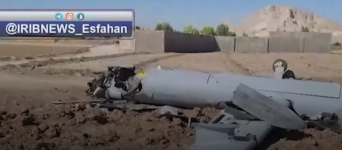
The IDF targeted several Iranian military sites in Esfahan Province in central Iran on June 17.[23] The IDF stated that it conducted a “massive wave” of strikes targeting ballistic missile launch and storage facilities in Esfahan Province.[24] The IDF reportedly struck the Artesh Air Force 8th Tactical Airbase in Esfahan, which houses F-14A/AM, F-7/FT-7N, and PC-7 aircraft.[25] The IDF previously struck this airbase in April 2024 following Iran’s drone and missile attack on Israel.[26] The 8th Tactical Airbase is strategically located near key Iranian nuclear and defense sites.[27] The IDF separately struck an Islamic Revolutionary Guards Corps (IRGC) missile base and the IRGC Ground Forces 8th Najaf-e Ashraf Armored Division’s Ashura Barracks in Najafabad, Esfahan Province.[28] The IDF also struck the IRGC Shahid Kharrazi Barracks and Iran Aircraft Manufacturing Industrial Company (HESA) near Shahin Shahr, north of Esfahan.[29] HESA manufactures Ababil and Shahed-series drones.[30]
There are unverified reports that the IDF struck the IRGC headquarters in Khomein, Markazi Province, on June 17.[31] The IDF previously struck the Hazrat-e Masoumeh air defense site in Markazi Province on June 13 and 16. This air defense site is responsible for defending the Fordow Fuel Enrichment Plant and is located roughly 16 kilometers east of Fordow.[32]
Israeli airstrikes have continued to degrade Iran’s air defense capabilities. The IDF has destroyed over 70 Iranian air defense systems since June 12.[33] The IDF destroyed over 40 air defense systems in the first 24 hours of its air campaign, which enabled Israel to establish air superiority over western Iran and Tehran.[34] The IDF has since destroyed another 30 air defense systems.[35] The IDF stated that the destruction of Iranian air defense systems will allow Israeli Air Force (IAF) fighter jets and drones to operate deeper within Iran.[36] The IAF conducted its deepest strike in Iran thus far on June 16, when the IAF targeted an Artesh airbase in Mashhad, Khorasan Razavi Province.[37] Some Iranian air defense systems remain intact and have reportedly activated in response to Israeli airstrikes.[38] It is unclear whether these systems have successfully intercepted Israeli missiles or airstrikes.
The IDF continued to target Iranian energy infrastructure and infrastructure related to internal security on June 17. Israeli strikes reportedly targeted oil refineries in Tehran and Esfahan provinces.[39] CTP-ISW assessed on June 15 that Israeli strikes on Iranian energy infrastructure will likely worsen Iran’s ongoing energy crisis and cause more widespread and frequent electricity shortages and outages. Frustration over energy shortages could trigger internal unrest.[40] The IDF also expanded its air campaign to target a Basij headquarters in Esfahan Province on June 17.[41] The Basij is a paramilitary organization that recruits and organizes regime loyalists and uses them to produce and disseminate propaganda, suppress internal dissent, and conduct civil defense operations. An outlet controlled by the Iranian Armed Forces General Staff published an article on June 15 calling for the deployment of the Basij across Iran to promote internal security and regime stability.[42]
The IDF targeted the Shahid Meisami Group in Karaj, Alborz Province, as CTP-ISW reported in its June 16 morning update.[43] The United States sanctioned the Shahid Meisami Group in December 2020 for testing and producing chemical agents for use as incapacitation agents.[44] Iran has previously used pharmaceutical-based agents to suppress internal dissent.[45]
Israeli Prime Minister Benjamin Netanyahu addressed the Iranian people during an interview with Iranian opposition media on June 16.[46] Netanyahu stated that "a light has been lit—carry it to freedom." He added that "your hour of freedom is near—it's happening now." Netanyahu similarly addressed the Iranian people in a speech on June 12 and said that “I believe the day of your liberation is near.”[47]
Iran struck the Israeli Military Intelligence School in Camp Moshe Dayan in Tel Aviv with ballistic missiles on June 17, as CTP-ISW reported in its June 17 morning update.[48] A video of the strike showed nearby Israeli air defense systems attempting to intercept the missiles before four ballistic missiles struck in the vicinity of the school.[49] Two of the missiles landed in agricultural fields while a third struck a wastewater treatment plant.[50] One missile struck a warehouse in the Military Intelligence School, damaging the warehouse and starting a fire.[51] No casualties have been reported at the time of this writing.
The Israeli Navy intercepted several drones heading toward Israel on June 17.[52] The navy released a video of a Saar 6-class Corvette intercepting a drone.[53] The vessel has reportedly intercepted approximately 20 drones since the start of the Israeli air campaign against Iran on June 12.[54]