Navigation
Install the app
How to install the app on iOS
Follow along with the video below to see how to install our site as a web app on your home screen.
Note: This feature may not be available in some browsers.
More options
Style variation
You are using an out of date browser. It may not display this or other websites correctly.
You should upgrade or use an alternative browser.
You should upgrade or use an alternative browser.
Iran launches Operation True Promise - massive missile/drone strikes across Israel, Israel allegedly responds with quadcopters
- Thread starter Mehdipersian
- Start date
- Status
- Not open for further replies.
More options
Who Replied?
lightning f57
Trusted Member

Good to see the zionist nazi's scrambling for different scenarios they might be attacked. These sicko's killed over 40k civilians and celebrated it, see how they run around headless making threats and all sorts when Iran hasn't even done anything yet. This is the true nature of these, scared to die but quick to kill.

Nuffle
Registered Member

About Fattah-2:Sejjil
Khorramshahr-4
Emad
Shahab-3
Qadr
Paveh (cruise missile)
Fattah-2
Kheibar Shekan
Haj Qasem
It is worth noting that there are inconsistencies regarding the data on this Iranian hypersonic missile. A boost-glide missile with a range of 1400 km would have to be launched by a short-range ballistic missile (SRBM) rocket propulsion system, which are missiles with a range between 300 km and 1000 km.
Assuming a ballistic missile with a range of 500 to 700 km that released the HGV 700 to 900 km from the target, which would continue gliding up to 1400 km away, it would not be traveling at more than 3 km/s (Mach 9 to 10) when it was released and would reach the target at a much slower speed.
This speed quoted in articles of 5 km/s is compatible with a medium-range ballistic missile and in theory would provide a much greater range for a hypothetical HGV that was launched by it than the 1400 km cited.
Just as an example, the LRHW Dark Eagle that the US is putting into operation, the boost-glide type, reaches 5 km/s and has a reported range of at least 3000 km.
Another example is the American ballistic Pershing II, retired in the 90s. It reached 3.2 km/s and had a range of 1600 km. If he had an HGV he would definitely have about 3000 km of range, which is the sum of the ballistic range plus the glide range. Even if he released this hypothetical HGV on a depressed trajectory so as not to leave the atmosphere, it would have a range of at least 1500 km.
In short, the inconsistency is: if the missile “only” reaches 1400 km, then its maximum speed when the propelled engines exit is much lower than Mach 15. If it is really Mach 15, then it must have a maximum range greater than the quoted 1400 km.
Most realistically, this missile would take at least 10 to 15 minutes to reach Israel. The weapon that can intercept it in Israeli possession is the Arrow 2 missile with a range of around 200 km. The radar would be the Green Pine with a range for RVs in the range of 500 to 800 km. Early warning could be provided by the US with its global coverage IR warning satellite system providing more reaction time for the Israelis.
Objects at speeds exceeding Mach 15 have been intercepted in tests and training on several occasions, including an Arrow 3 intercepting an RV launched by a Yemeni MRBM in a real combat situation.
To understand hypersonic boost-glide missiles, we have to understand how ballistic missiles work.
Assuming a ballistic missile (MRBM) with a range of 2000 km (speed of 4 km/s – Mach 13) on a trajectory called lowest energy expenditure, that is, ideal from a ballistic point of view.
This hypothetical missile that we will call the H missile can then deposit a ballistic payload (with a minimum drag profile) 2000 km away with a speed very close to Mach Mach 13.
If instead of a ballistic reentry vehicle it launches a hypersonic gliding vehicle (HGV) as soon as it enters the atmosphere (100 km high) at 4 km/s, the range of this missile would be much greater than 2000 km because it would have to be added the propelled/ballistic range with the HGV glide range. Let's guess that this same missile would now reach a range of 3000 km, but at a much slower speed because it slowed down while gliding. Let's assume it reaches 2 km/s.
The problem with this mode of operation is that the space component of the missile persists and it could be detected and intercepted in space before re-entering the atmosphere. To avoid this, we will make the H missile adopt a depressed trajectory that practically does not make it leave the atmosphere (remembering that the propulsion of this type of missile only occurs in the initial 10% of the trajectory and the rest comes through inertia and gravitational attraction ).
Let's assume it now reaches Mach 10 at an altitude of 100 km. Its range now drops to around 800 km, both because the trajectory is not ideal and because the drag factor is acting all the time.
Now, let's remove the RV from this missile and install an HGV (hypersonic gliding vehicle). This missile will eject the HGV at a height of approximately 100 km, which will now glide towards a target. The range in this mode will be 800 km plus the glide range. Let's guess the 800 km due to the greater drag and lower speed. This missile will now have a range of 1600 km with the advantage of not having left the atmosphere but with the disadvantage of reaching the target at a speed of less than 2 km/s.
In short, the same “drive system” can have 4 types of action:
1- H missile equipped with RV implementing an ideal ballistic trajectory:
2000 km range
apogee of 400 km
speed after burning the propellant of 4 km/s
target arrival speed of 4 km/s
–
2-H missile equipped with HGV implementing an ideal ballistic trajectory:
range of 3000 km
apogee of 400 km
speed after burning the propellant of 4 km/s
target arrival speed of 2 km/s
–
3- H missile equipped with RV implementing an extremely shallow depressed trajectory that does not allow it to leave the atmosphere;
range of 800 km
apogee of 100 km
speed after burning the propellant of 3 km/s
target arrival speed of 3 km/s
–
4-H missile equipped with HGV implementing an extremely shallow depressed trajectory that does not allow it to leave the atmosphere
range of 1800 km
apogee of 100 km
speed after burning 3 km/s
target arrival speed of 2 km/s
Hypersonic missiles cannot be intercepted by mid-course interceptors capable of intercepting ballistic missiles, for the simple fact that they do not leave the atmosphere and enter space, which is where “exoatmospheric interceptors” (or if you prefer, space interceptors) act to intercept ballistic missiles.
The fact that hypersonic missiles cannot be intercepted in the intermediate phase by missiles dedicated to intercepting ballistic missiles in the intermediate phase does not mean that they cannot be intercepted in the intermediate phase by high-performance AA missiles, which operate in the upper atmosphere. Ex: SM-6, 40N6, THAAD, S-300V4...
Just as a comparison, the trajectory profiles of several missiles with a range of 2000 km:
Ballistic missile: apogee altitude around 300 to 400 km. Peak speed around 4.5 km/s (in Mach it would be equivalent to Mach 15). Solid rocket engine. Trajectory time to target: 10 minutes.
Boost-glide hypersonic missile: around 70 km high. Peak speed of Mach 15. Solid rocket engine. Flight time to target: 11 to 12 minutes.
Hypersonic “cruise” type missile: around 40 km high. Speed around Mach 8 to 10. Scramjet type aspirated engine. Flight time: 11 minutes.
Subsonic cruise missile: altitude of up to 65 m above the ground (depending on the relief). In a Hi-Lo profile it can vary from 3000 m to 65 m in height. Speed around Mach 0.8. Turbofan engine. Flight time: 2 hours.
–
It is clear that from the target's point of view, the first to be detected, taking into account the curvature of the Earth and the relief, would be the ballistic missile and the last would be the subsonic cruise missile.
OFF:
Shahab-1 > up to 300 km
Fateh-110 > up to 300 km
Shahab-2 > up to 500 km
Raad-500 > up to 500 km
Fateh-313 > up to 500 km
Zolfaghar > up to 700 km
Qiam-1 > up to 800 km
Dezful > up to 1,000 km
Abu Mahdi (cruise) > up to 1,000 km
Haj Qasem > up to 1,400 km
Hoveyzeh (cruise) > up to 1,400 km
Rezvan > up to 1,400 km
Fattah-2 (hypersonic) > up to 1,400 km
Kheibar Shekan > up to 1,500 km
Paveh (cruise) > up to 1,600 km
Fajr-3 > up to 2,000 km
Shahab-3/Emad/Ghadr > up to 2,000 km
Sejjil > up to 2,000 km
Khorramshahr-4 > up to 2,000 km
Qadr-110 > up to 2,000 km
Ashoura > up to 2,000 km
Soumar (cruise) > up to 2,500 km
Ships:
Talaiyeh (cruise) > up to 1,000 km
Qadr-474 (cruise) > up to 2,000 km
Are these Iran's current missiles?
Nuffle
Registered Member
One intriguing thing is this article in which they say that Iran can create an A2AD layer:Where are the IAF attacks when this movement has already started?
As I already stated, Israel for now is only issuing protests and doing nothing about it.
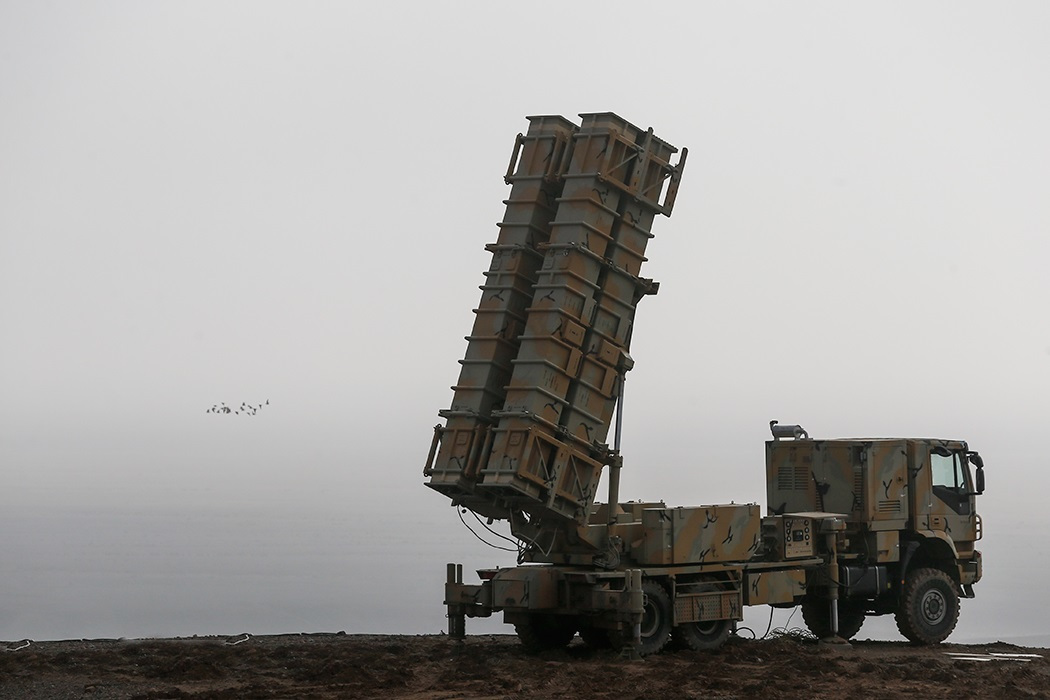
Iran Potentially Expanding Its Air Defense Axis in Lebanon and Syria
Tehran is seemingly redoubling its efforts to equip Hezbollah and other regional allies with advanced air defense systems, which could affect Israeli and U.S. calculations in the Gaza war and beyond.
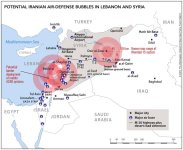
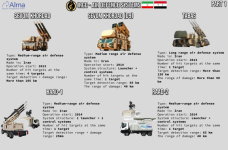
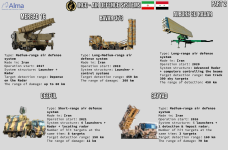
I wonder what systems would be used for this. A big factor of contention between Syria and Russia is Russian passivity in not shooting down Israeli aircraft, perhaps Syria will run to Iran to create its own A2AD layer with Iranian systems:

Xerxes22
Registered Member


With all honesty, If Iran doesnt retaliate tonight then I dont know what to make of it. It makes no damn sense to me. They are dragging this on and on and on. I dont see the logic behind it anymore if the retaliation doesn't happen tonight
Awwad
Registered Member

With all honesty, If Iran doesnt retaliate tonight then I dont know what to make of it. It makes no damn sense to me. They are dragging this on and on and on. I dont see the logic behind it anymore if the retaliation doesn't happen tonight
Swift / instant response has its own unique benefit. Your adversary comes to know that you don't wait too long or lay back and you respond instantly.
Thinking too much or holding yourself back can come as a sign of weakness. Still couple of days left where Iranians can make an impact by responding. Let's see

F-22Raptor
Elite Member

Iran has reportedly delayed strikes on Israel due to warnings from President Biden.


They probably need time to prepare their proxies. They want to turn this into an 'ummah thing' by involving Yemen, Lebanon, Syria and Iraq. Incidentally, it has the advantage of stretching out a possible Israeli response which proves itself very beneficial for our Shia bros in Tehran...you get the point.Swift / instant response has its own unique benefit. Your adversary comes to know that you don't wait too long or lay back and you respond instantly.
Thinking too much or holding yourself back can come as a sign of weakness. Still couple of days left where Iranians can make an impact by responding. Let's see

Mehdipersian
Trusted Member

- Thread starter
- #969
This is not just a retaliation . It may turn into a war with both Israel and America, even the Strait of Hormuz may be closed, and...With all honesty, If Iran doesnt retaliate tonight then I dont know what to make of it. It makes no damn sense to me. They are dragging this on and on and on. I dont see the logic behind it anymore if the retaliation doesn't happen tonight
every attack needs proper planning.
Also, waiting for a missile attack is very difficult for Jewish terrorists

Messerschmitt
Registered Member
Liquid fuel SSBMs:About Fattah-2:
It is worth noting that there are inconsistencies regarding the data on this Iranian hypersonic missile. A boost-glide missile with a range of 1400 km would have to be launched by a short-range ballistic missile (SRBM) rocket propulsion system, which are missiles with a range between 300 km and 1000 km.
Assuming a ballistic missile with a range of 500 to 700 km that released the HGV 700 to 900 km from the target, which would continue gliding up to 1400 km away, it would not be traveling at more than 3 km/s (Mach 9 to 10) when it was released and would reach the target at a much slower speed.
This speed quoted in articles of 5 km/s is compatible with a medium-range ballistic missile and in theory would provide a much greater range for a hypothetical HGV that was launched by it than the 1400 km cited.
Just as an example, the LRHW Dark Eagle that the US is putting into operation, the boost-glide type, reaches 5 km/s and has a reported range of at least 3000 km.
Another example is the American ballistic Pershing II, retired in the 90s. It reached 3.2 km/s and had a range of 1600 km. If he had an HGV he would definitely have about 3000 km of range, which is the sum of the ballistic range plus the glide range. Even if he released this hypothetical HGV on a depressed trajectory so as not to leave the atmosphere, it would have a range of at least 1500 km.
In short, the inconsistency is: if the missile “only” reaches 1400 km, then its maximum speed when the propelled engines exit is much lower than Mach 15. If it is really Mach 15, then it must have a maximum range greater than the quoted 1400 km.
Most realistically, this missile would take at least 10 to 15 minutes to reach Israel. The weapon that can intercept it in Israeli possession is the Arrow 2 missile with a range of around 200 km. The radar would be the Green Pine with a range for RVs in the range of 500 to 800 km. Early warning could be provided by the US with its global coverage IR warning satellite system providing more reaction time for the Israelis.
Objects at speeds exceeding Mach 15 have been intercepted in tests and training on several occasions, including an Arrow 3 intercepting an RV launched by a Yemeni MRBM in a real combat situation.
To understand hypersonic boost-glide missiles, we have to understand how ballistic missiles work.
Assuming a ballistic missile (MRBM) with a range of 2000 km (speed of 4 km/s – Mach 13) on a trajectory called lowest energy expenditure, that is, ideal from a ballistic point of view.
This hypothetical missile that we will call the H missile can then deposit a ballistic payload (with a minimum drag profile) 2000 km away with a speed very close to Mach Mach 13.
If instead of a ballistic reentry vehicle it launches a hypersonic gliding vehicle (HGV) as soon as it enters the atmosphere (100 km high) at 4 km/s, the range of this missile would be much greater than 2000 km because it would have to be added the propelled/ballistic range with the HGV glide range. Let's guess that this same missile would now reach a range of 3000 km, but at a much slower speed because it slowed down while gliding. Let's assume it reaches 2 km/s.
The problem with this mode of operation is that the space component of the missile persists and it could be detected and intercepted in space before re-entering the atmosphere. To avoid this, we will make the H missile adopt a depressed trajectory that practically does not make it leave the atmosphere (remembering that the propulsion of this type of missile only occurs in the initial 10% of the trajectory and the rest comes through inertia and gravitational attraction ).
Let's assume it now reaches Mach 10 at an altitude of 100 km. Its range now drops to around 800 km, both because the trajectory is not ideal and because the drag factor is acting all the time.
Now, let's remove the RV from this missile and install an HGV (hypersonic gliding vehicle). This missile will eject the HGV at a height of approximately 100 km, which will now glide towards a target. The range in this mode will be 800 km plus the glide range. Let's guess the 800 km due to the greater drag and lower speed. This missile will now have a range of 1600 km with the advantage of not having left the atmosphere but with the disadvantage of reaching the target at a speed of less than 2 km/s.
In short, the same “drive system” can have 4 types of action:
1- H missile equipped with RV implementing an ideal ballistic trajectory:
2000 km range
apogee of 400 km
speed after burning the propellant of 4 km/s
target arrival speed of 4 km/s
–
2-H missile equipped with HGV implementing an ideal ballistic trajectory:
range of 3000 km
apogee of 400 km
speed after burning the propellant of 4 km/s
target arrival speed of 2 km/s
–
3- H missile equipped with RV implementing an extremely shallow depressed trajectory that does not allow it to leave the atmosphere;
range of 800 km
apogee of 100 km
speed after burning the propellant of 3 km/s
target arrival speed of 3 km/s
–
4-H missile equipped with HGV implementing an extremely shallow depressed trajectory that does not allow it to leave the atmosphere
range of 1800 km
apogee of 100 km
speed after burning 3 km/s
target arrival speed of 2 km/s
Hypersonic missiles cannot be intercepted by mid-course interceptors capable of intercepting ballistic missiles, for the simple fact that they do not leave the atmosphere and enter space, which is where “exoatmospheric interceptors” (or if you prefer, space interceptors) act to intercept ballistic missiles.
The fact that hypersonic missiles cannot be intercepted in the intermediate phase by missiles dedicated to intercepting ballistic missiles in the intermediate phase does not mean that they cannot be intercepted in the intermediate phase by high-performance AA missiles, which operate in the upper atmosphere. Ex: SM-6, 40N6, THAAD, S-300V4...
Just as a comparison, the trajectory profiles of several missiles with a range of 2000 km:
Ballistic missile: apogee altitude around 300 to 400 km. Peak speed around 4.5 km/s (in Mach it would be equivalent to Mach 15). Solid rocket engine. Trajectory time to target: 10 minutes.
Boost-glide hypersonic missile: around 70 km high. Peak speed of Mach 15. Solid rocket engine. Flight time to target: 11 to 12 minutes.
Hypersonic “cruise” type missile: around 40 km high. Speed around Mach 8 to 10. Scramjet type aspirated engine. Flight time: 11 minutes.
Subsonic cruise missile: altitude of up to 65 m above the ground (depending on the relief). In a Hi-Lo profile it can vary from 3000 m to 65 m in height. Speed around Mach 0.8. Turbofan engine. Flight time: 2 hours.
–
It is clear that from the target's point of view, the first to be detected, taking into account the curvature of the Earth and the relief, would be the ballistic missile and the last would be the subsonic cruise missile.
OFF:
Shahab-1 > up to 300 km
Fateh-110 > up to 300 km
Shahab-2 > up to 500 km
Raad-500 > up to 500 km
Fateh-313 > up to 500 km
Zolfaghar > up to 700 km
Qiam-1 > up to 800 km
Dezful > up to 1,000 km
Abu Mahdi (cruise) > up to 1,000 km
Haj Qasem > up to 1,400 km
Hoveyzeh (cruise) > up to 1,400 km
Rezvan > up to 1,400 km
Fattah-2 (hypersonic) > up to 1,400 km
Kheibar Shekan > up to 1,500 km
Paveh (cruise) > up to 1,600 km
Fajr-3 > up to 2,000 km
Shahab-3/Emad/Ghadr > up to 2,000 km
Sejjil > up to 2,000 km
Khorramshahr-4 > up to 2,000 km
Qadr-110 > up to 2,000 km
Ashoura > up to 2,000 km
Soumar (cruise) > up to 2,500 km
Ships:
Talaiyeh (cruise) > up to 1,000 km
Qadr-474 (cruise) > up to 2,000 km
Are these Iran's current missiles?
Shahab-1/2 (300/500 km)
Shahab-3 (1150 km)
Qiam-1/2 (800/1000 km)
Rezvan (1400 km)
Ghadr-S/H/F (1350/1650/1950 km)
Emad (1750 km)
Khorramshahr-1/2/3/4 (2000 km)
Solid fuel SSBMs:
Ababil/-OP (86 km)
Unknown miniature BM
BM-45 (45 km)
Fath (120/300 km)
BM-250 (250 km)
Fateh-110A/B/C/D (200/250/300/300 km)
Fateh-313 (500 km)
Fateh Mobin (500 km)
Zoheir (500 km)
Zolfaghar (700 km)
Dezful (1000 km)
Haj Qasem (1400 km)
Kheibar-Shekan (1450 km)
Fattah (1400 km)
Fattah-2
Sejjil-1/2 (2000 km)
ALBMs:
Arman
AShBMs:
Ababil-OP (86 km)
Khalij-e Fars (300 km)
Hormuz-1/2 (250 km)
Zolfaghar-e Basir (700 km)
Unknown AShBM (1500 km)
LACMs:
Hoveizeh (1350 km)
Paveh (1650 km)
LR-ALCMs:
Asef (1500 km)
AShCMs:
Kowsar/TL-10 (15 km)
Zafar/C-701 (25 km)
Nasr/C-704 (35-40 km)
Nasir (90/120 km)
Noor/C-802 (120 km)
Qader (200 km)
Ghadir (300/400 km)
Unknown CM (600 km)
Unknown Supersonic CM 1 (300 km)
Unknown Supersonic CM 2 (750 km? Iranian Kalibr/YJ-18?)
Abu Mahdi (>1000 km)
Ghadr-474 (2000 km)
Other announced/upcoming:
Qahhar CM
Majed CM
And probably more...

PakAl
Elite Member

The biggest enemy of the Muslims is not the Jews but treacherous MBS of Saudi and the UAE rulers.. MBS and like minded need to be sent a crate of mangoes..
This may be true but these same nations pump billions in to the media, literature to control the Muslim minds. We all follow what their preachers tell us but then call them traitors.
Nuffle
Registered Member
They mentioned until the 12th, I will wait until the 13th and if there is no attack I will stop following, but if the US says an attack is imminent, I will believe it, but consider how long it took when in the Russian situation when they mentioned the imminent attack on February 11th, Russia invaded on February 24th, almost two weeks later.Swift / instant response has its own unique benefit. Your adversary comes to know that you don't wait too long or lay back and you respond instantly.
Thinking too much or holding yourself back can come as a sign of weakness. Still couple of days left where Iranians can make an impact by responding. Let's see


Xerxes22
Registered Member
Does anyone believes the report that Iran delayed the retaliation, cuz of US warning? If this turns out to be true, then it would be a dark day for us all. Tell me its not true guys. Please reassure me
Mehdipersian
Trusted Member
- Thread starter
- #975
If America's words were important to Iran, it would never be hostile to Israel and America.Does anyone believes the report that Iran delayed the retaliation, cuz of US warning? If this turns out to be true, then it would be a dark day for us all. Tell me its not true guys. Please reassure me
After the assassination of General Soleimani, Trump threatened to bomb 52 locations in Iran if Iran responded, but after the attack on Ain al-Assad, he forgot everything like a coward.
- Status
- Not open for further replies.
Users who are viewing this thread
Total: 16 (members: 0, guests: 16)
Pakistan Defence Latest
-
 Al - Haider VT-4 MBT - The Premier PA Ground Asset [Developments] (12 Viewers)
- Latest: Intervention-06
-
 Federal cabinet gives nod to imposition of emergency in KP; summary sent to president (27 Viewers)
- Latest: hydrabadi_arab
-

-

-

Country Watch Latest


Latest Posts
-
-
Al - Haider VT-4 MBT - The Premier PA Ground Asset [Developments] (12 Viewers)
- Latest: Intervention-06
-

-
Federal cabinet gives nod to imposition of emergency in KP; summary sent to president (27 Viewers)
- Latest: hydrabadi_arab
-
