Follow along with the video below to see how to install our site as a web app on your home screen.
Note: This feature may not be available in some browsers.
thenewregion.com
Not going to happen, Syria has nothing to gain and everything to lose.![]()
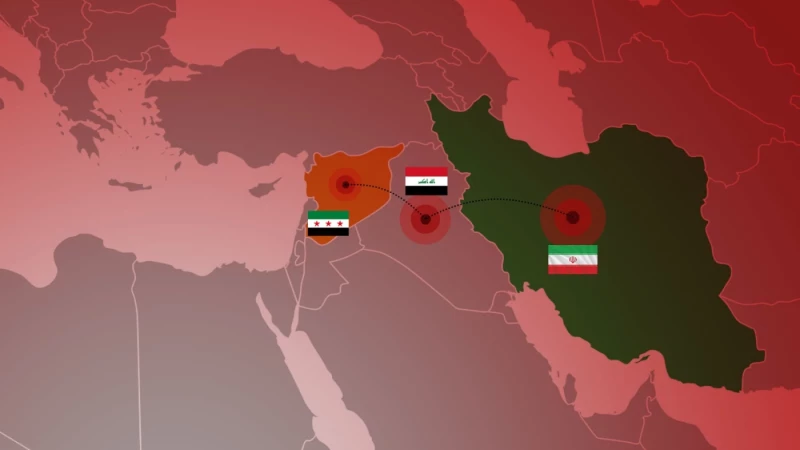
Iraq quietly mediates between Iran, Syria in effort to thaw relationship
Political sources told The New Region that Iraq is working behind the scenes to repair ties between Iran and Syria, whose once-strong alliance has cooled after Syria’s new government took power.thenewregion.com
This is a pan-kurd source, so I don't know how credible this article is.
But in general it is clear that secret talks are held. Sooner or later Iran always gets back what it "lost"....Iran lost Sudan and finally got it back.
And Syria knows that it is geo-politically a nobody without Iran.
I'd rather ask a prostitute if she s a Virgin.......This is interesting.....yes, I know the source sucks, but the there are some good nuggets of info in it
![]()
Former Iranian Security Chiefs Turn on Each Other
Read this article and more on NewsNow, the independent news discovery platform.c.newsnow.co.uk
This is clear narrative framing and pure sensationalism with lines like “the wall is crumbling…” It’s trying to build a dramatic story rather than question motives. The article jumps straight to “either Rouhani knew or the security council hid it from him” just because Shamkhani said so, as if no other possibilities exist.This is interesting.....yes, I know the source sucks, but the there are some good nuggets of info in it
![]()
Former Iranian Security Chiefs Turn on Each Other
Read this article and more on NewsNow, the independent news discovery platform.c.newsnow.co.uk
Iran has been weak in cultivating and sustaining strategic thinking. This weakness is rooted not only in the realm of politics and militarism, but also in the culture of decision-making and foresight.
In most periods, Iran's political structure has been based on personalities, not systems. Whenever a strong and thoughtful individual has emerged, the country has made a leap; but when he leaves, everything has collapsed. While in Western and East Asian civilizations, the idea of governance was transferred from the individual to the institution, in Iran, thought and power have always remained dependent on the presence of one person.
Another problem is the lack of educational and thought-provoking institutions for training politicians and strategic managers. While military schools and think tanks had been established in ancient Greece, China, and later Europe to teach the art of government and strategy planning, such a tradition was not institutionalized in Iran. Figures such as Nizam al-Molk and Amir Kabir were the result of individual genius, not the product of a purposeful educational system. Iran has produced strategists throughout its history, but it has never trained strategists.
Decisions have been made more in response to threats and crises than based on long-term, premeditated planning. From the invasions of Alexander and the Mongols to the colonial rivalries of the 19th century, Iranian politics has been shaped by defense and survival, not by plans for expansion and development. As a result, strategic thinking has given way to short-term expediency in the minds of Iranian politicians.
Every time a dynasty has fallen, its intellectual and administrative legacy has also disappeared. There has been no transfer of experiences or institutional continuity. Unlike Europe, where the idea of governance has continuously evolved from the Roman Empire to the modern era, in Iran each new government has started from scratch by destroying the previous structure. This historical rupture has resulted in no lasting accumulation of experience in decision-making and foresight.
In Iran, those in power have often feared strategists because independent and forward-looking thinking has been mistaken for a threat to power. As a result, power in Iran has come to trust reason less, and in the absence of a link between thought and politics, strategy has given way to short-term decisions.
Despite what people often claim here, Iran will never become a a prosperous, powerful, or influential nation, with or without IR. Iran will always be a victim of more advanced and civilized nations because it lacks basic institutions most civilized nations developed centuries if not millennia ago, and Iran's superstitious and individualistic/entitled people are not up to the task of developing these institutions or working for the common benefit.Iranian thought has long been rich in philosophy, mysticism, and ethics, but has remained weak in systematic and pragmatic design. Iranian thought has been more concerned with saving the individual and society than with structure and institutions.
Good post on why Iran has failed for hundreds of years and continues to fail at essentially everything. He brings many good points that users here frequently ignore or deny:
Despite what people often claim here, Iran will never become a a prosperous, powerful, or influential nation, with or without IR. Iran will always be a victim of more advanced and civilized nations because it lacks basic institutions most civilized nations developed centuries if not millennia ago, and Iran's superstitious and individualistic/entitled people are not up to the task of developing these institutions or working for the common benefit.
In summary:
Conditions will worsen
Like what?Iran will always be a victim of more advanced and civilized nations because it lacks basic institutions most civilized nations developed centuries if not millennia ago
We use essential cookies to make this site work, and optional cookies to enhance your experience.