Iranian Space program | News and Discussions

Anyone have list of Iranian satellites launched (successfully), acquired to date?
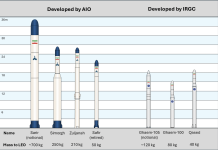
Soraya, Chamran-1 - launched by Qaem-100 SLV

Noor-1, Noor-2, Noor-3 - launched by Qased SLV

Sina-1, Khayyam-1, Nahid-2 - launched by Russia

Mahda, Keyhan-2, Hatef-1, Fakhr-1 - launched by Simorgh SLV

Omid, Rasad, Navid, Fajr - launched by Safir SLV (discontinued)

probably some older ones I forgot too
 
Soraya, Chamran-1 - launched by Qaem-100 SLV

Noor-1, Noor-2, Noor-3 - launched by Qased SLV

Sina-1, Khayyam-1, Nahid-2 - launched by Russia

Mahda, Keyhan-2, Hatef-1, Fakhr-1 - launched by Simorgh SLV

Omid, Rasad, Navid, Fajr - launched by Safir SLV (discontinued)

probably some older ones I forgot too
Thanks for the info.
 
Unless ISA or IRGCAF develops larger more powerful SLV buses that can deploy 100+ LEO sats atleast within one span of launches to build a constellation, the space program just cant do anything for Iranian defense. Current SLV fleet is more of a cover for disguised ICBMs if Khamenei ever allows them to be tested with RVs which wont ever happen.
 
To view this content we will need your consent to set third party cookies.
For more detailed information, see our cookies page.
 
To view this content we will need your consent to set third party cookies.
For more detailed information, see our cookies page.
 
first phase of Chabahar space centre reaching completion, first launch scheduled by end of Iranian year (by March 2026)

Phase 1 - equip Chabahar for launch of small, solid fuel SLVs (probably Zoljanah since IRGC uses Shahroud space centre to launch its SLVs) - ready by March 2026

Phase 2 - equip Chabahar for liquid-fuel SLVs (probably Simorgh/Sarir) - construction to start soon

Phase 3 - equip Chabahar for launch of super heavy liquid fuel SLVs (Soroush) - to start after Phase 2 is complete

it is due to be complete by March 2031

Chabahar will be Iran's third space port (and Iran's biggest once complete), after Imam Khomeini centre and Shahrud (used by IRGC). Chabahar is closer to the equator and has many benefits for space launches.
 
Dr. Hassan Salarieh, head of the Iranian Space Agency:
  • Iran is actively cooperating with China on its Chang'-8 lunar project (planned for 2029)
  • Pars-2 (4-8m resolution imaging satellite) is undergoing final tests before launch
  • Pars-3 is under development at the Iranian Space Research Institute since last year and will be the first Iranian satellite with imaging resolution better than 1m
  • Nahid-3 communication satellite is also under development since last year
  • Shahid Soleimani constellation project: will comprise 20 nano satellites in the first phase. First prototype satellites (3U and 6U types) have recently been produced.
  • Chabahar space port: first phase is nearing completion and preparing for first launch (likely Zoljanah). Phase 2 will soon begin construction - groundbreaking for phase 2 will take place this year.
  • Private sector companies (Omid Faza) have built Kowsar-2 satellite, after Kowsar-1 was put into orbit by Russia last year. Kowsar-2 combines the functions of Kowsar-1 and Hodhod (remote sensing and IoT) and should be placed into orbit by March 2026.
  • Zafar-2 and Paya earth observation satellites will be launched by Russia in the coming months.
  • Another Nahid-2 will be launched by Simorgh this year.
  • Several orbital and sub-orbital test launches are planned for the Shahid Soleimani constellation and other research payloads by March 2026.
 
Iran has officially lost contact to “Kosar” and “Hodhod” satellites which were launched last year, due to “technical failures”.

The Hodhod satellite however, according to Iran’s CEO of space industry, received an “unexpected external command,” not from their own control system, 2 weeks before the 12-day war, after which contact was completely lost.

--

luckily these were tiny private sector satellites but still concerning
 
Iran has officially lost contact to “Kosar” and “Hodhod” satellites which were launched last year, due to “technical failures”.

The Hodhod satellite however, according to Iran’s CEO of space industry, received an “unexpected external command,” not from their own control system, 2 weeks before the 12-day war, after which contact was completely lost.

--

luckily these were tiny private sector satellites but still concerning
Unexpected external commands! lol
It shows you how easily they can break into our encryption protocols.
 
Unexpected external commands! lol
It shows you how easily they can break into our encryption protocols.
these are private sector IoT satellites, imagine their encryption levels are much lower than other satellites
 
To view this content we will need your consent to set third party cookies.
For more detailed information, see our cookies page.


Iran officially announced that it is participating in the program to build a base on the moon along with China and Russia. I hope that Iran will also participate in other areas such as the BRICS (Russia) and China space base, and that the Shahid Raisi (RA) space base in Chabahar will also enter the space industry cycle.

If IR was smart it would be marketing and developing Chahbahar as a replacement for Baikonur given its better location.
 
Last edited:
Hossein Shahrabi, head of the Tehran-based knowledge-based company Omid Faza, told Tasnim news agency that preparations for the satellite were complete and that it would be launched aboard the same rocket that carried Iran’s Kosar and Hodhod satellites last year.

He said the new spacecraft combines Earth observation and telecommunications functions, integrating improved solar arrays and communication links to address problems that limited image transmission in earlier models.

“The issue linking attitude control to solar energy absorption has been resolved,” Shahrabi said. The satellite adds an S-band link, enabling full attitude control from the ground, he added.

The Do-Namay 1 is a modified version of the Kosar platform and marks Iran’s growing use of private-sector firms in its space program.

According to Shahrabi, image resolution has improved to about 3.5 meters, and its optical payloads now achieve near-ground-test performance levels.

The official said the satellite would be delivered to the launch operator within a month, with a target launch date in Azar, the ninth month of the Iranian calendar (November–December).

Iran loses two satellites

Shahrabi, referring to technical issues with the Kosarsatellite, said its attitude control and power absorption systems had become unintentionally interdependent.

“This prevented us from first stabilizing the satellite’s orientation and then delivering the necessary power according to the original design,” he explained.

“Although the satellite remains in orbit and we receive signals in some areas with sufficient sunlight, we ultimately failed to obtain any imagery from it.”

He added that communication with the Hodhod satellite was lost about two weeks before the 12-day war.

“I don’t want to directly link the satellite’s condition to that event,” he said, “but a series of incidents occurred, and unfortunately the satellite received an unauthorized command from outside the control system. After that, we completely lost contact with Hodhod.”
 

Users who are viewing this thread

Pakistan Defence Latest

Back
Top