Immortals
Elite Member


1. This is the WZ-8 reconnaissance drone. It does not possess strike capabilities.
That is a mere small redesign change
2. This drone has been in the public eye for many years; it is not a recent development.
Such drones have existed for decades, see below.
Its endurance is limited; it is a strategic-level, short-duration emergency reconnaissance system. The support systems required for such drones are extremely complex to develop. Iran currently faces significant gaps in this area.
They are not “extremely complex” to develop if the U.S. developed them in the 1960’s predating the age of computers. China is merely developing its own updated take on a similar purpose.
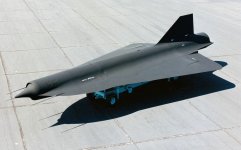
The U.S. Cold War version (D-21) had 90,000 altitude and Mach 3.3 speed with a 5600 km range.
Even if Iran could replicate even half that range with a small payload it could be used to strike enemy bombers, tankers, fighter jets at distant airbases as well as HVT like THAAD radars and valuable air defense nodes all across the Middle East. They could be stored at mountain airbases and take off with an assisted boosters until reaching proper altitude for main engine ignition.
For Iran, investing funds and effort in its development is indeed impractical.
Not impractical if it can do the cost of what 200-500 missiles or 1000 shaheed drones takes to do which is strike high value enemy assets at distant bases with quick to strike assets and hard to counter assets.
Right now Iran is a one trick pony of BMs that can be detected due to their exhaust plums during ascent and Shahed drones that are slow to arrive to target and have a lot of noise pollution.
Iran’s strategy is entirely reliant on swarm and saturation until enemy defenses are depleted or statistical probability says that a few get thru while many get intercepted. Such a quantity centric approach can be used across a battlefield, but will be difficult to sustain in future wars as radars and air defenses get even more advanced and laser based air defense becomes more deployable against cheap drone swarms.
The enemy is also developing hypersonic air launched missiles that are economically costing to be able to launch at far stand off distances without having to penatrate enemy airspace.
Thus Iran will need a strike platform that while more expensive on a per unit basis, will be focused on attacking high value enemy assets while they are operating at airbases. It needs to be able to reliably strike these critical radars and aircraft in the early days of conflict. During the 12 day and 40 day war, Iran was not able to reliably penetrate air bases or slow the nonstop sorties of tankers and transport aircraft that allow the USAF/IAF to fly all the way to Iran everyday.


