Navigation
Install the app
How to install the app on iOS
Follow along with the video below to see how to install our site as a web app on your home screen.
Note: This feature may not be available in some browsers.
More options
Style variation
You are using an out of date browser. It may not display this or other websites correctly.
You should upgrade or use an alternative browser.
You should upgrade or use an alternative browser.
Israel’s Genocide in Gaza | 2023- till present
- Thread starter Ali_Baba
- Start date
- Status
- Not open for further replies.
More options
Who Replied?


Khansaheeb
Elite Member


Meanwhile the genocide continues by the US supported evil Israeli Nazi state:-

By Yolande Knell,BBC News, Jerusalem
Share
 BBC
BBC
While the media's glare in the Middle East this past week was diverted to Iran's dramatic missile and drone attack on Israel, there has been no let-up in fighting in Gaza.
Dozens of Palestinians were killed daily - including many children, according to figures from the Hamas-run health ministry. It now says Israel has killed more than 34,000 people in Gaza since the start of the war.
As Israel's forces continue with their efforts to destroy Hamas, they have conducted small-scale, often deadly operations, from the top to the bottom of the territory over the past week.
On Tuesday, in the middle of Gaza, relatives clutching limp and bloodstained bodies of small boys and girls rushed from al-Maghazi refugee camp to al-Aqsa Martyrs' hospital in nearby Deir al-Balah.
Medics at the hospital said that at least 12 people were killed and some 30 injured by shelling in al-Maghazi.
"They were playing in the street. Why were they struck? They weren't in any position close to Israeli forces," one man told the BBC. Another added: "They were just playing. They were in the market with people coming and going normally."
Israel's military has not commented on what happened there, but this week in Gaza the central refugee camps have been its main focus. It said it was "eliminating terrorists and destroying terrorist infrastructure" such as attack tunnels and military compounds used by armed Hamas fighters in "precise" action.
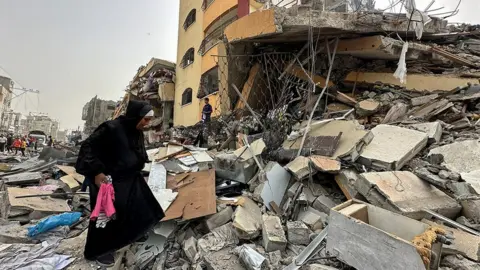
After Israeli forces were reported to have left another camp, Nuseirat, late on Wednesday, residents began trickling back to inspect the damage to their homes.
 Reuters
Much of the Nuseirat camp has been reduced to rubble
"We have no place to stay, 90% of the houses are destroyed," one father told us despairingly as he picked his way through the new piles of rubble.
In the very north of Gaza, Israel's tanks rolled back into Beit Hanoun, which troops had left weeks earlier. Israel said it was targeting Hamas and Islamic Jihad operatives based at schools where displaced families were living. Locals talked of men being stripped and detained.
Footage has also emerged of Israeli strikes in parts of Gaza City, in the north, and Rafah, on the border with Egypt, where hundreds of thousands of Palestinians live in tents after fleeing the fighting elsewhere.
Israeli defence analysts say that the military is carrying out targeted operations against Hamas, in line with a switch to lower-intensity fighting that was agreed with the US.
Earlier this month, Israel withdrew most ground forces from Gaza, leaving just one brigade to secure a line that splits the enclave into two parts - north and south.
While it has since been announced that two reservist brigades are being called up, and some soldiers have been deployed across the border, the prevailing opinion is that a planned ground offensive in Rafah is still some way off.
"I don't think anything is imminent," says Prof Chuck Freilich, a former Israeli deputy national security adviser, now based at the Institute for National Security Studies in Tel Aviv. "I don't think there's the force there for conducting a major operation in Rafah."

Israel has promised to root out remaining Hamas battalions in Rafah - the one Gazan city where it has not yet launched a ground offensive. It believes that some of the remaining 130-plus hostages snatched from southern Israel during the deadly Hamas attacks on 7 October, which also killed more than 1,200 people, are held there.
But Prof Freilich says for "the full-on attack that people were talking about you'd need two things: to move out all the refugees and then to call up some of those reserves".
"Between those, it's at least a couple of weeks. And now there's the [week-long Jewish] Passover holiday."
The US and other allies point out that a large-scale invasion could deepen an already dire humanitarian crisis.
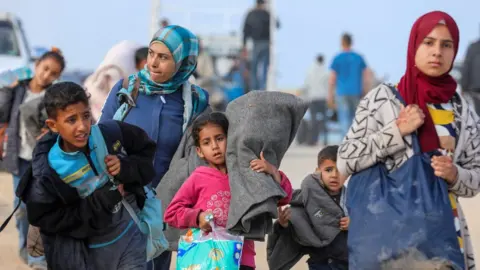
Amid miserable living conditions and the continuous threat to Rafah, many Gazans stuck there long to return home to the north of the territory.
 Reuters
Israeli military warned Palestinians not to return to their homes in north Gaza
But on Monday, Israel's military renewed warnings for them not to make the journey, a day after witnesses said its forces had opened fire on crowds heading along a main coastal road. killing five people.
The IDF did not comment directly on that incident, but an Israeli military spokesman said afterwards that Palestinians should stay in southern Gaza because the north is a "dangerous combat zone".
"We have dreamt of returning home since we left in the early months of the war," Amr Daoudi told us back in Rafah. "But for now we have put it out of our thoughts."
More than six months of fighting have flattened vast tracts of the north. Israel's restrictions on aid have also left some 300,000 who remained there through the war on the brink of famine, according to the United Nations.
International pressure on Israel in the wake of the killing of seven aid workers from US charity World Central Kitchen on 1 April led to a string of announcements on increasing relief to Gaza, notably opening up the Ashdod commercial port and a new northern crossing.
While aid concerns have been overshadowed, in the past week, by fears of a wider regional war, there have been constant updates on developments - Israeli defence officials declaring the arrival of shipments of flour destined for newly reopening bakeries, for example.
Anecdotal evidence, including social media footage of grilled meat being sold in Jabalia camp for the first time in months, has also circulated, suggesting food is becoming more easily available.
 Getty Images
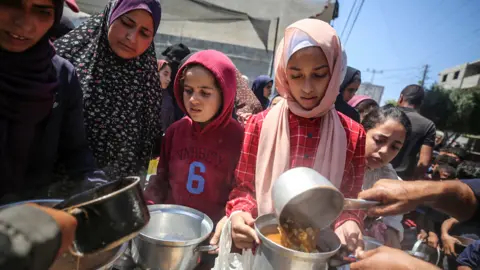
Palestinians at a food distribution point in Deir al-Balah in central Gaza
However, aid agencies say that far more needs to be done to reverse critical shortages.
As the UN launched a flash appeal to raise $2.8bn (£2.3bn) in funding, mainly for Gaza, a senior official from its humanitarian office complained of lingering access problems, particularly to reach the north.
"We are dealing with this dance where we do one step forward, two steps backwards; or two steps forward and one step backward," says Andrea de Domenico, who heads the UN humanitarian office for Palestinian territories.
If Israel's response to Iran's recent strikes is now over, drawing a line under the latest round of violence between these two old enemies, the media and foreign players are likely to increase their scrutiny of goings-on in Gaza once again.
Already, we got a hint of this when the UK Foreign Secretary David Cameron came to express solidarity with Israel and try to reduce tensions after the Iranian attacks of 13-14 April.
"The real need is to refocus back on Hamas, back on the hostages, back on getting the aid back in, back on getting a pause in the conflict in Gaza," he said, ahead of meetings with Israeli and Palestinian leaders.
For now, international mediation efforts to secure a new truce have largely stalled.
The main obstacle remains that Israel will discuss a temporary halt to bring home hostages but will not stop fighting until Hamas is eliminated. Hamas says it will not release the hostages without a path to end the war.
For ordinary Gazans struggling just to survive and Israelis desperate to bring home loved ones trapped in captivity, the best hope now could come from a new diplomatic thrust.
Without it there is the threat of a lingering war which carries a huge cost to humanity and constantly risks sparking further destabilising conflict in an already volatile part of the world.
Israel-Gaza briefings: No let-up for Gazans while world focused on Iran attack
Fighting continues in Gaza, where a humanitarian crisis is overshadowed by the wider regional conflict.
www.bbc.com
Israel-Gaza briefings: No let-up for Gazans while world focused on Iran attack
16 hours agoBy Yolande Knell,BBC News, Jerusalem
Share
While the media's glare in the Middle East this past week was diverted to Iran's dramatic missile and drone attack on Israel, there has been no let-up in fighting in Gaza.
Dozens of Palestinians were killed daily - including many children, according to figures from the Hamas-run health ministry. It now says Israel has killed more than 34,000 people in Gaza since the start of the war.
As Israel's forces continue with their efforts to destroy Hamas, they have conducted small-scale, often deadly operations, from the top to the bottom of the territory over the past week.
On Tuesday, in the middle of Gaza, relatives clutching limp and bloodstained bodies of small boys and girls rushed from al-Maghazi refugee camp to al-Aqsa Martyrs' hospital in nearby Deir al-Balah.
Medics at the hospital said that at least 12 people were killed and some 30 injured by shelling in al-Maghazi.
"They were playing in the street. Why were they struck? They weren't in any position close to Israeli forces," one man told the BBC. Another added: "They were just playing. They were in the market with people coming and going normally."
Israel's military has not commented on what happened there, but this week in Gaza the central refugee camps have been its main focus. It said it was "eliminating terrorists and destroying terrorist infrastructure" such as attack tunnels and military compounds used by armed Hamas fighters in "precise" action.
After Israeli forces were reported to have left another camp, Nuseirat, late on Wednesday, residents began trickling back to inspect the damage to their homes.
Much of the Nuseirat camp has been reduced to rubble
"We have no place to stay, 90% of the houses are destroyed," one father told us despairingly as he picked his way through the new piles of rubble.
In the very north of Gaza, Israel's tanks rolled back into Beit Hanoun, which troops had left weeks earlier. Israel said it was targeting Hamas and Islamic Jihad operatives based at schools where displaced families were living. Locals talked of men being stripped and detained.
Footage has also emerged of Israeli strikes in parts of Gaza City, in the north, and Rafah, on the border with Egypt, where hundreds of thousands of Palestinians live in tents after fleeing the fighting elsewhere.
Israeli defence analysts say that the military is carrying out targeted operations against Hamas, in line with a switch to lower-intensity fighting that was agreed with the US.
Earlier this month, Israel withdrew most ground forces from Gaza, leaving just one brigade to secure a line that splits the enclave into two parts - north and south.
While it has since been announced that two reservist brigades are being called up, and some soldiers have been deployed across the border, the prevailing opinion is that a planned ground offensive in Rafah is still some way off.
"I don't think anything is imminent," says Prof Chuck Freilich, a former Israeli deputy national security adviser, now based at the Institute for National Security Studies in Tel Aviv. "I don't think there's the force there for conducting a major operation in Rafah."
- EXPLAINED: What we know about Israel's attack on Iran
- BACKGROUND: Why have Israel and Iran attacked each other?
- ANALYSIS: An audible sigh of relief in the Middle East
Israel has promised to root out remaining Hamas battalions in Rafah - the one Gazan city where it has not yet launched a ground offensive. It believes that some of the remaining 130-plus hostages snatched from southern Israel during the deadly Hamas attacks on 7 October, which also killed more than 1,200 people, are held there.
But Prof Freilich says for "the full-on attack that people were talking about you'd need two things: to move out all the refugees and then to call up some of those reserves".
"Between those, it's at least a couple of weeks. And now there's the [week-long Jewish] Passover holiday."
The US and other allies point out that a large-scale invasion could deepen an already dire humanitarian crisis.
Amid miserable living conditions and the continuous threat to Rafah, many Gazans stuck there long to return home to the north of the territory.
Israeli military warned Palestinians not to return to their homes in north Gaza
But on Monday, Israel's military renewed warnings for them not to make the journey, a day after witnesses said its forces had opened fire on crowds heading along a main coastal road. killing five people.
The IDF did not comment directly on that incident, but an Israeli military spokesman said afterwards that Palestinians should stay in southern Gaza because the north is a "dangerous combat zone".
"We have dreamt of returning home since we left in the early months of the war," Amr Daoudi told us back in Rafah. "But for now we have put it out of our thoughts."
More than six months of fighting have flattened vast tracts of the north. Israel's restrictions on aid have also left some 300,000 who remained there through the war on the brink of famine, according to the United Nations.
International pressure on Israel in the wake of the killing of seven aid workers from US charity World Central Kitchen on 1 April led to a string of announcements on increasing relief to Gaza, notably opening up the Ashdod commercial port and a new northern crossing.
While aid concerns have been overshadowed, in the past week, by fears of a wider regional war, there have been constant updates on developments - Israeli defence officials declaring the arrival of shipments of flour destined for newly reopening bakeries, for example.
Anecdotal evidence, including social media footage of grilled meat being sold in Jabalia camp for the first time in months, has also circulated, suggesting food is becoming more easily available.
Palestinians at a food distribution point in Deir al-Balah in central Gaza
However, aid agencies say that far more needs to be done to reverse critical shortages.
As the UN launched a flash appeal to raise $2.8bn (£2.3bn) in funding, mainly for Gaza, a senior official from its humanitarian office complained of lingering access problems, particularly to reach the north.
"We are dealing with this dance where we do one step forward, two steps backwards; or two steps forward and one step backward," says Andrea de Domenico, who heads the UN humanitarian office for Palestinian territories.
If Israel's response to Iran's recent strikes is now over, drawing a line under the latest round of violence between these two old enemies, the media and foreign players are likely to increase their scrutiny of goings-on in Gaza once again.
Already, we got a hint of this when the UK Foreign Secretary David Cameron came to express solidarity with Israel and try to reduce tensions after the Iranian attacks of 13-14 April.
"The real need is to refocus back on Hamas, back on the hostages, back on getting the aid back in, back on getting a pause in the conflict in Gaza," he said, ahead of meetings with Israeli and Palestinian leaders.
For now, international mediation efforts to secure a new truce have largely stalled.
The main obstacle remains that Israel will discuss a temporary halt to bring home hostages but will not stop fighting until Hamas is eliminated. Hamas says it will not release the hostages without a path to end the war.
For ordinary Gazans struggling just to survive and Israelis desperate to bring home loved ones trapped in captivity, the best hope now could come from a new diplomatic thrust.
Without it there is the threat of a lingering war which carries a huge cost to humanity and constantly risks sparking further destabilising conflict in an already volatile part of the world.
Khansaheeb
Elite Member
Similarity how German Nazis dehumanised the Jews and how the Jews are dehumanising the Muslims:-
/cloudfront-eu-central-1.images.arcpublishing.com/prisa/EGLLTOIJH5HBVOZV7O4SUY4PQU.jpg)
 english.elpais.com
How Nazi propaganda dehumanized Jews to facilitate the Holocaust
A new study of speeches, pamphlets and articles from the period shows how German fascism denied Jewish people humanity to fuel hate and justify genocide.
english.elpais.com
Khansaheeb
Elite Member
Cruel, evil and sadistic murder of Palestinian women and children continues by the Israeli Nazi forces:-
Khansaheeb
Elite Member

Khansaheeb
Elite Member
Google is a Hindjew proxy company staunchly in the Israeli camp.Google fires 28 workers in aftermath of protests over big tech deal with Israeli government
Google has fired 28 employees in the aftermath of protests over technology that the internet company is supplying the Israeli government amid the Gaza war, further escalating tensions surrounding a hot-button deal.
The firings confirmed by Google late Wednesday came a day after nine employees were arrested during sit-in protests at offices in New York and Sunnyvale, California, after the company called police.
The dissent roiling Google centers on “Project Nimbus,” a $1.2 billion contract signed in 2021 that calls upon Google and Amazon to provide the Israeli government with cloud computing and artificial intelligence services.
The protests are being organized primarily by a group called No Tech For Apartheid. Google says Nimbus isn’t being deployed in weaponry or intelligence gathering.
In a statement, Google attributed the firing of the 28 employees to “completely unacceptable behavior” that prevented some workers from doing their jobs and created a threatening atmosphere. The Mountain View, California, company added it is still investigating what happened during the protests, implying more workers could still be fired.
In a blog post, No Tech For Apartheid accused Google of lying about what happened inside its offices during what it described as “peaceful sit-in” that received overwhelming support from other workers who weren’t participating in the protest.
“This flagrant act of retaliation is a clear indication that Google values its $1.2 billion contract with the genocidal Israeli government and military more than its own workers,” No Tech For Apartheid asserted.
Without calling out a specific incident, Google CEO Sundar Pichai indicated in a Thursday blog post that employees will be on a short leash as the company intensifies its efforts to improve its AI technology at a pivotal moment in the industry and, potentially, humanity.
“This is a business, and not a place to act in a way that disrupts coworkers or makes them feel unsafe, to attempt to use the company as a personal platform, or to fight over disruptive issues or debate politics,” Pichai wrote. “This is too important a moment as a company for us to be distracted.”
The contract raising the ire of some Google workers runs within the company’s cloud computing division that is overseen by a former Oracle executive, Thomas Kurian.
Under Kurian’s leadership, cloud computing has emerged as one of Google’s fastest-growing divisions, with revenue of $33 billion last year, a 26% increase from 2022. A wide range of private-sector companies also buy Google’s cloud computing services, in addition to governments around the world.
Google workers have periodically staged angry protests over other deals the company has been working on and have also raised ethical concerns about the way it is developing artificial intelligence.
One of the previous employee uprisings resulted in Google deciding in 2018 to end a contract with the U.S. defense department called “Project Maven” that involved helping the armed forces analyze military videos.
But Google has continued to thrive, despite the internal misgivings about the way it is making some of its money. Its revenue mostly comes through digital advertising sold through an internet empire that depends on its dominant search engine as its main pillar.
Google’s parent company, Alphabet Inc., posted a $74 billion profit last year and now employs about 182,000 workers worldwide — about 83,000 more people than in 2018 when it abandoned Project Maven.

Google fires 28 workers in aftermath of protests over big tech deal with Israeli government
Google's firings follow protests over technology that the internet company is supplying the Israeli government amid the Gaza war, further escalating tensions surrounding a hot-button deal.apnews.com
UKBengali
Elite Member

Pierce looks like if he is going to cry.
That Iranian Professor destroyed the lying Zionist toad Morgan.
Unknowntruth
Trusted Member


Persian Gulf
INT'L MOD

this guy is hilarious
rabid settler in the West Bank tried to take down a Palestinian flag but a bomb was planted there which exploded once he kicked the flag out of Zionist anger
Shags202
Trusted Member
Not going to lie I was laughing my butt off

PAKISTANFOREVER
Trusted Member
Not going to lie I was laughing my butt off
Is this real? Did the guy die? The woman who was filming this, who was she? If it is real why did she not get emotional or go out and try to help him? What is wrong with these people? Are they born psychopaths?
Last edited:
Persian Gulf
INT'L MOD
average day on Israel's biggest TV channel, pseudo-journalist publicly and openly calling for "more rivers of Gazans' blood"
more evidence for the ICJ and ICC.
Persian Gulf
INT'L MOD
Lebanese people are amazing


K2RULEZ
Elite Member

Is this real? Did the guy die? The woman who was filming this, who was she? If it is real why did she not get emotional or go out and try to help him? What is wrong with these people? Are they born psychopaths?
She was obviouly shocked. Well, the Zionist died like a pig. That is for sure.
UKBengali
Elite Member
She was obviouly shocked. Well, the Zionist died like a pig. That is for sure.
From the explosion it looks like serious injury at the very least.
Probably a recent arrival from USA to claim “his” land as he sees it and to kick out the Palestinian “squatters”.
- Status
- Not open for further replies.
Users who are viewing this thread
Total: 69 (members: 0, guests: 69)
Pakistan Defence Latest
-
-

-
 Bangladesh - China keen to build 100MW nuclear power plant in Mongla (3 Viewers)
- Latest: AbuShalehRumi
-
-
Country Watch Latest


Latest Posts
-
-
-

-
-
Hyundai Motor Group to plug $15.5 billion in India's automotive sector (11 Viewers)
- Latest: Lionheart