Japan Defence and General News Discussions

Japan is just an US vassal, it can't buy cheap and available oil and other cheap resources from nearby Russia to fuel its fast declining industries and its economy as a whole, it can't sell to neighoring huge market Russia and China, at least many of its key products in China's case. Being a vassal state of US is strangling Japan on all fronts.

Japan has many issues including an ageing population.
 

Japan Approves Record Defense Budget for Fiscal Year 2026​

  • Published on 30/12/2025
  • By Kosuke Takahashi
  • In News
Japan ASEVScale model of ASEV at DSEI 2025 exhibition in Tokyo (Credit: Author)

The cabinet of Japanese Prime Minister Sanae Takaichi on December 26 approved $58 billion (9.04 trillion yen) defense spending for fiscal year 2026, as Tokyo faces growing military pressure from three nuclear-armed neighbors—China, North Korea, and Russia—and U.S. calls for higher defense outlays.


The draft budget represents a 3.8 percent increase from the current fiscal year, marking a record high for the 12th consecutive year.


The defense budget, expected to pass Japan’s bicameral legislature in coming months, aims to bolster unmanned defense systems and standoff missile capabilities to address the country’s deteriorating security environment.


In its defense budget, the Japan Maritime Self-Defense Force (JMSDF) secured funding for the construction of four types of JMSDF vessels, as well as the procurement of various aircraft. Key maritime-related items in the budget are as follows:


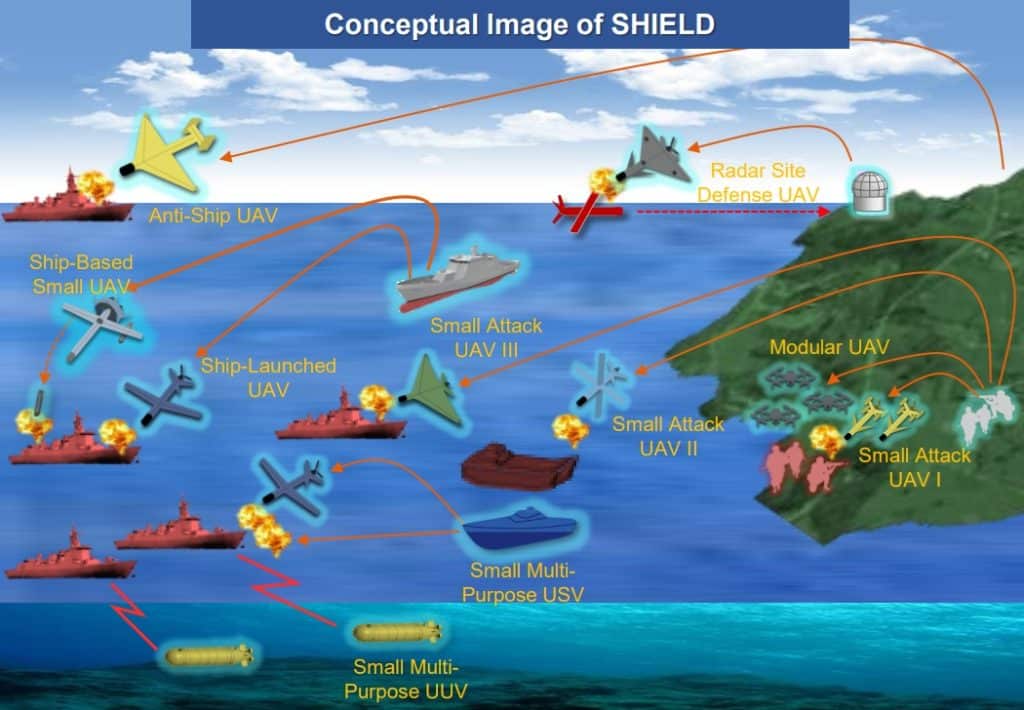
The establishment of the national multi-layered coastal defense system called “SHIELD” ($640.6 million)


Conceptual-Image-of-SHIELD-1024x710.jpg


Credit: Japanese MoD

The defense ministry plans to acquire an unspecified number of surface ship-launched UAVs, small ship-based UAVs, and small multi-role USVs for the JMSDF to build SHEILD. The name stands for “Synchronized, Hybrid, Integrated and Enhanced Littoral Defense.”


The ministry said the plan would involve purchasing existing UAVs and USVs, primarily from foreign manufacturers. It also said that surface-launched UAVs will attack enemy ships from JMSDF ships. Meanwhile, small ship-based UAVs will improve the intelligence gathering and surveillance capabilities of surface vessels, and will also be able to attack enemy vessels.


In July, JMSDF officials told Naval News that the U.S. aerospace and defense technology company Shield AI’s V-BAT is being considered as an UAV to be installed on the upgraded Mogami-class frigate—known in Tokyo as the “New FFM” and also called as the 06FFM.


The JMSDF has already decided to equip its new Sakura-class offshore patrol vessels (OPVs), with a standard displacement of 1,900 tons, with the V-BAT. Under the Defense Buildup Program adopted in December 2022, the MoD plans to acquire 12 OPVs over the next decade. The fiscal 2025 defense budget earmarks 4 billion yen for the procurement of six V-BAT systems for new patrol vessels.


In addition, the Defense Ministry was allocated $14.1 million to conduct demonstration tests for simultaneous control of a large number of various unmanned assets.


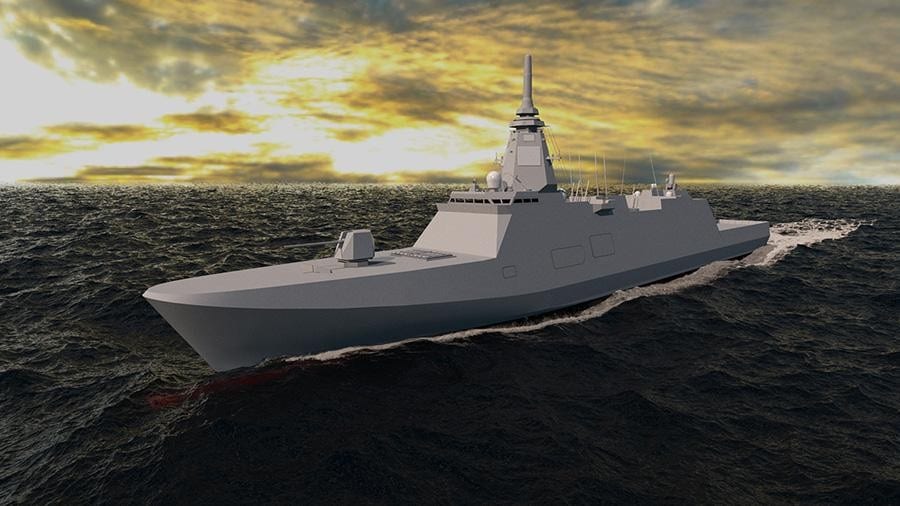
Construction of one New FFM ($667 million)


MHI-New-FFM.jpg


A computer generated image depicting the future upgraded Mogami-class frigate.(Credit: Mitsubishi Heavy Industries)

The ministry earmarked $667 million to build the sixth ship of the upgraded Mogami-class, which has a full-load displacement of about 6,200 tons. The lead ship of the New FFM class is scheduled to be laid down in fiscal year 2025 and commissioned in fiscal year 2028. According to Mitsubishi Heavy Industries, if construction proceeds smoothly, all 12 vessels are expected to be in service by fiscal year 2032.


Securing construction costs for one New FFM in one year is very unusual because the MoD in Tokyo has so far earmarked the construction costs for two ships in the 2024 budget and three ships in the 2025 budget.


The move came as the Australian government selected the upgraded Mogami-class as the Royal Australian Navy’s future fleet of general-purpose frigates in August. The Japanese defense ministry is believed to have prioritized near-term shipyard slots and supply-chain resources at MHI’s Nagasaki shipyard for Australia, taking into account Canberra’s urgent push to strengthen its naval capabilities.


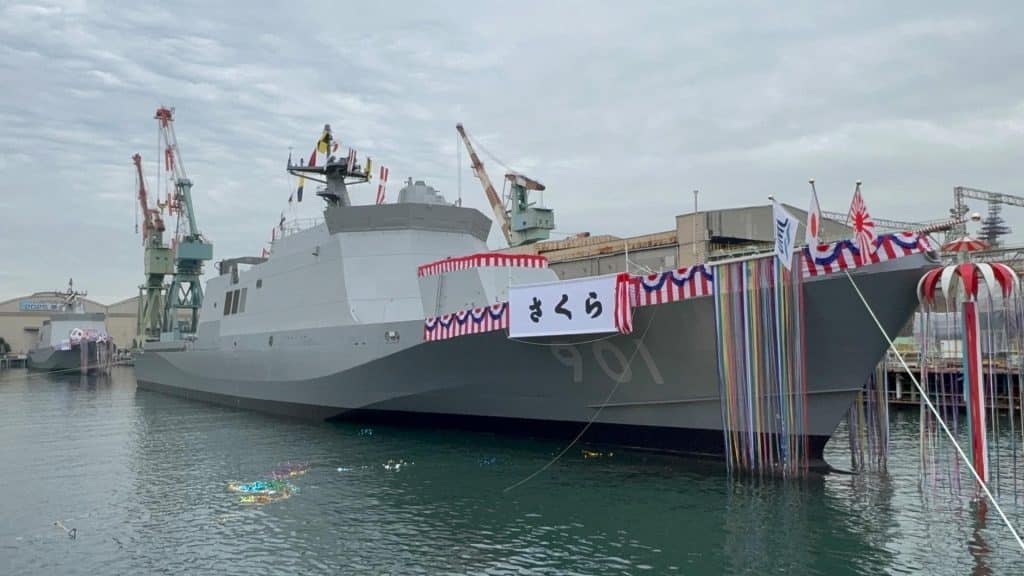
Construction of two Sakura-class OPVs ($182.3 million)


Sakura-class-OPV-1024x576.jpeg


The first and second ships of the Japan Maritime Self-Defense Force’s new patrol vessel class, Sakura and Tachibana, were launched by Japan Marine United (JMU) on November 13, 2025 (Credit: Author)

The defense ministry was allocated $182.3 million to build the fifth and sixth ships of the new Sakura-class OPVs. The JMSDF plans to acquire a total of 12 patrol vessels over roughly 10 years.


Construction of one Taigei-class submarine($773 million)

The MoD earmarked $773 million to build the 10th Taigei-class submarine, Japan’s latest diesel-electric submarine with a displacement tonnage of 3,000 tons.


Construction of one Awaji-class minesweeper ($217.5 million)

The defense ministry was allocated $217.5 million to build the 690-tonne seventh Awaji-class minesweeper, which has improved capabilities to deal with various types of mines, including deepwater mines. The planned number of Awaji-class vessels is nine.


Preparation for various tests of two Aegis system equipped vessels – ASEVs ($510 million)

The MoD secured $510 million as expenses related to the acquisition of two Aegis system equipped vessels. Specifically, it made mention of costs associated with preparation for various tests.

The ASEVs are an alternative to the two land-based Aegis Ashore ballistic missile defense (BMD) system, which was cancelled in June 2020 over concerns that falling components from missile interceptors might hit heavily populated areas over Japan.

The defense ministry explained that the new ships will be 190 meters long, 25 meters wide, and have a standard displacement of 12,000 tons.

The JMSDF is expected to take delivery of the first ASEV during fiscal year 2027, with the second one in the following fiscal year.


Modifications of Izumo-class helicopter carriers($182.3 million)

The JMSDF earmarked $182.4 million to continue modifying its two Izumo-class helicopter carriers – JS Izumo and JS Kaga – into aircraft carriers capable of enabling Lockheed Martin F-35B fighter aircraft operations.

As for the Izumo, the defense official said $5.8 million was allocated to install deck status lights on the ship, which allow deck workers to share the status of the deck, and to cover the test cost of the landing guidance system on the Izumo.

As for the Kaga, $176.6 million was allocated for hull modifications, including upgrades to hangar facilities.

The Ministry of Defense said JS Izumo‘s modification is scheduled to be completed in fiscal 2027, and JS Kaga‘s in fiscal 2028.

According to the ministry, the cost of modifying the Izumo-class helicopter carriers, including funding in next year’s budget, will total $687.2 million.


Acquisition of the ship-launched, improved version of the Type 12 SSM ($228.4 million)

The MoD began mass production of the long-range, ship-launched, improved version of the Type 12 SSM in the current fiscal 2025. The JMSDF will begin operating this new missile on the refurbished JS Teruzuki (DD-116) in fiscal 2027.


Acquisition of submarine-launched missiles ($102.4 million)

The MoD also began mass production of the new submarine-launched missile in the current fiscal year. It is a long-range cruise missile that can be launched from a submarine’s torpedo tubes.

The MoD explained that the missile will be installed on the JMSDF’s Taigei-class submarines.


Adding Tomahawk launch function to two Aegis destroyers ($7.7 million)

The MoD plans to equip the JMSDF’s two Aegis destroyers Myoko (DDG-175) and Atago (DDG-177) with a function to launch U.S.-made Tomahawk cruise missiles during fiscal 2026.

Defense officials said three Aegis destroyers, namely Chokai (DDG-176), Haguro (DDG-180), Kirishima (DDG-174) have already undergone for the addition of a Tomahawk launch function during this current fiscal 2025.

The JMSDF currently possesses a total of eight Aegis destroyers: four Kongo-class, two Atago-class, and two Maya-class. This means the remaining three JS Kongo (DDG-173), JS Ashigara (DDG-178) and JS Maya (DDG-179) will also be given Tomahawk capabilities in the near future.


Acquisition of four MQ-9B SkyGuardian UAVs ($489.4 million)

The defense ministry secured $489.4 million to acquire four more MQ-9B SkyGuardian UAVs for the JMSDF.

The JMSDF plans to use the SeaGuardian for persistent surveillance of surface vessels and submarines, with crewed P-1 and P-3C maritime patrol aircraft conducting anti-submarine warfare once any submarine is detected. The JMSDF ultimately aims to acquire a total of 23 aircraft by around fiscal 2032, with roughly half to be deployed at the service’s Kanoya Air Base in Kagoshima Prefecture and the remainder at Hachinohe Air Base in Aomori Prefecture.
 

Japan Approves Record Defense Budget for Fiscal Year 2026​

  • Published on 30/12/2025
  • By Kosuke Takahashi
  • In News
Japan ASEVScale model of ASEV at DSEI 2025 exhibition in Tokyo (Credit: Author)

The cabinet of Japanese Prime Minister Sanae Takaichi on December 26 approved $58 billion (9.04 trillion yen) defense spending for fiscal year 2026, as Tokyo faces growing military pressure from three nuclear-armed neighbors—China, North Korea, and Russia—and U.S. calls for higher defense outlays.


The draft budget represents a 3.8 percent increase from the current fiscal year, marking a record high for the 12th consecutive year.


The defense budget, expected to pass Japan’s bicameral legislature in coming months, aims to bolster unmanned defense systems and standoff missile capabilities to address the country’s deteriorating security environment.


In its defense budget, the Japan Maritime Self-Defense Force (JMSDF) secured funding for the construction of four types of JMSDF vessels, as well as the procurement of various aircraft. Key maritime-related items in the budget are as follows:


The establishment of the national multi-layered coastal defense system called “SHIELD” ($640.6 million)


Conceptual-Image-of-SHIELD-1024x710.jpg


Credit: Japanese MoD

The defense ministry plans to acquire an unspecified number of surface ship-launched UAVs, small ship-based UAVs, and small multi-role USVs for the JMSDF to build SHEILD. The name stands for “Synchronized, Hybrid, Integrated and Enhanced Littoral Defense.”


The ministry said the plan would involve purchasing existing UAVs and USVs, primarily from foreign manufacturers. It also said that surface-launched UAVs will attack enemy ships from JMSDF ships. Meanwhile, small ship-based UAVs will improve the intelligence gathering and surveillance capabilities of surface vessels, and will also be able to attack enemy vessels.


In July, JMSDF officials told Naval News that the U.S. aerospace and defense technology company Shield AI’s V-BAT is being considered as an UAV to be installed on the upgraded Mogami-class frigate—known in Tokyo as the “New FFM” and also called as the 06FFM.


The JMSDF has already decided to equip its new Sakura-class offshore patrol vessels (OPVs), with a standard displacement of 1,900 tons, with the V-BAT. Under the Defense Buildup Program adopted in December 2022, the MoD plans to acquire 12 OPVs over the next decade. The fiscal 2025 defense budget earmarks 4 billion yen for the procurement of six V-BAT systems for new patrol vessels.


In addition, the Defense Ministry was allocated $14.1 million to conduct demonstration tests for simultaneous control of a large number of various unmanned assets.


Construction of one New FFM ($667 million)


MHI-New-FFM.jpg


A computer generated image depicting the future upgraded Mogami-class frigate.(Credit: Mitsubishi Heavy Industries)

The ministry earmarked $667 million to build the sixth ship of the upgraded Mogami-class, which has a full-load displacement of about 6,200 tons. The lead ship of the New FFM class is scheduled to be laid down in fiscal year 2025 and commissioned in fiscal year 2028. According to Mitsubishi Heavy Industries, if construction proceeds smoothly, all 12 vessels are expected to be in service by fiscal year 2032.


Securing construction costs for one New FFM in one year is very unusual because the MoD in Tokyo has so far earmarked the construction costs for two ships in the 2024 budget and three ships in the 2025 budget.


The move came as the Australian government selected the upgraded Mogami-class as the Royal Australian Navy’s future fleet of general-purpose frigates in August. The Japanese defense ministry is believed to have prioritized near-term shipyard slots and supply-chain resources at MHI’s Nagasaki shipyard for Australia, taking into account Canberra’s urgent push to strengthen its naval capabilities.


Construction of two Sakura-class OPVs ($182.3 million)


Sakura-class-OPV-1024x576.jpeg


The first and second ships of the Japan Maritime Self-Defense Force’s new patrol vessel class, Sakura and Tachibana, were launched by Japan Marine United (JMU) on November 13, 2025 (Credit: Author)

The defense ministry was allocated $182.3 million to build the fifth and sixth ships of the new Sakura-class OPVs. The JMSDF plans to acquire a total of 12 patrol vessels over roughly 10 years.


Construction of one Taigei-class submarine($773 million)

The MoD earmarked $773 million to build the 10th Taigei-class submarine, Japan’s latest diesel-electric submarine with a displacement tonnage of 3,000 tons.


Construction of one Awaji-class minesweeper ($217.5 million)

The defense ministry was allocated $217.5 million to build the 690-tonne seventh Awaji-class minesweeper, which has improved capabilities to deal with various types of mines, including deepwater mines. The planned number of Awaji-class vessels is nine.


Preparation for various tests of two Aegis system equipped vessels – ASEVs ($510 million)

The MoD secured $510 million as expenses related to the acquisition of two Aegis system equipped vessels. Specifically, it made mention of costs associated with preparation for various tests.

The ASEVs are an alternative to the two land-based Aegis Ashore ballistic missile defense (BMD) system, which was cancelled in June 2020 over concerns that falling components from missile interceptors might hit heavily populated areas over Japan.

The defense ministry explained that the new ships will be 190 meters long, 25 meters wide, and have a standard displacement of 12,000 tons.

The JMSDF is expected to take delivery of the first ASEV during fiscal year 2027, with the second one in the following fiscal year.


Modifications of Izumo-class helicopter carriers($182.3 million)

The JMSDF earmarked $182.4 million to continue modifying its two Izumo-class helicopter carriers – JS Izumo and JS Kaga – into aircraft carriers capable of enabling Lockheed Martin F-35B fighter aircraft operations.

As for the Izumo, the defense official said $5.8 million was allocated to install deck status lights on the ship, which allow deck workers to share the status of the deck, and to cover the test cost of the landing guidance system on the Izumo.

As for the Kaga, $176.6 million was allocated for hull modifications, including upgrades to hangar facilities.

The Ministry of Defense said JS Izumo‘s modification is scheduled to be completed in fiscal 2027, and JS Kaga‘s in fiscal 2028.

According to the ministry, the cost of modifying the Izumo-class helicopter carriers, including funding in next year’s budget, will total $687.2 million.


Acquisition of the ship-launched, improved version of the Type 12 SSM ($228.4 million)

The MoD began mass production of the long-range, ship-launched, improved version of the Type 12 SSM in the current fiscal 2025. The JMSDF will begin operating this new missile on the refurbished JS Teruzuki (DD-116) in fiscal 2027.


Acquisition of submarine-launched missiles ($102.4 million)

The MoD also began mass production of the new submarine-launched missile in the current fiscal year. It is a long-range cruise missile that can be launched from a submarine’s torpedo tubes.

The MoD explained that the missile will be installed on the JMSDF’s Taigei-class submarines.


Adding Tomahawk launch function to two Aegis destroyers ($7.7 million)

The MoD plans to equip the JMSDF’s two Aegis destroyers Myoko (DDG-175) and Atago (DDG-177) with a function to launch U.S.-made Tomahawk cruise missiles during fiscal 2026.

Defense officials said three Aegis destroyers, namely Chokai (DDG-176), Haguro (DDG-180), Kirishima (DDG-174) have already undergone for the addition of a Tomahawk launch function during this current fiscal 2025.

The JMSDF currently possesses a total of eight Aegis destroyers: four Kongo-class, two Atago-class, and two Maya-class. This means the remaining three JS Kongo (DDG-173), JS Ashigara (DDG-178) and JS Maya (DDG-179) will also be given Tomahawk capabilities in the near future.


Acquisition of four MQ-9B SkyGuardian UAVs ($489.4 million)

The defense ministry secured $489.4 million to acquire four more MQ-9B SkyGuardian UAVs for the JMSDF.

The JMSDF plans to use the SeaGuardian for persistent surveillance of surface vessels and submarines, with crewed P-1 and P-3C maritime patrol aircraft conducting anti-submarine warfare once any submarine is detected. The JMSDF ultimately aims to acquire a total of 23 aircraft by around fiscal 2032, with roughly half to be deployed at the service’s Kanoya Air Base in Kagoshima Prefecture and the remainder at Hachinohe Air Base in Aomori Prefecture.
To view this content we will need your consent to set third party cookies.
For more detailed information, see our cookies page.
 
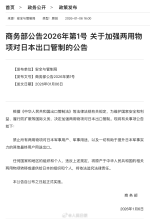
Just now, China's Ministry of Commerce has issued a ban against Japan.
=======================================
商务部公告2026年第1号 关于加强两用物项对日本出口管制的公告
【发布单位】安全与管制局
【发布文号】商务部公告2026年第1号
【发文日期】2026年01月06日

根据《中华人民共和国出口管制法》等法律法规有关规定,为维护国家安全和利益、履行防扩散等国际义务,决定加强两用物项对日本出口管制。现将有关事项公告如下:

禁止所有两用物项对日本军事用户、军事用途,以及一切有助于提升日本军事实力的其他最终用户用途出口。

任何国家和地区的组织和个人,违反上述规定,将原产于中华人民共和国的相关两用物项转移或提供给日本的组织和个人,将依法追究法律责任。

本公告自公布之日起正式实施。

商 务 部

2026年1月6日
=======================================
Core content translation:
The export of all dual-use items to Japanese military users, for military purposes, and for any other end-uses that could enhance Japan's military capabilities is prohibited.
1767689903969.png

 
Last edited:
  • Like
Reactions: ety
Foreign friends may not realize the implications of this announcement.

This is the most stringent business ban the Chinese government has issued to date. Its severity surpasses all previously issued bans.

1. The list covers a very wide range of products. It includes not only rare earth elements but also a large number of basic industrial products such as chemicals, machinery, metallurgical products, and electronics.
This is the current list of regulations in effect. It's over 150 pages long. All items listed on the list are subject to the ban.

2. The ban is a complete and direct cutoff; no negotiations, appeals, or alternative measures will be accepted.
3. The ban is effective for all countries worldwide. If a country imports listed materials from China and then resells them to Japan, or manufactures them into parts, sub-materials, or finished products before selling them to Japan, that country will also be subject to penalties under the ban, without exception.
 
Last edited:

Japanese PM’s Taiwan comments prompt China to ban certain exports to Japan

By John Liu

4 hr ago


Japanese Prime Minister Sanae Takaichi speaking in Tokyo on November 7, 2025.

Japanese Prime Minister Sanae Takaichi speaking in Tokyo on November 7, 2025.
Kyodo News/Getty Image

Hong Kong — China has banned exports of some rare earth elements and other items to Japan that could be used for military purposes, straining already tense relations between the two countries following the Japanese prime minister’s recent remarks on Taiwan.

The sweeping restrictions on so-called dual-use items – goods, services and technologies that have both civilian and military applications – are effective immediately, China’s Ministry of Commerce said in a statement Tuesday.

While the ministry did not specify what the impacted exports are, a catalogue of dual-use items published by the ministry includes rare earths, advanced electronics, aerospace and aviation components, drones and nuclear-related technology, among other items.

Rare earth elements are critical to a wide range of goods, from everyday electronics and vehicles to advanced weapons systems such as F-35 fighter jets. It is not yet clear how far-reaching the impact of the latest restrictions will be for Japan.

Relations between the two Asian powers have deteriorated rapidly since Japan’s leader, Sanae Takaichi, said in parliament in November that a Chinese invasion of Taiwan would constitute “a situation threatening Japan’s survival,” potentially triggering a military response from Tokyo.

China’s ruling Communist Party claims Taiwan as its territory, despite having never controlled it, and has vowed to annex the island, by force if necessary.

Since Takaichi’s remarks, Beijing has unleashed a series of economic measures aimed at pressuring Japan to retract the comments, including cutting flights to the country, warning its citizens against traveling to or studying in Japan and suspending seafood imports from Japan.

Unmanned electric mining truck operating in the mining area of Huzhou Nanfang Mining Co. on March 14, 2025, in Huzhou, Zhejiang Province of China.

Unmanned electric mining truck operating in the mining area of Huzhou Nanfang Mining Co. on March 14, 2025, in Huzhou, Zhejiang Province of China.
Tan Yunfeng/VCG/AP


A spokesperson for China’s commerce ministry said the new restrictions had been imposed in response to Takaichi’s “erroneous” comments and for “safeguarding national security and interests.”

“These comments constitute a crude interference in China’s internal affairs, seriously violate the one-China principle and are extremely harmful in nature and impact,” the spokesperson said in a statement Tuesday.


In its statement, the ministry added that any organization or individual from any country that violated the export restrictions would be held legally accountable.

CNN has reached out to Japan’s Ministry of Economy, Trade and Industry for comment.

Related article
Workers transport soil containing rare earth elements for export at a port in Lianyungang.

What are rare earth minerals, and why are they central to Trump’s trade deal with China?

Using its global dominance in the rare earths supply chain, China has imposed controls on these exports as a powerful weapon in the trade war unleashed by US President Donald Trump last year. The move wreaked havoc in industries around the world, including the automotive sector – a critical pillar of Japan’s economy.

This is not the first time Beijing has weaponized rare earth exports against Japan. In 2010, China also restricted such shipments to the country following a diplomatic spat triggered by Japan’s arrest of a Chinese fishing boat captain near the disputed Senkaku Islands, known in China as the Diaoyus.


Japanese PM’s Taiwan comments prompt China to ban certain exports to Japan

By John Liu

4 hr ago


Japanese Prime Minister Sanae Takaichi speaking in Tokyo on November 7, 2025.

Japanese Prime Minister Sanae Takaichi speaking in Tokyo on November 7, 2025.
Kyodo News/Getty Image

Hong Kong — China has banned exports of some rare earth elements and other items to Japan that could be used for military purposes, straining already tense relations between the two countries following the Japanese prime minister’s recent remarks on Taiwan.

The sweeping restrictions on so-called dual-use items – goods, services and technologies that have both civilian and military applications – are effective immediately, China’s Ministry of Commerce said in a statement Tuesday.

While the ministry did not specify what the impacted exports are, a catalogue of dual-use items published by the ministry includes rare earths, advanced electronics, aerospace and aviation components, drones and nuclear-related technology, among other items.

Rare earth elements are critical to a wide range of goods, from everyday electronics and vehicles to advanced weapons systems such as F-35 fighter jets. It is not yet clear how far-reaching the impact of the latest restrictions will be for Japan.

Relations between the two Asian powers have deteriorated rapidly since Japan’s leader, Sanae Takaichi, said in parliament in November that a Chinese invasion of Taiwan would constitute “a situation threatening Japan’s survival,” potentially triggering a military response from Tokyo.

China’s ruling Communist Party claims Taiwan as its territory, despite having never controlled it, and has vowed to annex the island, by force if necessary.

Since Takaichi’s remarks, Beijing has unleashed a series of economic measures aimed at pressuring Japan to retract the comments, including cutting flights to the country, warning its citizens against traveling to or studying in Japan and suspending seafood imports from Japan.

Unmanned electric mining truck operating in the mining area of Huzhou Nanfang Mining Co. on March 14, 2025, in Huzhou, Zhejiang Province of China.

Unmanned electric mining truck operating in the mining area of Huzhou Nanfang Mining Co. on March 14, 2025, in Huzhou, Zhejiang Province of China.
Tan Yunfeng/VCG/AP


A spokesperson for China’s commerce ministry said the new restrictions had been imposed in response to Takaichi’s “erroneous” comments and for “safeguarding national security and interests.”

“These comments constitute a crude interference in China’s internal affairs, seriously violate the one-China principle and are extremely harmful in nature and impact,” the spokesperson said in a statement Tuesday.


In its statement, the ministry added that any organization or individual from any country that violated the export restrictions would be held legally accountable.

CNN has reached out to Japan’s Ministry of Economy, Trade and Industry for comment.

Related article
Workers transport soil containing rare earth elements for export at a port in Lianyungang.
What are rare earth minerals, and why are they central to Trump’s trade deal with China?
Using its global dominance in the rare earths supply chain, China has imposed controls on these exports as a powerful weapon in the trade war unleashed by US President Donald Trump last year. The move wreaked havoc in industries around the world, including the automotive sector – a critical pillar of Japan’s economy.

This is not the first time Beijing has weaponized rare earth exports against Japan. In 2010, China also restricted such shipments to the country following a diplomatic spat triggered by Japan’s arrest of a Chinese fishing boat captain near the disputed Senkaku Islands, known in China as the Diaoyus.


The people on this forum don't seem to have realized that the conflict has begun.

China's stance:
============================================================
CCTV: It’s reported that Japanese Prime Minister Sanae Takaichi held a New Year’s press conference where she said challenges to a free and open international order based on the rule of law are gaining momentum. She mentioned that in the “Indo-Pacific,” China and the DPRK are increasing military power, and the cooperation between China and Russia and the cooperation between Russia and the DPRK have been enhanced. Takaichi also noted that in order to respond appropriately to the rapid changes in the security environment and with strong determination to protect Japan’s independence and peace as well as the lives and livelihood of the Japanese people, the country will proceed with discussions with the aim of revising the three national security documents by the end of this year. What’s China’s comment?

Mao Ning: According to Japanese media reports, major adjustments to the three national security documents include increasing defense spending, revising the three non-nuclear principles, lifting restrictions on arms export and developing offensive military capability. It reflects the dangerous trend of Japan “remilitarizing” itself faster, which is bound to undermine regional peace and stability. The international community must stay on high alert.

With the aim of preventing the revival of Japanese militarism, a series of instruments with legal effect under international law, including the Cairo Declaration and the Potsdam Proclamation, clearly require Japan to be “completely disarmed” and not to maintain such industries as “would enable her to re-arm for war.” Japan’s Constitution also made strict restrictions on the country’s military forces, the right of belligerency and the right to war. However, in recent years, right-wing forces in Japan have been expediting military buildup and gradually breaking free from postwar norms such as the exclusively defense-oriented principle and a series of international rules, which constitutes a challenge to the postwar international order. The right-wing forces time and again used disguises and fabricated false narratives, and kept shifting focus, provoking its neighbors, creating troubles and stirring up tensions. They even pretended to be “threatened” and caught in a dead end. In fact, they are using “survival” and “defense” as an excuse to tie the Japanese people to the war chariot to serve their hidden agenda. What’s the difference between their practice and what the Japanese militarists did in the last century?

The painful lessons of history remind us that Japanese right-wing forces’ “remilitarization” attempt has posed a threat to regional and world peace and tranquility. China and all peace-loving countries and people in the world should never allow Japanese right-wing forces to turn back the wheel of history or allow the revival of militarism.

Original article link.
============================================================


Japan's response:
To view this content we will need your consent to set third party cookies.
For more detailed information, see our cookies page.
 
The people on this forum don't seem to have realized that the conflict has begun.

China's stance:
============================================================
CCTV: It’s reported that Japanese Prime Minister Sanae Takaichi held a New Year’s press conference where she said challenges to a free and open international order based on the rule of law are gaining momentum. She mentioned that in the “Indo-Pacific,” China and the DPRK are increasing military power, and the cooperation between China and Russia and the cooperation between Russia and the DPRK have been enhanced. Takaichi also noted that in order to respond appropriately to the rapid changes in the security environment and with strong determination to protect Japan’s independence and peace as well as the lives and livelihood of the Japanese people, the country will proceed with discussions with the aim of revising the three national security documents by the end of this year. What’s China’s comment?

Mao Ning: According to Japanese media reports, major adjustments to the three national security documents include increasing defense spending, revising the three non-nuclear principles, lifting restrictions on arms export and developing offensive military capability. It reflects the dangerous trend of Japan “remilitarizing” itself faster, which is bound to undermine regional peace and stability. The international community must stay on high alert.

With the aim of preventing the revival of Japanese militarism, a series of instruments with legal effect under international law, including the Cairo Declaration and the Potsdam Proclamation, clearly require Japan to be “completely disarmed” and not to maintain such industries as “would enable her to re-arm for war.” Japan’s Constitution also made strict restrictions on the country’s military forces, the right of belligerency and the right to war. However, in recent years, right-wing forces in Japan have been expediting military buildup and gradually breaking free from postwar norms such as the exclusively defense-oriented principle and a series of international rules, which constitutes a challenge to the postwar international order. The right-wing forces time and again used disguises and fabricated false narratives, and kept shifting focus, provoking its neighbors, creating troubles and stirring up tensions. They even pretended to be “threatened” and caught in a dead end. In fact, they are using “survival” and “defense” as an excuse to tie the Japanese people to the war chariot to serve their hidden agenda. What’s the difference between their practice and what the Japanese militarists did in the last century?

The painful lessons of history remind us that Japanese right-wing forces’ “remilitarization” attempt has posed a threat to regional and world peace and tranquility. China and all peace-loving countries and people in the world should never allow Japanese right-wing forces to turn back the wheel of history or allow the revival of militarism.

Original article link.
============================================================


Japan's response:
To view this content we will need your consent to set third party cookies.
For more detailed information, see our cookies page.

Yeah, Japan now with the right wing on power for years and Germany too are well on their way to remilitarization, that' should never happened with Japan. The Japanese right wing gov looks like is gearing for a military confrontation with China in the near future if not a final show down. Japanese just can't accept that China is resurging and right now is on top of Japan. The world outside East Asia doesn't care what Japan does, it doesn't possibly harm them, some are even cheering for the rearm of Japan, that's sad.
 

China Deprives Japan of Rare-Earths Supply, Escalating Dispute​

Beijing is punishing Tokyo for leader’s remarks on Taiwan, again wielding critical minerals as an economic weapon

By Jon Emont
Jan. 8, 2026 6:31 am ET

A man conducting a quality inspection of automobile transmission parts.
Japan’s auto industry stands to suffer the effects of Chinese rare-earth export restrictions. ISSEI KATO/REUTERS

China has begun choking off exports of rare earths and rare-earth magnets to Japan, a potential blow to Japanese companies that use them to produce components for global chip makers, car companies and defense firms.

The move is the latest by Beijing to punish Japan for Prime Minister Sanae Takaichi’s remarks late last year suggesting the country could become involved in a conflict over Taiwan, the self-ruled island that China has pledged to take by force, if necessary.


Japan’s real wages fall for 11th straight month​

By KEIKO NANNICHI/ Staff Writer
January 8, 2026 at 17:15 JST

Photo/Illutration


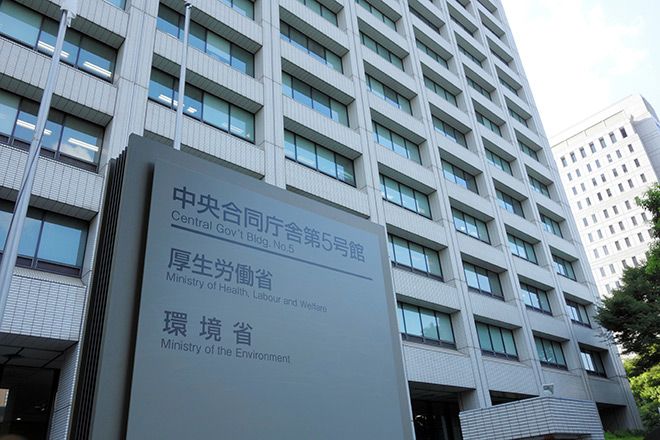
The Ministry of Health, Labor and Welfare (Asahi Shimbun file photo)


Real wages in Japan fell 2.8 percent in November 2025 from a year earlier, marking the 11th consecutive month of decline, as persistent inflation continued to outpace salary growth, the labor ministry announced on Jan. 8.

According to the ministry's preliminary monthly labor survey, total cash earnings, or nominal wages, rose 0.5 percent to 310,202 yen ($1,980), the 47th straight month of increase.

However, the consumer price index, a key measure of inflation, remained high with a 3.3 percent increase, overwhelming the gains in nominal wages.

The ministry noted that the November survey deadline was earlier than usual and that growth rates could be revised upward in the final report.

Special payments, including bonuses, decreased by 17 percent to 19,293 yen, a figure that may also rise as many winter bonuses are paid in the latter half of the month.

Scheduled earnings, which include basic pay and other compensation, increased by 2 percent to 270,041 yen. A ministry official said the steady 2-percent growth level indicates a "firm trend."

By employment type, earnings for full-time general workers grew 0.8 percent to 399,997 yen, while part-time workers saw a 1 percent increase to 113,165 yen.

The overall growth rate was slowed by the fact that there were two fewer weekdays in November 2025 compared to the previous year.


Looks like China itself is taking action against critical dichlorosilane from Japan before it imposes ban on China in response to China's dual purpose products ban on Japan, lol.


China initiates anti-dumping probe against Japan over key semiconductor chemical

Beijing’s investigation targets imports of dichlorosilane from Japan, alleging dumping that harms Chinese production, amid escalating bilateral and trade tensions​

Reading Time: 2 minutes


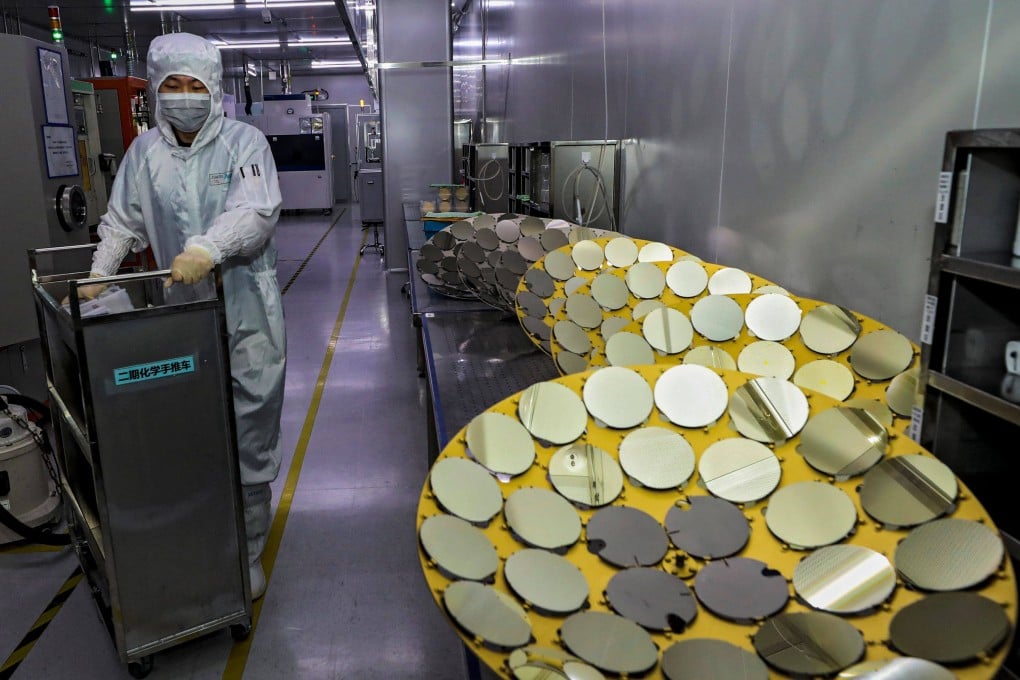
A worker is seen at a semiconductor factory in China’s Jiangsu province. Beijing has launched an anti-dumping investigation against Japan over a chemical used in chipmaking. Photo: AFP

Ji Siqiin Beijing and Xiaofei Xu in Paris
Published: 6:00pm, 7 Jan 2026

China has launched an anti-dumping investigation against Japan over a crucial chemical for chipmaking, marking a new escalation in tensions between Beijing and Tokyo.

The investigation, set to run for one year with a possible extension of six months, targets dichlorosilane – a chemical that is primarily used in thin-film-deposition processes in semiconductor manufacturing and which plays a key role in the production of various types of chips, according to a notice from the Ministry of Commerce on Wednesday.

The investigation was initiated at the request of a domestic industry player, which submitted preliminary evidence showing that China’s imports of dichlorosilane from Japan increased between 2022 and 2024 while prices fell by 31 per cent.


The domestic industry claimed that the imports from Japan constituted dumping and had caused harm to Chinese domestic production and operations, according to a separate statement from the ministry on Wednesday.

After receiving the application, Chinese authorities determined that it met relevant requirements for launching an anti-dumping investigation and consequently decided to initiate the process, the ministry said.

“The investigating authority will conduct the investigation in accordance with the law, fully safeguard the rights of all interested parties, and make an objective and impartial ruling based on the investigation results,” the statement said.

The investigation came a day after China banned the export of products with both commercial and military applications to end users linked to the Japanese military, as a row between Beijing and Tokyo continues to intensify.

Japanese Prime Minister Sanae Takaichi angered Beijing on November 7 by suggesting that a hypothetical attack on Taiwan could constitute an “existential threat” warranting a military response under the limitations of Tokyo’s pacifist constitution.


Why have Takaichi’s Taiwan comments sent China-Japan ties into a tailspin?

Beijing sees Taiwan as part of China to be reunited by force if necessary. Most countries, including the US, do not recognise Taiwan as an independent state, but Washington is opposed to any attempt to take the self-governed island by force and is committed to supplying it with weapons.

Japan has a dominant lead in the production of dichlorosilane, with the world’s top three producers – Shinetsu, Nippon Sanso and Sumitomo Seika – all Japanese, while the largest Chinese producer, Tangshan Sunfar Silicon, ranked fourth in market share as of 2023, according to an industry report published by QYResearch.

European producer Linde Gas rounds out the list of top-five producers, which together account for 78 per cent of the global market share, according to the report.

China’s domestic supply of dichlorosilane has traditionally relied heavily on imports, and Japanese products represented 72 per cent of China’s domestic market of the chemical between 2022 and 2024, according to Sunfar, the company that filed for the anti-dumping investigation.

China has accelerated its efforts for domestic substitution, with Sunfar emerging as a major player aiming to challenge Japan’s dominance in this sector.


Based in Tangshan, Hebei province, Sunfar operates a 500-tonne electronic-grade dichlorosilane production line, which began operations in November 2020, its assistant general manager, Wang Baojie, said in an interview with a local news organisation last month.

“We have already achieved large-scale supply to leading chip manufacturers, both domestically and internationally,” Wang was quoted as saying. “Previously, only a few overseas countries could produce it.

“But now, we not only manufacture it, [we] also stably supply top-tier chip companies globally.”

 
Japan needs additional 1.23 million immigrant workers by 2028. Or 410,000 a year. Who wants to come to Japan?

I suggest not immigrating to Japan. China has issued the strictest regulatory ban on Japan in history, involving thousands of goods. And yesterday, the spokesperson of the Chinese Ministry of Foreign Affairs made it clear that Japan must completely disarm. This means that unless Japan disbands all military forces, including the Self Defense Forces, China's control ban will undoubtedly be prolonged. Regardless of whether the Japanese government is at fault or not, Japan's economy must confront China head-on. Immigrating to Japan at this time is a foolish choice.
 
Yeah, Japan now with the right wing on power for years and Germany too are well on their way to remilitarization, that' should never happened with Japan. The Japanese right wing gov looks like is gearing for a military confrontation with China in the near future if not a final show down. Japanese just can't accept that China is resurging and right now is on top of Japan. The world outside East Asia doesn't care what Japan does, it doesn't possibly harm them, some are even cheering for the rearm of Japan, that's sad.
We just need to patiently wait for the Japanese government to start manufacturing nuclear weapons, which will give us a legitimate and reasonable reason to strike Japan. It can also make Japan a battlefield for a complete showdown between China and the United States.
 
We just need to patiently wait for the Japanese government to start manufacturing nuclear weapons, which will give us a legitimate and reasonable reason to strike Japan. It can also make Japan a battlefield for a complete showdown between China and the United States.
I think Japan is destined to have a military show down with China in the not too distant future. The problem is that Japan doesn't teach the true history of Japanese atrocities and crimes on Asians to their population, so Japanese never accept their defeat in WW II esp at the hands of Chinese and that now China is on top of Japan. Japanese think Japan should be on top of China and dominate Asia. They will never be content to peacefully stay on the Japanese islands, always looking for opportunities to expand and conquer the Asian continent. Japan is really a middle power country in terms of population, territory, economy and other resources(even less), but they always have the wolf's desire and ambition wanting Japan to break out into superpower rank, lol. Future history will teach these wolves lessons again.
 
I think Japan is destined to have a military show down with China in the not too distant future. The problem is that Japan doesn't teach the true history of Japanese atrocities and crimes on Asians to their population, so Japanese never accept their defeat in WW II esp at the hands of Chinese and that now China is on top of Japan. Japanese think Japan should be on top of China and dominate Asia. They will never be content to peacefully stay on the Japanese islands, always looking for opportunities to expand and conquer the Asian continent. Japan is really a middle power country in terms of population, territory, economy and other resources(even less), but they always have the wolf's desire and ambition wanting Japan to break out into superpower rank, lol. Future history will teach these wolves lessons again.
The warships of China's North Sea Fleet are located in Qingdao Port, not far from the mainland of Japan. This is a good opportunity for Japan to launch another attack similar to the Pearl Harbor attack, and they can try to gamble on their national fortune again.
 
  • Like
Reactions: ety

Users who are viewing this thread

Country Watch Latest

Latest Posts

Back
Top