Japan Defence and General News Discussions

China has condemned the launch of maritime boundary negotiations between Japan and the Philippines, calling the talks “completely illegal and void”.
The protest followed a joint statement released on Thursday after a summit between Japanese Prime Minister Sanae Takaichi and Philippine President Ferdinand Marcos Jnr in Tokyo.

During the talks, the two sides agreed to elevate bilateral ties to a comprehensive strategic partnership to strengthen cooperation in areas including the economy, security and intelligence sharing.

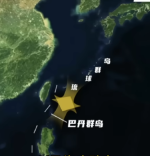
Japan and the Philippines do not share maritime borders, but their seabed claims could overlap as both look to extend their legal continental shelves beyond 200 nautical miles (370km or 230 miles).

Tokyo claims Okinotori, in the southernmost part of Japan, as an island that entitles it to an exclusive economic zone. But other governments in the region, including Beijing and Seoul, insist that the atoll does not meet the definition of an island under the United Nations Convention on the Law of the Sea (Unclos).
Speaking at a daily press conference on Friday, Chinese foreign ministry spokeswoman Mao Ning said the area covered by the Japan-Philippines maritime border talks sat directly east of Taiwan, where Beijing maintained its own exclusive economic zone and continental shelf rights under both domestic and international law.

“The unauthorised launch of these so-called maritime delimitation negotiations by Japan and the Philippines seriously infringes upon China’s maritime rights and interests,” Mao said.
 
Japan and the Philippines made a deal sharing east Taiwan sea. They completely ignoring China's existence. What the two countries are thinking? Are they mad?
1780280198149.png
 

Mapped: How Japan Lost Its Economic Dominance in Asia

June 12, 2026

Japans-Economic-Position-Over-Time_WEB.webp


Key Takeaways​

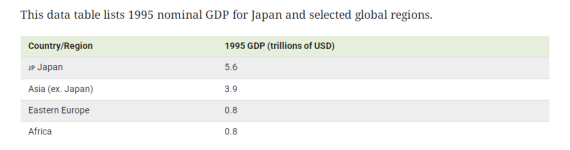
  • In 1995, Japan’s economy was larger than the rest of Asia, Africa, and Eastern Europe combined.
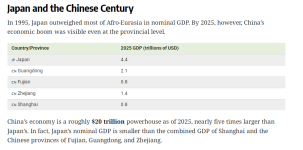
  • By 2025, the combined economies of four Chinese provincial regions exceeded Japan’s entire GDP.
  • The comparison highlights one of the biggest shifts in global economic power over the last 30 years.
The story of modern Asia can be told through a single economic handoff.

For decades, Japan was the region’s dominant economic power and one of the world’s most influential economies. But while Japan’s growth slowed after the collapse of its asset bubble, China embarked on an expansion that reshaped global trade, manufacturing, and investment.

This graphic compares Japan’s nominal GDP in 1995 and 2025, using two striking snapshots to show how the balance of economic power in Asia has changed. National GDP figures come from the International Monetary Fund’s World Economic Outlook (April 2026), while Chinese provincial data comes from official statistical bulletins.

Japan: Big in the 90s​

In 1995, the Soviet Union had just collapsed, and Japan was comfortably the world’s second-largest economy by nominal GDP after the United States.

As the first non-Western country to industrialize, Japan had long been the dominant economic power in its region, aided by postwar rebuilding and high-quality, high-value exports coveted around the world. By 1995, Japan’s economy was larger than the rest of Asia, Africa, and Eastern Europe combined.

This data table lists 1995 nominal GDP for Japan and selected global regions.

搜狗截图20260613110106.png

Japan’s rise was so dramatic that many observers in the 1980s believed it could eventually challenge U.S. economic leadership. Japanese firms dominated industries ranging from consumer electronics to automobiles, while Tokyo became synonymous with corporate and technological excellence.

Washington responded with restrictions on Japanese car and semiconductor exports, as well as the Plaza Accord, which led to a sharp appreciation of the Japanese yen against the U.S. dollar and other currencies. Japan’s policy responses to the Plaza Accord have been cited in part for contributing to the country’s massive asset price bubble of the late 1980s.

Japan’s Decline and the Rise of China​

Japan’s economy began to sputter after the collapse of the asset price bubble in 1990, and the following decades have often been referred to as the Lost Decades. During this period, Japan’s nominal GDP fell in part because of a weaker yen, real GDP growth slowed to a crawl, and national debt surged.

Meanwhile, across the East China Sea, another Asian giant emerged. Through its reform and opening-up era, China’s economy grew rapidly throughout the early 21st century, averaging at least 7% growth annually and reshaping global supply chains.

Despite having been an impoverished and underdeveloped country for much of the 20th century, China surpassed Japan in nominal GDP in 2010 and became the world’s second-largest economy.

搜狗截图20260613110216.png
Just as Japan once towered over the rest of Asia, China now stands as the region’s dominant economic power.


"China-made products are impossible to beat after all"... Japan's top five semiconductor equipment makers face an unprecedented sales plunge​

2026-06-22 10:16:55

Sales in China for Japan's semiconductor manufacturing equipment industry have fallen for the first time ever. The decline reflects Beijing's strong support for building up its domestic semiconductor equipment ecosystem amid the U.S.-China race for technological dominance. As a result, the market power that Japanese, U.S. and European equipment giants had built over decades is now being rapidly eroded by local companies.

According to a Nikkei Asia report on the 21st, the combined sales in China of Japan's top five semiconductor equipment makers — Tokyo Electron Ltd., Advantest, SCREEN Holdings Co., Ltd., DISCO Corporation and Kokusai Electric — totaled 1.47 trillion yen, or about 13.968 trillion won, in the fiscal year ended March 31, 2026. That was down roughly 10% to 12% from the previous year. This is the first time the country's core equipment makers have posted a combined annual sales decline in the Chinese market.

Tokyo Electron recorded the steepest drop. In the January-March quarter this year, China accounted for 27% of the company's total sales, down 7 percentage points from a year earlier. That was a sharp fall to about half the level seen in the April-June quarter of 2024, when China sales made up nearly 50% of total revenue.

Top-tier Western equipment makers are also struggling in China, including the Netherlands' ASML Holding N.V. (ASML), U.S.-based Applied Materials and KLA Corporation (KLA). For ASML, the share of sales from China fell to 19% in the first quarter this year, down 8 percentage points from a year earlier.

Behind this shift is Beijing's strong administrative control, aimed at completing a self-sufficient system in response to U.S. restrictions on semiconductor exports to China. As Washington built a tighter wall blocking advanced equipment imports, the Chinese government issued directives requiring domestic chipmakers to prioritize Chinese-made equipment when building new fabs.

According to Japanese market research firm MIR, the localization rate for front-end semiconductor equipment in China surged to 21% last year, more than doubling from 10% in 2021. The localization rate for back-end equipment used in chip packaging and assembly also jumped from 19% to 36% over the same period.

Even so, Japan's major equipment makers say they will maintain their technological edge and push back against China's advance.

Toshiki Kawai, president of Tokyo Electron, said, "Japanese equipment still stands out for its strengths in safety, environmental performance and overwhelming production capacity," expressing confidence that the company can hold its ground.

SCREEN Holdings also expects new business opportunities to emerge as mass production lines for high-performance semiconductors in China begin full-scale operations.

 
To view this content we will need your consent to set third party cookies.
For more detailed information, see our cookies page.


To view this content we will need your consent to set third party cookies.
For more detailed information, see our cookies page.


Report in English subtitles.
 
Interesting how this thread is about Japan defense force and not one Japanese individual is taking part here.
 

China adds 20 Japanese entities to its export control list, citing the need to curb a new form of militarism.

Written by: Zhang Zijie
publishing: 2026-06-29 10:28 renew: 2026-06-29 10:28


China adds 20 Japanese entities to its export control list, citing the need to curb a new form of militarism.


On June 29, China’s Ministry of Commerce announced that it would add 20 Japanese entities to its export control list, saying the move was to curb Japan’s “new militarism.”

A spokesperson for the Ministry of Commerce stated that, in accordance with the relevant provisions of the Export Control Law of the People's Republic of China and the Regulations on Export Control of Dual-Use Items of the People's Republic of China, and in order to safeguard national security and interests and fulfill international obligations such as non-proliferation, it has been decided to include 20 Japanese entities, including the National Institute for Defense Studies, that are involved in enhancing Japan's military capabilities, in the export control list.

The authorities have also taken the following measures: Exporters are prohibited from exporting dual-use items to the aforementioned 20 entities; foreign organizations and individuals are prohibited from transferring or providing dual-use items originating in the People's Republic of China to the aforementioned 20 entities; ongoing related activities must cease immediately. In special circumstances where export is truly necessary, exporters must apply to the Ministry of Commerce.


China-Japan relations: The photo shows the national flags of China and Japan flying in Tiananmen Square, Beijing, on October 25, 2018. (Getty)

China-Japan relations: The photo shows the national flags of China and Japan flying in Tiananmen Square, Beijing, on October 25, 2018. (Getty)

According to the Ministry of Commerce's website, the Japanese entities subject to export controls are as follows:

1. National Institute for Defense Studies

2. Ground Systems Research Center

3. Naval Systems Research Center

4. Air Systems Research Center

5. NIKKO TOKKI Co., Ltd.

6. Nikko-YPK SHOJI Co., Ltd.

7. Mitsubishi Electric Defense and Space Technologies Corporation

8. Mitsubishi Electric Software Corporation

9. Mitsubishi Electric Engineering Company, Limited

10. Mitsubishi Precision Company, Limited

11. Mitsubishi Heavy Industries Ocean Technology Co., Ltd.

12. Mitsubishi Heavy Industries, Sagami High-tech, Ltd.

13. Mitsubishi Heavy Industries Logistics Technology Co., Ltd.

14. KOWA KOGYO, Ltd.

15. MHI Special Vehicles Parts Supply & Technical Service Co., Ltd.

16. Mitsubishi Heavy Industries Marine Technology Co., Ltd.

17. KGM Co., Ltd. (Kawajyu Gifu Manufacturing Co., Ltd.)

18. NIPPI Corporation (Japan Aircraft Corporation)

19. Fortunio Co., Ltd.

20. Aoki Seimitsu Kogyo Co., Ltd.


Japanese Defense Minister Shinjiro Koizumi held talks with South Korean Defense Minister Ahn Gyu-baek in Seoul on June 28. (Reuters)

Japanese Defense Minister Shinjiro Koizumi held talks with South Korean Defense Minister Ahn Gyu-baek in Seoul on June 28. (Reuters)

A spokesperson for the Ministry of Commerce stated regarding export control measures against Japan that on February 24th of this year, China added 20 Japanese entities, including Mitsubishi Shipbuilding Corporation, to its export control list, and 20 Japanese entities, including Subaru Corporation, to its watch list. The aim was to deter Japan's "remilitarization" and attempts to acquire nuclear weapons. China's actions are entirely legitimate, reasonable, and legal, and are intended to resolutely curb Japan's reckless actions toward "new types of militarism."

The spokesperson stated that China hopes Japan will realize its mistakes, change its erroneous actions, and genuinely reflect on and return to the right track. China's legally mandated list targets only a small number of Japanese entities, and the measures only apply to dual-use items; they do not affect normal Sino-Japanese economic and trade exchanges, and honest and law-abiding Japanese entities have absolutely nothing to worry about.

In addition, the Ministry of Commerce also released a list of 20 Japanese entities under its watch list on the same day:

1. Mitsui E&S Co., Ltd.

2. Mitsui Bussan Aerospace Co., Ltd. Maintenance Center

3. Terra Drone Corporation

4. ACSL Ltd.

5. Mitsubishi Nuclear Fuel Co., Ltd.

6. Japan Nuclear Fuel Limited

7. Fujitsu Network Solutions Limited

8. Hitachi Advanced Systems Corporation

9. Komatsu Industries Corporation

10. Komatsu NTC Ltd.

11. OKI Electric Industry Co., Ltd.

12. OKI Com-Echoes Co., Ltd.

13. OKI Circuit Technology Co., Ltd.

14. OKI Nextech Co., Ltd.

15. OKI Engineering Co., Ltd.

16. YDK Technologies Co., Ltd.

17. Nihon Denji Sokki Co., Ltd.

18. Howa Machinery, Ltd.

19. Hosoya Pyro-Engineering Co., Ltd.

20. The Fujikura Parachute Co., Ltd.

The statement indicates that exporters exporting dual-use items to the aforementioned entities may not apply for a general license or obtain export certificates through registration and information filing. When applying for a single license, they must submit a risk assessment report on the entities on the watch list and provide a written commitment that the dual-use items will not be used for any purpose that would enhance Japan's military strength. The license review period is not subject to the time limit stipulated in Article 17, Paragraph 1 of the "Regulations of the People's Republic of China on the Export Control of Dual-Use Items".

The Ministry of Commerce will implement stricter end-user and end-use reviews on exports of dual-use items by entities on the watch list. Exports involving Japanese military users, military uses, and any other end-user uses that contribute to enhancing Japan's military strength will not be approved.


On May 6, 2026, in Ilocos Norte, Philippines, a Japan Ground Self-Defense Force Type 88 ship-to-ship missile launcher was fired as part of the Joint Task Force (JTF) maritime strike exercise during the annual US-Philippines joint military exercise Balikatan. (Reuters)

On May 6, 2026, in Ilocos Norte, Philippines, a Japan Ground Self-Defense Force Type 88 ship-to-ship missile launcher was fired as part of the Joint Task Force (JTF) maritime strike exercise during the annual US-Philippines joint military exercise "Balikatan". (Reuters)

Entities on the watch list that fulfill their obligations to cooperate with verification in accordance with Article 26 of the Regulations of the People's Republic of China on Export Control of Dual-Use Items may apply to be removed from the watch list. The Ministry of Commerce may remove such entities from the watch list after verification.


Users who are viewing this thread

Country Watch Latest

Latest Posts

Back
Top