JH-7 as a Missile Hauler Repurposing MastanKhans idea

But is it available to Pakistan? It's based on Soviet/Russian design (Su-30 MKK/MKK2) with indigenous avionics , So I don't think it's available to Pakistan because its design is RUSSIAN INTELLECTUAL PROPERTY

If Pakistan makes diplomatic efforts to get Russia to agree, then yes.

I know it's hard. But the JH-7A is really too obsolete. I believe the J-16D b13/14 and F-15EX are the TOP 2 of the 4.5G heavy fighters.
 
Last edited:
Kaan is the platform that Pakistan will use for whatever capability that we think the JH-7 platform offers interms of range and load.
 
The JH-7A. Is a good option for PAF. I thing Pakistan should makes deal with Russia and China to obtain J-16D that can carry PL-17.
 
Last edited:
If Pakistan makes diplomatic efforts to get Russia to agree, then yes.

I know it's hard. But the JH-7A is really too obsolete. There is no other option for Pakistan except J-16D. Or do you have a better suggestion?
My suggestion which I had made previously on this forum is to divert all funding being funnelled into any potential domestic stealth fighter, and instead go for a more realistic goal of developing a strike platform. It doesn't even have to be manned but maybe attempt a UCAV strike platform.

This makes more sense to me too since we are (supposedly) in the long-term going to be fielding 2 foreign stealth fighters anyway, the J35E and KAAN. So a third stealth fighter platform development doesn't make sense.
 
Need a stealth long range strike platform. J20 not likely so Kaan makes the most obvious choice.
 
More J-35A would be a better long term choice, than any other platform at this moment. Even the J-16, unless it is the J-16D.

If I remember correctly, the role for the JH-7A was focused on long range naval aerial warfare, A2A and A2Ship.

IMHO, improving the J-35A to have a more capable engine to power jammers as well as haul heavier munitions is the way to go. The J-16 would work if the plan was to go far into the Indian Ocean and swing around to attack an Indian navy task force from a different direction, as well as to have EW supper with that package.

These are all things that might no longer be possible to be done with the JH-7A because they would be picked up on all the modern ISR India will be procuring if not already in their possession.

The JH-7A was a platform choice before there were other options.

To make up for the range issue on the J-35A the use of more capable standoff munitions is the way to go. Besides with a lower RCS, the J-35A is less likely to be engaged by Indian navy SAMs (150 km max range Barak 8) off their destroyers or fighters (MiG-29K or Rafale) off their carriers. Firing standoff, as we Have also seen in the crisis a few weeks ago, is the way future battles will be fought.

The thought process has to be what munition are we trying to get against which part of the enemy’s war machine. The goal should be to make it so that the enemy does not want to or ideally is not able to pursue war any more.

let's figure out the munitions and work backwards to the platform that would be able to carry it. The same way the J-10 was at the limit of its capabilities carrying a 300 km PL-15 (or 400 Km PL-17 in the future) independently, working with the AWACS to get the kills. So not just the platforms but more importantly the munitions and the ABC (electromagnetic support) ecosystem that is needed to enable decisive operations.

So J-35A all the way. That’s just my two cents.

P.S. the tech developed for the J-35 would have its costs spread across the Pakistani and Chinese fleet, so shared burden shared reward.
 
Last edited:
More J-35A would be a better long term choice, than any other platform at this moment. Even the J-16, unless it is the J-16D.

If I remember correctly, the role for the JH-7A was focused on long range naval aerial warfare, A2A and A2Ship.

IMHO, improving the J-35A to have a more capable engine to power jammers as well as haul heavier munitions is the way to go. The J-16 would work if the plan was to go far into the Indian Ocean and swing around to attack an Indian navy task force from a different direction, as well as to have EW supper with that package.

These are all things that might no longer be possible to be done with the JH-7A because they would be picked up on all the modern ISR India will be procuring if not already in their possession.

The JH-7A was a platform choice before there were other options.

To make up for the range issue on the J-35A the use of more capable standoff munitions is the way to go. Besides with a lower RCS, the J-35A is less likely to be engaged by Indian navy SAMs (150 km max range Barak 8) off their destroyers or fighters (MiG-29K or Rafale) off their carriers. Firing standoff, as we Have also seen in the crisis a few weeks ago, is the way future battles will be fought.

The thought process has to be what munition are we trying to get against which part of the enemy’s war machine. The goal should be to make it so that the enemy does not want to or ideally is not able to pursue war any more.

So J-35A all the way. That’s just my two cents.
J35 + KAAN in the long-term. (Next couple decades). Try to secure local production for at least one of them. I've heard rumours about a possible assembly/production deal for the KAAN.

And use PFX stealth fighter funds for a local strike-bomber platform, instead of another typical fighter which we have the above already.
 
J35 + KAAN in the long-term. (Next couple decades). Try to secure local production for at least one of them. I've heard rumours about a possible assembly/production deal for the KAAN.

And use PFX stealth fighter funds for a local strike-bomber platform, instead of another typical fighter which we have the above already.
PFX would be better as a UCAV ;)
Also, a lot of export potential as a UCAV.

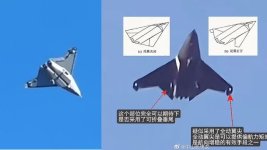
Ideally I would like to see a single engine version of the J-50 as the real PFX, built in the 2030s. That would be how to make a project worth while, assimilate 5th gen tech and work with China to go to 6th gen; WS-15 engine and next next gen capabilities.

1748099974527.jpeg
 
PFX would be better as a UCAV ;)
Also, a lot of export potential as a UCAV.

Ideally I would like to see a single engine version of the J-50 as the real PFX, built in the 2030s. That would be how to make a project worth while, assimilate 5th gen tech and work with China to go to 6th gen; WS-15 engine and next next gen capabilities.

View attachment 123551
Yeah, if in the future we can get a decently capable domestic UCAV or stealth fighter flying, it definitely presents an opportunity for export markets. We are one the rare countries that actively engages in real time combat skirmishes, against a larger foe, and comes out successful.

Should be leveraging being a security state at least.
 
JH-7 as a Missile Hauler: Bridging the BVR Gap in South Asian Skies

The concept of using the Chinese-origin JH-7 fighter-bomber as a long-range bomber was first introduced by forum member MastanKhan, who proposed its employment for standoff missile delivery in a networked air combat environment. This idea gains renewed relevance in the aftermath of the intense aerial activity observed during the May 2025 face-off between the Pakistan Air Force (PAF) and Indian Air Force (IAF), where over 100 fighters were reportedly airborne and an estimated 400 BVR missiles were in play.

While the IAF benefits from platforms like the Su-30MKI and Rafale—with the ability to carry up to 8–12 BVRs per aircraft—PAF’s lighter fleet, consisting primarily of F-16s, JF-17s, and even the advanced J-10CE, generally carries fewer missiles. This disparity in BVR saturation could prove critical in large-scale engagements, where volume of fire and missile persistence can tip the balance.

Repurposing the JH-7: A Logical Step Forward

The JH-7, known for its strike role, features twin engines, high fuel capacity, and a heavy weapons load. Though not designed for air superiority, its physical capacity to carry multiple heavy payloads makes it an excellent candidate for repurposing as a BVR missile truck. Stripped of air-to-ground ordnance and equipped with PL-15 LRAAMs, a JH-7 could potentially field 8–10 missiles per sortie—dramatically increasing PAF’s BVR count in the air.

Tactical Integration

This approach would not require JH-7s to enter contested airspace. They could remain in standoff zones, protected by fighters and supported by AWACS, and launch PL-15s based on cueing from forward-deployed JF-17 Block III or J-10CEs. With the PL-15’s estimated range of 200–300 km and active AESA seeker, this tactic significantly extends the engagement envelope.

Such missile carriers would serve as force multipliers, enabling PAF to saturate Indian airspace with long-range missiles, complicating IAF’s tactical calculations, and helping to neutralize their numerical advantage in missile loadouts.

LRAAM Guidance via AWACS and Networked Fighters

The key to making this approach viable is data-link integration. JH-7s would not operate independently but would act as rear-echelon missile launchers. Cueing and mid-course guidance would be provided by frontline fighters like the JF-17 Block III and J-10CE, both of which support advanced targeting through datalink systems. AWACS platforms such as the Saab Erieye and ZDK-03 would provide battlespace awareness and tracking, turning the JH-7 into a standoff shooter.

Strategic Impact

Integrating JH-7s in this role could be a game-changer. In high-tempo engagements, where the rate of missile expenditure is high, having additional platforms dedicated purely to missile carriage and launch relieves the burden on frontline fighters. It also helps saturate enemy defenses, complicates interception planning, and adds strategic depth to the air battle.

Furthermore, with PL-15s estimated to have ranges exceeding 200 km, such tactics enable PAF to hold enemy assets at risk from much greater distances—especially valuable in denying airspace or neutralizing high-value enemy enablers like AWACS and refueling aircraft.

Conclusion

What began as a forum concept by MastanKhan now appears as a tactically sound and operationally feasible idea. Employing JH-7s as missile haulers could significantly enhance PAF’s ability to contest the skies in high-intensity scenarios. It’s an adaptive solution to the growing challenge of BVR volume—a vital factor in the evolving calculus of South Asian air combat.

UFC
@MastanKhan
Hi,

Thank you---. Necessity is the mother of invention---.

The americans have given re-birth to the F-15's and made it into a missile truck when needed---.

Similarly---Paf will have to find an aircraft that can carry a minimum of 8 PL-15 BVR missiles---.

The next step up missile---the PL-17 is going to get larger and then next one be heavier than the PL-17---.

First day---first strikes will determine which way the battle goes---.

So---either an upgraded JH7A would be needed or something else---that could also carry heavier longer range air to ship or air to ground missiles
 
Last edited:
Kaan is only J-35 size. J-35 would make better sense than Kaan for PAF.
That is not true. The KAAN demonstrator is currently powered by two F110 engines, which firmly places in the heavy fighter category. From an external geometry’s point of view, it is wider than the Su-57, taller than the F-22, and is only slightly shorter than the J-20 by a tiny margin with a very ample and spacious airframe. Given TAI’s official statement describing the KAAN a long-range multi-role fighter that have an emphasis in long range, ample Air to surface ordnance to support power projection, it should be regarded as somewhat similar to the Pak-fa. In fact most estimate places the KAAN, should it ever enter service in the 40-ton MTOW range.

And I do agree, J-35/FC-31 is a much better fit for pakistan but for a bucket load of other reasons…
 
Hi,

Thank you---. Necessity is the mother of invention---.

The americans have given re-birth to the F-15's and made it into a missile truck when needed---.

Similarly---Paf will have find an aircraft than can carry a minimum of 8 PL-15 BVR missiles---.

The next step up missile---the PL-17 is going to get larger and then next one be heavier than the PL-17---.

First day---first strikes will determine which way the battle goes---.

So---either an upgraded JH7A would be needed or something else---that could also carry heavier longer range air to ship or air to ground missiles

F-15EX has always been opposed by the USAF. It was Biden who pushed it.
 
Okay. I think this is stretching it a bit too far.

You definitely won't be getting any strategic stealth bombers like the H-20 or J-36. It's just common sense these are top of the line Chinese strategic assets not for export, extremely expensive and in fact don't even fit within the PAF's doctrine.
Heard the same mantra in 2016 about J10's and even about J35's few months ago ..
J10's were finally acquired and hence you see the results..
J35 however is largely due to recent air battle... expect 20-25 by the end of the year ..
H20 is required NOW more than ever..... NOTHING is expensive if security is at stake ....
Here is an article about Ukraine Russia war specifically highlighting the aspects of R 37m's being used by Russians, and here is view of one of the Ukrainian pilot :

"The R-37M isn’t scoring a lot of “hard” kills resulting in the destruction of a Ukrainian plane, according to Juice. But it is forcing Ukrainian pilots to break away from their planned flight paths in order to perform evasive maneuvers.

That could count as a “soft” kill. Even when it doesn’t shoot them down, the R-37M might be preventing Ukrainian pilots from completing their missions."
The entire article below
The Point is if PAF gets some long heavy arms something like H20, it can help achieve PAF total air dominance be able to strike on mass and that too further deep into Indian territory while keeping the heavy bombers on safe distance.....
 
Further more having a heavy missile truck loaded with 4 PL 15 and 4 PL 17 firing a volley at the incoming package gives the fighters more time to adjust and make better situational decisions...while creating confusion among the incoming package "soft kill" if not "hard kill"..
E.Jamming environment
Being locked on
And having being fired a volley of bvr's
And fear of PAF
Too much for IAF
 

Users who are viewing this thread

Back
Top