JH-7 as a Missile Hauler

It depends on the size of the ALBMs.

Technically, the CM-400AKG is an ALBM, and the JF-17 has deployed those in May 2025. Similarly, the Roketsan UAV-230 is also technically an ALBM, and it was recently tested from the Akinci.

Just IMO, but if the PAF wants to continue building ALBM capabilities, it can continue working off of the CM-400AKG or, potentially, Fatah-1 (or Fatah-1 ER). That would give it options in the 400 mm and 300 mm diameter range, respectively, and its current platforms should be able to deploy those.
Yes, the artillery rocket turned ALBMs and smaller ranged ones are possible today. I meant a capability like Air Lora, Rocks, in other words an air launched Fatah-2 adaptation for opening day high impact (almost) assured strikes.
 
Yes, the artillery rocket turned ALBMs and smaller ranged ones are possible today. I meant a capability like Air Lora, Rocks, in other words an air launched Fatah-2 adaptation for opening day high impact (almost) assured strikes.
What's interesting is that South Korea is developing a new ALBM for use from the KF-21. So, there is a potential design route here that could work within the PAF's platform constraints (e.g., JF-17, J-10CE, J-35AE), the question is they'd need to develop it as a new platform or if they can adapt the Fatah-2.

I think with the ROK example, one route might be to re-leverage parts of the Fatah-2 (e.g., rocket motor), but potentially design a smaller missile (likely closer to the size of the CM-400AKG). The goal could be to have a true hypersonic strike missile (sustained flight through impact + maneuvering).

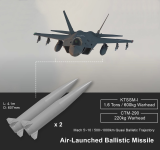
For ex., what ROK has done is develop a 607 mm diameter missile (similar to Fatah-2), but it's much shorter and has a lighter warhead.

1792439666431.png
 
I don't agree with you. The reach and strike across India is very much needed. If India needs to feel pain, the fear of pain is bigger than pain itself. They need to know that PAF has the capability and capacity, plus the firepower, to go beyond LR drones and rockets to attack the length and breadth of Bharat. Just like they, the bhindi mindset, always claim that they can annihilate entire Pakistan conventionally... let them have this pain also. For me, the updated JH7P is the only option until / unless the J16 is available.


No Material in your post except rhetoric. How come you can even imagine that JH-7 will help in any of things you said ? like "The reach and strike across India" - Its not going to fly over indian airspace anyways to hit deep inside india. Its not a stealth aircraft. It will be detected as soon as it leaves the airbase and it will be shot down if flying over hostile airspace or even over LOC.

We need capability to hit at farthest corners of india but for that you need long ranged missiles, which ARFC is testing newer versions and increasing ranges. Why we should send pilots on suicide mission on an ancient airframe like JH-7. Its like giving a trophy to enemy by yourself.

So if we have zero interest to utilize the range of the aircraft then whole purpose of this platform is dead. As far as payload is concerned. Again its total nonsense that just to pack 4 ALBMs on single platform we buy such a heavy maintenance platform. When we can still fire 4 ALBMs using 2 jeffs. Or as many ALBMs as we want with plenty of Jeffs that we have. Why should not we spend that huge amount of money on building more ALBMs and procuring aircrafts that adds real value instead of absurd theories.

So:

ARFC / Long range missiles : Yes
Buying a fleet of Ancient airframes like JH-7: Big No / Impossible. Not in this universe.

Its hilarious to even consider it in 2026. These kind of threads were tolerable in early 2000s.
 
What's interesting is that South Korea is developing a new ALBM for use from the KF-21. So, there is a potential design route here that could work within the PAF's platform constraints (e.g., JF-17, J-10CE, J-35AE), the question is they'd need to develop it as a new platform or if they can adapt the Fatah-2.

I think with the ROK example, one route might be to re-leverage parts of the Fatah-2 (e.g., rocket motor), but potentially design a smaller missile (likely closer to the size of the CM-400AKG). The goal could be to have a true hypersonic strike missile (sustained flight through impact + maneuvering).

For ex., what ROK has done is develop a 607 mm diameter missile (similar to Fatah-2), but it's much shorter and has a lighter warhead.

View attachment 219948
Fatah-2 (Rocks class) will be out of question with ~2500kg mass. Even at ~1600kg I don’t think any JF-17 hard points are rated for it, maybe centerline but then we’ll have ground clearance issues.

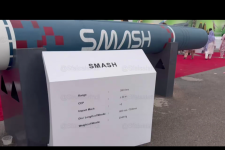
SMASH as Fatah-2 proxy for mass and dimensions:
IMG_5350.png

J35 probably but it would kill the low observability, do we really want to use our ace platform (when it arrives) as bomb truck.

J10C probably ok for the 1600 range similar to the Korean solution but “probably”.
 
Fatah-2 (Rocks class) will be out of question with ~2500kg. Even at ~1600 I don’t think any JF-17 hard points are rated for it, maybe centerline but then we’ll have ground clearance issues.

J35 probably but it would kill the low observability, do we really want to use our ace platform (when it arrives) as bomb truck.

J10C probably the 1600 range similar to the Korean solution but “probably”.
Maybe the key is to keep iterating on the CM-400AKG design such that it can provide sustained hypersonic flight?
 
Maybe the key is to keep iterating on the CM-400AKG design such that it can provide sustained hypersonic flight?
Yeah the problem is we can iterate but it will soon hit physics limits. We simply can’t have a heavier rocket’s performance it terms of range and throw weight, no matter how much we iterate it. And we have a deep enemy.
 
I don't agree with you. The reach and strike across India is very much needed. If India needs to feel pain, the fear of pain is bigger than pain itself. They need to know that PAF has the capability and capacity, plus the firepower, to go beyond LR drones and rockets to attack the length and breadth of Bharat. Just like they, the bhindi mindset, always claim that they can annihilate entire Pakistan conventionally... let them have this pain also. For me, the updated JH7P is the only option until / unless the J16 is available.
Oh Bhai, ever heard Stand-off munitions and missiles, With Fateh-4ER's 1000+ KM range we covered almost India's swath, and India has LAYERED AD systems (S-400/S-300/AKASH/BARAK-8ER/Spider) SAMs so tell me how JH-7P can survive from these threats, it is a 70s design comparable to British Tornado but without variable sweep wings, and similar to Tornado it has very Big radar cross section same goes to JH-7, so JH-7 is not suitable in modern warfare at all
 
Why not buy more J-10Cs instead ? JF-17s/J-10Cs can carry ALBMs.
This perspective represents a common misunderstanding that many people have regarding the JH-7 series of fighter-bombers.

Within the PLA’s operational framework, the JH-7 series of fighter-bombers is primarily tasked with medium-to-long-range anti-ship strikes and ground-attack missions.

The JH-7 series—most notably its latest iteration, the JH-7A2—was designed with Aegis-class destroyers as a primary target. Consequently, it is capable of carrying a comprehensive suite of armaments and equipment—including anti-ship missiles, anti-radiation missiles, electronic warfare jamming pods, and short-to-medium-range air-to-air missiles (for self-defense)—while maintaining an operational radius exceeding 1,500 km without the need for external fuel tanks.

While the JF-17 Block 3 and J-10CE fighter jets are also capable of carrying such munitions, neither can accommodate this full, integrated strike payload simultaneously. Operators are forced to make trade-offs; furthermore, achieving an extended operational range would require the use of external fuel tanks, which would further diminish the aircraft's capacity to carry weapons. This is the core reason why the PLA continues to retain the JH-7 series in its inventory. The only aircraft capable of replicating this specific set of capabilities is the J-16. The PLA is currently in the process of replacing the JH-7 series with the J-16, though this transition will take time.

As the JH-7 series of fighter-bombers are currently slated for replacement within the PLA’s inventory, AVIC has little incentive to develop more comprehensive upgrade programs for them. Consequently, the JH-7 series has fallen behind the rest of the PLA’s operational ecosystem—a key reason why it fails to attract interest from many international clients. This is also the primary basis for the criticism leveled against the aircraft by many in Pakistan.

Nevertheless, this does not mean the platform is entirely without merit; the airframe itself still holds significant potential. This stands in stark contrast to the JF-17 platform, the potential of which has been fully exhausted by the JF-17 Block 3 (JF-17B3) variant—leaving virtually no room for further development.

Of course, I know the J-16 fighter is better. But the J-16 is not for sale. By comparison, the JH-7 series of fighter-bombers is a solid alternative.
 
This stands in stark contrast to the JF-17 platform, the potential of which has been fully exhausted by the JF-17 Block 3 (JF-17B3) variant—leaving virtually no room for further development.
You, and those who hold the same view, are in for a nasty surprise.
 
You, and those who hold the same view, are in for a nasty surprise.
I fully understand the point you are trying to make. This perspective refers to the fighter aircraft platform.

I shared my own analysis on this issue quite some time ago. For the JF-17 series, potential future upgrades could include replacing the engine (for instance, with the WS-21) to boost power generation capacity, integrating an IRST system—which is currently missing—and fully unlocking the capabilities of the existing avionics suite. ------ These measures fall within the scope of the platform’s inherent growth potential, though they offer limited economic value.

As for the more radical proposals often suggested by fans—such as incorporating stealth features or developing a twin-engine variant—I personally do not believe they are feasible.

Of course, I am well aware that these views are a subject of debate.
 
The more I research JH7A, the more I think Mastan Khan's initial idea wasn't a bad one. PAF could have invested in an updated version of JH7A with all modern 4.5+ gen bells and whistles to support JF-17.

The JH7A belongs in a museum and that is exactly where the PLAAF is putting it...
 
though they offer limited economic value.
That is a highly subjective assessment, as economic value must be evaluated in light of the broader strategic and operational context. In this particular case, the benefits in terms of autonomy, operational control, and replacement capability are substantial and, arguably, immense.
 
That is a highly subjective assessment, as economic value must be evaluated in light of the broader strategic and operational context. In this particular case, the benefits in terms of autonomy, operational control, and replacement capability are substantial and, arguably, immense.
I have never opposed Pakistan conducting in-depth research into fighter jet design and manufacturing technologies for research purposes. That is the premise.

However, technical research and actual production are two entirely different systems. Even if you possess the complete technical knowledge, it does not guarantee an ability to carry out actual production (there are numerous real-world examples of this). Yet, it is only through actual production that economic value is generated and strategic autonomy is achieved.

This touches upon the issue of an industrial ecosystem. Perhaps you could explore other avenues to gain a deeper understanding of this.

The current cost of the JF-17 Block III exceeds $30 million. If we were to replace the engine with the WS-21, add an Infrared Search and Track (IRST) system, and re-optimize the internal avionics and electronic systems, the cost would surpass $40 million—or even more. —And this is an assessment based on the use of mature, Chinese-supplied subsystems. If one were to factor in your requirement for "autonomy"—by replacing these with components manufactured entirely within Pakistan—the costs would skyrocket, potentially to an astronomical level.

Now, assuming you were a customer (such as the Pakistan Air Force), and faced with a choice between the JF-17 Block IV and the J-10CE at a similar price point, which would you choose?
 

Users who are viewing this thread

Pakistan Defence Latest

Latest Posts

Back
Top