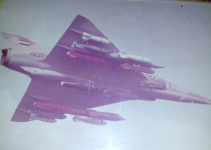
JH-7 as a Missile Hauler

Pakistan can lease out its rare earth mines to Chinese companies for like 99 years to exchange low interest loans to buy J-10Cs.
Why don't you prioritize using your finances to thoroughly eradicate TTP and BLA, and provide a stable social environment for economic development? You cannot rely on a few planes to destroy India in a short period of time, it is a long process. Prioritizing the resolution of domestic issues and developing the economy and overall national strength is the only path to victory.
 
You don't need haulers. Your enemy is right next door. Spend the money you would on the acquisition of JH-7, training of crews and pilots, maintaining huge airbases and facilities with a truck that can drive out to a range and fire that same missile with a booster.
 
The PAF needs a fighter capable of delivering bombs and missiles across the Indian border.
Along with the MK, I also held the opinion that the JH-7A could have been produced in Pakistan for that purpose. However, time has passed, and it is necessary to move forward. A version of the J-16 could still be procured, if feasible, for this role. However, given evolving technology, I believe a long-range version of the J-35 capable of striking Assam, Calcutta, and Madras, and reaching the Andaman Islands, would be a better investment. The KAAN may also have this capability. Nevertheless, the adversary should be aware that the PAF has the capability and range to strike anywhere in India using not only missiles and drones, but also fighter aircraft. That is a threat they would have to live with.
 
You don't need haulers. Your enemy is right next door. Spend the money you would on the acquisition of JH-7, training of crews and pilots, maintaining huge airbases and facilities with a truck that can drive out to a range and fire that same missile with a booster.
You need to understand the true reality.

Ultimately, in warfare, it is the warhead that delivers the actual destructive impact. There is little difference in cost between a long-range or intercontinental ballistic missile (ICBM) and a bomber capable of carrying an equivalent payload—in fact, a missile might even be more expensive.
However, a missile is a one-time-use asset, whereas a bomber can be employed repeatedly.
This is the fundamental reason why the United States and Russia continue to maintain large fleets of bombers, and why China is actively working to develop its own stealth bombers.
However, time has passed, and it is necessary to move forward. A version of the J-16 could still be procured, if feasible, for this role.
To reiterate, China’s Flanker-series fighter jets—including all variants—are not for sale.

Instead of hoping that China will sell its J-16 series fighter jets to Pakistan, it would be more realistic to consider purchasing Russia’s Su-35 series fighter jets.

As of now, China’s JH-7 series of fighter-bombers has indeed been cleared for export. CATIC has publicly showcased the JH-7E, an export variant of the aircraft. China’s H-6 series of bombers also has a track record of exports. These are the only products in this category that China currently permits for export. Apart from this, China currently has no other exportable bombers or fighter-bombers capable of carrying heavy munitions available for foreign customers to choose from.
 
buy kizilelma and use it for heavy strike air to air and other things . it can be used in present as well as in future with smart missiles . jh 7a is just the idea its not something its compulsory to buy. Future warefare is changing .
 
You need to understand the true reality.

Ultimately, in warfare, it is the warhead that delivers the actual destructive impact. There is little difference in cost between a long-range or intercontinental ballistic missile (ICBM) and a bomber capable of carrying an equivalent payload—in fact, a missile might even be more expensive.
However, a missile is a one-time-use asset, whereas a bomber can be employed repeatedly.
This is the fundamental reason why the United States and Russia continue to maintain large fleets of bombers, and why China is actively working to develop its own stealth bombers.

To reiterate, China’s Flanker-series fighter jets—including all variants—are not for sale.

Instead of hoping that China will sell its J-16 series fighter jets to Pakistan, it would be more realistic to consider purchasing Russia’s Su-35 series fighter jets.

As of now, China’s JH-7 series of fighter-bombers has indeed been cleared for export. CATIC has publicly showcased the JH-7E, an export variant of the aircraft. China’s H-6 series of bombers also has a track record of exports. These are the only products in this category that China currently permits for export. Apart from this, China currently has no other exportable bombers or fighter-bombers capable of carrying heavy munitions available for foreign customers to choose from.

Bombers need huge ass paved runways to operate off of. Multiple pilots and crew, escorts and all sorts of headaches. This is a luxury for the US and China. Not even Russia now, they can barely afford it.

For everyone else, the ballistic missile is better.
 
The PAF needs a fighter capable of delivering bombs and missiles across the Indian border.
Along with the MK, I also held the opinion that the JH-7A could have been produced in Pakistan for that purpose. However, time has passed, and it is necessary to move forward. A version of the J-16 could still be procured, if feasible, for this role. However, given evolving technology, I believe a long-range version of the J-35 capable of striking Assam, Calcutta, and Madras, and reaching the Andaman Islands, would be a better investment. The KAAN may also have this capability. Nevertheless, the adversary should be aware that the PAF has the capability and range to strike anywhere in India using not only missiles and drones, but also fighter aircraft. That is a threat they would have to live with.
For a certain radius, an in-service aircraft with a long range missile fired from within own airspace instead of crossing the border like JFT with CM-400 which was fired on S-400. For targets which may lie out of range of the aircraft or weapons system, the surface to surface strike missiles are the answer.

In Pakistan's case, its best to conserve aircraft instead of sending them across the border when technology and aerial warfare (especially shown in May 2025) has shifted. IAF fired missiles from within their own airspace and PAF did the same in retaliation. The crossing of border was not required.
 
JH-7 as a Missile Hauler: Bridging the BVR Gap in South Asian Skies

The concept of using the Chinese-origin JH-7 fighter-bomber as a long-range bomber was first introduced by forum member MastanKhan, who proposed its employment for standoff missile delivery in a networked air combat environment. This idea gains renewed relevance in the aftermath of the intense aerial activity observed during the May 2025 face-off between the Pakistan Air Force (PAF) and Indian Air Force (IAF), where over 100 fighters were reportedly airborne and an estimated 400 BVR missiles were in play.

While the IAF benefits from platforms like the Su-30MKI and Rafale—with the ability to carry up to 8–12 BVRs per aircraft—PAF’s lighter fleet, consisting primarily of F-16s, JF-17s, and even the advanced J-10CE, generally carries fewer missiles. This disparity in BVR saturation could prove critical in large-scale engagements, where volume of fire and missile persistence can tip the balance.

Repurposing the JH-7: A Logical Step Forward

The JH-7, known for its strike role, features twin engines, high fuel capacity, and a heavy weapons load. Though not designed for air superiority, its physical capacity to carry multiple heavy payloads makes it an excellent candidate for repurposing as a BVR missile truck. Stripped of air-to-ground ordnance and equipped with PL-15 LRAAMs, a JH-7 could potentially field 8–10 missiles per sortie—dramatically increasing PAF’s BVR count in the air.

Tactical Integration

This approach would not require JH-7s to enter contested airspace. They could remain in standoff zones, protected by fighters and supported by AWACS, and launch PL-15s based on cueing from forward-deployed JF-17 Block III or J-10CEs. With the PL-15’s estimated range of 200–300 km and active AESA seeker, this tactic significantly extends the engagement envelope.

Such missile carriers would serve as force multipliers, enabling PAF to saturate Indian airspace with long-range missiles, complicating IAF’s tactical calculations, and helping to neutralize their numerical advantage in missile loadouts.

LRAAM Guidance via AWACS and Networked Fighters

The key to making this approach viable is data-link integration. JH-7s would not operate independently but would act as rear-echelon missile launchers. Cueing and mid-course guidance would be provided by frontline fighters like the JF-17 Block III and J-10CE, both of which support advanced targeting through datalink systems. AWACS platforms such as the Saab Erieye and ZDK-03 would provide battlespace awareness and tracking, turning the JH-7 into a standoff shooter.

Strategic Impact

Integrating JH-7s in this role could be a game-changer. In high-tempo engagements, where the rate of missile expenditure is high, having additional platforms dedicated purely to missile carriage and launch relieves the burden on frontline fighters. It also helps saturate enemy defenses, complicates interception planning, and adds strategic depth to the air battle.

Furthermore, with PL-15s estimated to have ranges exceeding 200 km, such tactics enable PAF to hold enemy assets at risk from much greater distances—especially valuable in denying airspace or neutralizing high-value enemy enablers like AWACS and refueling aircraft.

Conclusion

What began as a forum concept by MastanKhan now appears as a tactically sound and operationally feasible idea. Employing JH-7s as missile haulers could significantly enhance PAF’s ability to contest the skies in high-intensity scenarios. It’s an adaptive solution to the growing challenge of BVR volume—a vital factor in the evolving calculus of South Asian air combat.

UFC
@MastanKhan
For Afghanistan may be good choice but against India with current avionics package would be a flying duck.
 

Users who are viewing this thread

Pakistan Defence Latest

Country Watch Latest

Latest Posts

Back
Top