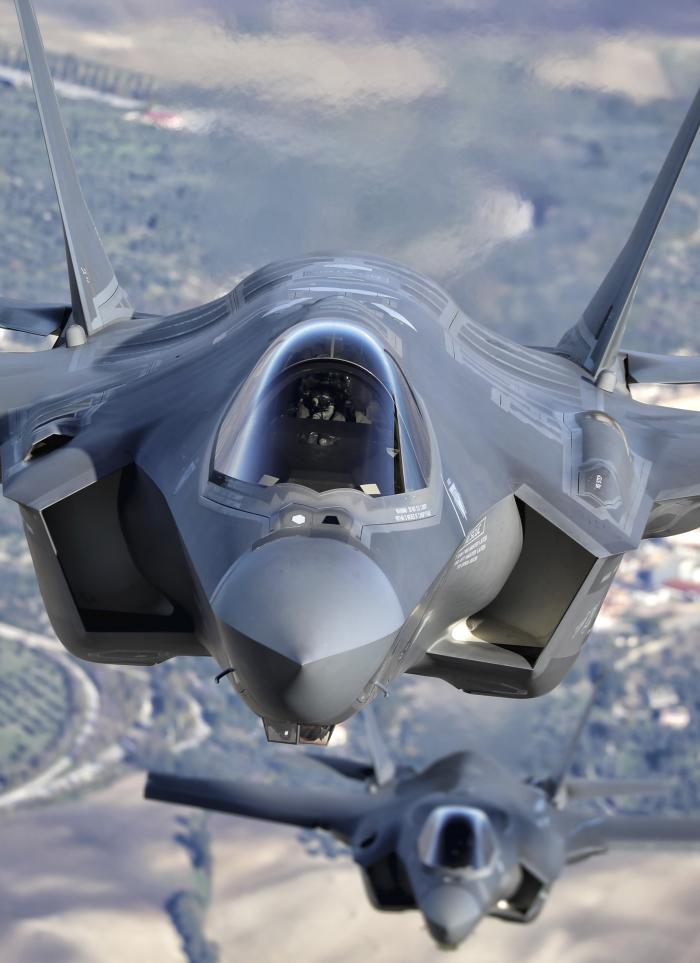
This pic shows one thing about how far the US is ahead of everyone else when it comes to military aviation technology specifically the air intake. First there's the supersonic divertless air intake which is the first time we see that concept in US jet designs (although I believe the Chinese led the technology in that first) and then the incredible S-ducting of inside the intake. If there is ever a photo that shows how drastic the S-ducting is on the F-35, it's this one. You can clearly see the intake on the right side of the photo (left side of the aircraft) visibly shows how immediately the duct turns right past the opening. The ducting takes an immediate, sharp turn to the center of the fuselage and to the engine fan. Granted that's assisted by the fact that it's a single engine located in the center of the fuselage forcing the ducting to take that drastic turn anyway, but that's all part of the genius of the design to being with. Had the aircraft incorporated dual engines, they would've needed to be spaced wider causing the intake to not need such a drastic turn.
That sharp turn is huge in maintaining the aircraft's stealthy features as it prevents radar waves & beams from penetrating the entire duct and bouncing like crazy off the fan blade, resulting in a significant radar signature return.
This is just one of many incredible, innovative designs on the F-35 that make it what it is, a highly sought-after stealth platform and adding to the greatness of the United States military aviation technology.
View attachment 27873
Captain Christopher Stricklin, the pilot of US Air Force F-16C serial number 87-0327, part of the USAF Thunderbirds demonstration team, ejects at low level, seconds before it crashed on September 14, 2003, during an air show at Mountain Home Air Force Base, Idaho. The ACES II ejection seat meant Stricklin was uninjured
USAF
I actually remember when this happened since we were going to see the Thunderbirds that year and it was big news. For the most part, they stopped coming up here in the North East for a few years after the crash and we were only able to see the Blue Angels for the next 5 years or so until the T-Birds started coming back again.
Come to find out it was a major error in the planning and altitude settings during their pre-show exercises (if you can call it that) which had terrible consequences. luckily no one died or was hurt. I think he suffered minor injuries from the ejections but lost his spot as the #6 Thunderbird after that.
A huge part of that is they plan the majority of the stunts over what they call "ground zero" which is always a marked point on the ground, an empty patch of land that marks the center of all their maneuvers for reference. Also the spot where they determine the critical ground level setting.
During the previous week leading up to the show, the team has its practice sessions which entails familiarizing with this point on the ground and practicing all the routines. Getting used to the air & thermals above the hot ground etc. The Blue Angels always commented on how flying over water (as in the sea being navy pilots) was always much steadier as the heat would reflect the hot air off the water at an even pace. Over land, it's totally inconsistent as some spots over rough terrain & mountains are much more drastic than over flat plains etc.
The other critical setting is the altimeter on the aircraft. That's set by 2 factors, mean sea level altitudes and ground level altitudes. Most of the time in higher elevations such as mountainous regions like here, the difference between the two levels could be as much as 5000 ft. above sea level. In this case in Idaho, ground level setting was 3000ft ABOVE mean sea level and the altimeter needed to be set on the F-16 to mark that difference, so the pilots know what their altitude is at all times. And that setting couldn't be more important than when performing a low-level loop (or in this case they called it a Split-S) upon takeoff!!
So this pilot, for some reason didn't set the correct altitude in his F-16 which was the critical error that caused this unfortunate mishap.
He lines up on the runway, does a super short takeoff followed by an impressive full vertical climb until he reaches only 1670ft (he should've climbed to at least 2000ft) altitude to begin the inverted loop/split-S and goes into it. Only to find out once he comes out of it at the bottom of the loop that he's way too low and the aircraft was headed straight into the ground.
Give him credit for recognizing the danger and acting in milliseconds to save his life, undoubtedly accompanied by countless alarm bells and ground approach warnings. The rest is history.
How quick it happens!








 Afghans yet to receive ‘genuine justice’ for Western coalition abuses: HRW (41 Viewers)